Business hours
Monday to Friday (8.30AM - 5PM)
Weekend (Closed)



A high earner nearing retirement, a pre-retiree still carrying a mortgage, and a recent retiree trying to turn super into dependable income all face the same problem from different angles. None of them need isolated tips. They need retirement planning strategies that connect super, tax, investments, debt, housing, insurance and estate decisions into one workable plan.
That matters more in Australia because you can retire from work before you can access super, and for most Australians preservation age is now 60 while Age Pension age is 67 or older, which creates a real planning gap between stopping work and drawing retirement benefits from super or government support through the myGov retirement and super overview. If you treat each decision separately, you'll usually miss the bigger trade-offs.
A strong review process starts by asking the right question for your stage of life. Are you still building? Are you shifting from accumulation to income? Or are you already focused on spending sustainability and wealth transfer? Different answers call for different actions.
That's where a practical advice framework helps. Wealth Collective's free 10-minute introductory call can help you identify where the pressure point sits first, then match that to support through Protection Plus, Guided Growth or Retirement Roadmap. The point isn't to create more paperwork. It's to turn a scattered financial life into an action plan you can follow.
1. Superannuation Optimisation and Contribution Strategy
A 52-year-old employee on a rising salary, a self-employed couple with lumpy business income, and a 60-year-old planning to stop work soon should not use the same super strategy. Super is the main funding vehicle for retirement in Australia, but the right move depends on whether you are still building, preparing to draw income, or trying to improve tax outcomes while there is still time.
The first job is simple. Stop treating super as a set-and-forget account. Contribution rates, account balances between spouses, investment settings and insurance inside super all need review, because small mistakes made in your 40s and 50s often leave fewer options later.
The benchmark matters because it turns a vague goal into a funding target. ASFA estimates a comfortable retirement at age 67 needs about $730,000 for a couple and about $630,000 for a single person, while a modest retirement still needs roughly $120,000 for a couple and $110,000 for a single person through the ASFA Retirement Standard.

Choose the strategy that fits your stage
Pre-retirees should focus on contribution efficiency and time. If you are in your 40s or 50s, salary sacrifice and planned after-tax contributions usually deserve attention first, especially if income has risen but super habits have not changed with it.
High earners should review concessional contribution use every year. Waiting until June and hoping there is spare cash left over is poor planning. Build contributions into payroll or business cash flow so the strategy happens.
Couples should assess super as a household balance sheet, not as two separate accounts. If one partner has a much lower balance, spouse contribution planning or contribution splitting can improve future flexibility, tax outcomes and pension structuring options later.
Business owners and self-employed Australians need more discipline here than employees do. Irregular income is not an excuse to ignore super. It is the reason to set contribution rules in advance.
Retirees and near-retirees need a different review. The issue is no longer just how much goes in. The issue is whether the super mix, account structure and insurance still suit the shift from accumulation to retirement income and, later, wealth transfer.
Practical rule: Review super every year and after a pay rise, bonus change, business profit swing, inheritance, separation, or planned retirement date change.
A worthwhile review should cover four decisions:
- Contribution mix: Use pre-tax and after-tax contributions deliberately, based on income level, tax position and remaining working years.
- Spouse positioning: Compare both balances, ages and retirement timing before directing extra money into one account.
- Investment option: Match the super investment setting to the time horizon, not to a default option chosen years ago.
- Insurance inside super: Keep cover that protects your plan. Cut cover that only drains the balance without serving a clear purpose.
This is one of the clearest decision points in the move from wealth building to retirement income. Get contributions wrong and you lose tax advantages and future income capacity. Get the household structure wrong and you reduce flexibility right when retirement decisions become less reversible.
For a practical next step, start with the Wealth Collective guide to maximising superannuation. If your situation is more complex, such as uneven couple balances, business income, or a retirement date within the next decade, this is usually the point to put the review into a formal advice process rather than relying on defaults.
2. The 4% Withdrawal Rule and Safe Spending Strategy
A couple retires with $1.2 million in super, some cash in the bank, and plans for travel in the first 10 years. Their real question is not whether 4% is “right”. It is how much they can spend this year without putting pressure on the years when markets fall, health costs rise, or one partner dies first.
The 4% rule is a starting rate. Use it to test a plan, not to run one on autopilot. Australian retirees draw income from account-based pensions, cash, part-time work, and sometimes the Age Pension. That mix changes over time, so spending has to be reviewed as a household decision, not set once and ignored.

The practical approach is to split retirement spending into two layers. First, lock down the income needed for rates, groceries, utilities, insurance and healthcare. Then set a separate pool for travel, family support, renovations and other discretionary costs that can rise or fall with portfolio performance.
That structure matters most at the handover point from wealth building to retirement income. Pre-retirees need to test whether their future spending target is realistic before work stops. Retirees need a drawdown process that responds to markets and changing health. High earners with larger balances need tighter tax and pension sequencing, because poor withdrawal decisions can waste concessionally taxed super and reduce later flexibility.
A useful review usually turns on four decisions, but they do not need a checklist treatment every time:
Set the first-year drawdown rate.
Start with a rate that fits the portfolio, age, and other income sources. A healthy couple in their early 60s with strong growth assets and no Age Pension entitlement has a different spending capacity from a single retiree in their late 70s relying on super plus part Age Pension.
Decide what stays fixed and what floats.
Keep core spending stable. Let discretionary spending absorb market shocks. That avoids the common mistake of cutting everything after a bad year, then overspending after a strong one.
Plan lump sums separately.
Car upgrades, helping adult children, major dental work, and home repairs should not be buried inside a simple annual drawdown rate. Pull them out and fund them deliberately.
Review each year against reality.
Check portfolio value, inflation, legislative changes, pension eligibility, and actual spending. If the gap between planned and real spending keeps widening, reset the plan.
If you want a clearer estimate of how different drawdown rates affect longevity, use this guide on how long retirement savings may last under different spending patterns.
Wealth Collective's role here is usually straightforward. Turn a rough withdrawal rule into a review process. For pre-retirees, that means testing whether the target lifestyle is affordable before the pay cheques stop. For retirees, it means adjusting pension payments, reserve cash, and discretionary spending in a measured way instead of reacting to headlines.
3. Diversified Investment Portfolio Construction
A Perth couple, both 59, can have the same super balance as their friends and still need a completely different portfolio. One plans to retire at 62 and draw on investments straight away. The other expects to work part-time until 68 and leave more to children. Portfolio construction follows the decision, not the other way around.

Diversification matters most at the handover point between accumulation, retirement income, and eventual wealth transfer. Australians often spend years building a portfolio, then reach their late 50s or 60s with a collection of super options, shares, ETFs, property exposure and cash that was never set up to do one clear job. Fix that before retirement gets close.
Start with three buckets and give each one a purpose. Growth assets are there to support decades of retirement and keep pace with inflation. Defensive assets reduce the pressure to sell growth holdings after a market fall. Cash covers known spending in the near term, especially around the first years of retirement when sequencing risk can do the most damage.
Who should hold what depends on stage and income profile.
A high earner in peak earning years can usually accept more growth risk, especially when salary, bonus income and ongoing concessional contributions are still doing heavy lifting. A pre-retiree with five years left needs a portfolio that can absorb a bad market without wrecking the planned retirement date. A retiree drawing regular income needs enough stability and liquidity to fund spending without turning every market dip into a forced sale.
The common mistakes are predictable. Holding too much employer stock or bank shares because they feel familiar. Shifting heavily into cash the moment retirement appears on the horizon, then locking in a lower long-term return profile. Leaving several accounts untouched for years so the actual risk level drifts well above what the household can tolerate.
A better review process is less about product selection and more about decisions:
- What spending needs to be funded in the next few years? Keep that money in lower-volatility assets or cash.
- What capital is meant to fund later-life income? Keep that invested for growth with a time horizon to match.
- What portion is likely to be passed on? That pool can often stay invested differently from the money meant to fund immediate retirement living costs.
That last point matters. Money for your own retirement does not need the same structure as money likely to go to adult children or charities. Mixing those goals inside one undifferentiated portfolio leads to bad calls, usually either too much caution or too much risk.
If your investments have been built account by account over time, review the whole mix as one household balance sheet and reset the job of each asset class. Wealth Collective usually helps clients do this through a practical allocation review, especially when retirement timing, pension commencement and estate goals are starting to collide. If you need a clearer framework, review your asset allocation strategy for retirement and income planning before the portfolio is forced to do a job it was never designed for.
4. Debt Elimination and Strategic Debt Management
A couple can look retirement-ready on paper, then hit a wall for one reason: the mortgage is still there, the credit card never quite clears, and business borrowings are tangled up with the household balance sheet. Income stops. Repayments do not.
Debt is one of the clearest dividing lines between wealth building and retirement income planning. Before retirement, debt can be a tool. After retirement, the wrong debt becomes a fixed claim on cash flow and shrinks your margin for error.
Start with one question. Which debts will still exist when work income ends, and what will they force the retirement plan to fund each month?
That answer drives the next move.
Consumer debt should be cleared first, without debate. Credit cards, personal loans and unsecured lending give you high interest costs with no strategic benefit. Keeping them into retirement is a bad decision.
Home loans need a harder judgement call. Some pre-retirees should attack the mortgage while they still have strong wages, bonuses and borrowing flexibility. Others are better off keeping more cash available and entering retirement with a smaller, manageable loan balance because their super, pension timing or planned asset sales can support it. The trade-off is simple. Push too hard on repayments and you can leave yourself asset-rich but cash-poor. Ignore the debt and you lock in a permanent drag on retirement income.
Business owners need a separate review. Personal and business debt often get mixed together, which makes retirement timing messy and usually expensive. Clean that up before you scale back work. If the exit plan depends on selling the business, the lending structure should support that plan instead of delaying it.
A useful review is less about whether debt is good or bad and more about matching each liability to a decision point:
- Debt that must be gone before retirement: consumer debt, short-term unsecured lending, loans that rely on full-time employment income
- Debt that can be reduced but may be carried briefly: a home loan with clear repayment capacity and enough liquid assets
- Debt that needs restructuring now: mixed personal and business borrowings, outdated loan splits, facilities that become harder to refinance once employment stops
Tie the debt plan to a date, not a hope. If retirement is five years away, map what needs to be eliminated each year. If retirement is closer, test whether the planned income strategy still works after repayments, rates, insurance and basic living costs.
This is often where Wealth Collective helps clients make a cleaner call. Not by chasing a generic debt-free ideal, but by reviewing whether paying down debt, preserving liquidity, or restructuring loans will produce a stronger transition from accumulation to retirement income.
5. Income Protection and Personal Insurance Planning
A retirement plan can fail long before retirement starts. One health event, one long claim period, or one death in a working household can stop contributions, force asset sales and push the whole timetable back.
This decision matters most for pre-retirees, high earners, business owners and families still relying on salary or business profits. Retirees still need an insurance review, but the question changes. They are usually deciding whether to keep legacy cover, fund likely health costs, or make sure the estate has enough liquidity to avoid a rushed sale.
The right approach depends on where you sit on the path from wealth building to retirement income.
If you are in your 40s or early 50s and still building assets, protect income first. Income protection usually does more for the retirement plan than excess life cover because the biggest asset at that stage is future earnings. If a long illness cuts that off, super contributions stop, loan repayments become harder, and investment plans get shelved.
If you are within roughly 10 years of retirement, review insurance against the gap you still need to close. A household with a strong super balance, low debt and adult children often needs less cover than it held a decade earlier. Keeping old policies out of habit is expensive. Cutting cover too early is worse if retirement still depends on several strong earning years.
Business owners need a harder review. Personal insurance, business expenses, key person risk and debt guarantees often overlap, and that can leave the family exposed even when premiums are being paid. If the retirement plan depends on selling the business, test whether illness, disability or death would still allow an orderly exit.
Use insurance as a decision filter, not a product shopping list:
- Protect earnings that still matter: Prioritise income protection while work income is carrying the plan.
- Cover forced-capital events: Use life, TPD or trauma cover where a claim would prevent a distressed sale of investments, property or the business.
- Check ownership carefully: Cover held inside super can help cash flow, but definitions, tax treatment and access on claim can differ from personally owned policies.
- Reduce cover with intent: As debts fall, children become independent and assets rise, step down cover deliberately instead of paying for outdated needs.
Wealth Collective often helps clients review this at the point where accumulation decisions need to support retirement income and, later, wealth transfer. The useful outcome is not more policies. It is a clear answer on what needs protection, what can be self-funded, and what can be trimmed now without weakening the plan.
6. Tax-Effective Investing and Tax-Loss Harvesting
A couple in their late 50s can hold the same total wealth and get very different retirement outcomes purely because of tax. One household keeps high-income assets in personal names, triggers gains in a high-income year and pays more than necessary. Another uses super for income-heavy assets, manages realised gains before 30 June and arrives at retirement with more spendable capital.
That is the key decision here. Tax affects the handover from accumulation to retirement income, and later the amount left to family.
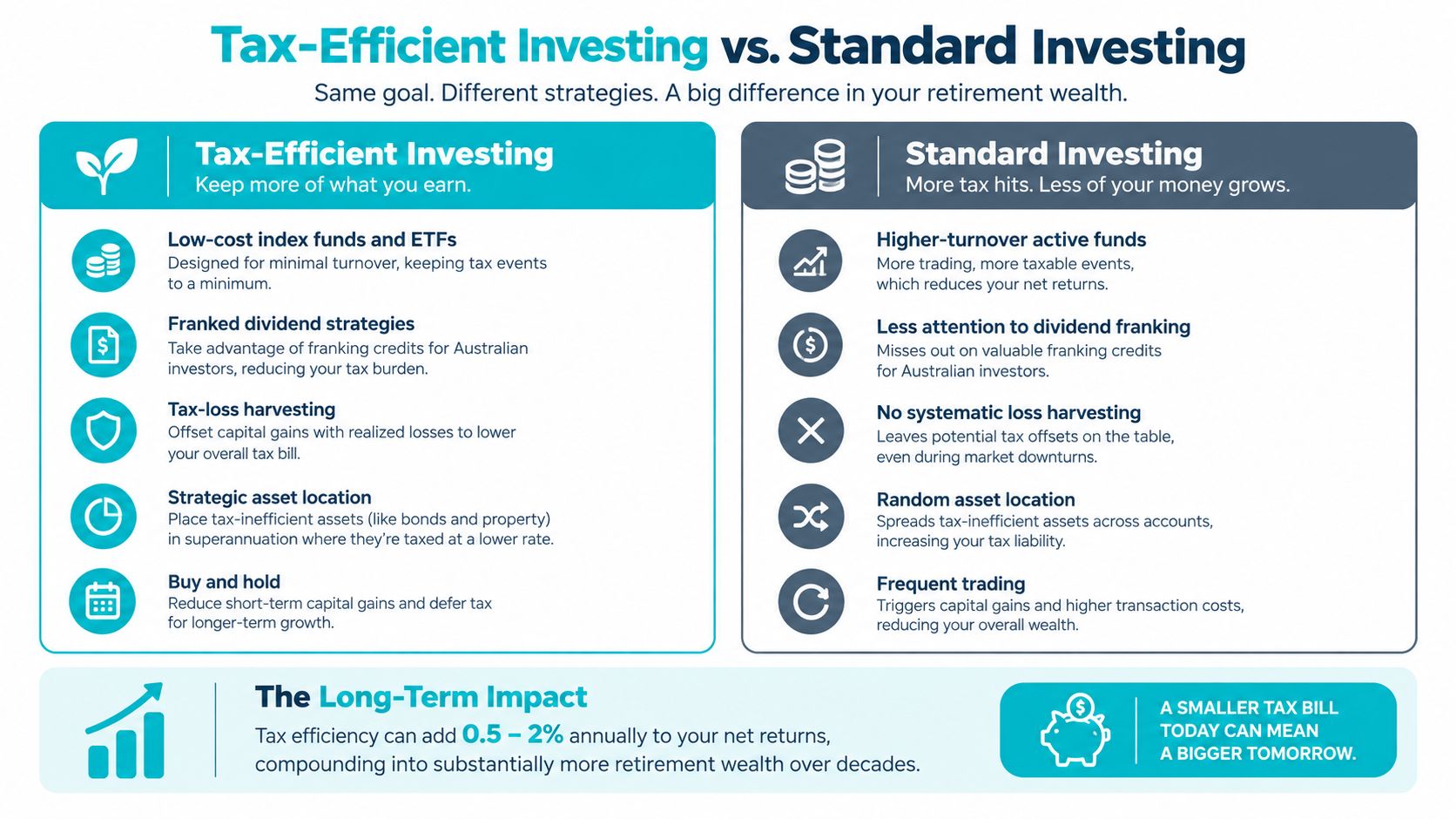
Asset location should be deliberate. In Australia, high-yield bonds, listed property trusts and other income-heavy assets usually fit better inside super, where earnings are taxed more lightly than in a personal or trust portfolio during working years. Australian shares with franked dividends can make more sense outside super for some investors, especially pre-retirees and retirees on lower marginal tax rates who can use franking credits efficiently. High earners should review this first because the cost of getting it wrong is highest in the final working decade.
Timing matters as much as location. If you have realised capital gains during the year, review unrealised losses before 30 June and decide whether crystallising some losses improves the after-tax result. That is tax-loss harvesting. It is not a trading strategy. It is a record-keeping and discipline strategy that can offset gains now or carry losses forward for later years.
The review process should be practical:
- Match each asset to the best owner or structure. Personal name, spouse, super, pension account or family trust.
- Separate income-heavy assets from growth assets and check where tax hurts most.
- Review realised gains and available losses before 30 June, not after the financial year closes.
- Confirm cost bases, parcel records and transfer history while the paperwork is still easy to trace.
- Coordinate decisions across both spouses, especially if one is still working and the other has retired.
The right setup depends on who is making the decision. Pre-retirees usually need to reduce tax drag while preserving flexibility for drawdowns. Retirees need cleaner sequencing between super pension money, taxable investments and Centrelink-sensitive assets. High earners often need tighter control over where investment income lands each year, particularly when bonuses, business income or asset sales can push them into a higher tax bill.
Wealth Collective often helps clients review this at the point where portfolio structure, contribution strategy and future withdrawals need to work together. The useful outcome is a clearer ownership map, a pre-30 June action list and fewer avoidable tax leaks in the years that matter most.
7. Pension and Annuity Strategies for Retirement Income
You stop work. Super is finally there to be used. Then the decision starts. Which income should stay flexible, which income should be locked in, and how much certainty do you want to buy?
This is the point where retirement planning shifts from wealth building to income design. A good pension strategy pays the bills, protects flexibility, and leaves the right amount for later life or family transfer. A poor one leaves too much sitting in cash, forces sales in bad markets, or locks up capital you may need.
Set up retirement income in clear layers
Start with spending, not products. Separate your costs into three buckets. Core living costs, discretionary spending, and one-off large expenses such as travel, home upgrades or family support.
Then match each bucket to the right income source.
- Account-based pension: Best for flexible drawdowns, market exposure and estate value that can continue to beneficiaries.
- Lifetime or fixed-term annuity: Best for covering a base level of income where certainty matters more than access to capital.
- Cash reserve: Best for near-term spending so you are not selling growth assets to meet regular withdrawals.
That mix should change by life stage.
Pre-retirees usually need to test whether their expected super balance can support the income they want, and whether part of that income should come from guaranteed sources.
Retirees need to decide how much income must be stable every month and how much can rise and fall with markets.
High earners often have larger balances and more options, but they also face a bigger risk of making lazy allocation decisions, such as leaving too much in pension cash or buying income products they do not need.
Use annuities for certainty, not as a default answer
Annuities suit retirees who value stable income and lower sequencing risk. They are useful for funding baseline expenses such as groceries, utilities, insurance premiums and basic healthcare. They are less useful for money you may want to access, reallocate or leave to family with maximum flexibility.
The trade-off is simple. More guaranteed income usually means less control over capital. That is why a partial allocation often works better than an all-in commitment. Keep enough in flexible pension assets to handle inflation, lifestyle spending and changing health or family needs.
Review the drawdown structure, not just the rate
The decision is not only how much to withdraw. It is where each dollar comes from, when to refill cash, and whether guaranteed income still fits your goals.
A practical review should cover:
- which expenses must be met regardless of markets
- how many years of planned withdrawals should sit in cash or defensive assets
- whether an annuity would reduce pressure on pension withdrawals
- how much capital should remain accessible for aged care, helping children, or estate planning
- whether both spouses hold the right mix of pension and non-pension assets
Estate treatment matters here as well. While Australian super and pension rules differ from the United States, the practical lesson in how Texas courts treat inherited IRAs still applies. Beneficiary design, legal ownership and account structure shape what happens after death. Pension income decisions and wealth transfer decisions should be reviewed together.
Wealth Collective often helps clients at this stage by testing different income mixes, stress-checking drawdowns, and comparing flexibility against certainty before retirement starts. The useful outcome is a clearer income map, a better fit between spending and product choice, and fewer expensive mistakes once work income stops.
8. Family and Estate Planning for Wealth Transfer
A couple in their early 60s can spend 30 years building wealth and still leave a mess if ownership, nominations and legal documents do not match. In Australia, that risk is higher than many families realise because super does not automatically follow the will.
This strategy sits at the handover point between wealth building, retirement income and wealth transfer. Pre-retirees need to decide who controls assets if capacity is lost. Retirees need to decide how pension assets, super death benefits and the family home pass to the next generation. High earners and business owners usually need a tighter structure again, especially where trusts, companies, SMSFs or second-family issues are involved.
Match the transfer method to the asset type
Start with the assets that cause the most confusion. Super, personally held investments, trusts, companies and the home can each pass under different rules. Treating them as one pool invites mistakes.
For pre-retirees, the priority is getting the documents and control settings right before retirement starts. For retirees, the priority is checking whether the current structure still suits the intended beneficiaries, tax position and family dynamics. Adult children do not always need equal treatment if one child receives business assets, an earlier gift, or care-related support. The plan should be fair by design, not accidentally uneven.
Focus on these review points:
- Will and enduring powers: update them for your current family structure, asset base and wishes
- Super beneficiary nominations: confirm they are valid, current and consistent with the wider estate plan
- Asset ownership: check whether assets sit in the right names, entities or joint arrangements
- Trustee and executor control: choose who makes decisions after death or loss of capacity
- Liquidity: hold enough accessible cash or insurance to cover debts, tax, legal costs and near-term family needs
- Family communication: tell the right people where documents are and what decisions have been made
Insurance can also shape the outcome. The practical lesson behind life insurance coverage for California families applies here too. Cover is not only about replacing income. It can create cash for debt repayment, equalise inheritances between children, or protect a surviving spouse from having to sell assets at the wrong time.
The trade-offs are clear. More control through trusts or SMSFs can improve flexibility, but it also increases the need for current legal documents and reliable successor decision-makers. Simpler ownership can reduce administration, but it may limit tax planning or asset protection options for high-wealth families.
A useful review process is straightforward. List each major asset, identify how it passes on death, test whether that result matches your intentions, then fix the gaps with your adviser and estate planning lawyer. Wealth Collective often helps clients do the financial side of that review first, so the legal work reflects the actual asset structure, retirement income plan and family objectives rather than outdated assumptions.
9. Catch-Up Contributions and Accelerated Retirement Savings
A lot of Australians reach their early 50s, check their super balance, and realise the plan needs a reset. At that point, vague intentions are useless. You need a short list of decisions that can still materially improve retirement income and reduce pressure on your portfolio later.
Brighter Super found many pre-retirees still expect a retirement income gap in the Brighter Super Retirement Income Report 2025. The practical response is simple. Work out whether you are better served by adding more to super, working longer, clearing debt faster, or lowering the income target your assets need to support.
Focus on the decisions that change the outcome
For pre-retirees on stable salaries, extra concessional contributions usually come first. They can cut tax now and build the pool that will later fund pension payments or account-based drawdowns. High earners often get the most immediate value here, especially if they have unused concessional cap amounts available under the carry-forward rules. The Nexist guide to carry forward contributions gives a clear summary of how those rules work.
For business owners and people with uneven income, timing matters more than good intentions. Strong income years are the window to make larger contributions. Weak income years call for cash reserves and flexibility, not forced savings targets that create stress or push borrowing back up.
For people within five to ten years of retirement, delaying retirement by one or two years can do more than chasing higher returns. It gives you more time to contribute, less time to fund from savings, and often a better sequence-of-returns position when pension withdrawals begin. That trade-off is usually far more reliable than increasing portfolio risk late in the game.
Use a review process that ranks the levers in order of impact:
- measure the retirement income gap in dollars, not guesswork
- compare extra super contributions against debt reduction and retirement timing
- separate actions for salary earners, self-employed clients and high-income households
- automate the chosen contribution level
- review the result each year against your target retirement date
This strategy sits at the turning point between wealth accumulation and retirement income planning. Catch-up contributions matter most before retirement, but the decision should still be tested against what happens next. Higher super balances can improve flexibility for pension payments, reduce reliance on taxable investments, and leave a cleaner asset base for later estate planning.
Wealth Collective often helps clients run that comparison first, so the recommendation matches their stage of life, tax position and retirement income objective rather than defaulting to “just contribute more.”
10. Housing Strategy and Home Equity Optimisation
A couple reaches 62 with a valuable family home, modest super, and no clear plan for how the house fits into retirement. That is a planning failure. In Australia, the home is often the biggest asset on the balance sheet, yet many households treat it as separate from retirement income, Centrelink strategy and estate planning.
Housing decisions shape three outcomes at once. They affect how much cash you can spend, how much investment risk you need to carry, and what you leave behind. If you ignore the house until retirement is close, your options narrow fast.
Downsizing is not automatically the right move. Staying put is often the better choice if the home is affordable to maintain, suits your health needs, and supports the life you want to live. Selling can make sense when the house is draining cash flow, creating maintenance stress, or tying up equity that would be more useful funding retirement.
Services Australia's Age Pension assets test from 1 July 2026 sets full-pension thresholds at $333,000 for a single homeowner, $600,000 for a single non-homeowner, $499,000 combined for a couple who own their home, and $766,000 combined for a couple who do not own their home under the Services Australia assets test rules. A housing decision can move you from one category to another, so the pension impact needs to be tested before you sell, gift money, or shift assets.
The practical review process is straightforward:
- Pre-retirees: test whether paying down the mortgage beats extra investing once tax, interest and cash flow are accounted for
- Retirees: compare the cost of staying in the home against the income gain from releasing equity or downsizing
- High earners: decide whether the home should remain a lifestyle asset or become part of a broader intergenerational wealth plan
- All households: check how any property move changes Age Pension treatment, liquidity, estate intentions and future care options
Debt deserves a hard line. Entering retirement with a mortgage raises the income you need every year and limits flexibility when markets fall. For pre-retirees, clearing housing debt is usually a better use of capital than stretching for extra returns in taxable investments.
Equity release has a role, but only in specific cases. It suits retirees who want to stay in the home, need extra cash flow, and accept that using equity reduces the estate left to family. It is a funding tool, not a first choice. Model life expectancy, spending needs and aged care contingencies before using it.
For retirees, the key question is simple. Is the home supporting retirement, or is retirement supporting the home?
Wealth Collective often helps clients run that housing review alongside retirement income, super drawdown and estate planning decisions, so the recommendation fits the stage of life and the trade-offs involved rather than defaulting to “just downsize.”
10-Point Retirement Strategy Comparison
| Title | Implementation complexity 🔄 | Resource & cost ⚡ | Expected outcomes 📊 | Ideal use cases 💡 | Key advantages ⭐ |
|---|---|---|---|---|---|
| Superannuation Optimisation and Contribution Strategy | High 🔄🔄🔄, complex caps, tax rules | Moderate ⚡⚡, adviser fees, admin, payroll adjustments | High long-term tax-efficient growth 📊 ⭐⭐⭐ | High earners, business owners, mid-career planners | Substantial tax savings; compound growth; contribution flexibility |
| The 4% Withdrawal Rule and Safe Spending Strategy | Low 🔄, simple rule-based framework | Low ⚡, portfolio monitoring, inflation adjustments | Moderate–High sustainability for 30-year retirements 📊 ⭐⭐ | Retirees wanting simple, steady income guidance | Easy to apply; psychologically reassuring; stress-testable |
| Diversified Investment Portfolio Construction | Medium 🔄🔄, allocation and rebalancing | Moderate ⚡⚡, multiple funds, rebalancing costs | High risk-adjusted returns and smoother cycles 📊 ⭐⭐⭐ | Investors seeking long-term growth across life stages | Reduces single-stock risk; inflation protection; evidence-based |
| Debt Elimination and Strategic Debt Management | Low–Medium 🔄🔄, prioritisation and refinancing | Low ⚡, cash-flow allocation, possible fees | High cash-flow improvement in retirement 📊 ⭐⭐ | Pre-retirees with mortgages or high-interest debt | Lowers monthly expenses; reduces financial stress; improves liquidity |
| Income Protection and Personal Insurance Planning | Medium 🔄🔄, policy selection and review | High ⚡⚡⚡, ongoing premiums, policy fees | High protection of earning capacity and plan continuity 📊 ⭐⭐⭐ | Primary earners, business owners, families with dependents | Protects income and assets; preserves retirement progress; tax-deductible premiums (often) |
| Tax-Effective Investing and Tax-Loss Harvesting | Medium–High 🔄🔄🔄, tax rules and record-keeping | Moderate ⚡⚡, adviser/time costs, record maintenance | Moderate–High after-tax return improvement (0.5–2% p.a.) 📊 ⭐⭐ | Taxable account investors, long-term holders, high-turnover portfolios | Improves after-tax returns; defers/offsets tax; complements asset location strategies |
| Pension and Annuity Strategies for Retirement Income | High 🔄🔄🔄, product choice and tax considerations | Moderate ⚡⚡, purchase costs, adviser input | High income stability and longevity protection 📊 ⭐⭐⭐ | Retirees needing guaranteed baseline income or longevity cover | Guaranteed income (annuities); tax-efficient account-based pensions; blended flexibility |
| Family and Estate Planning for Wealth Transfer | High 🔄🔄🔄, legal structures and coordination | Moderate–High ⚡⚡⚡, legal/accounting fees, administration | High preservation of wealth and reduced disputes/taxes 📊 ⭐⭐⭐ | Those with dependents, significant assets, business owners, blended families | Ensures wishes are met; minimizes estate taxes; protects beneficiaries |
| Catch-Up Contributions and Accelerated Retirement Savings | Medium 🔄🔄, contribution planning and timing | Moderate ⚡⚡, increased contributions, possible salary sacrifice | High potential improvement in retirement readiness (short term) 📊 ⭐⭐ | Late savers 10–15 years from retirement; peak-earning years | Rapid balance growth; tax benefits on concessional contributions; flexible strategies |
| Housing Strategy and Home Equity Optimisation | Medium 🔄🔄, timing, market and product choices | Variable ⚡⚡, transaction costs, loan fees, relocation expenses | High capital release or reduced living costs if executed well 📊 ⭐⭐ | Homeowners with equity considering downsizing, reverse mortgage, or payoff | Eliminates major expense (mortgage); unlocks capital; supports lifestyle or legacy planning |
Turn the Right Strategies Into One Roadmap
The best retirement planning strategies depend on your actual mix of age, income, super balance, debt, health, dependants, housing preferences and the kind of retirement you want to live. A high-income executive in their 40s needs a different sequence from a couple in their late 50s trying to close a gap, and both need something different from a retiree deciding how much to draw from super each year.
Australia's retirement system gives you useful tools, but it also forces trade-offs. Preservation age is different from Age Pension age. Super is powerful, but it's not the whole balance sheet. Housing can provide security or flexibility, but sometimes not both at once. Tax, pension eligibility, debt and estate structure all interact, which is why isolated product decisions usually create weak outcomes.
The cleanest next step is a short action sequence. First, identify your cohort. Are you still building, five to ten years from retirement, or already drawing income? Second, gather the documents that matter: super statements, investment account summaries, loan details, insurance schedules, wills, powers of attorney and beneficiary nominations.
Then choose the two highest-impact reviews, not ten at once. For one person that may be super and debt. For another it may be retirement income and housing. For a business owner it may be insurance and contribution strategy. For a blended family it may be estate coordination and pension structure.
Good retirement plans are built by sequencing decisions in the right order.
A structured advice process helps. Wealth Collective's framework is designed to sort decisions into the right service lane rather than forcing every issue into one generic plan. Guided Growth can support investment, super and wealth-building reviews. Protection Plus can help test whether personal risk settings still protect the retirement timeline. Retirement Roadmap is suited to the retirement transition itself, including super, debt, investments and income planning.
That doesn't replace specialist tax or legal work. It coordinates with it. Retirement decisions often need input from accountants and estate planning lawyers, especially where business interests, trusts, SMSFs, complex pensions or blended families are involved. The value of a financial planning process is making sure those pieces connect before money moves.
If you want clarity, don't start by trying to solve every future scenario alone. Start by identifying the next two decisions that matter most, then book Wealth Collective's free 10-minute introductory call to turn those reviews into a practical plan.
Wealth Collective helps Australians connect super, investments, debt, insurance and retirement income decisions into one clear plan through Protection Plus, Guided Growth and Retirement Roadmap. If you want help identifying your highest-impact next moves, visit Wealth Collective and book a free 10-minute introductory call.