Business hours
Monday to Friday (8.30AM - 5PM)
Weekend (Closed)


Ask around about stepped vs level premiums and you'll hear one clean rule: choose stepped for short-term cover, choose level if you'll hold the policy for a long time. It's tidy, it's memorable, and it's the most repeated piece of advice on the topic in Australia.
It's also incomplete in two ways that matter. It treats a level premium as a flat premium, and it treats "long term" as a number you already know. Neither holds up. A level premium can be re-rated, and the point where level overtakes stepped on total cost sits further out than most people's actual holding period.
The question worth answering isn't which label sounds more responsible. It's which structure you can still afford in the year you most need the cover.
Stepped and Level Premiums at a Glance
Here's the shorthand. Stepped premiums start lower and are recalculated at each renewal using your attained age, so the price climbs as you get older. Level premiums start higher and are built around the age you were when cover began, so the age-driven part of the price moves far more slowly.
ASIC's MoneySmart explains that insurers price cover using factors including age, health, occupation and lifestyle, and warns that premiums aren't guaranteed under either structure and may change annually (MoneySmart). Both columns can move. What separates them is the engine behind the movement.
Stepped vs level premiums compared
| Feature | Stepped premiums | Level premiums |
|---|---|---|
| Starting premium | Lower | Higher |
| Basis of renewal changes | Attained age, recalculated at each renewal | Set on your age at the start, not mainly on age later |
| Predictability over time | Usually rises most years as you age | Smoother, but not fixed |
| Insurer repricing risk | Yes | Yes, and the regulator review found larger rises on level |
| Lapse rate in ASIC data | Higher | Lower |
| Usually suits | Short-term cover, declining debts, tight early cash flow | Long-term cover running into pre-retirement or retirement |
The lapse row is the one people skip. ASIC's review data shows stepped-premium policies lapse at a higher rate than level-premium policies, and the likeliest explanation is affordability stress: the premium rises, the income doesn't, and the direct debit gets cancelled. That's a signal about sustainability, not a verdict on value. Cover that lapses paid nothing.
Scale matters here. As of December 2024, Australians paid approximately $9.4 billion a year for individual life insurance obtained through financial advisers, according to APRA. A structural difference that compounds over decades runs through that figure household by household.
If you want the mechanics of the underlying products before comparing structures, our explainer on how life insurance works covers definitions, ownership and benefit design.
Find the column that matches your current policy or the quote in front of you. Everything from here applies to that column.
How Premiums Change and When They Cross Over
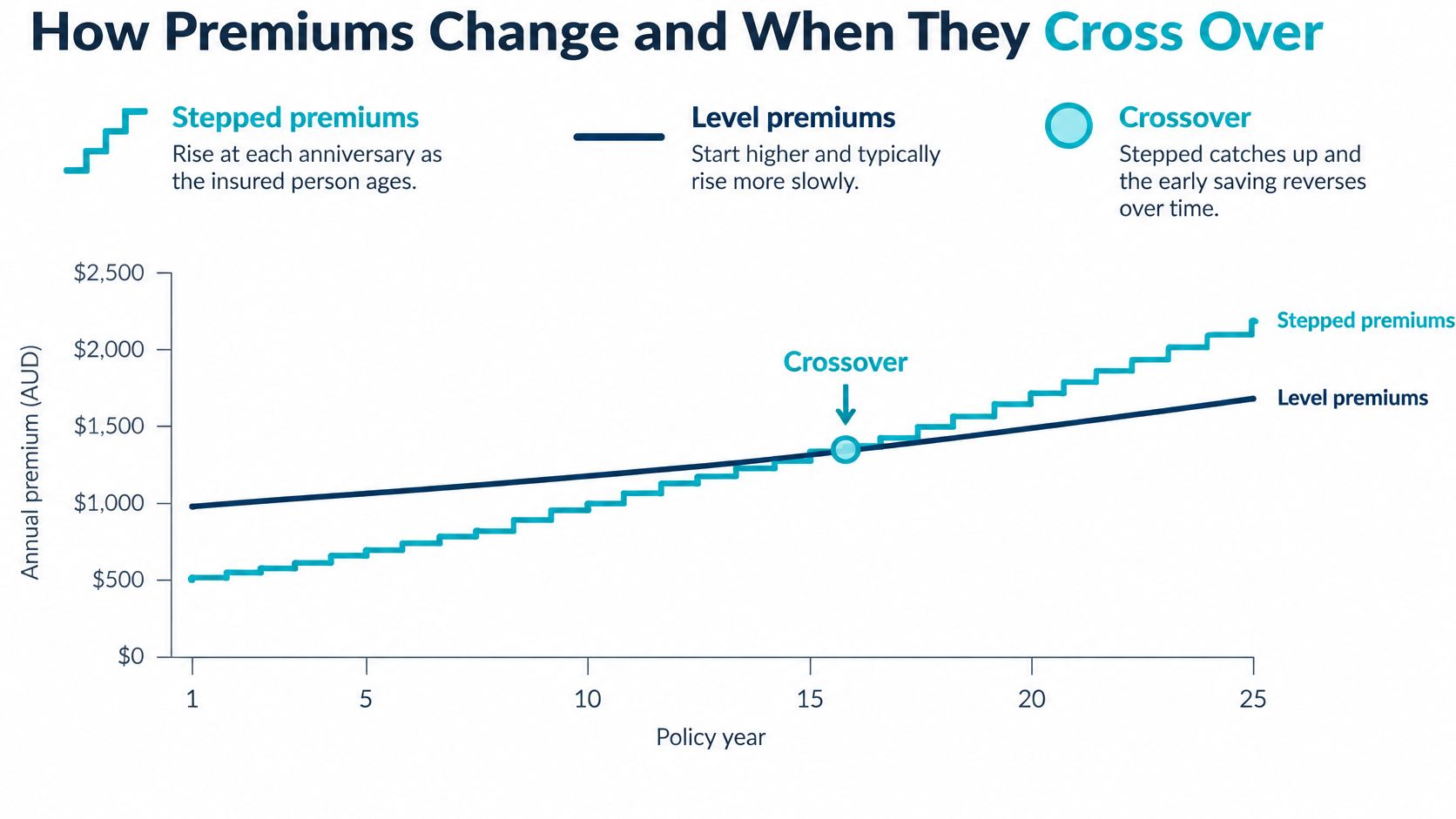
The crossover isn't a single date. It's the point where the total you've paid on stepped passes the total you've paid on level, and where it falls depends on how steeply your age-based pricing climbs.
Stepped premiums are repriced at every anniversary, so the increase isn't a one-off adjustment. It's a curve that steepens through your forties and fifties and keeps going. Early on the curve is gentle and the gap to a level premium stays wide. Later, accumulated stepped costs close that gap, then cross it.
Level premiums don't escape increases. They're calculated using your age when cover begins and aren't ordinarily raised just because you've had another birthday, but insurers can still apply CPI indexation, policy-wide repricing and other terms disclosed in the policy (ASIC report 587). What level buys is slower movement on the age component, not immunity.
The crossover is often further out than the advice suggests. In ASIC's limited-advice worked example, the level option became more cost-effective only after 16 years, and stepped stayed cheaper if the client cancelled, replaced or reconsidered the policy inside that window (ASIC information sheet 267).
Sixteen years is a long time to stay in one contract. People refinance, change jobs, start families, drop cover when a mortgage clears, or find a better offer.
Here's the shape of it across a policy's life:
Break-even in ASIC's worked example
| Holding period | Likely cheaper structure | Why |
|---|---|---|
| Under 16 years | Stepped in ASIC's example | Lower early outlay, and stepped stayed cheaper if cover was cancelled or replaced early |
| 16 years or more | Level in ASIC's example | Higher starting cost was offset by smaller age-based rises |
| Holding period unknown | Model both structures | Use a realistic retention horizon rather than assuming a result |
The method that answers this properly is cumulative, not annual. Add up everything you'd pay under each structure across the years you expect to hold the cover, then bring those totals to present value so a dollar at 60 is compared fairly with a dollar at 35. Include the annual age rises on stepped, the higher starting level premium, CPI-linked increases, any insurer-wide repricing, and any planned change to the sum insured.
A useful test: model the first five years and the first ten years separately. Plenty of people replace or cancel cover well before any crossover, and a structure that only wins in year sixteen hasn't won anything for them.
If part of your plan involves time in Europe, or an overseas move later, the same age-banding logic shows up in other markets. You can compare Spanish health cover costs to see how another country prices age bands, which is a useful sanity check on how much of any premium is age and how much is product design.
Factors That Widen or Narrow the Gap
The crossover moves with roughly eight inputs. Some shift it by years, others by a little. Knowing which is which stops you optimising the wrong thing.
Age at entry is the biggest lever, and it works in both directions. Start at 32 and the level premium has a long runway to repay its higher starting cost. Start at 52 and the insurer has fewer years to spread the risk, so the level premium starts at a much higher point and has less time to earn that back. Quotes are only comparable at the same entry age, so ask for both structures on the same day, for the same sum insured.
Health, smoking status and occupation set the base rate before structure is applied, and any underwriting loading sits on top of whichever structure you choose. A loading of a few hundred dollars a year on a stepped policy is a small early cost and a growing one later. Occupation class does more than change price, because it can change how cover is defined and when it pays.
The smaller levers, roughly in order of effect:
- Sum insured changes: increasing cover after a new loan resets part of the cost path, and the extra amount may be priced at your current age rather than your original one.
- Indexation: CPI-linked increases lift a level premium each year, so budgeting a flat figure is a mistake whatever the label says.
- Repricing history: what an insurer has done to this product in recent years tells you more about the next decade than the marketing description does.
- Ownership: cover held personally comes out of after-tax income, while cover funded through superannuation affects your balance and may be taxed differently.
- Benefit period and planned exit: the shorter the benefit period, and the sooner you intend to cancel or replace, the less time a level premium has to repay itself.
The three that change most answers: the age you start at, how long you genuinely expect to hold cover, and how much movement sits in indexation and repricing rather than in age.
Repricing Risk and Documents to Check
The assumption goes like this: pay more at the start on a level premium and you've bought a fixed cost for life. It's the reason many people choose level as they approach retirement, and it's the assumption Australia's regulators tested against what insurers do.
What the regulators found
In a joint review published on 14 December 2023, APRA and ASIC found that consumer expectations about level premiums didn't always match insurers' practices. Life companies generally re-rated level premiums by more than stepped premiums, even though consumers commonly expected level premiums to provide greater stability. Only one life company had deliberately kept increases for level-premium customers below those applied to stepped-premium customers.
The same review found that most product disclosure statements said premiums could vary for both structures, but often didn't explain clearly why premiums might increase or how changes were likely to develop over the policy's life. The regulators called for clearer explanations at sale and at each policy anniversary.
For a 58-year-old planning to retire at 65, that gap between expectation and practice carries a specific cost. A premium chosen for predictability can become an affordability problem at the exact point the salary supporting it stops. The risk isn't that level premiums are bad. It's that "level" was never a promise about the dollar amount.
The document that settles most of it
Before you commit, get two things in front of you: the current policy or quote, and the Product Disclosure Statement. Australian insurers must provide a PDS before issuing life insurance, and MoneySmart advises checking it for what the policy covers and excludes, what information you must provide, and how premiums can change over time.
Read it hunting for six things:
- Underwriting loadings and exclusions. These sit on top of the structure and often cost more over the life of the policy than the structural choice does.
- Occupation definitions. A narrow definition can mean a claim is declined in the circumstances you most expected cover.
- Benefit periods. A shorter benefit period lowers the premium and lowers what the policy can pay.
- Indexation. Check whether the sum insured and the premium are indexed, and at what rate.
- Renewal provisions. Confirm whether the policy is guaranteed renewable, and on what terms.
- Cancellation rules and policy fees. Establish what you'd pay to exit or vary the cover.
A policy with a narrow occupation definition and a two-year benefit period is a different product from one with a broad definition and five years, no matter which premium basis sits at the top of the quote.
The vocabulary is shifting too. Insurers have increasingly adopted "variable" and "variable age-stepped" descriptions, which makes older side-by-side comparisons of stepped against level potentially misleading, as APRA and ASIC noted in their December 2023 letter to the industry. Ask what the structure is called in the current PDS, not what a comparison site called it in 2019.
Questions to put to the insurer before you sign
- When can this premium be repriced, and on what basis?
- What increases have applied to this exact product over the last three years?
- What will the premium be at the next three anniversaries, under both structures?
- If I increase the sum insured, does the new amount stay on the level basis or get priced at my current age?
- What happens if I reduce cover, take a payment break, or switch benefit types?
Ask for the premium history against the specific product code, not the brand name. Two products sold under the same name in different years can carry different terms and a different repricing record.
Get it in writing. If the answer to "can my level premium change" arrives verbally, ask for it in writing and keep the reply alongside the PDS.
Test two scenarios, not one
Run the projection twice. First with a steady annual rise, which mirrors how stepped behaves and gives a sensible buffer for indexation on a level policy. Then with a single large repricing in a middle year, the kind of event that breaks a household budget. If the cover survives both tests, the structure is probably sustainable. If it only survives the gentle scenario, you've found the thing to fix before you buy.
Ownership sits inside that test. Cover held through superannuation is funded from the fund rather than your take-home pay, with different consequences for your balance and for tax, and we've set out the trade-offs in life insurance through super. Our Protection Plus service simplifies personal insurance and superannuation, helping clients get better coverage and lower fees.
The label is a starting point. The terms behind it decide what you pay in year twenty.
Which Structure Fits Your Situation
Four patterns come up again and again. Each has a verdict and the one check that would overturn it.
A visual helps before the detail: picture someone reviewing a car loan statement alongside two insurance quotes, because that's usually the moment the question gets asked.

A renter in their late twenties covering a car loan that ends in four years. Stepped fits. The cover exists to clear a debt that disappears, and the age-based rises never get long enough to overtake the lower starting premium. The check that reverses it: if the plan is to convert this into lifetime cover once a family starts, taking level now locks in a younger rate and avoids new underwriting later, when health may have changed.
A dual-income family with two children and a 25-year mortgage. Level is the usual answer, because the need runs well past the crossover and the mortgage doesn't shrink as fast as a stepped premium grows. The check is a stress test rather than a spreadsheet: could the household carry the level premium on one income for six months? If a single redundancy would force a cancellation, stepped cover that survives beats level cover that lapses.
A pre-retiree expecting cover to run to retirement. Level, but only after the premium has been tested against the income it will be paid from. Retirement income is usually lower and less flexible than a salary, and insurance is one of the few costs that can be cut without selling an asset. Project the premium to age 75 next to the pension or drawdown it competes with. If it takes a share of income that causes genuine anxiety, a smaller level policy that lasts is worth more than a larger one that gets cancelled.
An executive funding cover through superannuation. Here the comparison isn't premium against premium, it's premium against fund balance, contributions tax and the amount eventually drawn in retirement. Value the cover inside the fund structure, including fees, instead of comparing two quotes in isolation.
Whoever you are, the structure that works is the one still being paid in the year the cover matters. Every recommendation depends on the client's circumstances, goals and priorities, which is why the starting point is a conversation rather than a calculator. When you're ready to look at the wider menu, these are the life insurance types we match to a plan.
Confirm Your Structure on a Free Intro Call
The decision comes down to three steps, in this order.
- Match your expected holding period to the crossover. If you're likely to replace or cancel inside a decade, the long-run maths rarely gets a chance to work.
- Test affordability under a higher-increase scenario. A steady annual rise, plus one large repricing, tells you whether the cover survives a bad year.
- Confirm the contract terms in the PDS. Repricing rights, indexation, occupation definitions and benefit periods decide more than the label does.
If those three line up, the structure is doing its job. If one of them fails, the answer changes, and it's cheaper to find that out now than at age 68.
Prospective clients can book a free 10-minute intro call, and Wealth Collective takes care of the rest. The first step in our process is a complimentary strategy session to get clear on your goals, your current position, your desired position, and what has stopped you reaching it.
Bring three things to that conversation: the current policy or quote, the PDS, and a rough picture of your cover period, debts and income over the next ten years. That's enough to model both structures against the life you're planning, rather than the average policyholder in a comparison table.
Premium structure only matters inside the wider plan. Our job is to run the numbers and show you the trade-offs, not to hand you a label.
Wealth Collective works with Australians on protection, superannuation and retirement planning, and premium structure is one of the few decisions where a small amount of modelling now saves real money later. Our advisers can project the cost of stepped and level cover against your actual plan, then stress test it against the income you'll have when the premium is highest. Start with a free 10-minute intro call at Wealth Collective and bring your current policy or quote.