Business hours
Monday to Friday (8.30AM - 5PM)
Weekend (Closed)



You've got a mortgage ticking along, super sitting in a fund you picked years ago, maybe a few investments, and a vague hope that retirement will sort itself out. Each piece looks fine on its own. The problem is that nobody's checked whether they work together, or whether a change to one undoes another. That's the gap a strategic financial planner is meant to fill.
What a Strategic Financial Planner Actually Does
Say you're a dual-income household in Western Australia. You've got a home loan, a super balance in a default fund, some shares you bought when you had spare cash, and no clear answer to when you could stop work. Nothing's broken, but nothing's coordinated either.
A strategic financial planner reviews your whole balance sheet and cash flow, then sets the order of decisions across super, tax, investments, debt, insurance and retirement. Think of the role like a GP who coordinates specialists. A GP doesn't replace a surgeon, but they make sure the surgeon, the physio and the medication aren't working against each other.

How this role differs from other providers
An accountant typically handles tax after the fact. A product seller recommends one product. A robo-adviser automates a portfolio without seeing your mortgage, insurance or retirement timing. A strategic planner connects those pieces before you act.
At Wealth Collective, we research and model your options and create a detailed financial plan that balances financial structure, money success and lifestyle. Every piece of advice is customized to your unique circumstances, goals and priorities, and it's revisited as your life changes. You can see how that sequencing works in our financial planning process.
Why coordination matters more now
Households now hold more, and more complex, wealth than they did twenty years ago. The Australian Bureau of Statistics household wealth data shows average household wealth, measured as net worth, rose from approximately $530,000 in 2004 to $1.584 million in 2024, almost a threefold increase over 20 years. That average conceals significant differences between age groups, homeowners and renters, and households with different investment exposure, so it isn't a target for you personally.
More wealth spread across property, super and investments means more interactions to get wrong, not fewer decisions to make.
Three questions test whether you need that coordination:
- Do your assets decide for each other: Does a property, super or investment choice change your tax, cash flow or retirement date without you realising?
- If income stops: Do you know what happens to the mortgage and the plan in the first six months?
- Since life last changed: Has anyone checked the plan after a job move, a child, an inheritance or a business change?
Core Services and What Each One Covers
A strategic planner usually works across six areas. The table below shows what each covers, the question it answers and the trade-off you need to weigh. Read it across, not down, because the trade-off column is where poor sequencing causes problems.
Core services a strategic financial planner covers
| Service | What It Covers | Question It Answers | Trade-Off to Weigh |
|---|---|---|---|
| Retirement roadmap | Target retirement income, timing and the savings gap | Will my savings last? | Results depend heavily on assumptions |
| Investment strategy | Asset mix, risk tolerance and rebalancing | How much risk do I actually need? | Higher expected returns bring more volatility |
| Tax and super optimisation | Contribution caps, fund choice and tax on income and gains | Am I using my caps well? | Contribution rules change from year to year |
| Personal insurance | Life, total and permanent disability, and income protection cover | What happens if I cannot work? | Premiums rise with cover and age |
| Debt and cash flow | Mortgage structure, offset use and emergency reserves | Should I repay debt or invest? | Liquidity is traded against return |
| Estate and wealth transfer | Wills, binding nominations and beneficiaries | Who receives what, and when? | Legal drafting needs a solicitor |
You don't buy all six at once
A good planner starts with the largest gap, not the longest list. That might be no income protection while you have dependants and a mortgage, or a growing super balance sitting in a high-fee default option that doesn't match your timeframe. Fixing the biggest risk first usually changes what you need next.
Sequencing matters because services interact. Say you lift your investment risk setting to chase a retirement target. That can change how much cash buffer you need and how much insurance cover protects the plan if you can't work during a market fall. A retirement decision checked against insurance and tax first is less likely to need undoing later.
Practical rule: Start where a single bad event or a missed deadline would do the most damage, then work outward.
A quick self-test
- Protection gap: Could your household keep the mortgage and essentials for a year if one income stopped tomorrow?
- Super gap: Do you know your fund fees, your investment option and whether your contributions use your available cap room?
- Direction gap: Can you state, in one sentence, when you want to stop work and what income you want after that?
If you can't answer one of those, that's probably your starting service. You don't need to solve all six rows before you begin. You need the order right.
How Super, Tax and Investments Work Together
Many people assume more super contributions are always better. A planner doesn't start there. Contributions are a cap-constrained problem, so the first job is calculating how much room you've got, then comparing super with debt reduction and investing outside super.
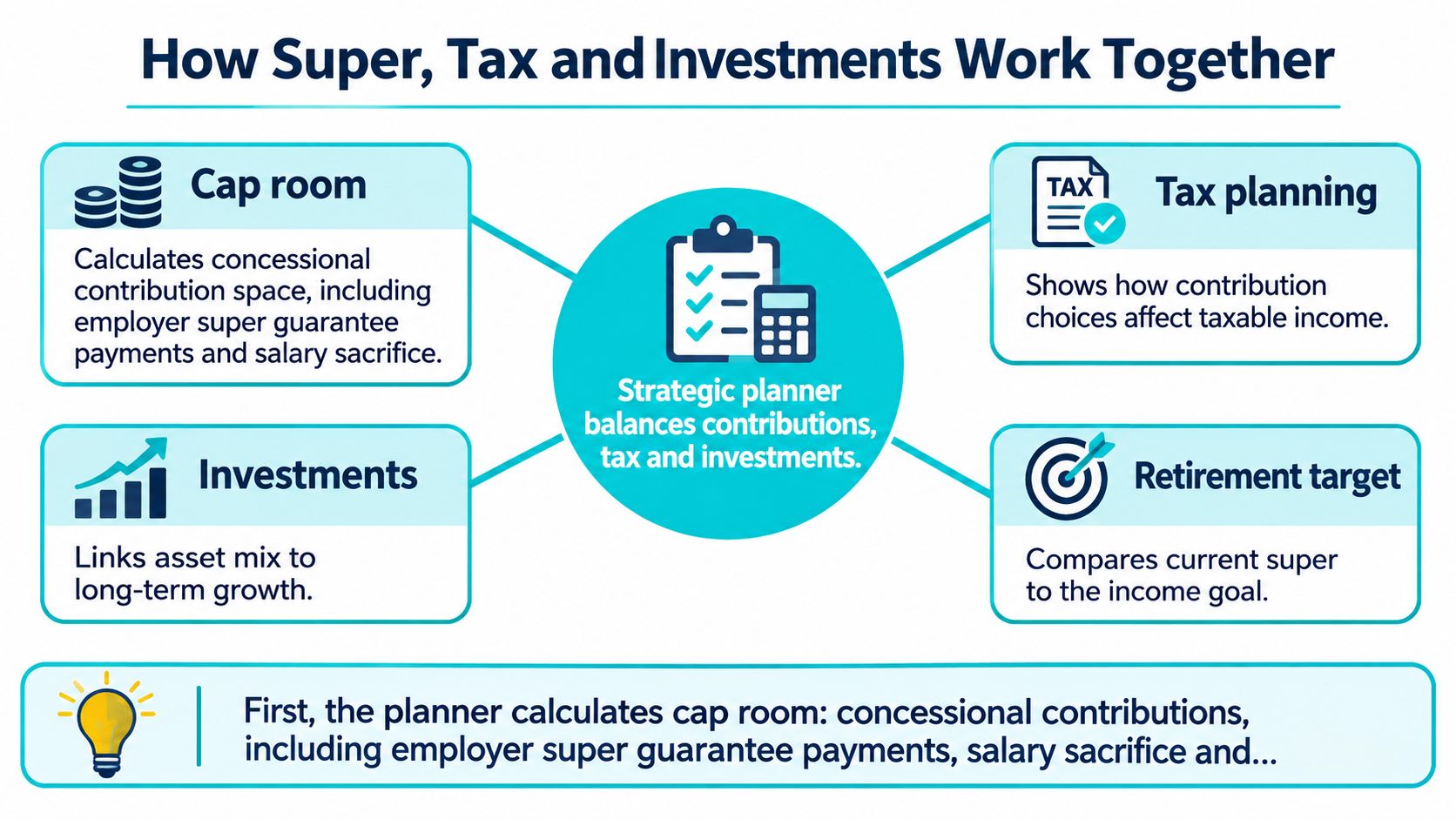
The Australian Taxation Office guidance on personal super contributions sets the concessional contributions cap at $30,000 for 2025–26, including employer superannuation guarantee payments, salary-sacrifice amounts and deductible personal contributions, and exceeding the cap can create additional tax exposure. The non-concessional cap is $120,000 for eligible members, but eligibility depends on your total super balance at the previous 30 June, and the general transfer balance cap is $2 million from 1 July 2025.
Super limits a planner checks for 2025–26
| Limit | 2025–26 Value | What It Means |
|---|---|---|
| Concessional contributions cap | $30,000 | Includes employer SG, salary sacrifice and deductible personal contributions |
| Non-concessional contributions cap | $120,000 | Depends on total super balance at the previous 30 June |
| Bring-forward arrangement | Up to $360,000 over three years | Available only below the relevant balance thresholds |
| Nil non-concessional cap | Total super balance of $2 million or more | No non-concessional contributions allowed |
| General transfer balance cap | $2 million from 1 July 2025 | Limits how much can move into the retirement phase |
| Superannuation Guarantee rate | 12% (1 July 2025 to 30 June 2026) | Employer compulsory contribution rate |
| Maximum quarterly SG contribution base | $62,500 base; $7,500 maximum quarterly SG | Salary above the base adds no extra compulsory contribution |
Two examples of why timing decides the answer
Say you're a 45-year-old executive. Your employer contributions and salary sacrifice already use most of your concessional cap, and income above the contribution base doesn't add proportionally more compulsory super. Tipping extra cash into super could breach the cap, while your offset account or a non-super investment might give you liquidity before preservation age. The planner models tax saved against access lost.
Now say a couple sells an investment property in the same year they want to make a large after-tax contribution. Their total super balances at the previous 30 June, and whether bring-forward is available, decide how much can go in and when. Getting the sequence wrong by a few weeks can close a door that was open.
The same allocation thinking applies outside super. If you're weighing newer asset classes alongside shares and property, learning how to build a crypto asset allocation strategy can help you size any exposure deliberately rather than adding it on impulse.
The sequence to follow
- Check the caps: Add employer, salary sacrifice and deductible personal contributions together first.
- Check the balance: Confirm your total super balance at the previous 30 June before planning after-tax contributions.
- Model cash flow: Test whether locking money away leaves enough accessible reserves.
- Compare alternatives: Weigh super against offset savings, debt reduction and non-super investing on tax, risk and access.
Contributions are a timing decision, not a loyalty test. The right amount in the wrong year can cost more tax than it saves.
Turning Your Super Balance Into Retirement Income
Reaching a target balance isn't the finish line. The harder job is turning that balance into income that lasts, adjusts when markets fall, and still lets you live the life you planned.
Australia is in the middle of that shift. Treasury reporting on super in retirement noted around 16 million Australians held a superannuation account in 2023, the system contained approximately $3.6 trillion in funds under management, and about 1.6 million people aged 65 and over were receiving income from a superannuation product. Approximately 84% of retirement savings were held in account-based or allocated pensions, while only 3.5% were held in annuities, which means most retirees carry the investment and longevity decisions themselves.

Five steps from balance to income
- Separate essential from lifestyle spending: Housing, food, health and utilities need reliable funding. Travel and upgrades can flex.
- Model a sustainable withdrawal rate: Test your spending against different returns, inflation and retirement dates, not one straight line.
- Test sequencing risk: A market fall in the first two years hurts more than the same fall later, because you're selling units while prices are down.
- Set spending guardrails: Agree in advance to trim discretionary spending by a set percentage if the portfolio falls below a threshold, and restore it when it recovers.
- Hold a cash buffer and check the Age Pension: One to two years of spending in cash can stop forced selling, and drawdowns should be modelled alongside Age Pension eligibility.
Our guide to retirement income streams explains the product mechanics, but the strategy comes first. Product choice follows the spending plan, not the other way around.
What an early fall does in practice
Say a 62-year-old couple retires with $1.2 million and plans steady lifestyle spending from day one. If markets fall sharply in year one and they keep withdrawing the same amount from falling assets, the portfolio has less capital left to recover. With guardrails and a cash buffer, they instead draw essentials from cash, pause a major trip, and restore spending when balances recover. Same starting balance, very different outcome.
If retirement might involve time living overseas, health cover becomes part of that spending plan too, and medical insurance planning for retiring abroad is worth factoring in before you lock in a withdrawal rate. Bring your planner three questions: How much can we spend if markets fall early? What triggers a spending change? How long does our cash buffer last?
Credentials and Questions to Ask Before You Hire
Credentials don't guarantee good advice, but missing credentials are a clear stop sign. Check the basics before you discuss your goals, because it's much harder to walk away once you've shared everything and feel committed.
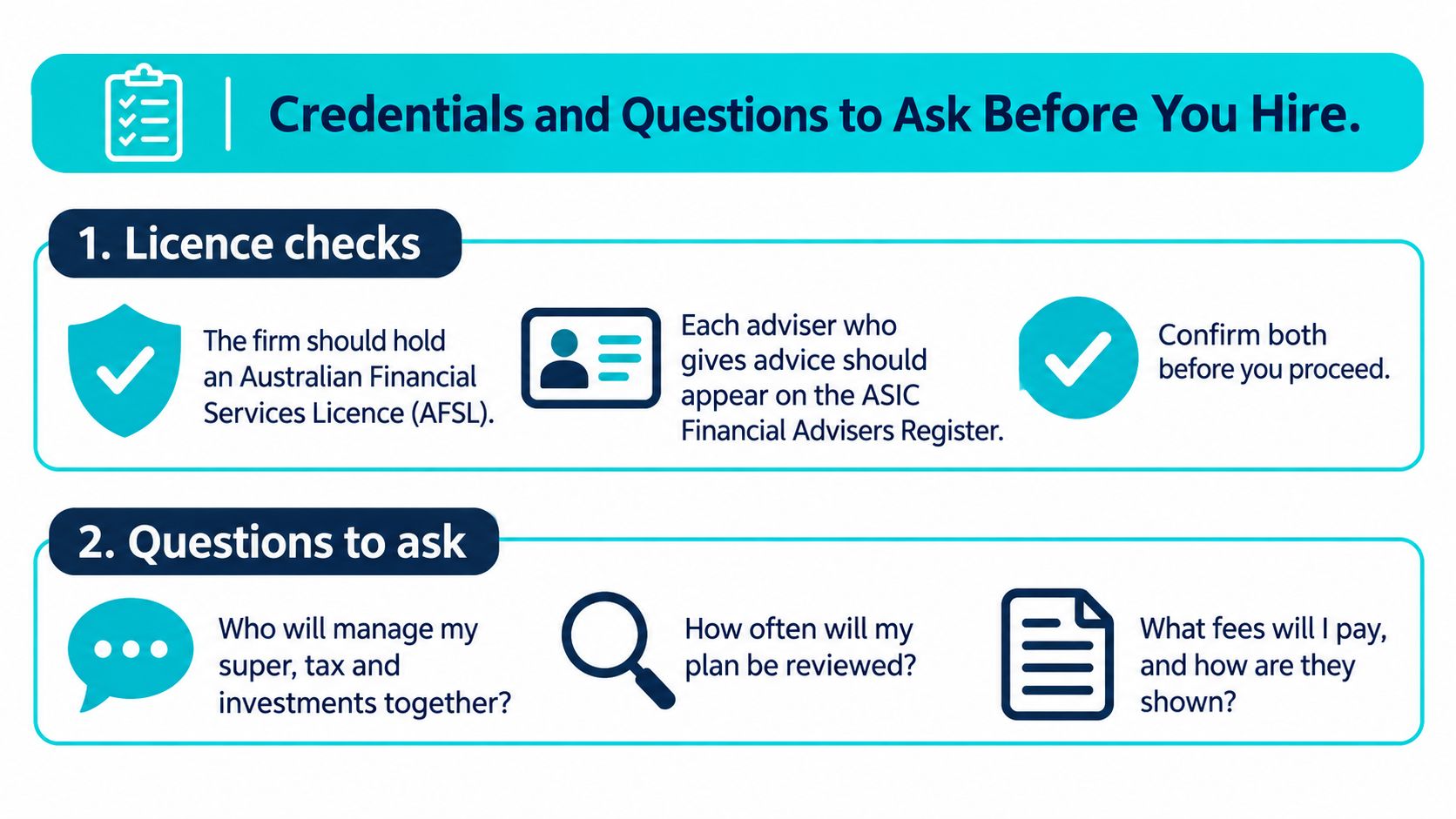
Licence checks to do first
- AFSL check: The firm should hold an Australian Financial Services Licence, or operate as an authorised representative of a licensee.
- Adviser register check: Each adviser who gives you advice should appear on the ASIC Financial Advisers Register.
- In writing: Ask the firm to state its licence number and any authorised representative arrangement in writing before you proceed.
For example, Wealth Collective is a Corporate Authorised Representative of Wealth Collective Adviser Services Pty Ltd (AFSL 538833). Whatever firm you choose, you should be able to verify an equivalent statement quickly.
Next, check qualifications and professional standing. Ask about a relevant degree or equivalent, certification such as the CFP mark where held, membership of a professional body and ongoing professional development. You're not collecting badges. You're checking that the person advising on super, tax and insurance together is trained and accountable across those areas.
Questions for a first conversation
- How are you paid: Do you receive commissions, and will you show every fee in dollars?
- What's in writing: What will my Statement of Advice include, and what won't it cover?
- Who's my contact: Who manages my plan day to day, and who do I call when something changes?
- How do reviews work: How often will we review the plan, and what happens if my circumstances change between reviews?
Clear answers suggest a structured service. You'll hear a fee in dollars, a named contact and a set review schedule. Vague answers, pressure to decide quickly, or a product recommendation before the adviser understands your full position are warning signs.
The same discipline helps with other professionals in your team. If you're coordinating tax support alongside advice, it's sensible to compare accountants by industry expertise so your accountant and planner aren't giving you conflicting instructions.
A good adviser answers licence and fee questions plainly, in writing, without making you feel difficult for asking.
General information on a website, including this guide, is not personal financial advice. You should consider your own circumstances and consult one of our qualified Financial Advisers before acting on it.
Fee Structures and What Each One Costs
Cost is where many people stall, and that's understandable. CPA Australia's In the Black coverage of advice affordability reported only 10.4% of Australians received professional financial advice in 2025, while median advice fees reportedly rose 18% in 2025 to $4,668, a 67% increase over five years. Low uptake doesn't automatically mean low interest. It often means unclear entry points.
Fee models for strategic financial planning
| Fee Model | How It Is Charged | Usually Best For | Watch Out For |
|---|---|---|---|
| Ongoing fee | Percentage of funds under advice, charged each year | Continuing management and regular reviews | Cost grows as the balance grows |
| Fixed plan fee | One agreed price for a defined piece of work | A one-off plan or a defined review | Scope must be written down |
| Hourly rate | Charged per hour of work | Narrow questions or short reviews | Total cost is hard to predict |
| Retainer or subscription | Monthly or annual fee for ongoing access | Regular check-ins and quick questions | Confirm what is included |
| Commission | Paid by the product provider | Some insurance products | Ask whether it is disclosed and how it affects the advice |
Always convert percentages to dollars
Ask for the total dollar cost per year, not only the percentage. For example, a 1% ongoing fee on $500,000 costs $5,000 a year. That's more each year than a typical one-off full-service fee, so you'd want to know exactly what ongoing work justifies it. For some households, a fixed-fee review at key moments delivers better value.
Our breakdown of financial advice fees in Australia works through that comparison in more detail. Whichever model you're offered, ask three things: Does the fee cover implementation and reviews? Are any commissions received, and how are they disclosed? What measurable outcome should this work produce?
Start smaller if you need to
You don't have to buy a full plan as your first step. A focused engagement on one decision, such as an insurance adequacy check for a young family, a super and debt priority review for a dual-income household, or a retirement income check-up, can answer the highest-impact question first. The scope, price and outcome should be written down before work starts.
Rule of thumb: Pay for decisions that change your outcomes, and don't pay ongoing fees for services you aren't using.
Book a Free Intro Call to Test Your Plan
A first conversation is easier when you have a rough picture of how your money is arranged. Note your super, debts, savings and retirement aims. These details help frame the questions, even if you do not have exact figures.
Prepare in three steps
- Super snapshot: Note your balance, fund fees, investment option and any insurance held inside super.
- Money in and out: List household income, debts and interest rates, plus cash reserves.
- Retirement goal: Write down when you might stop work or reduce your hours, and the lifestyle you would like.
Rough figures are enough to start. Later, accurate details help an adviser assess how super, debt, investments and insurance fit together.
What happens next with us
Book a free 10-minute intro call with Wealth Collective. The process starts by reviewing your current situation and creating a plan that works for you. In a complimentary strategy session, the team clarifies your goals, current position, desired position and what has stopped you reaching those goals.
Wealth Collective researches and models your options, then creates a detailed financial plan balancing financial structure, money success, and lifestyle. Advice is customized to your circumstances, goals, and priorities. Once you are 100% comfortable with the outcomes, the team takes care of the paperwork, products if required, and end-to-end implementation.
If your super, mortgage, investments and insurance have not been considered together, a free intro call can help identify the first decision to examine. Visit Wealth Collective to discuss your goals and current position.