Business hours
Monday to Friday (8.30AM - 5PM)
Weekend (Closed)


A Melbourne couple in their retirement years may think their home is the family's main asset. Then one partner dies, and the $850,000 super balance becomes the largest piece of wealth outside the house. The family's next decision is not where to invest it. It's who receives the death benefit, whether the payment is made directly or through the estate, and how the fund's taxable and tax-free components are distributed.
The biggest lever is tax dependant status. If the recipient is a dependant, a lump-sum super death benefit is tax-free. If the recipient is a non-dependant, the taxable component can be taxed at 15% for the taxed element and 30% for the untaxed element, with PAYG withholding rates of 17% and 32% respectively when Medicare levy is included in withholding. The ATO explains these distinctions in its guidance on paying superannuation death benefits.
That difference can matter more than years of investment performance. It affects SMSF balances, reversionary pensions, adult children, blended families and nominations that looked sensible when they were signed but no longer match the family. This guide focuses on the decisions that determine how much your family keeps.
Why Super Death Benefits Tax Matters to Australian Families
The balance on the statement isn't the inheritance
Suppose the Melbourne husband dies first. His wife is still living in the family home, and their two adult daughters expect the super to form part of their eventual inheritance. The account statement shows $850,000, but that figure doesn't tell the family what the daughters will receive after tax.
If the benefit is paid to the wife as a tax dependant, a lump sum can pass tax-free. If the wife later dies and the super passes to the adult daughters, their status will usually be different. An independent adult child is generally a non-dependant for super death benefit tax purposes, so tax can apply to the taxable component before the money reaches them.
The same issue arises in an SMSF. A trustee may have flexibility over the form and recipient of a death benefit, but that discretion doesn't remove the tax rules. A reversionary pension may move automatically to a spouse, while a later payment to adult children can produce a different result.
The practical question isn't “How much super is there?” It's “How much of that balance can this beneficiary receive without tax?”
The recipient can matter more than the investment return
The ATO's rules distinguish between the person receiving the benefit and the components inside the account. A spouse or other death benefits dependant can receive a lump sum tax-free, including taxed and untaxed elements. A non-dependant can face tax on the taxable component, while the tax-free component remains outside the tax calculation.
That makes beneficiary planning an estate decision, not just an administrative task. A nomination can direct money away from the estate, preserve a spouse's access to super, or expose adult children to tax that the family didn't anticipate.
The mistake is to treat the nomination as a form you complete once and forget. Family structures change. Divorce, remarriage, new children, SMSF deed amendments and pension arrangements can all affect whether the original plan still works.
Who the ATO Treats as a Super Death Benefit Dependant
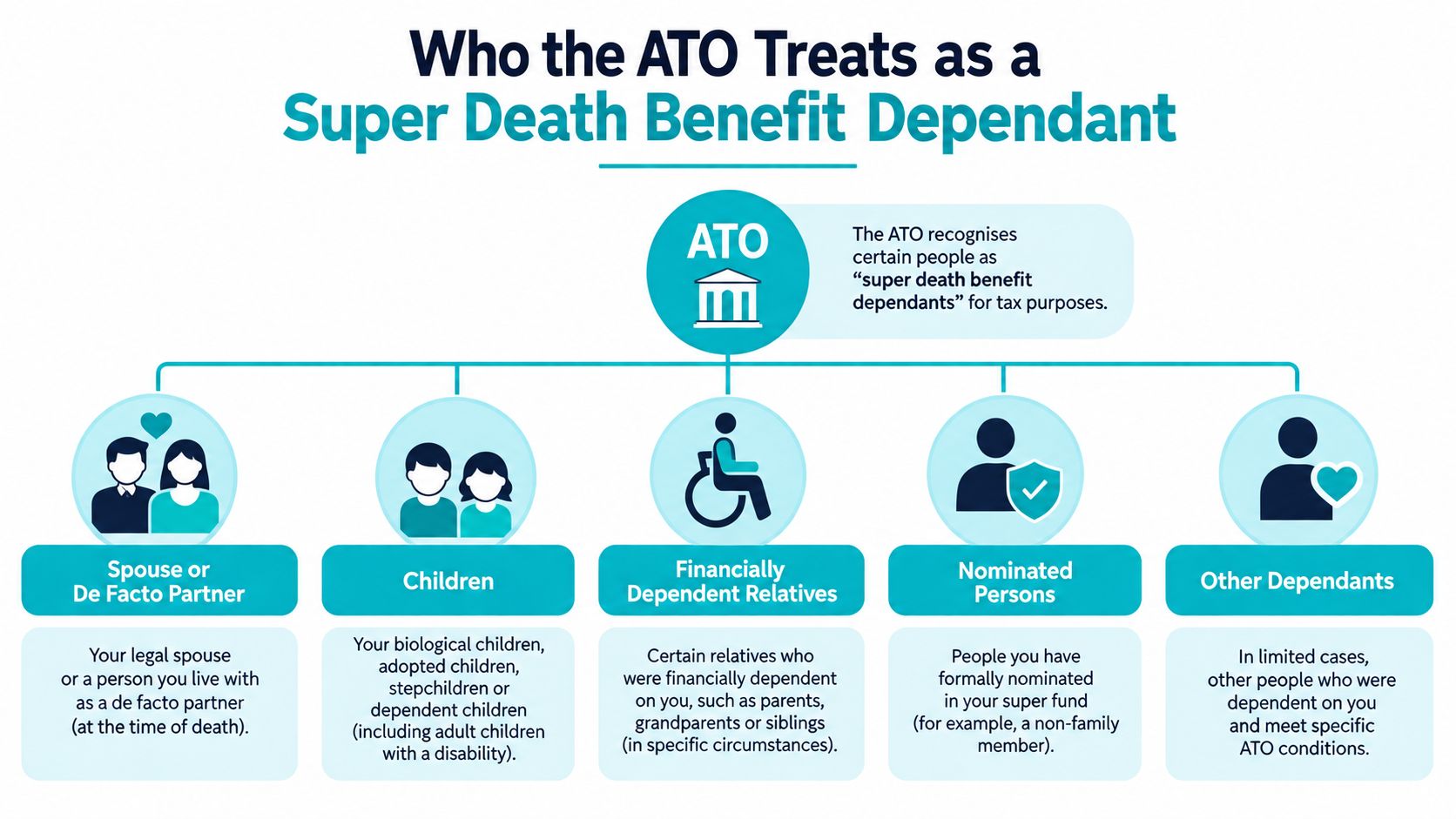
The ATO dependant test works like a filter. Take the proposed recipient's name, then ask whether they fit one of the recognised categories on the date of death. The answer determines the tax treatment of the super death benefit, regardless of what the family intended informally.
Start with the relationship
A spouse or de facto partner qualifies, including a former spouse in the relevant circumstances and a same-sex partner. For example, a surviving wife, husband or de facto partner can generally be treated as a death benefits dependant.
A child under 18 is included. That covers a biological, adopted or step-child who is under 18 at the relevant time. An adult child doesn't qualify merely because they are the deceased's son or daughter.
A person in an interdependency relationship may qualify where the relationship existed on the date of death. This is more than living in the same household. The facts may involve close personal support, financial support, domestic support and personal care.
An interdependency claim can sometimes survive a recent relationship breakdown under a two-year rule. That needs careful evidence, particularly where the parties were no longer living together but the relationship had only recently ended. An adult child with a disability may also qualify through a separate provision, so don't assume age alone settles every case.
Who usually fails the filter
Independent adult children over 18, adult grandchildren, parents, siblings, friends and charities aren't automatically tax dependants under the super rules. They may still receive a benefit, but the taxable component can be taxed as a payment to a non-dependant.
A will doesn't change that classification. It controls estate assets, but superannuation is governed by the fund rules, the nomination, the trustee's decision and the superannuation legislation. A payment to the estate can then be taxed according to the status of the people who ultimately benefit, as the ATO explains in its guidance on super death benefit income streams.
Don't label an adult child a “dependant” because they depend on the family emotionally. The ATO test is technical, and the evidence matters.
How Taxed, Untaxed and Tax-Free Components Drive the Outcome
The headline rate is only the starting point. The fund first separates the death benefit into its tax-free component, taxed element and untaxed element. The component split determines how much of the payment is exposed to tax.
The tax-free component is the simplest. The ATO confirms that it isn't taxed when a super death benefit is paid to a non-dependant. The taxable component contains the taxed and untaxed elements, and those two elements can produce different outcomes.
The taxed element generally reflects amounts on which the fund has already paid tax within the super system. The untaxed element hasn't had that tax applied in the same way. It can occur in certain legacy arrangements and defined-benefit structures, and it can also appear in SMSF accounts depending on the source of the member's benefits. The ATO's superannuation payment rates sets out the different treatment.
The component split is the real planning map
| Component | Dependant, lump sum | Non-dependant, lump sum |
|---|---|---|
| Tax-free component | Tax-free | Not taxed |
| Taxed element | Tax-free | Taxed at up to 15% |
| Untaxed element | Tax-free | Taxed at up to 30% |
For illustration only, a balance could contain 30% tax-free, 60% taxed and 10% untaxed. Those percentages aren't a universal profile, and your annual statement or fund records must be checked before making a decision.
The tax-free slice passes without death benefit tax. The taxed slice is exposed to the non-dependant rate, and the untaxed slice carries the highest rate. That makes the untaxed element a silent problem in a large SMSF or legacy fund, particularly where adult children are intended beneficiaries.
For example, if a benefit contained $300,000 tax-free, $600,000 taxed and $100,000 untaxed, a non-dependant could face tax on the taxable portions while the $300,000 tax-free component remained untouched. The exact amount withheld would depend on the payment structure and applicable withholding rules. The key planning point is clear: two accounts with the same balance can produce different inheritances because their component splits differ.
Dependants Versus Non-Dependants at a Glance
The 2026 PAYG withholding table makes the cash difference visible at the point of payment. A dependant receives nil withholding on both taxed and untaxed taxable components. A non-dependant receives withholding at 17% on the taxed element and 32% on the untaxed element, as shown in the ATO's 2026 superannuation lump-sum tax table.
| Component | Dependant, taxed | Dependant, untaxed | Non-dependant | Earnings top-up |
|---|---|---|---|---|
| Taxed element | Nil withholding | Not applicable | 17% withholding | Earnings may be taxed separately |
| Untaxed element | Not applicable | Nil withholding | 32% withholding | A further tax outcome may arise |
| Tax-free component | Nil tax | Nil tax | Nil tax | No tax on the component |
The 17% rate includes Medicare levy in the withholding calculation. The 32% rate also includes Medicare levy, with the ATO table reflecting the applicable Medicare-loaded withholding treatment. The final tax position can require reconciliation, so PAYG withholding isn't always the final assessment.
The taxable element can be assessable income for the non-dependant, with the tax treatment incorporating the relevant offset for the taxed element. The untaxed element has its own higher-rate treatment, including the possibility of a different final outcome where excess withholding is refunded. The fund's payment statement and the recipient's tax return remain important.
Earnings can create another layer
A death benefit paid to a non-dependant may also involve earnings on the benefit. Those earnings can attract another marginal tax outcome, including a further 15% rate in the circumstances described by the ATO guidance. That means the family shouldn't look only at the withholding line on the original lump sum.
Classification decides whether the tax starts at zero or whether the taxable components begin leaking value before the family receives the money.
The expensive error is assuming the whole super balance is taxed at one simple rate. The tax-free component is protected, the taxed element and untaxed element are treated differently, and earnings can sit separately from the original death benefit.
Two Worked Examples That Show the Real After-Tax Gap
The safest way to understand the rules is to apply them to a payment. The examples below use the requested figures as illustrations, but the exact result depends on the fund's component records, the payment type and the recipient's legal status.
Example one, a spouse receives the payment
A 62-year-old retired public servant dies with a super balance described as a $900,000 taxed-element accumulation balance. The family decides that $700,000 will be paid as a lump sum to the deceased's 60-year-old spouse.
For this illustration, assume the $700,000 payment contains $200,000 tax-free and $500,000 taxed. The spouse is a tax dependant, so the lump sum is tax-free. The $500,000 taxed element is reported with a 15% tax offset, leaving an illustrated net amount of roughly $425,000 after applying the assumed treatment.
The ATO's rules support the central outcome here, a lump sum paid to a dependant is tax-free. The exact reporting mechanics still need to be checked against the fund's payment statement and the recipient's circumstances.
Example two, an adult daughter receives the same payment
Now change only the recipient. The same $700,000 is paid to a 35-year-old adult daughter who is a non-dependant. Under the illustration, the $200,000 tax-free component remains untouched, while the taxable parts are exposed to the non-dependant treatment.
Using the requested scenario, the taxed element is subject to 32% withholding, and any untaxed element is subject to 30% tax treatment in the calculation. The illustrated net result is around $448,000, producing an approximately $23,000 gap driven by recipient classification rather than investment performance.
That example needs careful handling because a “taxed-element accumulation balance” and a separate untaxed allocation must be reconciled with the fund's actual records. The figures demonstrate the planning principle, not a personal tax assessment.
Why scale changes the decision
A larger balance magnifies the difference between a dependant and non-dependant payment. At $1.5 million, the same classification issue can create a substantially wider dollar gap, depending on the tax-free, taxed and untaxed mix.
Nomination wording therefore deserves more attention than a casual beneficiary form. A fund statement, trust deed, pension terms and estate plan should be reviewed together before the family relies on a projected inheritance.
Paying Direct to Beneficiaries or Through the Estate
The payment route creates a different planning question from the dependant test. A super fund may pay a death benefit directly to an eligible beneficiary, or it may pay the trustee of the deceased estate for distribution under the will.
A direct payment to a dependant can keep the benefit outside the estate administration process. It may also help a surviving spouse access the money without waiting for estate administration. The drawback is that the payment generally bypasses the will, so it won't automatically help with debts, specific gifts or equalisation between children.
Payment to the legal personal representative gives the estate a central pool to administer. The ATO confirms that a super death benefit paid to the trustee of a deceased estate isn't subject to PAYG withholding at the fund level. The estate is taxed in the same way the benefit would have been taxed if paid directly to the beneficiary, making the ultimate dependant status and distribution plan critical. See the ATO's explanation of taxation of super benefits paid to an estate.
When an estate payment can be more useful
The estate route can suit a blended family where one child receives the home and another is intended to receive super. It can also help where the executor needs to meet liabilities or apply a controlled distribution rather than allowing a direct nomination to determine the result.
A corporate trustee may need discretion over whether a benefit is paid as a lump sum or pension, particularly where the intended recipient's age, dependency status or legal capacity affects the available structure. The choice must be coordinated with the SMSF deed and legal advice.
For a plain-English explanation of the broader issue, read what happens to super when you die. Don't assume the estate route automatically makes the benefit tax-free. It can improve control, but it doesn't erase the underlying tax classification.
Common Traps That Quietly Lift the Tax Bill
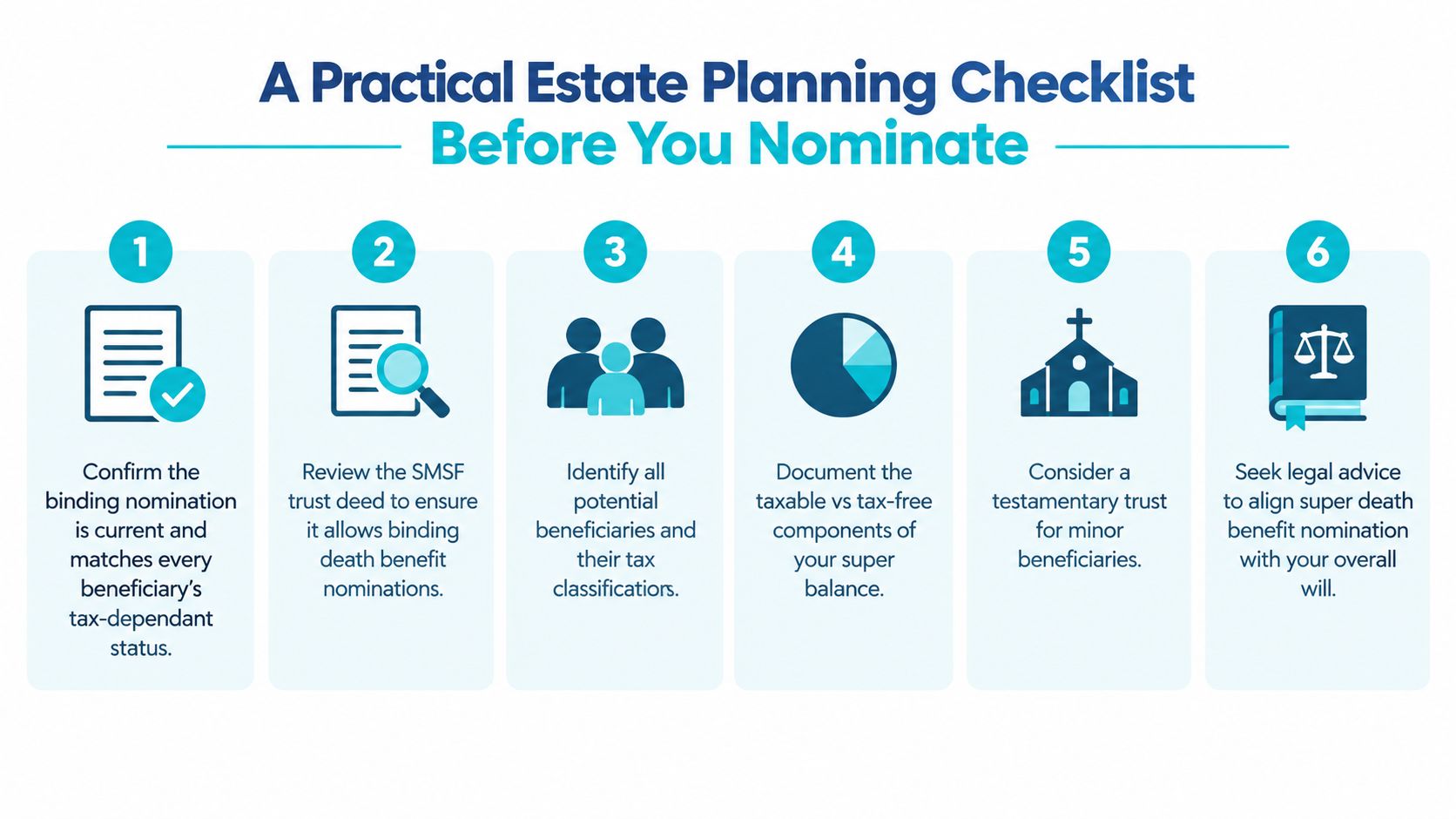
Families often focus on the tax rate and overlook the document that sends the money to the wrong person. These are the traps I see most often in practical reviews.
An old nomination can outlive the family structure
A binding nomination may name a former spouse, an adult child or a beneficiary who no longer reflects the client's wishes. The fund may also have an SMSF trust deed that doesn't support the nomination in the way the member expects. The corrective action is to check the nomination against the current deed, family structure and component split.
An adult child isn't automatically a dependant
Calling an adult child a dependant on a form doesn't make them one for tax purposes. If they don't meet the ATO test, the taxable component can be exposed to the non-dependant rates, and an untaxed element can produce the sharpest leakage.
Before naming an adult child, obtain advice on whether there is a genuine dependency or interdependency basis. If not, model whether a payment to the estate, a different nomination, or lifetime planning better meets the family's objectives.
The deed can override what the member thought they had arranged
An SMSF trust deed may contain binding death benefit provisions that constrain the trustee. Those provisions can direct a benefit to an ex-spouse or adult child even when the member's current wishes point elsewhere. The trustee must follow the governing documents, not a handwritten preference discovered after death.
Reversionary pensions deserve a tax review
A reversionary pension can look efficient because it may automatically continue to a spouse. But if the reversionary beneficiary is a non-dependant, the intended pension structure may not produce the expected tax result. The ATO identifies restrictions on paying a super income stream to a non-dependant, with legacy treatment for certain income streams paid before 1 July 2007, as outlined in its death benefit income stream guidance.
One useful companion resource is this guide to superannuation recontribution strategy. It shouldn't be treated as a universal answer. A recontribution decision must consider access, investment, personal tax and the client's need for retirement income.
A Practical Estate Planning Checklist Before You Nominate
A nomination should be the final expression of a wider plan, not the first step. Before signing, work through the balance, the beneficiaries and the documents in the same meeting.
- Confirm the nomination: Check that the binding nomination is current and reflects every beneficiary's actual tax-dependant status.
- Read the SMSF deed: Confirm that the trust deed permits the proposed nomination and deals properly with death benefits and reversionary pensions.
- Map the components: Record the tax-free component, taxed element and untaxed element, then compare each with the intended recipient.
- Choose the payment route: Decide whether direct payment or payment through the estate better handles liquidity, tax spread, debts and adult beneficiaries.
- Align the will: Make sure the nomination and will work together, particularly where the estate must equalise gifts or support a testamentary arrangement.
- Write trustee instructions: A trustee letter of wishes can explain the intended outcome, although it must remain consistent with the deed and binding documents.
- Recalculate after change: Review the after-tax inheritance after major family events and as the balance or component mix changes. A planned review every two years can keep the strategy current.

The legal documents deserve their own specialist review. If your will involves a blended family, a disabled beneficiary or a testamentary trust, consider speaking with a vetted estate planning specialist who can coordinate the will, trust and superannuation instructions.
For the nomination mechanics, review what is a binding death benefit nomination and then have the fund's deed, nomination form and estate plan checked together. The goal isn't to reduce tax. It's to deliver the right money, to the right person, through the right structure, without leaving the trustee to guess.
Bring your latest super statement, trust deed, nomination, pension documents and will to an adviser. A proper review should calculate the likely after-tax inheritance rather than relying on the balance shown in the account.
Wealth Collective helps clients review superannuation components, beneficiary nominations, estate structures and retirement strategies so the family can make an informed decision about superannuation death benefits tax. Book an initial conversation by visiting Wealth Collective, and bring your current super and estate documents so the advice starts with the facts.