Business hours
Monday to Friday (8.30AM - 5PM)
Weekend (Closed)


You've logged into your super fund after a pay rise, ready to make a sensible decision, and found a menu packed with investment options that sound familiar but don't tell you much. Balanced, growth, conservative, international shares, property, cash, direct assets. The labels look simple. The underlying decisions aren't.
That confusion is understandable. Australia's superannuation investment options market now offers a broad range of portfolio structures rather than one universal default. APRA reported 895 superannuation products at 30 June 2025, with 23.3 million member accounts holding $2.68 trillion in assets, while Choice products alone included 35,552 single-sector options, 14,540 multi-sector options and 85,477 direct-asset options (APRA's quarterly superannuation industry publication).
This guide cuts through the menu. You'll see what the main categories hold, how the risk and return trade-off works, when changing options makes sense, and which details deserve your attention before you switch.
Staring at the Super Menu and Not Knowing Where to Start
A 35-year-old Perth engineer opens her super portal after a pay rise, ready to put her growing balance to work. The screen offers more than one hundred investment choices, several versions of “balanced”, a lifecycle option, Australian and international shares, property and a direct investment menu.
She closes the tab.
That response is understandable. Super members can choose between default products and self-directed pathways. MySuper became the default super framework from 1 January 2014, directing compulsory Superannuation Guarantee contributions into approved low-cost default products unless an employee selected another arrangement (APRA's product-level data publication). Choice products now offer a much broader menu, but more choice does not automatically produce a better result.

The menu isn't the decision
You do not need to become an investment analyst. Start with four questions: which assets the option owns, how much is invested for growth, how the portfolio is managed and whether it is properly diversified.
The label alone is inadequate. Two options called Balanced can hold materially different asset mixes and behave very differently during a market decline. Compare the strategic asset allocation table in the product disclosure statement, then check fees, investment objectives and the level of risk you can tolerate.
Adviser rule: Choose the portfolio whose risk, fees and time horizon fit your actual life, not the option with the most impressive name.
Your stage of life should guide the decision. A person in their thirties with decades before retirement can generally accept more short-term volatility in pursuit of long-term growth, provided they can stay invested during market falls. Someone approaching retirement should focus on the capital they may need soon, their withdrawal plans and the risk of a poorly timed loss. Moving automatically into the safest-looking option can create its own cost through weaker growth.
The outcome gap sits between these choices. Capital stable, balanced and growth options can produce very different results over time because their exposure to shares and other growth assets differs. APRA's product-level data helps compare what funds offer, rather than relying on labels alone.
For background, Wealth Collective's guide to what superannuation is in Australia explains how the account works. That context makes the investment menu easier to judge against your goals.
The Building Blocks Inside Every Superannuation Investment Option
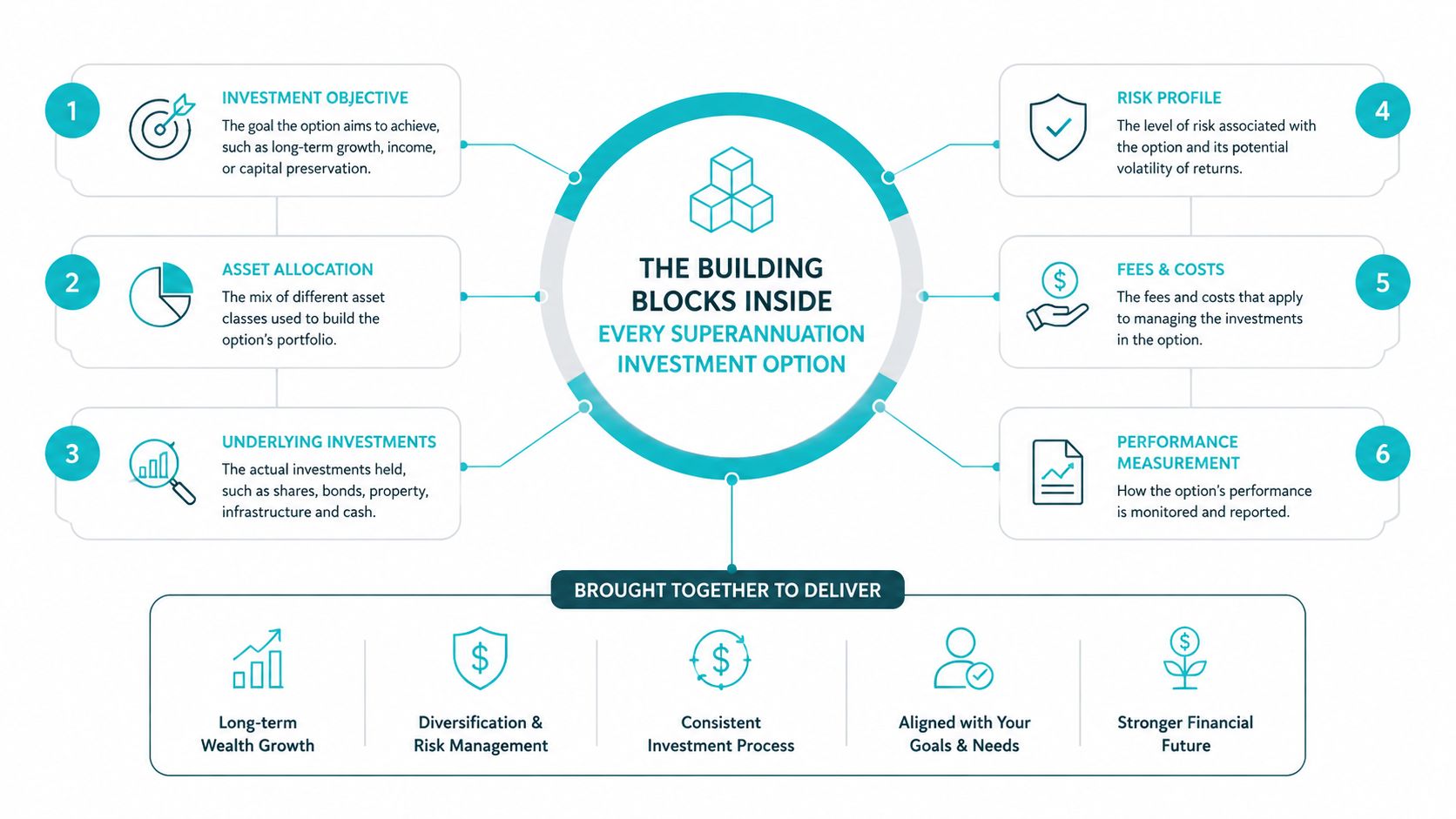
Every option is a recipe. The name on the packet might say capital stable, balanced or high growth, but the outcome depends on the ingredients and the proportions.
Start with the assets
Asset classes are the first building block. Cash and fixed interest generally form the more defensive ingredients. Australian and international shares, property, infrastructure and alternatives usually provide more growth exposure, although each carries its own risks.
Shares give you ownership exposure to businesses. Property and infrastructure can add income and diversification. Fixed interest can provide a steadier portfolio component, but it isn't risk-free. Cash generally moves less sharply than shares, but it also offers less long-term growth potential.
Australian academic analysis of 1,220 options over 30 years examined allocation data across cash, domestic and international shares, domestic and international fixed income, and listed and unlisted property (the academic analysis published in the Annals of Operations Research). That range explains why selecting “growth” doesn't reveal the whole investment experience. The international allocation affects currency exposure. Property affects liquidity and valuation behaviour. Shares affect drawdown risk.
Then find the four decisions underneath
Growth versus defensive mix: This is the main dial. More growth assets can improve long-term return potential, but they can also produce larger short-term falls. More defensive assets can smooth the ride while reducing the portfolio's growth engine.
Active versus passive management: An active manager is like a chef cooking from scratch, selecting investments and making decisions about what to include. Passive management is closer to buying a well-made ready meal that follows a defined market index. Active management may justify higher fees if it adds value, but you should demand evidence rather than assume it will.
Diversified versus single-sector construction: A diversified option combines several asset classes. A single-sector option concentrates on one area, such as Australian shares or international shares. Buying one single-sector option is like buying one spice rather than a complete marinade. It can be useful, but it shouldn't be mistaken for a full portfolio.
Control and responsibility: Some members select a premixed portfolio. Others combine sector options or choose direct assets. More control means more responsibility for diversification, rebalancing, fees and emotional discipline. A managed fund can provide a structured way to pool investments, while direct options require closer attention.
Capital stable, balanced and growth options are different combinations of these building blocks. Once you understand the recipe, you can stop treating the label as a recommendation.
The Main Option Categories and How They Typically Behave
The right option depends on when you need the money, how long it can remain invested, and whether you can stay invested through a sharp fall. The table is a starting point, not a promise. Each fund sets its own asset allocation, risk measure, fees and investment objective.
| Option category | Typical growth/defensive split | Risk band | Best suited life stage |
|---|---|---|---|
| Capital stable | 20% to 30% growth, 70% to 80% defensive | Lower | Money needed soon, or low tolerance for volatility |
| Conservative balanced | 30% to 50% growth, 50% to 70% defensive | Low to moderate | Earlier retirement planning or cautious investors |
| Balanced | 50% to 70% growth, 30% to 50% defensive | Moderate | Broad working-life default for members with a long horizon |
| Growth | 70% to 85% growth, 15% to 30% defensive | Moderate to high | Members with substantial time before retirement |
| High growth | 85% to 100% growth, up to 15% defensive | High | Younger members who can tolerate large fluctuations |
| Single-sector or direct assets | Depends on the selected asset | Varies widely | Experienced investors with a deliberate portfolio role |
Capital stable and conservative balanced
A member approaching retirement who expects to draw on super soon may value a steadier account balance. Capital stable options generally hold a large allocation to cash and fixed interest, reducing the effect of sharemarket falls.
That smoother ride has a clear trade-off: less exposure to assets that can drive long-term growth. A lower-volatility option can still leave a retirement account exposed to inflation, particularly when the money must fund many years of withdrawals.
Conservative balanced options retain more growth assets while keeping a substantial defensive allocation. They suit members who want to reduce risk gradually, rather than move entirely away from growth investments.
Balanced, growth and high growth
Balanced options combine shares, property and other growth assets with defensive investments. They suit many working Australians with a long horizon, but the word “balanced” does not describe one standard portfolio. Check the actual allocation before choosing it.
Growth options accept larger short-term fluctuations to pursue stronger long-term return potential. High growth options take that approach further, often placing most of the portfolio in shares and other growth assets. A younger member with decades before retirement can usually give these options more time to recover from falls, provided they will not sell during an uncomfortable period.
Single-sector options, such as Australian shares, international shares and listed property, can fill a deliberate role in a broader portfolio. Used alone or without an allocation plan, they can create concentration risk. Direct-asset options give members more control, while also making them responsible for research, diversification, rebalancing and monitoring.
The menu is broader than the default options suggest. APRA reported that Choice products held $1.44 trillion in member assets, compared with $1.13 trillion in MySuper products, at 30 June 2025 (APRA's December 2025 superannuation industry publication). Use those figures as context, then inspect the allocation table and investment objective. The label on the option is only a starting point.
What Recent Returns Reveal About Risk and Reward
A member with decades before retirement can usually tolerate more market movement than someone relying on super soon. Recent results show why that time horizon matters. SuperRatings reported median FY2026 returns of 6.4% for capital stable, 9.4% for balanced and 11.1% for growth options (SuperRatings' FY2026 super returns release).
AustralianSuper recorded a similar spread across its menu during the same financial year. Its super accounts returned 11.58% for High Growth, 9.77% for Balanced, 10.22% for Australian Shares and 14.46% for International Shares.
| Option category | Typical growth/defensive split | 1-Year Return | 10-Year Annualised |
|---|---|---|---|
| Capital stable | 20% to 30% growth | 6.4% median | Not provided |
| Balanced | 50% to 70% growth | 9.4% median | Not provided |
| Growth | 70% to 85% growth | 11.1% median | Not provided |
| AustralianSuper High Growth | Higher growth allocation | 11.58% | Not provided |
| AustralianSuper Balanced | Mixed growth and defensive allocation | 9.77% | Not provided |
| AustralianSuper Australian Shares | Single-sector | 10.22% | Not provided |
| AustralianSuper International Shares | Single-sector | 14.46% | Not provided |
The gap is genuine, but it does not make International Shares the right choice for everyone. A single-sector option can lead when its market is strong and fall sharply when conditions change. A diversified option spreads exposure across assets, accepting that it may give up some upside in the strongest segment while reducing reliance on one market.
Your decision should match the date you expect to use the money. Capital stable may suit someone near retirement who prioritises smaller fluctuations. Growth can suit a younger member with a long investment horizon and the discipline to stay invested through falls. Balanced sits between those positions, but its label says less than the actual asset allocation.
Why the benchmark matters
APRA's performance framework assesses each option against a benchmark linked to its strategic asset allocation. The test considers net investment return over nine years and a fee component based on a representative $50,000 account balance (APRA's quarterly superannuation product statistics).
Compare like with like. A growth option should not be judged against a capital stable option without allowing for their different portfolios. Ask whether the option produced an appropriate result after fees against its own benchmark.
Short-term rankings can reflect which asset class led the market, rather than superior management. Review the strategic allocation, the full-cycle record and the fees before switching.
How to Read a Product Disclosure Statement Like an Adviser
A product disclosure statement can look like legal furniture, but the important information is concentrated in a few places. Start with the strategic asset allocation table. It tells you what the option is designed to own, often using target allocations and permitted ranges.
Ranges matter. An option that can move substantially between growth and defensive assets may behave differently from one with a tightly managed mix, even if both have a similar target. Look at Australian and international shares, property, infrastructure, fixed interest, cash and any alternatives. Don't stop at the total growth percentage.
The four pages I'd inspect first
Investment objective: Find the return target, usually expressed relative to inflation or a benchmark. Then locate the Standard Risk Measure, which indicates the expected frequency of negative annual returns, and the minimum suggested investment timeframe. These details help you assess whether the option matches the period before you'll need the money.
Performance information: Check the APRA performance-test result for the current year. A failed flag deserves serious attention because it indicates the option hasn't met the regulator's test requirements. It's not a marketing slogan, and it shouldn't be ignored because the fund's recent headline return looks attractive.
Fees and costs: Identify administration fees, investment fees, indirect cost ratios and transaction costs. Also check the buy-sell spread, which can apply when investments enter or leave an option. Fees reduce the money that remains invested, so compare like with like.
Insurance and switching terms: Before changing options, check whether the move affects insurance, investment timing or transaction costs. Your super investment choice shouldn't be assessed separately from the protections attached to the account.
Practical rule: Read the allocation, objective, risk measure, fees and insurance impact before reading the recent return ranking.
Extract these five items before comparing two products:
- Strategic asset allocation and permitted ranges.
- Investment objective and minimum suggested timeframe.
- Standard Risk Measure.
- Total fees, indirect costs and buy-sell spread.
- APRA performance-test status and insurance consequences.
That list turns a long PDS into a practical comparison document.
When It Actually Makes Sense to Switch Options
A strong market run is a poor reason to change your super option. By the time a return ranking appears in a headline, the asset class that led may already be expensive, while the option you left may still offer the diversification and growth exposure your plan requires.
Emotional switching creates two timing decisions. You must decide when to leave, then when to return. Most members make the first decision after a fall or a strong run and postpone the second until confidence returns, often after prices have already recovered.
Four legitimate triggers
Your time horizon has changed. If you're moving materially closer to retirement or you now need capital for a known purpose, reducing portfolio volatility can be sensible. The change should follow a plan, not a market headline.
The strategy or fee structure has changed. A PDS update may reveal a new asset allocation, manager arrangement or cost structure. If the option no longer resembles the portfolio you selected, reassess it.
The option has persistently lagged its proper benchmark. APRA's performance framework gives you a useful reference point. A single disappointing period isn't enough, but sustained underperformance against the benchmark deserves investigation.
Your life has changed. Marriage, divorce, inheritance, a major income shift or a new financial responsibility can alter your goals and risk capacity. Your investment option should reflect the new plan.
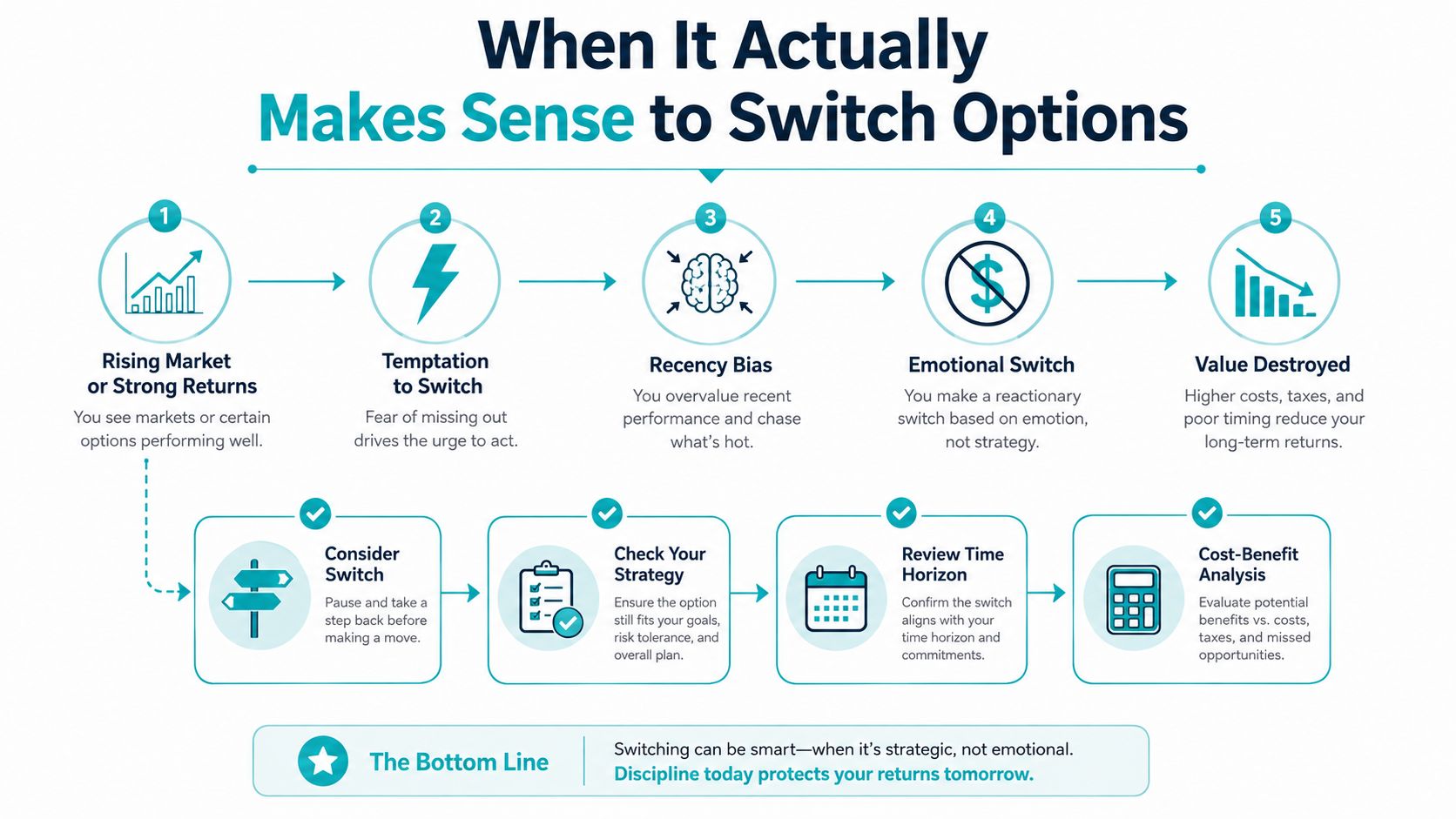
Before switching, write down the current and proposed growth/defensive split. Identify which asset classes you're selling and buying, estimate the fees and spreads, and work out how long the new option must outperform to recover the switching cost.
Default MySuper products have matured into substantial parts of the system. A switch should therefore solve a specific problem, such as an unsuitable risk profile, excessive fees or a changed goal. “The market has been strong” isn't a strategy.
Considering an SMSF and When It Truly Wins
An SMSF isn't automatically a better version of a super fund. It's a different governance structure, and it only earns its complexity when you have a clear reason to control the investment decisions yourself.
A well-chosen MySuper or Choice platform already provides diversified portfolios, professional administration, reporting and investment menus. An SMSF can provide customized asset allocation, direct property exposure, concentrated portfolios, intergenerational planning strategies and greater control over implementation. Those features can matter, but “more choice” alone isn't a sufficient reason.
| Factor | MySuper / Choice Platform | SMSF |
|---|---|---|
| Investment control | Fund or member selects from available options | Trustees choose and manage the portfolio |
| Diversification | Available through premixed and sector options | Trustee must design and maintain it |
| Administration | Managed by the fund | Trustees manage responsibilities or appoint providers |
| Compliance | Fund handles regulatory obligations | Trustees remain responsible for compliance |
| Direct assets | Depends on the platform | May support direct assets within the rules |
| Fixed-cost pressure | Generally simpler to scale | Costs can weigh heavily on smaller balances |
| Time commitment | Lower member administration | Ongoing governance and record-keeping required |
| Strategic use | Straightforward accumulation or pension pathways | Complex, deliberate strategies with a strong purpose |
An SMSF may be worth examining when the balance is above $750,000, you're prepared to handle ongoing administration or pay an administrator $3,000 to $5,000 a year, you have a strategic reason beyond wanting more options, and you expect a 10-year-plus horizon. The cost and time assumptions should be tested against your actual circumstances, not treated as automatic thresholds.
The responsibilities don't disappear
Trustees must act in the fund's best interests, follow the investment strategy, satisfy the sole-purpose test and meet reporting and record-keeping obligations. An audit is required, and an actuary may be needed where applicable. The ATO also uses data matching to identify compliance issues, so DIY governance is a real responsibility.
Property, private equity and complex estate planning can justify a detailed assessment. They can also introduce liquidity, valuation, borrowing, legal and administrative complexity.
Wealth Collective's guide to SMSF pros and cons is a useful starting point. Treat an SMSF as a tool for a defined job, not a status symbol.
Your Next Steps and How Wealth Collective Helps
Don't change your super investment option because the portal makes the current one look old-fashioned. Gather the evidence first, then make the decision in the context of your goals, insurance and contribution strategy.
A practical six-point review
- Open the portal: Record your current option, investment objective and strategic asset allocation.
- Collect your statements: Pull your last three annual statements and calculate the net return after fees.
- Use a relevant comparison: Compare your result with the SuperRatings median for the appropriate option category, while allowing for differences in asset allocation.
- Check insurance: Confirm that life, total and permanent disability, or income protection cover remains appropriate before making any change.
- Revisit the horizon: Decide whether your retirement timing, spending needs or broader goals have shifted.
- Write the reason: Document why you're changing, what asset mix you're moving towards and what would make you review the decision later.
Contribution rules also belong in the review. From 1 July 2026, the general concessional contributions cap is $32,500 for all ages, up from $30,000 for the 2024–25 and 2025–26 financial years, according to the ATO's indexed cap information. Employer contributions and personal contributions claimed as an income tax deduction count towards the concessional cap, and the ATO says you can monitor contributions through myGov under Super, then Information, then Concessional contributions (ATO concessional contributions guidance).
For 2026–27, the government co-contribution maximum entitlement is $500, with a lower income threshold of $49,293 and a higher threshold of $64,293 (ATO government contributions rates). The ATO's maximum contribution base is $270,830 for 2026–27, which limits the earnings on which an employer must pay Superannuation Guarantee contributions (ATO maximum contribution base).

A review should connect your investment option with your contribution capacity, insurance needs, debt position and retirement income plan. If you're nearing retirement, the transfer-cap rules and pension strategy also need attention, including the $1.79 million total super balance transfer-cap context for pension phase. Contribution limits and pension rules can change, so check current ATO information before acting.
Wealth Collective can help you compare superannuation investment options, assess fee drag, review insurance and build a transition plan around your time horizon. Book a complimentary 10-minute discovery call to discuss whether a personalised review is appropriate. The first conversation is a fit-check, not a commitment to proceed.
Book a complimentary 10-minute discovery call with Wealth Collective to review your super option, fees, insurance and retirement direction. You'll receive a clear conversation about whether your current strategy fits your goals and, if it doesn't, what a disciplined transition could look like.