Business hours
Monday to Friday (8.30AM - 5PM)
Weekend (Closed)



A high-income professional can do everything that looks sensible, salary sacrifice regularly, keep employer contributions invested, and review the fund once a year, yet still lose valuable tax and estate-planning opportunities. The problem isn't a lack of superannuation. It's poor sequencing.
From 1 July 2026, the general concessional contributions cap rises to $32,500, while Division 293 can apply once your income plus concessional contributions exceeds $250,000. The result is a more important question than “How much can I put into super?” The better question is, “Where should my next dollar go after the tax benefit starts to narrow?” (ATO contribution caps)
Why High Income Earners Need a Different Super Plan in 2026
Consider a mining engineer in Perth reviewing a super statement on a Sunday afternoon. The balance is growing, but the mortgage still feels like it's shrinking faster. Employer contributions are arriving, salary sacrifice is reducing take-home pay, and the tax outcome isn't as obvious as the strategy initially seemed.
That frustration is understandable. High-income earners face a different set of decisions because marginal tax rates, employer Superannuation Guarantee contributions, bonus income and Division 293 interact. Once income plus concessional contributions clears $250,000, Division 293 can add another 15% tax to the relevant concessional contributions. Those contributions can therefore face an effective tax rate of 30%, rather than the standard 15% inside super. (ATO Division 293 guidance)
The 2026 cap change matters because every concessional contribution counts towards one annual limit across all your super accounts. That includes employer contributions, salary sacrifice and personal deductible contributions. A higher cap creates more room, but it doesn't remove the need to track contributions precisely.
Practical rule: Treat the concessional cap as a tax-management limit, not an automatic target.
A generic super guide also misses the consequences outside accumulation. Family law can affect ownership and disclosure. Death benefits paid to adult children can produce an unfavourable tax outcome. A large balance can create transfer balance cap issues when retirement-phase pensions begin. These issues don't make super a poor strategy, but they do make unthinking accumulation a poor strategy.
The right process is a series of decisions. First, establish how much concessional capacity remains. Next, test whether Division 293 changes the result. Then compare debt reduction, spouse strategies and investments outside super. Finally, coordinate retirement income and estate arrangements. For broader context on coordinating tax, investment and retirement decisions, you can plan your finances with Blue Sage, while keeping the recommendations specific to Australian super rules.
Concessional vs Non-Concessional Contributions Compared
The 1 July 2026 cap changes make the choice more important for high-income professionals. Concessional contributions can reduce taxable income, but Division 293 may reduce that advantage. Non-concessional contributions provide no deduction, yet they can still suit surplus capital that you want invested in super.
Concessional contributions are made before personal income tax is applied and are generally taxed at 15% inside the fund. They include employer contributions, salary sacrifice and personal contributions claimed as a tax deduction. From 1 July 2026, the general concessional cap is $32,500. Check the ATO contribution cap rules before setting a target, because employer contributions use part of the same limit.
Non-concessional contributions come from money that has already been taxed. They do not create a personal deduction and have a separate cap. From 1 July 2026, the general cap is $130,000, as set out in the ATO non-concessional cap rules. Eligible people may use the bring-forward rule, subject to age and total super balance, with a possible contribution of $390,000 over 3 years where total super balance is below $1.84 million. The available period and amount reduce between $1.84 million and $1.97 million, with no arrangement available at $1.97 million or above.
| Feature | Concessional | Non-concessional |
|---|---|---|
| Money source | Pre-tax employer or personal income | After-tax personal money |
| Personal deduction | Available for eligible personal contributions | Not available |
| Tax inside super | Generally 15%. See the Division 293 discussion above for when the effective rate reaches 30%. | No contributions tax on the contribution itself |
| 2026 general cap | $32,500 from 1 July 2026 | $130,000 from 1 July 2026 |
| Best use | Reducing taxable income while building retirement savings | Investing surplus after-tax capital where super remains suitable |
For the current cap figures, review the ATO contribution caps. The ATO Division 293 guidance explains the additional tax treatment.
The recommendation is direct. Use concessional contributions when the deduction remains valuable after Division 293 and you do not need the money accessible. Choose non-concessional contributions, debt reduction or investments outside super when liquidity, control or after-tax returns deserve priority. Maxing the concessional cap is a strategy, not an obligation.
Using Salary Sacrifice and Carry-Forward Caps Together
The 1 July 2026 cap changes make sequencing more important. Salary sacrifice should not be set at the annual cap by default. First account for employer contributions, then decide whether current-year salary sacrifice or expiring carry-forward capacity gives you the better result after Division 293.
Salary sacrifice is an agreement with your employer to direct part of your pre-tax salary into super instead of receiving it as take-home pay. The contribution uses concessional cap space and is generally taxed at 15% inside super, subject to Division 293. Set the arrangement before the relevant pay period. Once the salary has been earned, changing the instruction will not create the same outcome.
Carry-forward capacity can make a later bonus year more valuable. If your total super balance was below $500,000 at 30 June of the prior financial year, unused concessional cap amounts can be carried forward for up to 5 previous years. Those amounts expire, so postponing a contribution can mean losing an available deduction. See the ATO carry-forward concessional contributions rules and review this guide to carry-forward concessional contributions before setting the amount.
The sequence that works
Calculate employer contributions first. Employer Superannuation Guarantee payments use part of the annual concessional cap. Subtract them before setting salary sacrifice.
Check your total super balance. Use the prior 30 June balance to confirm whether carry-forward rules apply to you.
Review available years. Apply the oldest capacity first, especially where an unused amount is close to expiry. Ignoring the order can waste a deduction.
Set salary sacrifice before payment. Have payroll confirm the effective date, contribution rate and reporting treatment. The instruction must apply before the relevant salary is paid.
Reconcile after the financial year. Compare fund records with payroll records. Multiple employers and accounts increase the chance of a cap error.
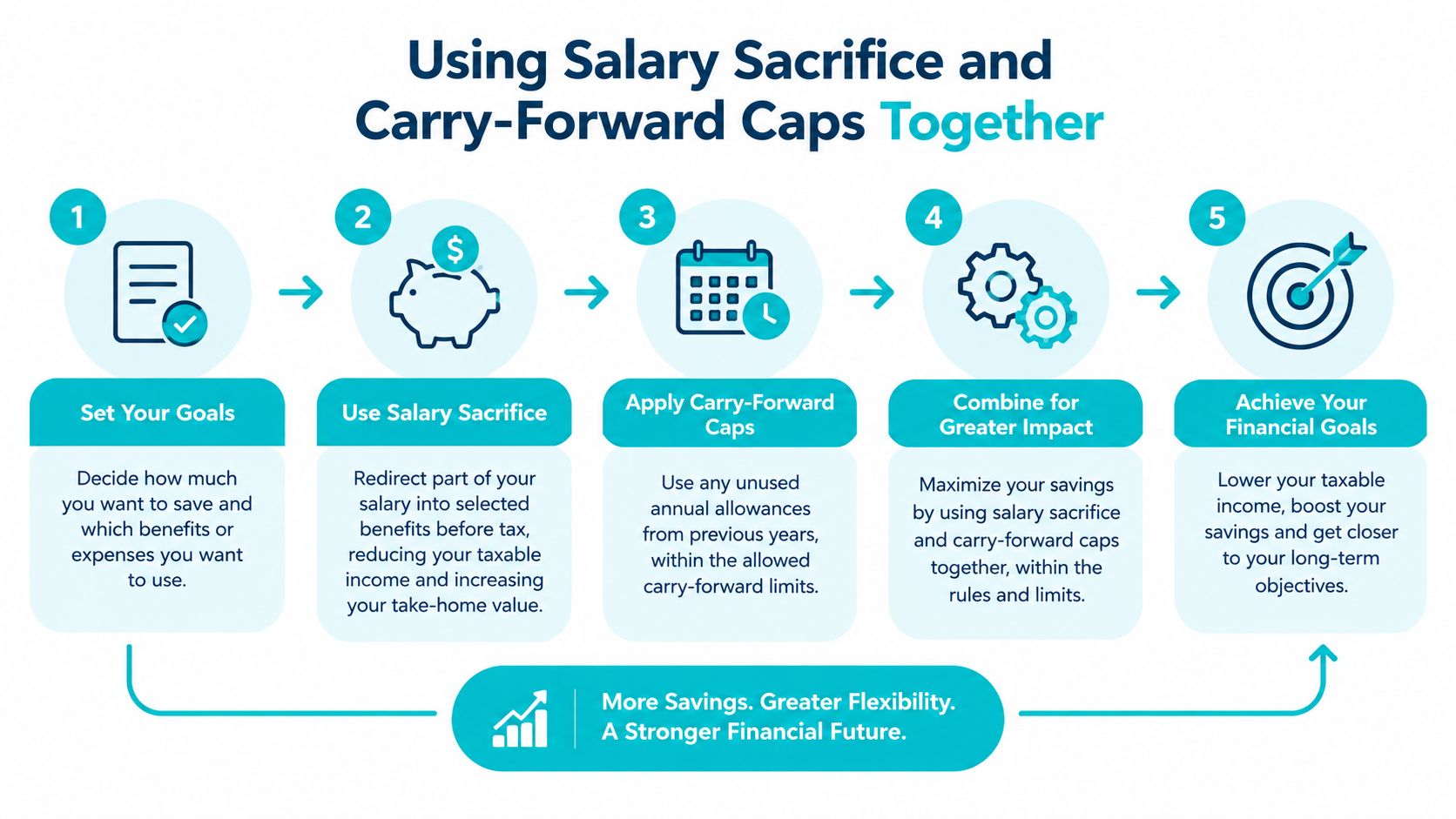
Consider a professional returning from maternity leave after a low-contribution year. She may have unused concessional capacity available when a later bonus or salary increase arrives. A larger salary sacrifice can then use the new cap, employer contributions and eligible carry-forward space together.
Do not estimate the available amount from payslips alone. Confirm contribution history and total super balance through ATO records, then model the timing against payroll data. If Division 293 reduces the benefit of a larger sacrifice, keep the process intact but compare the amount with debt reduction, investments outside super or after-tax contributions.
When Maxing Concessional Super Stops Making Sense
From the 1 July 2026 cap changes, reassess every additional concessional contribution rather than automatically filling the available space. Division 293 applies above the $250,000 income threshold. It adds 15% tax to affected concessional contributions, raising their effective tax rate from 15% to 30%. Read the ATO Division 293 guidance before finalising the contribution.
Salary sacrifice can still be worthwhile. The decision depends on how much of the contribution receives the lower tax treatment and what the next dollar could achieve elsewhere. For example, a person with taxable income of $260,000 plus $32,500 in concessional contributions has $42,500 above the $250,000 threshold. On that calculation, roughly $42,500 of contributions is taxed at 30%, while the remainder is taxed at 15%.
| Taxable income | Standard 15% applies to | Division 293 30% applies to | Effective blended rate |
|---|---|---|---|
| Below the Division 293 threshold | Concessional contributions within the cap | None | 15% on concessional contributions |
| Above the threshold | The portion not caught by Division 293 | The lesser of the relevant excess or taxable concessional contributions | Depends on the contribution mix |
| High income with contributions above the cap | Contributions within the cap | Division 293 can apply to relevant in-cap contributions | Excess concessional contributions are a separate issue |
Use this decision rule. Keep contributing concessional amounts when the tax outcome remains attractive, the money is genuinely for retirement and you have enough liquidity outside super. Redirect the marginal dollar when another financial objective produces a stronger result.
Prioritise repayment of expensive non-deductible debt, particularly where its interest cost exceeds the expected after-tax benefit from super. A spouse contribution strategy may improve the household outcome, especially where one partner has lower taxable income or a different retirement timeline. Shares held outside super can suit investors who value access, control and franking credits.
The right question is not whether Division 293 is bad. It is whether the next dollar has a better job elsewhere.
Non-concessional contributions can suit someone with surplus after-tax capital, available cap space and a clear retirement horizon. They are a poor choice if the money may fund property, a business opportunity, an emergency reserve or debt repayment. Model the household balance sheet, cash needs and retirement timeframe together, then choose the contribution level that supports the whole plan.
TTR Pensions and SMSFs for High Income Earners
A high-income executive approaching retirement may want income flexibility, investment control or simpler administration. A transition-to-retirement pension, self-managed super fund and accumulation-only strategy address different needs. Choose the structure for its job, not for its label.
| Strategy | Control and investment menu | Cost and administration | Suits |
|---|---|---|---|
| TTR pension | Provides a structured income stream while employment continues | Adds pension administration and payment requirements | Someone who needs cash-flow flexibility while continuing to work and contribute |
| SMSF | Gives direct control over investments, timing and asset selection | Trustees manage compliance, reporting, investment decisions and audits | A capable household with a clear need for control and enough complexity to justify the work |
| Accumulation only | Uses an existing fund's investment menu without starting a pension | Usually the simplest structure to maintain | Someone focused on accumulation, liquidity and straightforward administration |
Use a TTR pension only when the income stream has a defined purpose. It can fund living costs while salary is redirected to super, smooth irregular income or help a couple coordinate different work and retirement dates. If it solves no cash-flow or tax problem, leave the pension unopened.
An SMSF earns its place only when it provides something an existing regulated fund cannot. Direct property exposure, borrowing capacity or control over investment timing may justify the structure. Those benefits come with valuation, liquidity and compliance demands. The large-fund levy impact also requires careful assessment when balances are substantial. An SMSF does not automatically improve the tax result.
Time-poor executives frequently underestimate trustee work. Someone must document decisions, monitor the investment strategy, maintain records, coordinate advisers and meet compliance obligations. That workload can suit an engaged investor, but it is not a shortcut to better returns or easier retirement planning.
Before choosing a TTR pension or SMSF, define the investment objective, access requirement, estate outcome and administration tolerance. Review these self-managed super fund pros and cons before committing. The structure should follow the strategy, never lead it.
Estate Planning Around the Transfer Balance Cap
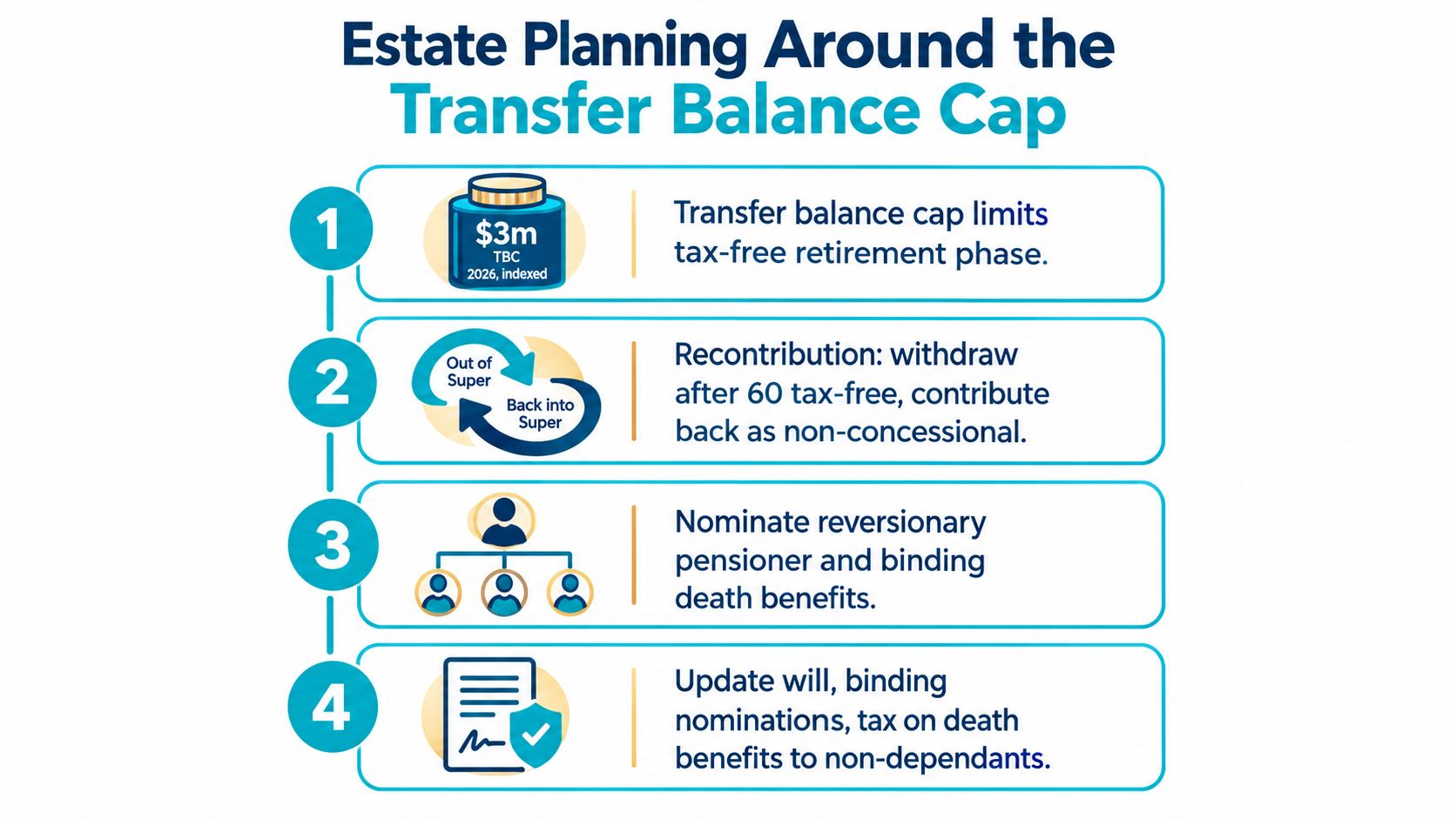
The general transfer balance cap increased from $2.0 million to $2.1 million on 1 July 2026. It limits the amount that can be transferred into retirement-phase super accounts. A person starting a pension for the first time from that date receives a personal transfer balance cap of $2.1 million, while someone who already had a pension may receive only a proportional increase based on unused cap space. (ATO transfer balance cap)
That distinction matters for high-balance members. Pension timing can affect how much super sits in the tax-free retirement phase, and indexation occurs in $100,000 increments, not continuously. Don't assume the general cap is automatically your personal available cap.
Recontribution in plain language
A recontribution strategy generally involves withdrawing money when permitted and contributing it back as a non-concessional contribution. The aim is to increase the tax-free component of the member's super and reduce the taxable component that may be paid to adult children as a death benefit. The strategy must fit within non-concessional cap rules and the receiving spouse's available transfer balance capacity.
Consider a 60-year-old with $2.4 million mostly held in the taxable component, a spouse aged 55, and adult children who aren't financially dependent. A carefully modelled withdrawal and recontribution may shift part of the balance into a more favourable tax component and place an amount in the younger spouse's name. It won't automatically create more retirement-phase capacity, and it can trigger cap, contribution and investment consequences.
Check the following before acting:
- Contribution capacity: Confirm the non-concessional cap, bring-forward eligibility and total super balance.
- Spouse capacity: Review the spouse's transfer balance position and contribution eligibility separately.
- Tax consequences: Consider capital gains tax, Division 293 exposure where relevant and the investment impact of changing ownership.
- Estate structure: Confirm whether the death benefit nomination matches the intended outcome.
- Liquidity: Keep enough accessible capital outside super for near-term needs.
Beneficiary nominations deserve the same attention as investment selection. Binding, lapsing and non-lapsing nominations have different validity and review requirements. Adult children may also face tax on taxable death benefits, so the nomination should be coordinated with the will and broader estate plan. A resource on Wisconsin estate plan options illustrates why beneficiary and asset-ownership decisions need to be considered together, even though Australian super law applies to this strategy.
For Australian-specific guidance on the cap, use this explanation of the superannuation transfer balance cap. Review nominations annually and after marriage, separation, birth, death, a major contribution or a substantial change in balance.
Building Your Strategy and Booking a First Conversation
The most effective superannuation strategies for high income earners aren't selected in isolation. They're sequenced so the tax, cash-flow, investment and estate decisions support one another.
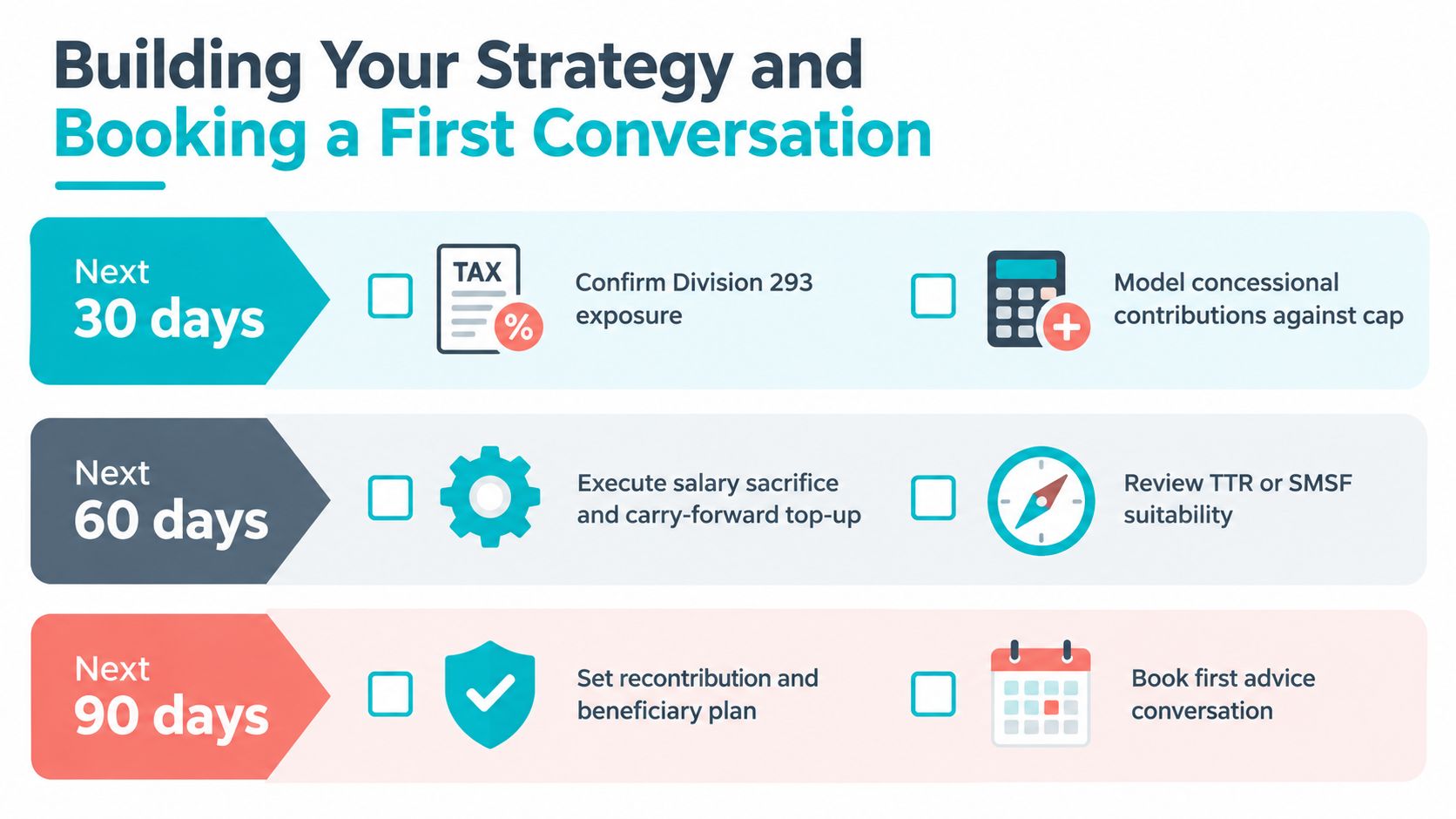
The next 30 days
Start with facts. Confirm employer contribution amounts, income sources and likely bonus timing. Check Division 293 exposure and compare total concessional contributions with the $32,500 cap. Then identify whether carry-forward amounts are available and whether any are approaching expiry.
Don't start by selecting a new fund or opening an SMSF. First determine whether the current fund, contribution structure and investment option are creating the actual problem.
The next 60 days
Set up salary sacrifice before the relevant payroll period if the modelling supports it. Coordinate employer contributions across all funds, then decide whether a personal deductible contribution has a role. If your household has a spouse with unused capacity, compare that option with making every contribution in the higher earner's name.
Review TTR and SMSF suitability only after the contribution position is clear. A FIRE number guide, such as this explanation of how to calculate your FIRE number, can help connect retirement spending goals with the amount that needs to remain invested. It shouldn't replace a cash-flow projection or advice about Australian super rules.
The next 90 days
Once the accumulation plan is clear, review pension timing, transfer balance capacity and beneficiary nominations. Recontribution may be appropriate for some high-balance couples, but only after checking contribution eligibility, ownership, tax components and estate objectives.
Bring these details to a first advice conversation:
- Current super balance: Include every account and investment option.
- Employer contribution rate: Confirm the amount and payment timing.
- Contribution history: Bring the last 5 years of concessional contribution records where available, especially if carry-forward capacity may apply.
- Income trajectory: Include salary, bonuses, business income and expected changes.
- Fund structure: Note whether you use an industry fund, retail fund, pension account or SMSF.
- Insurance in super: Record cover types, premiums and whether the policies still match your needs.
- Beneficiary nominations: Identify any binding or non-binding nominations and their review dates.
Wealth Collective's process can use this information to triage the situation before recommending a broader engagement. The aim of a free 10-minute introductory call isn't to push you into a full advice process. It's to identify the two or three strategies most likely to move the needle, whether that means contribution timing, debt reduction, investment structure, retirement income or estate planning.
Wealth Collective offers practical advice across superannuation optimisation, salary sacrifice, investment strategy, debt reduction and retirement planning, with a process designed to turn complex decisions into an organised action plan. Visit Wealth Collective to book a free 10-minute introductory call and bring clarity to the contribution, retirement and estate decisions that matter most in 2026.