Business hours
Monday to Friday (8.30AM - 5PM)
Weekend (Closed)


Most Australians are told that their superannuation already includes enough insurance. That advice is convenient, but it's often wrong. Default total and permanent disability cover is a starting point, not a complete protection strategy, particularly if you have a mortgage, children, business commitments, or years of work ahead of you.
TPD cover can provide a valuable lump sum after a serious illness or injury, but getting paid isn't as simple as proving that you can't do your current job. The policy definition, medical evidence, superannuation release rules, exclusions, and tax treatment can all affect the result. I've seen families discover these details only after a life-changing diagnosis, when changing the cover is no longer possible.
The right question isn't just, “Do I have TPD insurance?” It's “Would my current cover protect the life my family is living?”
Why Default TPD Cover May Not Be Enough
Default cover inside super is easy to overlook because premiums are generally deducted from your account rather than paid as a separate household bill. That convenience can create a dangerous assumption: if the fund provides cover automatically, the amount must be adequate.
It may not be. A recent industry report states that insurance through super covered around 8.2 million people for TPD, with an average sum insured of about $190,000 and an average premium per life of $305 in 2025. Those figures are cited in the Association of Superannuation Funds of Australia insurance report, but an average isn't a personal recommendation. A household with a mortgage, dependent children, ongoing medical costs, and retirement savings needs may require considerably more than a default amount.

The lump sum must serve several jobs
A TPD payout may need to address:
- Debt reduction: paying down or clearing a mortgage and other liabilities.
- Income replacement: supporting the household when the disabled person can't return to work.
- Care and treatment: funding rehabilitation, equipment, home changes, transport, or ongoing support.
- Family stability: covering school costs, daily living expenses, and future needs.
- Retirement protection: replacing superannuation contributions and preserving the partner's long-term plan.
A default benefit can look substantial on a statement yet prove inadequate once those needs are added together. This is especially important for households in higher-cost areas of Western Australia, where housing, care, and family expenses can place significant pressure on cash flow.
Claims are also becoming more difficult to assess
The problem isn't only the amount insured. Claim definitions and assessment practices matter just as much. ASIC reported that, in the 12 months to 31 December 2018, insurers received 26,150 TPD claims, accepted 14,772, declined 2,067, and had 1,619 withdrawn, while 7,692 remained pending at the end of that period. The ASIC review of TPD insurance shows how large and administratively prolonged this market can be.
More recent commentary reports that advised TPD claims accepted in the period to December 2025 stood at 82.9%, described as the lowest acceptance rate across major life cover types, while APRA reported deteriorating TPD claims experience across group and retail markets, particularly for complex mental-health-related claims. The reported analysis of changing claims profiles reinforces the practical point: you need to understand the policy before a claim arises.
Practical rule: Treat default TPD as the first layer of protection. Review it actively, then decide whether it matches your debts, dependants, occupation, and long-term plans.
Understanding TPD Definitions and Claim Criteria
TPD insurance pays a lump sum only when an illness or injury meets the policy's definition of total and permanent disability. The wording determines the claim pathway, and identical product labels can conceal very different tests. For households relying on default super cover, this distinction matters because modern work is harder to assess across changing duties, retraining options, and mental-health exclusions.
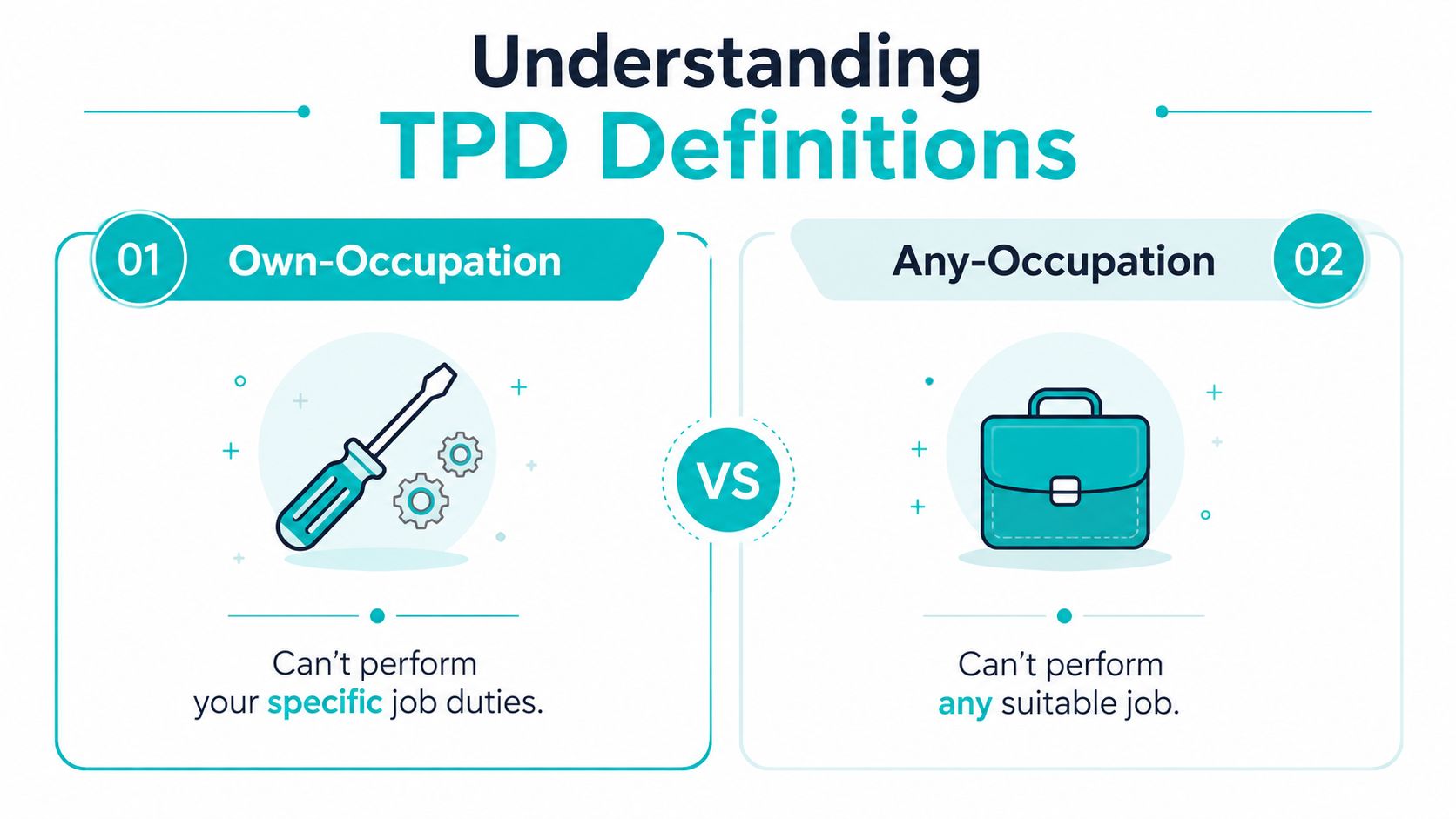
The first test to identify is own occupation or any occupation. Own-occupation cover generally responds when you are unlikely ever to return to your specific job. Any-occupation cover generally asks whether you are unlikely ever to work again in a role suited to your education, training, or experience. This comparison of own-occupation and any-occupation TPD definitions shows why the policy wording can materially change the result.
Own occupation focuses on your actual work
A specialist surgeon who loses the hand function required for surgery may satisfy an own-occupation definition even if another medical role remains possible. The assessment centres on the duties of the occupation insured under the policy.
Approval still requires evidence. The claimant must establish the condition, its permanence, the resulting functional restrictions, and the connection between those restrictions and the job's duties. Insurers may review job descriptions, employment records, treatment history, and specialist opinions. Mental-health claims can face closer scrutiny where exclusions, treatment requirements, or functional evidence narrow the available cover.
Reduced work capacity is a different issue from complete incapacity. A plain-language resource on partial disability explained can help distinguish partial benefits from a TPD lump-sum claim. Do not treat the two concepts as interchangeable.
Any occupation applies a broader test
Any-occupation cover asks whether you are unlikely ever to engage in gainful employment for which you are reasonably qualified by education, training, or experience. Someone unable to return to a physically demanding trade may still be assessed against office-based, supervisory, administrative, or other suitable work.
For TPD held through super, the insurer's assessment also interacts with the trustee's release requirements. The permanent incapacity condition requires the trustee to be reasonably satisfied that ill health, physical or mental, means the member is unlikely to engage in gainful employment for which they are reasonably qualified by education, training, or experience. The ASIC executive summary on TPD and superannuation outlines this relationship.
Read the policy, not the product label
Before relying on cover, obtain the product disclosure statement and check:
- Definition: own occupation, any occupation, activities of daily living, or another test.
- Waiting and permanence requirements: the policy may require a sustained period and evidence about prognosis.
- Exclusions: mental-health exclusions, pre-existing conditions, occupational restrictions, and other limitations.
- Automatic benefits: specified conditions may operate under clauses separate from the general work-capacity test.
- Evidence standard: confirm which doctors, specialists, employment records, and functional assessments may be required.
ASIC reported that nearly half a million Australians held cover based on narrow activities-of-daily-living definitions, and 60% of claims under that stricter cover were declined, compared with a 12% declined-claim rate across other TPD claims. Its review collected data on 35,000 TPD claims and found that over 12 million Australian workers were automatically paying for TPD through superannuation. These findings appear in ASIC's call for improved TPD consumer outcomes.
Compare TPD with other life insurance types before deciding how much protection your household needs. Read the exact test, exclusions, evidence requirements, and occupation wording. Default cover is a starting point, not proof that the policy matches your income, debts, dependants, or future work capacity.
TPD Inside Super Versus Standalone Policies
Holding TPD inside superannuation is common and can be practical. Premiums are usually paid from super, which may preserve household cash flow and make insurance easier to maintain. The trade-off is reduced control over the policy structure, benefit amount, definition, and access arrangements.
Standalone cover sits outside super and can offer a different design. It may provide greater flexibility around the amount insured, policy wording, ownership, and how the benefit integrates with other personal insurance. It can also require direct premium payments and detailed underwriting.
| Factor | Inside Super | Standalone Policy |
|---|---|---|
| Premium payment | Usually deducted from super | Usually paid personally |
| Policy control | Often linked to fund terms and group arrangements | Generally more directly selected and managed |
| Access | Must satisfy the policy and superannuation release requirements | Paid under the policy terms, without the same super release pathway |
| Tax | A payout may be taxed, particularly before age 60 | Tax treatment depends on the policy and circumstances |
| Flexibility | Default benefits may be limited or less tailored | More scope to select cover and structure |
| Review requirement | Check fund changes, insurance terms, and account balance | Review ownership, premiums, wording, and affordability |
Tax can change the amount your family receives
MoneySmart states that a TPD payout paid through super can be taxed at up to 22% if the claimant is under age 60. The MoneySmart guidance on TPD insurance makes the payment channel a central part of the advice conversation.
Australian guidance also explains that a super disability benefit can include a tax-free disability segment. If the claimant hasn't reached preservation age, the taxable component may still be taxed at 22%, including Medicare levy, while benefits paid after age 60 can be tax free. The explanation of TPD tax treatment in super provides further detail.
That means a benefit that appears sufficient on paper may not be sufficient after tax. Don't calculate the required sum insured only against the mortgage balance. Allow for the net amount available and the costs that continue after the claim.
The right structure is often a deliberate combination
Inside-super cover can provide a foundation, especially when budget constraints make personally paid premiums difficult. Standalone cover may then fill specific gaps, such as a larger benefit, a preferred definition, or protection that remains separate from superannuation arrangements.
There's no universal rule that standalone cover is always better. The right decision depends on occupation, health, family structure, debts, cash flow, tax position, and the policy wording available to you. A review of life insurance through super can help you examine the strengths and limitations of the super-based arrangement before adding another policy.
Real Claim Scenarios and Common Pitfalls
A serious diagnosis does not guarantee a TPD payment. The insurer assesses the medical evidence against the policy's exact definition, including permanence, functional limits, and the claimant's capacity for work. That gap between illness and eligibility explains why otherwise genuine claims can fail.
A builder with a severe physical injury may have a strong claim under an own-occupation definition. The evidence should show why the person cannot safely perform the essential duties of building work and why returning to that occupation is unlikely. Reports should address lifting, climbing, balance, grip, pain, fatigue, treatment response, and day-to-day restrictions. A diagnosis alone leaves too many questions unanswered.
An any-occupation definition creates a different hurdle. If the insurer considers estimating, project coordination, or office-based work suitable for the claimant's experience, it may challenge the claim. Work history, transferable skills, education, and actual functional capacity then become central to the assessment.
Mental-health claims need especially careful evidence
Mental-health-related TPD claims often involve fluctuating symptoms, changing treatment, relapse risk, and disagreement about future capacity. A diagnosis must be connected to functional evidence that explains why returning to suitable employment remains unlikely under the policy wording.
Exclusions and restrictions can narrow the available cover further. Insurers may examine treatment compliance, previous work attempts, workplace adjustments, and the difference between being unable to perform one role and being unable to perform suitable work. This is a growing weakness in default super-held cover, particularly for households whose income depends on specialised or mentally demanding work.
Administration can extend the claim
Claims may involve multiple doctors, insurers, trustees, and repeated requests for information. ASIC's executive summary records pending, accepted, declined, and withdrawn disability claims, illustrating how a matter can remain unresolved while evidence is gathered. The ASIC claims data review provides the relevant source.
Common mistakes include:
- Submitting a thin medical file: a short certificate may confirm illness but fail to describe permanence, restrictions, and occupational impact.
- Using the wrong employment test: evidence may focus on the claimant's usual role when the policy asks about any suitable employment.
- Ignoring multiple policies: cover may exist across more than one super fund or personal policy, subject to each contract.
- Giving inconsistent histories: differences between application forms, medical records, employment documents, and claim statements can prompt further questions.
- Lodging too early: the prognosis may not yet support the permanence requirement.
International comparisons, including resources about disability benefits for Wisconsin workers, offer background only. Australian TPD claims depend on the relevant Australian policy and superannuation rules. Before submitting paperwork, use this TPD insurance claim guide to organise the evidence and check the process.
A strong claim file connects the diagnosis to function, function to work duties, and work duties to the exact policy definition.
How to Review and Strengthen Your TPD Protection
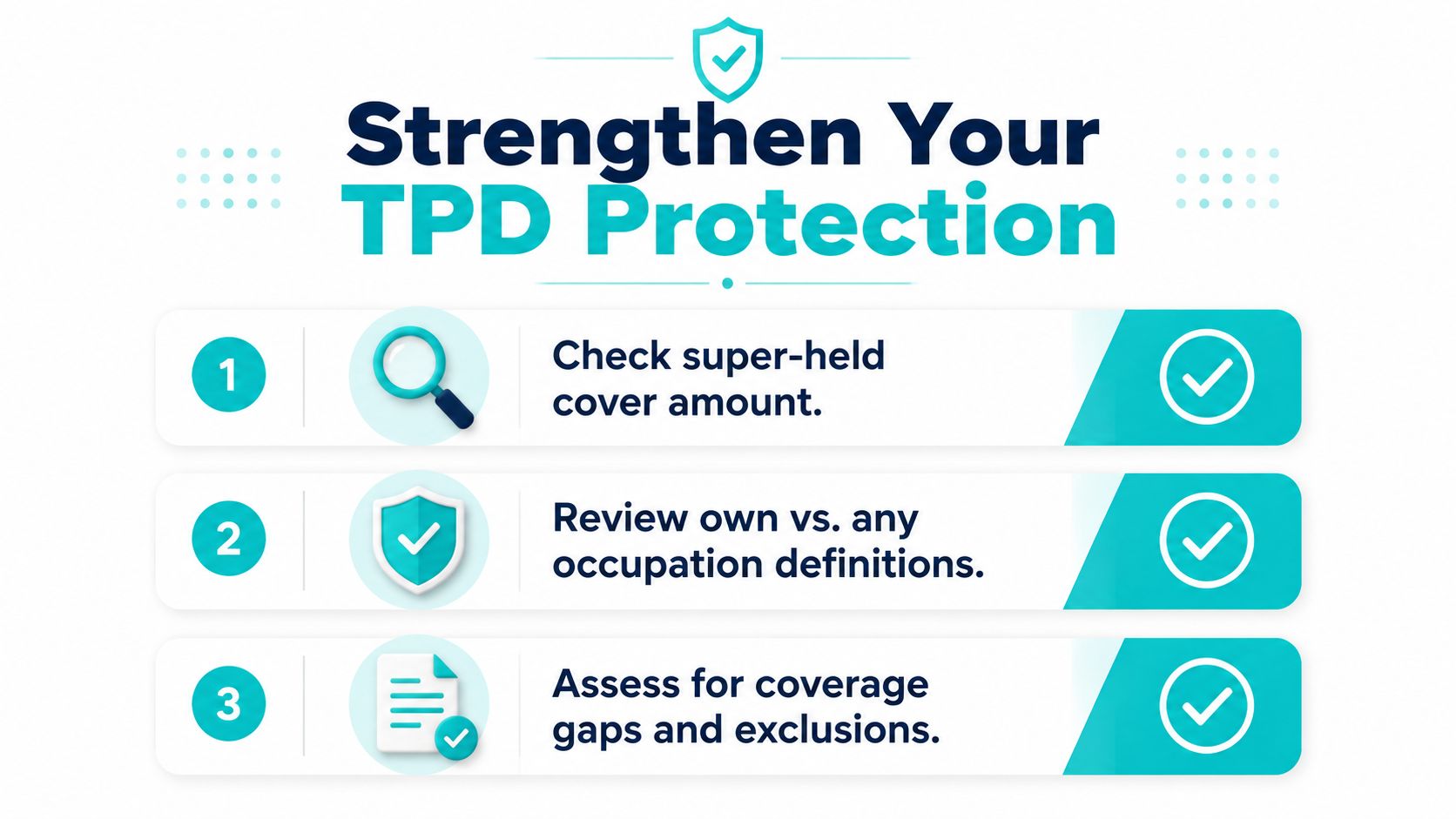
Start with evidence, not assumptions. Log in to each super account, download the latest insurance summary and product disclosure statement, and record the benefit amount, premium, definition, exclusions, and any age-based changes.
Check the cover against your real obligations
List the debts and costs your household would face if you couldn't work again. Include the mortgage, personal debt, education expenses, medical and care costs, home modifications, transport, everyday living expenses, and the super contributions you'd no longer make.
Then ask what your partner would need to maintain a stable life. A TPD payout shouldn't be treated as a windfall. It's a balance-sheet tool designed to reduce financial pressure after earning capacity has been permanently damaged.
Use this review process
- Confirm every policy: Check current and inactive super funds, personal policies, and employer arrangements. Don't cancel existing cover before replacement cover is approved and in force.
- Identify the definition: Confirm whether the policy uses own occupation, any occupation, activities of daily living, or another test. Record exclusions that could affect your occupation or health history.
- Calculate the funding gap: Compare the likely net payout with debts, care, family costs, and retirement needs. Consider that super-held benefits may be taxed depending on age and circumstances.
- Test affordability: Premiums must remain sustainable during career changes, parental leave, business uncertainty, or reduced income.
- Apply strategically: Increasing cover can involve health and occupation questions, medical reports, or underwriting. Answer accurately and keep copies of submitted information.
- Schedule reviews: Revisit cover after a marriage, separation, birth, property purchase, career change, major debt reduction, health change, or business transition.
The most important timing rule is simple: review while you're healthy and working normally. Once a condition appears, insurers may apply different terms, decline increased cover, or make new insurance substantially harder to obtain.
Ask your adviser to show you the policy definition in plain English and to explain how the benefit would interact with superannuation, tax, debt, income protection, and estate plans. If the explanation depends on slogans rather than the actual wording, keep asking questions.
Building a Comprehensive Protection Strategy with Wealth Collective
TPD cover works best as one part of a coordinated protection plan. It can address a permanent loss of earning capacity, but it doesn't automatically solve short-term income disruption, debt management, investment decisions, superannuation structure, or retirement funding.
A sensible strategy connects the risks. Income protection may address a temporary inability to work, while TPD may provide a lump sum if the condition satisfies the permanent incapacity test. Life cover can address death, trauma cover may respond to specified serious medical events, and a well-structured superannuation plan can help preserve retirement outcomes. Each policy has its own definitions, exclusions, ownership rules, and tax consequences.
Wealth Collective's Protection Plus service is designed to bring personal insurance and broader financial decisions into the same review. That can include checking super-held cover, assessing standalone protection, reviewing debts, considering superannuation optimisation, and testing how a disability event could affect retirement planning. The value lies in connecting the figures rather than reviewing each policy in isolation.
Advice should lead to an implementable decision
A useful advice process should answer practical questions:
- What would the household need if one income stopped permanently?
- Which debts should the payout address first?
- How much cover is already held, and what definition applies?
- Would tax reduce the available benefit?
- Are exclusions or policy changes creating unacceptable risk?
- Should existing cover be retained, increased, replaced, or supplemented?
- How will the strategy change as debts fall and retirement approaches?
Start with a short conversation, then gather the documents needed for a proper comparison. An adviser should explain the recommendations, disclose costs and trade-offs, and help implement the chosen structure. Ongoing reviews matter because your income, family, debts, health, occupation, and super balance won't remain static.
Don't wait for a claim to expose a gap. Review the cover while you still have choices, and make the policy serve your household rather than accepting whatever your fund provided by default.
Book an initial call with Wealth Collective to review your total and permanent disability cover, super-held insurance, debts, and wider protection needs. Their advisers can help you identify definition, adequacy, and tax gaps, then decide whether Protection Plus or another strategy is appropriate for your circumstances.