Business hours
Monday to Friday (8.30AM - 5PM)
Weekend (Closed)


The popular pitch for a Transition to Retirement strategy is simple. Work less, draw a tax-effective income from super, keep your lifestyle intact, then slide neatly into full retirement.
That pitch leaves out the hard part.
A TTR strategy can help in the right circumstances, but it can also become one of the more misunderstood decisions in pre-retirement planning. I've seen people focus on the immediate relief of topping up cash flow and miss what matters more: the long-term cost to their super, the knock-on effect on pension positioning, the extra complexity inside the structure, and the fact that retirement is not just a money event. It's an identity event.
That matters in Western Australia, where many pre-retirees are balancing mortgage tail-ends, business ownership, executive fatigue, family support, and the question they often avoid until late in the process: what exactly will life look like when work stops being the centre of it?
Is a TTR Strategy a Retirement Booster or a Trap?
A lot of retirement commentary treats TTR as an obvious upgrade. If you're over preservation age and still working, why not open the tap on super, reduce hours, and enjoy more freedom now?
Because the strategy only works when the numbers, timing, and purpose all line up.
Used well, a TTR can be a short-term planning tool. Used poorly, it becomes a slow leak in the retirement balance you'll depend on later. The danger is that the downside often isn't dramatic at the start. It feels manageable. The pension payments arrive. Work stress eases. Cash flow looks better. But underneath that, you may be giving up future growth, adding account complexity, and reducing flexibility at the exact stage of life when flexibility matters most.
That's why the glossy version of TTR is incomplete. A strategy that draws on super before full retirement is never neutral. You're making trade-offs.
For some people, those trade-offs are worth it. For many, they're not.
A useful starting point is to compare the sales pitch with the reality. If you want the upside case first, this overview of transition to retirement benefits explains why the strategy appeals to so many pre-retirees. The problem is that people often stop there.
Practical rule: If a TTR plan improves today's cash flow but weakens your position at full retirement, it isn't a solution. It's a deferral of the problem.
The true test isn't whether you can start a TTR pension. It's whether doing so improves your whole retirement plan.
What the popular advice misses
Most generic guides focus on mechanics. They explain eligibility, withdrawals, and tax treatment. They don't spend enough time on the bigger questions:
- How long will your super need to last? Early access means a longer funding period.
- What are you using the income for? A tax strategy is different from funding a lifestyle gap.
- What happens if your health, work capacity, or family circumstances change? TTR reduces room for error.
- What will replace the structure of work? Financial readiness and life readiness are not the same thing.
That last point is often ignored. It shouldn't be.
The TTR Promise What Is a Transition Strategy?
A Transition to Retirement strategy sounds like an easy middle ground. Keep working, start drawing from super, and smooth the run into retirement.
That promise is exactly why people underestimate the risk.
A TTR strategy lets you move part of your super from accumulation into a retirement income stream once you have reached your preservation age, while you are still employed. You have not fully retired. You are gaining limited access to super under a specific set of rules, and those rules matter because they shape what the strategy can and cannot do.

How it works on paper
At a structural level, a TTR arrangement usually looks like this:
- You have reached preservation age and meet the access rules for starting a TTR income stream.
- You keep working, whether that is full-time, part-time, or in a scaled-back role.
- You draw pension payments from the TTR account, subject to annual minimum and maximum withdrawal limits.
- Your employer can still contribute to super while you remain in paid work.
- You may combine the strategy with salary sacrifice contributions, although the tax outcome depends on your income, contribution caps, and timing. The disadvantages of salary sacrifice in late-career planning are often part of the same decision, not a separate one.
On paper, that can look tidy. In practice, it creates a split system. One part of your super is still being built up. Another part is being drawn down. That sounds manageable until the moving parts start pulling against each other.
Why people use it
Pre-retirees usually come to TTR for three practical reasons.
- They want to reduce working hours without cutting household cash flow too hard
- They want to improve after-tax income while they are still employed
- They want a trial run at retirement before making a permanent decision
All three reasons can be sensible. The problem is that the motive often gets more attention than the consequences.
I see this regularly in advice meetings. A client says, "I want more flexibility," but the underlying issue is burnout, caring responsibilities, poor role fit, or uncertainty about stopping work altogether. A TTR pension can help with cash flow. It does not solve the underlying decision. If the bigger retirement plan is unclear, the TTR strategy can give short-term relief while making the long-term position weaker.
The part generic guides leave out
Many explanations of TTR focus on eligibility, withdrawal limits, and tax treatment. Equip Super's overview of the strategy covers those mechanics well. What often gets missed is the human side of the decision.
A TTR strategy changes more than cash flow. It can change how work feels, how confident you feel about stopping, and how easily you drift into spending patterns that your future retired self has to fund. For some people, drawing from super while still earning creates a false sense of financial slack. For others, it delays the harder question of whether they are ready, financially and personally, to step back from work.
That is why we treat TTR as part of a broader Retirement Roadmap process at Wealth Collective. The strategy only makes sense when it fits the timing of retirement, the income gap that needs to be filled, the tax position, the super balance, and the life you are trying to build once work is no longer the centre of the week.
A TTR account is a tool. Good results come from the plan around it, not from the label on the strategy.
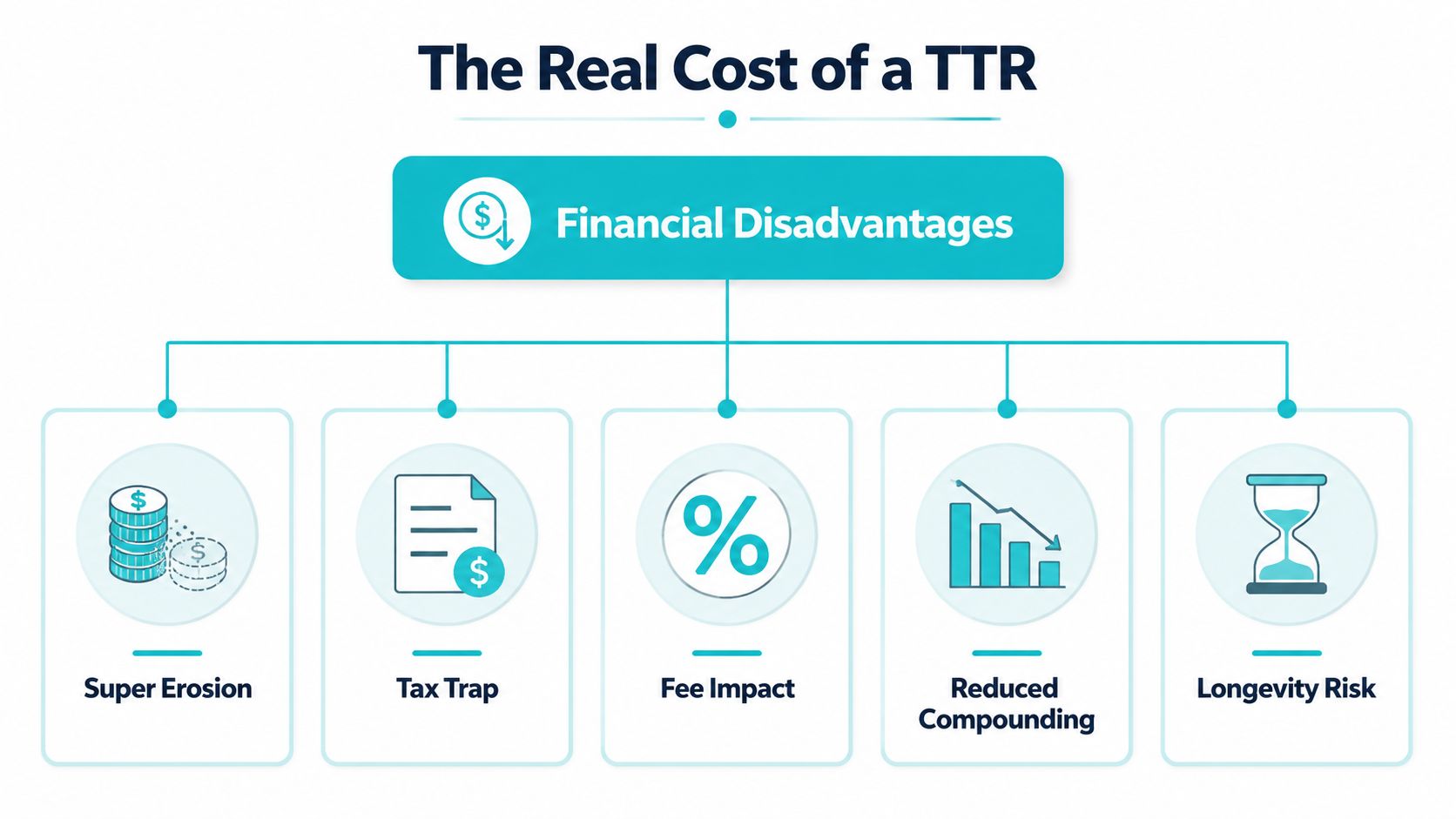
The Financial Traps The Real Cost of a TTR
A TTR strategy can improve cash flow and still leave you worse off.
That happens when the short-term relief looks manageable, but the long-term cost sits out of view for years. In practice, pre-retirees get caught at this point. They focus on the pension payment hitting the bank account and miss what that payment is taking away from the balance that still has to fund the next 25 to 30 years.
Capital erosion starts quietly
The first risk is simple. You are drawing on retirement capital while still in the years when compounding should be doing heavy lifting.
A $20,000 withdrawal does not cost only $20,000. It also reduces the amount that stays invested through the final stretch before full retirement, which is often one of the most important periods for building the base your later income depends on. That drag is easy to ignore because it does not arrive as a bill. It shows up later as lower flexibility, lower sustainable income, or a retirement date that has to move.
This is one of the reasons we do not assess TTR in isolation at Wealth Collective. In the Retirement Roadmap process, the question is never just, “Can you start one?” The better question is, “What future trade-off are you accepting to solve today's cash flow issue?”
Tax outcomes are often oversimplified
TTR is regularly presented as tax-effective. Sometimes it is. Sometimes it is only partly effective. Sometimes the tax benefit is too small to justify the complexity.
Investment earnings in a TTR pension are generally taxed at up to 15%, unlike an account-based pension in full retirement phase where earnings may be tax-free within the relevant caps. Add salary sacrifice to the mix and the result can improve or deteriorate depending on income, age, contribution levels, and whether the strategy is replacing income or adding more moving parts. That is why a side-by-side comparison with the disadvantages of salary sacrifice matters. Both strategies can work. Both can also produce a result that looks tidy on paper and underwhelming in your actual after-tax position.
The withdrawal rules can create pressure at the wrong time
A TTR pension comes with minimum and maximum annual drawdown limits. That matters if work hours fall faster than expected, employment ends early, or health forces a bigger income gap than the strategy can legally cover.
Analysts at the Transamerica Center for Retirement Studies found in its 2025 retiree survey that only 24% of retirees said they retired because they had saved enough. The same research found 27% cited physical limitations, 26% cited ill health, 33% experienced declining health after retirement, and 28% were affected by financial setbacks. Those are not edge cases. They are a reminder that retirement timing is often forced by events, not chosen neatly on a spreadsheet.
If super has already been drawn down through a loose TTR strategy, the buffer available when life changes course is smaller.
Pension interactions are rarely straightforward
A second-order risk is how today's drawdown decisions affect tomorrow's options.
Super, pension entitlements, partner assets, timing of retirement, and the way accounts are structured all interact. Early withdrawals can improve cash flow now but reduce flexibility later, especially for couples who may end up relying more heavily on Age Pension support than they expected. The problem is not that TTR automatically ruins pension outcomes. The problem is that many people start the strategy without modelling several future scenarios, including ill health, one spouse retiring earlier, or investment markets disappointing at the wrong time.
That is where advice earns its keep. The strategy needs testing under pressure, not just under ideal assumptions.
The friction costs are easy to miss
The drag is not limited to withdrawals and tax.
A TTR arrangement often means two super environments running side by side, more administration, more opportunities for contribution or pension payment errors, and more attention needed around insurance held inside super. Life cover or TPD cover can be affected if account balances change or contributions slow down. Those details are rarely the headline reason someone starts TTR, but they are often the reason the strategy becomes messy.
Then there is longevity risk. Every dollar taken out early leaves less capital available to support later years, when spending may become less discretionary and health costs less predictable.
TTR works best when it solves a specific problem, for a defined period, within a broader retirement plan. It works poorly when it becomes a habit that funds today at the expense of future choice.
The Hidden Psychological and Identity Costs
Most TTR discussions stay in spreadsheet territory. That's a mistake.
Retirement changes how money flows, but it also changes how days feel. Clients who've spent decades solving problems, leading teams, running businesses, or being the person others rely on often assume they're planning for income. In reality, they're also planning for the loss of structure, status, and routine.

Identity doesn't retire on schedule
One of the better descriptions of retirement transition is that the challenge isn't always financial. It's existential. That rings true in practice.
A capable executive can be fully prepared on paper and still feel destabilised once work no longer provides the daily architecture of life. The same applies to business owners who've tied their value to performance and output for years. If the TTR strategy only addresses cash flow, it leaves the harder problem untouched.
According to research discussed in this retirement identity article, retirement can trigger a fundamental identity crisis as a work-based self-concept dissolves. The same source says 41% of Australians stop work immediately upon retirement, while only 13% transition through reduced hours or alternative work arrangements. It also reports that retirees experience a greater increase in physical functioning difficulties compared with full-time workers.
That matters because a TTR strategy is often sold as a gentle bridge. But if someone uses it purely to fund fewer hours, without any plan for purpose or routine, the bridge may still lead to a very abrupt personal transition.
What this looks like in real life
The signs are often subtle at first:
- Weekdays lose shape: no meetings, no deadlines, no external rhythm
- Confidence dips: not because money is short, but because role and relevance feel less clear
- Health habits slip: exercise, sleep, and social contact weaken when structure disappears
- The household dynamic changes: one partner may adapt quickly, the other may struggle
A funded retirement can still be an unhappy retirement if no one has planned for identity after work.
Generic retirement content falls short. It treats transition as an administrative event. It isn't. It's a behavioural shift.
The planning gap most advisers still miss
A proper pre-retirement conversation should include more than super balances and tax settings. It should also cover:
- Daily rhythm once work reduces or stops
- Sources of purpose beyond title and income
- Social connection outside the workplace
- Family expectations about time, care, travel, and support
- A phased exit plan if full retirement feels too abrupt
That's not soft advice. It's durable planning.
When these issues are ignored, people often blame the money strategy for a dissatisfaction that comes from a life structure problem. TTR can expose that gap quickly.
TTR in Action A Tale of Two Pre-Retirees
A TTR strategy does not fail because the paperwork was wrong. It usually fails because the role it is being asked to play is too broad.
I see that in practice all the time. Two people can use the same rules, the same super system, and the same type of pension account, then end up in very different positions five years later. The difference is rarely technical alone. It comes down to purpose, time frame, spending discipline, and whether the strategy fits the person's actual transition into retirement.
Sarah uses TTR with a clear finish line
Sarah is in her early sixties and close to stopping work. Her mortgage is gone. Her spending is stable. She is not drawing on super to make an unaffordable lifestyle look sustainable.
For Sarah, TTR is a short-term planning tool. It helps manage tax and cash flow while she winds down work on her terms. She knows how much she is taking, why she is taking it, and when it stops. That matters.
Just as important, Sarah's identity is not hanging off the strategy. She is reducing work with a plan for what replaces it, financially and personally. The money structure supports the transition. It is not carrying the emotional weight of it.
David uses TTR to relieve pressure
David is younger, tired of full-time work, and wants more space. Reduced hours, a few trips, and less stress all sound reasonable. The problem is how he is funding that decision.
His TTR payments are covering an ongoing lifestyle gap. There is no firm end date. There is no clear trigger for full retirement. He is using super to replace income now while hoping the long-term consequences will sort themselves out later.
That approach creates pressure from several directions at once. Less money stays invested. Future retirement income becomes more dependent on market returns and later contributions. If his health changes or work dries up earlier than expected, the margin for error gets much smaller.
As noted earlier, even a relatively modest withdrawal in the mid-fifties can cost far more in lost future retirement capital than people expect. That is the part many pre-retirees underestimate. The immediate relief feels manageable. The long-term trade-off often does not.
TTR Outcome Comparison Sarah vs. David 5-Year Projection
| Metric | Sarah (High-Income, Tax Strategy) | David (Moderate-Income, Lifestyle Funding) |
|---|---|---|
| Primary purpose | Short-term tax management and controlled transition | Ongoing cash flow support for reduced work |
| Use of withdrawals | Replaces part of sacrificed income | Funds current lifestyle gap |
| Time horizon | Brief and defined | Open-ended |
| Pressure on super balance | More contained | Higher |
| Exposure to compounding loss | Managed | Significant |
| Fit with Age Pension planning | Less central to strategy | More sensitive |
| Risk if health or work changes | Lower if retirement is near | Higher if full retirement arrives early |
| Likely outcome | Can work if tightly modelled and reviewed | Often weakens long-term retirement security |
What actually separates the stronger decision
The gap between Sarah and David is not discipline in some abstract sense. It is whether the strategy has a specific job.
In Wealth Collective's Retirement Roadmap process, the substantive work happens. We test whether TTR is being used for a defined planning outcome, such as a short tax window or a staged reduction in work, or whether it is subtly covering fatigue, overspending, uncertainty, or a lack of readiness to retire. Those are different problems. They should not be funded the same way.
The stronger TTR cases usually share a few traits:
- A defined purpose, not general spending support
- A clear review date, not an account left running by default
- Stable household cash flow, not a budget already under strain
- Retirement timing that is reasonably close, not vague intention years out
- A life plan around work reduction, not just a financial mechanism
If a person cannot explain exactly what their TTR income is doing, how long it will do it, and what the fallback plan is if work stops sooner than expected, the strategy is not ready.
This is a key lesson from cases like Sarah and David. TTR can be useful. It can also hide a much bigger problem by making an early transition feel affordable before the person, the budget, and the retirement plan are fully prepared.
Who Should Avoid a Transition to Retirement Strategy?
TTR isn't automatically wrong. It's often just wrong for the person considering it.
The people who should be most cautious are usually those with the least room for compounding loss, the highest future dependence on super, or the biggest mismatch between financial planning and life planning.

Profiles that warrant real caution
A TTR strategy often deserves extra scrutiny if you fit one of these groups:
People planning to rely heavily on super for income
If your retirement cash flow will depend on preserving every available dollar, early drawdowns can hurt more than they help.Anyone still years away from full retirement
The longer the money would have remained invested, the larger the opportunity cost of using it now.Couples with complex household planning needs
One person's decision can affect the household much more than expected later on.Those using TTR to cover a spending problem
If the strategy exists because current lifestyle costs are too high, the answer may be budgeting, debt reduction, or a work redesign, not super access.People with no clear plan for life after work
As noted in this article on why retirement transition can feel harder than retirement planning, “the challenge isn't always financial. The challenge is existential.” That is exactly why a purely financial TTR decision can still produce a poor retirement outcome.
Better alternatives may exist
Sometimes the best TTR advice is to avoid TTR.
Other options can include:
Negotiating reduced hours without touching super
This preserves capital and still creates more space.Using long service leave or annual leave strategically
A trial run can tell you more than a spreadsheet.Drawing on non-super assets first
In some cases, keeping super intact longer improves future flexibility.Delaying the shift briefly while strengthening the plan
A short delay can be more valuable than a rushed transition.
The right strategy is the one that protects future options, not just the one that makes next month easier.
TTR tends to work best for people close to full retirement, with strong balances, controlled spending, and a precise reason for using the structure. Outside that group, caution is not pessimism. It's discipline.
Your Pre-Retirement Action Checklist
Before starting any TTR strategy, ask better questions than “Can I do this?”
Start with “What will this cost me later?” and “What problem is this really solving?”
Questions worth answering first
Use this checklist before you sign anything or move money:
Have I calculated the impact on my final super balance?
Not just the withdrawal amount. The lost future growth as well.Am I using TTR for a tax strategy or to fund spending I can't otherwise support?
Those are not the same decision.What happens if I need to stop work earlier than planned?
Health and employment don't always follow the preferred timeline.How will this affect my partner and our joint long-term security? Retirement planning for couples is often treated too superficially. As discussed in this article on retirement strategy complexity for couples, if the higher-earning spouse claims benefits early and dies first, the surviving spouse can be left with a permanently reduced benefit. The same source notes that 35% of people underestimate life expectancy, which increases the risk of poor coordination.
Do I understand exactly when I can access my super?
Timing, conditions of release, and account structure all matter. If you need a baseline refresher, this guide on when you can access your super is a useful place to start.What is my plan for routine, purpose, and identity when work reduces or stops?
If there's no answer yet, the retirement plan is incomplete.
What good planning looks like
A sound pre-retirement process does three things well. It models the money properly, pressure-tests the downside, and treats retirement as both a financial and personal transition.
That's what a solid Retirement Roadmap should do. It shouldn't just tell you whether a TTR strategy is available. It should tell you whether it belongs in your plan at all.
If you're weighing a TTR decision and want clear advice before making a costly mistake, Wealth Collective can help you build a practical Retirement Roadmap around your super, tax position, cash flow, and life after work. If you'd like a straightforward second opinion, book a free 10-minute introductory call and talk through your situation with an adviser who understands the trade-offs.