Business hours
Monday to Friday (8.30AM - 5PM)
Weekend (Closed)


A transition to retirement income stream lets someone who has reached preservation age draw a regular pension from part of their super while still working. For Australians born on or after 1 July 1964, that preservation age is 60, and annual withdrawals are generally capped at 10% of the account balance while investment earnings inside the fund continue to be taxed at 15%.
Why do so many pre-retirees treat this strategy as an automatic tax windfall when the rules haven't worked that way for years? The confusion comes from focusing on only half the equation. Payments landing in your bank account from age 60 are usually tax-free, yet the assets supporting that income stream still pay fund-level tax until you reach retirement phase.
Pair that tax drag with strict minimum and maximum payment bands, and a poorly modelled drawdown can trigger a compliance breach instead of boosting your wealth. Treat a transition to retirement income stream as a deliberate trade-off between cash flow today, tax paid inside super, and the balance left for full retirement.
What a Transition to Retirement Income Stream Is
Think of a transition to retirement income stream (commonly shortened to TRIS) as a dimmer switch for your working life. Instead of flicking straight from full-time employment to full retirement overnight, you can dial down your working hours and dial up a regular super pension to bridge the gap in your take-home pay.

According to the Australian Taxation Office guidance for superannuation professionals, you can generally start a TRIS once you reach preservation age, which is 60 for anyone born on or after 1 July 1964. You don't have to resign, change employers, or reduce your hours to qualify. Because you're still in the workforce, strict payment rules apply throughout: an account-based TRIS must pay at least the legislated minimum pension amount each financial year and generally can't pay more than 10% of the account balance annually.
How the Three Moving Parts Fit Together
Setting up a TRIS doesn't merge your entire super into one bucket. Instead, three distinct elements run side by side:
- Your super accumulation account: This stays open to receive ongoing employer super guarantee contributions and any salary-sacrifice amounts you make while working, as well as holding any personal insurance cover attached to your fund.
- The income stream account: You transfer part of your accumulated super into a separate pension account that pays regular income to your bank account within the legislated annual band.
- Your ongoing employment: You keep earning wages on full-time or reduced hours, giving you control over how much work income and pension income you blend together each year.
How It Differs From a Retirement Pension
A TRIS is not the same product as a standard retirement-phase pension, even though both pay regular income from super. A retirement-phase pension requires you to meet a full condition of release, such as retiring after preservation age or turning 65, and once you do, there's no annual maximum cap on what you can withdraw.
A TRIS generally stays outside the retirement phase until you turn 65, retire under the relevant condition of release, or qualify through permanent incapacity or a terminal medical condition. Before setting one up, you need to assess eligibility, withdrawal ceilings, tax rules on both payments and fund earnings, cash-flow modelling, and long-term balance risks together as a single decision.
Who Qualifies and When the Stream Changes Phase
Your birth date sets the earliest point you can access a transition to retirement income stream. Anyone born before 1 July 1964 reached preservation age between 55 and 59, while everyone born on or after that date must wait until 60.
| Date of birth | Preservation age |
|---|---|
| Before 1 July 1960 | 55 |
| 1 July 1960 to 30 June 1961 | 56 |
| 1 July 1961 to 30 June 1962 | 57 |
| 1 July 1962 to 30 June 1963 | 58 |
| 1 July 1963 to 30 June 1964 | 59 |
| On or after 1 July 1964 | 60 |
Reaching preservation age opens the door, but it doesn't turn your super into an unrestricted retirement pension. As the Australian Taxation Office transition to retirement guide sets out, a TRIS isn't automatically in the retirement phase just because it pays you an income. Until you turn 65 or meet a relevant condition of release, commonly retirement, investment earnings on the assets supporting your TRIS remain taxed at 15% inside the fund rather than receiving exempt current pension income treatment.
Moving From Transition to Retirement Phase
Your stream transitions into the retirement phase when one of four triggers occurs: you reach age 65 (even if you're still working), you retire after reaching preservation age, you qualify under permanent incapacity, or you meet the terminal medical condition rules. The ATO notes that entering the retirement phase changes both the tax treatment of the supporting assets and how the pension counts toward your transfer balance account.
Consider an illustrative scenario. Say a woman born in March 1966 reaches her preservation age of 60 in March 2026. She starts a TRIS while continuing to work four days a week, knowing her annual payments stay capped and her fund earnings stay taxed at 15%. Two years later, at age 62, she retires completely and notifies her super fund.
A transition to retirement stream won't automatically shift its tax status when you stop work before 65. Your fund must be notified that you've met a retirement condition of release before the earnings exemption and removal of the payment ceiling take effect.
At that moment, two practical constraints lift at once. The 10% maximum withdrawal ceiling disappears, and the assets backing her pension become eligible for tax-exempt retirement-phase earnings within her transfer balance cap.
Because personal tax savings don't automatically cancel out fund-level earnings tax, practical implementation requires modelling salary, salary-sacrifice contributions, pension withdrawals, marginal tax rates, contribution caps, and expected investment returns together. Before lodging any start-up paperwork, confirm your exact date of birth on file and verify what evidence your fund requires to record a future condition of release.
How Payments and Withdrawal Limits Work
Every account-based super pension must satisfy annual drawdown percentages based on your age, and a TRIS adds an upper ceiling on top. Once a stream enters the retirement phase, that upper ceiling falls away while the age-based minimums step up over time.
| Age | Minimum annual payment | Maximum annual payment |
|---|---|---|
| Under 65 (still a TRIS) | 4% | 10% |
| 65 to 74 (retirement phase) | 5% | No maximum |
| 75 to 79 (retirement phase) | 6% | No maximum |
| 80 to 84 (retirement phase) | 7% | No maximum |
| 85 to 89 (retirement phase) | 9% | No maximum |
| 90 to 94 (retirement phase) | 11% | No maximum |
| 95 and over (retirement phase) | 14% | No maximum |
Under the ATO income stream pension rules and payments, while your stream remains under transition-to-retirement restrictions, annual payments generally can't exceed 10% of your account balance for the financial year. That ceiling applies alongside standard account-based income-stream rules and disappears only when you meet a condition of release with no cashing restriction, such as turning 65 or retiring after preservation age.
How the Percentage Rules Apply in Dollars
The percentage band applies to your account balance at commencement and then at the start of each new financial year. Take an illustrative $300,000 TRIS balance held by someone under 65:
- Calculate the minimum floor: Multiply $300,000 by 4% to find the minimum annual drawdown of $12,000 for the financial year.
- Calculate the maximum ceiling: Multiply $300,000 by 10% to set the hard upper limit of $30,000 for the same year.
- Convert to a monthly sanity check: Divide your chosen annual drawdown by 12 to find your monthly payment figure, then confirm the annual total stays comfortably between the minimum floor and the maximum ceiling for the full year.
Keep one technical rule in mind if you're trying to meet the minimum late in the year: partial commutation lump-sum withdrawals don't count toward your minimum annual pension payment. Your required amount must be paid as actual pension income.
Why Breaching the Cap Costs More Than Expected
Drawing too much isn't a minor administrative slip. The ATO states that exceeding the 10% maximum can cause the super income stream to be treated as having stopped for income-tax purposes from the start of that financial year. Falling short of the legislated minimum carries its own compliance headaches, which is why cash-flow modelling and an annual 1 July check are essential before you set automated payment instructions.
If you're weighing whether to hold a capped TRIS now or wait until you can move straight into an unrestricted pension, reviewing how an account-based pension operates in retirement phase clarifies which rules lift once you stop work.
How Tax Works Before and After Age 60
Tax on a transition to retirement income stream works at two separate layers: tax on the money paid into your personal bank account, and tax on investment earnings inside the super fund. Mixing those two layers up is the main reason pre-retirees overestimate the net benefit.
| Stream position | Tax on payments to member | Tax on fund earnings |
|---|---|---|
| TRIS, member aged 60 or over | Generally tax-free, no PAYG withholding | 15% |
| TRIS, member under 60 | Taxed element up to 15% plus Medicare levy | 15% |
| Retirement phase | Tax-free | 0% (exempt current pension income) |
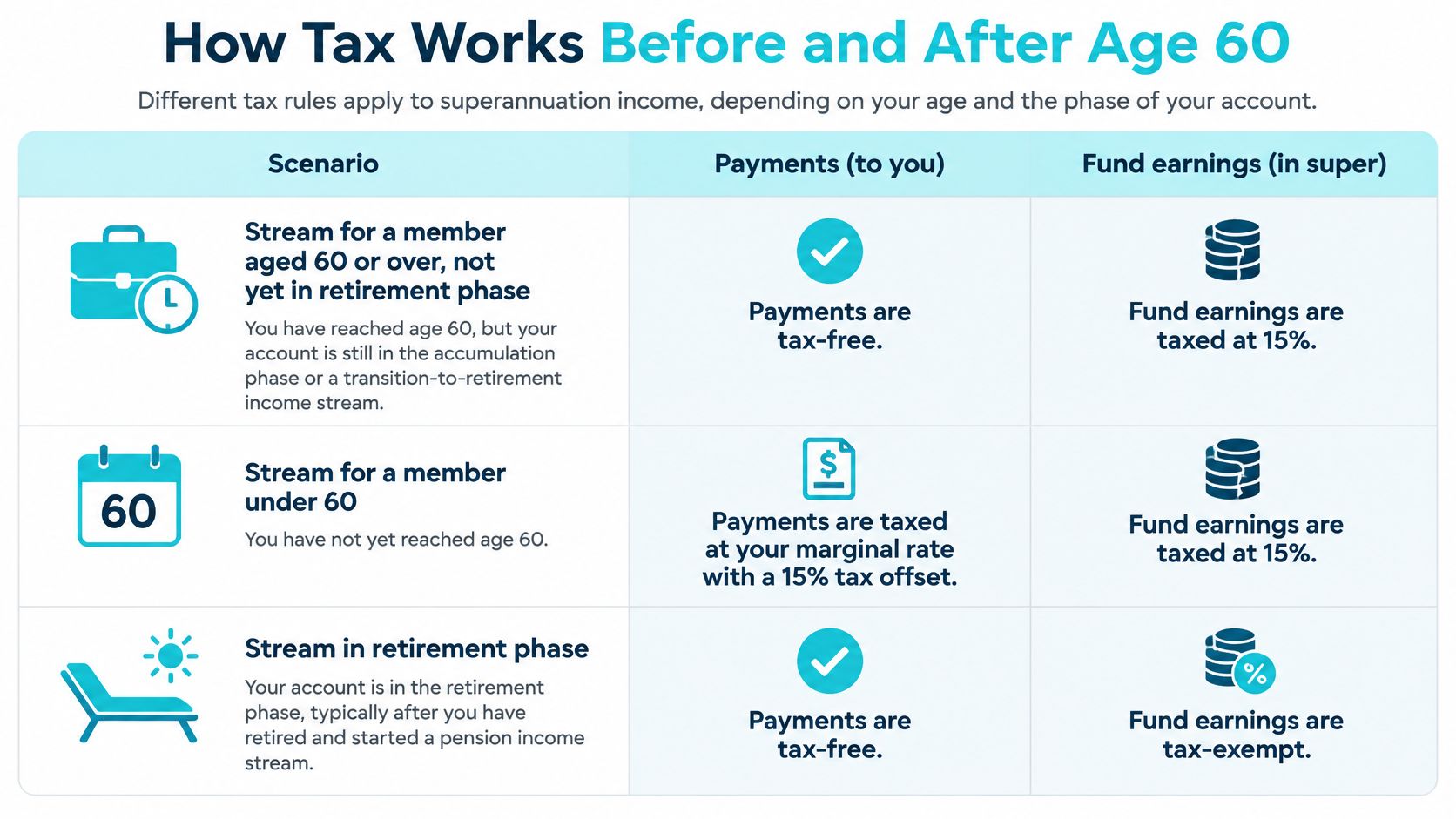
According to ATO Guidance Note GDN 2019/1, members aged 60 or over generally receive TRIS payments tax-free, with no PAYG withholding required by the fund and usually no need to declare those payments in their personal tax return. For younger recipients under 60, the outcome depends on age, the mix of taxable and tax-free components, and other employment income: the taxed element is generally subject to a maximum effective rate of 15% plus the Medicare levy, with a 15% tax offset applying in relevant circumstances.
Why Tax-Free Payments Still Leave Earnings Taxed
Personal tax-free status at 60 doesn't exempt the super fund itself. As outlined in the ATO's updated guidance on transition to retirement income streams, tax law changed materially on 1 July 2017. Before that date, funds could generally claim exempt current pension income for assets supporting a TRIS, giving those investment earnings a 0% tax rate inside super. Since 1 July 2017, a TRIS that hasn't entered the retirement phase generally pays the concessional superannuation rate of 15% on taxable investment earnings.
That policy change reshaped how Australians use the strategy. ATO self-managed super fund (SMSF) statistics reported in the same guidance show that in 2019-20, transition-to-retirement income streams accounted for 2.5% of total SMSF benefit payments, down sharply from 3.3% the year before and 11.9% in 2015-16, even though 62% of all SMSF benefit payments were still paid as income streams including TRIS payments.
Adviser perspective: Reaching retirement phase, not turning 60, is what removes the 15% tax on fund earnings. That timing directly affects your net compounding returns as well as your cash flow.
If you want to unpack how contributions, earnings, and withdrawals interact across your whole fund, our breakdown of how superannuation is taxed maps out each stage cleanly.
A Worked Example of Reducing Hours With a Stream
Numbers reveal trade-offs faster than rules do. Take an illustrative scenario: Sarah is 61, earns a $120,000 full-time salary, holds $400,000 in super, and wants to step back to four days a week without completely gutting her lifestyle. Every figure below is illustrative only and rounded to show how the mechanics interact.
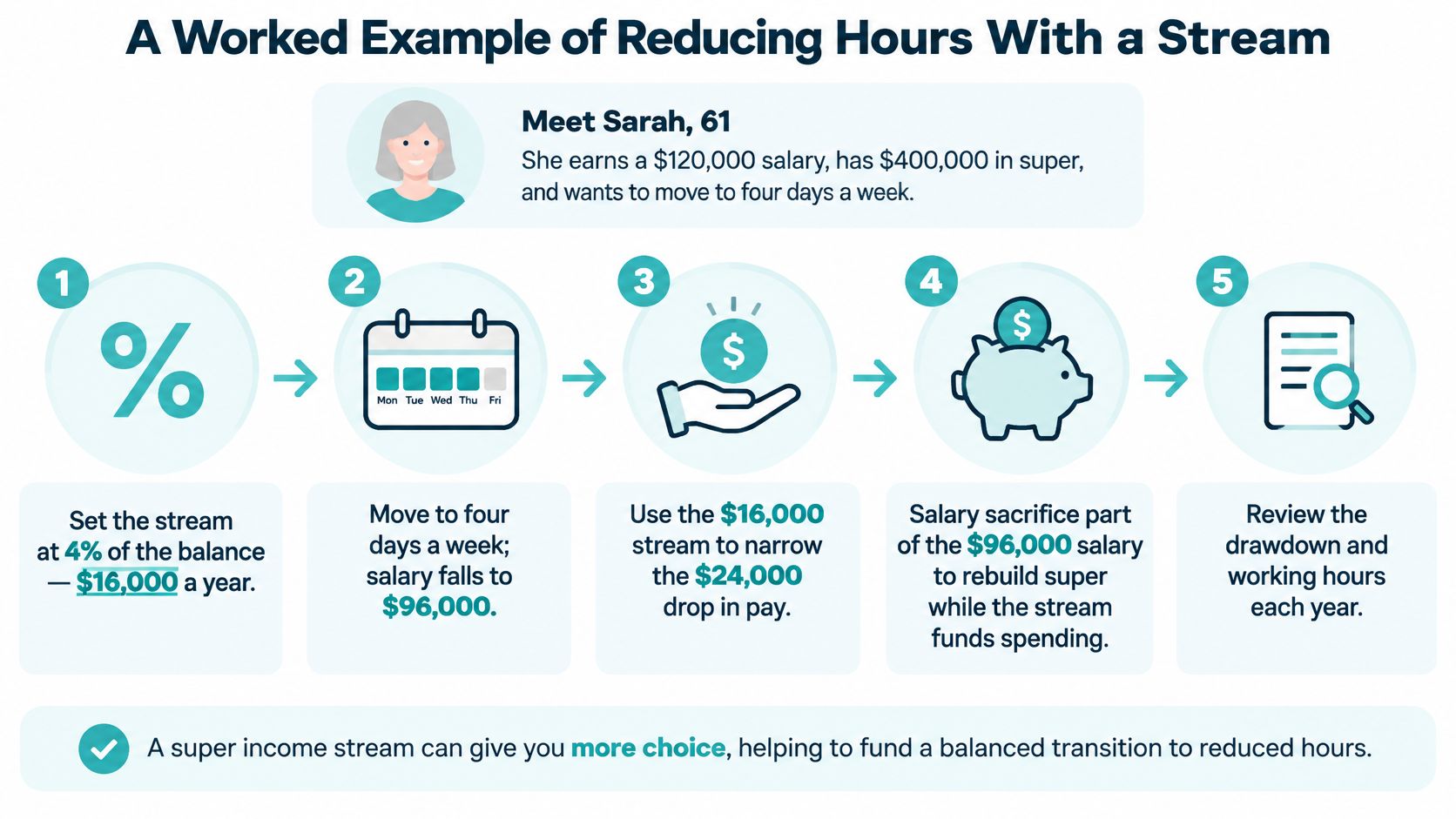
- Set the initial drawdown inside the band. Sarah starts her TRIS at the 4% minimum on her illustrative $400,000 balance, giving her $16,000 a year (roughly $1,333 a month). Because she's over 60, that $16,000 lands in her account tax-free and sits comfortably below her 10% maximum ceiling of $40,000.
- Step down to four days a week. Dropping one workday reduces her illustrative gross salary by 20% to $96,000, a $24,000 pay cut before tax. Adding the $16,000 TRIS payment brings her combined annual income to $112,000, narrowing the gross shortfall to $8,000 (and even less in take-home terms, because the top slice of salary she gave up was taxed at her highest marginal rate, leaving any smaller net gap to cover from savings or budget adjustments).
- Check the concessional cap before salary sacrificing. Sarah wants to rebuild some of the super she's drawing by salary sacrificing from her $96,000 wage. According to the Australian Government's Moneysmart transition to retirement guide, the concessional contributions cap for the 2024-25 financial year was $30,000, and concessional contributions are generally taxed at 15% (always confirm the cap for the current financial year before committing).
- Count employer super guarantee first. Many pre-retirees trip up on this detail. Using an illustrative 12% employer super guarantee rate on her $96,000 part-time salary, Sarah's employer contributes $11,520 into her accumulation account. Against a $30,000 cap, that leaves about $18,480 of remaining room for salary sacrifice rather than the full cap amount.
- Compare household cash flow before and after. Before the shift, Sarah earned $120,000 gross and worked five days. After the shift, she works four days, combines $96,000 in salary with $16,000 in tax-free pension payments, and can divert any spare cash flow into salary sacrifice up to her remaining cap room.
- Account for the 15% tax still running inside super. Suppose her illustrative $400,000 TRIS earns 6% over the year, generating about $24,000 in investment income. Because her stream is still outside retirement phase, 15% fund-level tax trims roughly $3,600 from those earnings.
Where Small Modelling Errors Become Expensive
Precision matters at both ends of the payment band. If Sarah accidentally draws more than her $40,000 maximum, she breaches the 10% cap and puts the tax treatment of her entire year's income stream at risk. Conversely, if she pauses payments mid-year and withdraws less than $16,000, she fails the 4% minimum standard on her $400,000 balance.
Never copy an example's percentages straight onto your own fund. Model your exact salary, marginal tax rate, employer super contributions, and current-year contribution cap before submitting any paperwork.
Benefits and Risks to Weigh Before Starting
Conventional wisdom paints a transition to retirement income stream as a painless way to work less and pay less tax. Look closer at the trade-offs, and you'll see why it suits some pre-retirees well while eroding the savings of others.
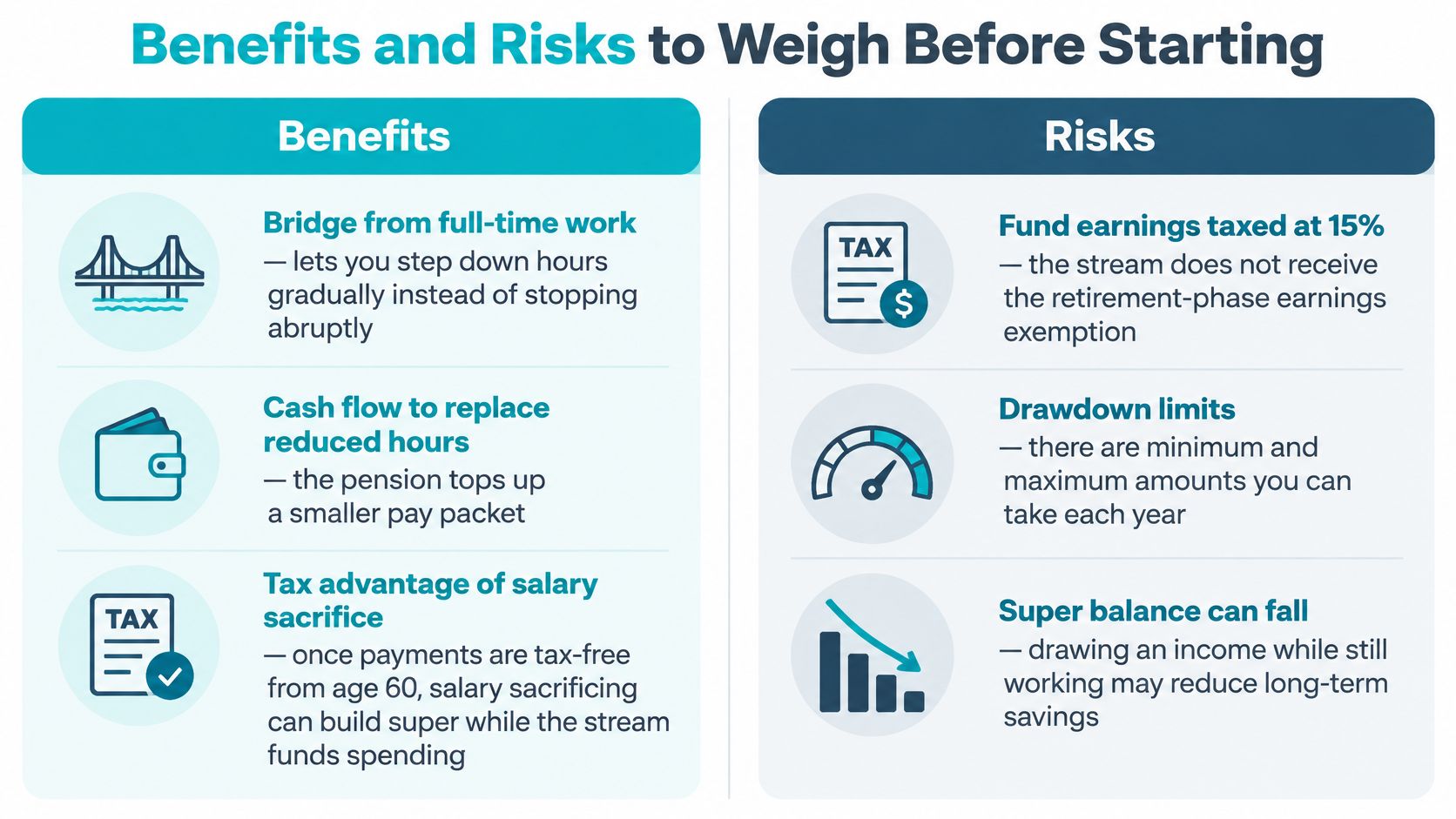
The strongest case for starting a TRIS is lifestyle flexibility paired with tax-effective cash flow. As the ATO SMSF transition to retirement guidance highlights, members aged 60 or over generally receive TRIS payments tax-free, creating room to replace part of taxable wages with super pension payments while continuing salary-sacrifice contributions to improve after-tax cash flow. Yet the same guidance points out the counterweights: supporting fund assets still face 15% earnings tax outside retirement phase, and drawing money during a market downturn introduces sequencing risk.
Weighing Cash-Flow Flexibility Against Balance Erosion
Put the advantages directly alongside the costs so neither side gets glossed over:
- A smoother bridge out of full-time work: Stepping down to three or four days a week preserves energy and health while keeping you engaged at work, funded by regular pension income rather than draining emergency cash.
- Tax arbitrage via salary sacrifice: If your marginal tax rate sits comfortably above the 15% concessional contributions tax, channelling pre-tax salary into super while replacing take-home pay with tax-free pension payments from age 60 can leave you ahead. On lower incomes, that gap narrows or vanishes entirely.
- Ongoing 15% earnings tax drag: Leaving money in a TRIS outside retirement phase doesn't give you the tax-free investment environment of a full retirement pension, which slows long-term compounding.
- Sequencing risk and capital depletion: Selling down investment units to fund mandatory annual withdrawals during a market fall locks in losses permanently. Even in steady markets, drawing super early leaves you with a smaller balance when work finally stops.
- Compliance and insurance traps: Poorly monitored withdrawals risk breaching the 10% ceiling, and shifting too much super out of your accumulation account can leave too little behind to cover ongoing life or income protection premiums.
Three Questions to Test Your Strategy
Before committing to a TRIS, run your situation through three direct checks:
- Is your taxable income high enough for extra concessional contributions to deliver a real tax saving? If your marginal rate sits near the 15% contributions tax, salary sacrificing alongside a TRIS may add complexity without meaningful upside.
- Do you have a liquidity plan for the mandatory minimum payment during a market downturn? Holding a cash buffer inside the pension account prevents forced asset sales when share markets dip.
- Does your timeline to age 65 or full retirement justify running two super accounts? If you plan to retire within months rather than years, waiting for full retirement-phase status is often cleaner.
At Wealth Collective, we research and model each client's options to create a detailed financial plan that balances financial structure, money success, and lifestyle.
Important note: General information on our website is not personal financial advice, so consider your own circumstances and consult one of our qualified Financial Advisers before acting on it.
Confirm Your Numbers Before You Start
Confirm your exact numbers before starting a transition to retirement income stream. Because a single move affects your personal tax bill, your super balance, your fund-level earnings tax, your insurance cover, and your household cash flow at the same time, personalised modelling is the right first step before you lodge any fund forms.
How Our Advice Process Works
You don't need to untangle contribution caps, drawdown bands, and phase-change triggers alone. Prospective clients can book a free 10-minute intro call, and Wealth Collective takes care of the rest.
Our intro call process starts with reviewing your current situation so we understand your work plans, super structure, and lifestyle targets, and then creating a plan that works for you. Before you speak with an adviser, running through our retirement readiness assessment is a practical way to spot any immediate gaps in your super or cash-flow plan.
Once we walk through your projections and you're 100% comfortable with the outcomes, we take care of the paperwork, products (if required), and end-to-end implementation. That keeps your accumulation account funded for employer contributions and insurance while setting your pension payments accurately inside the annual rules.
What to Gather Before Your Intro Call
Having five details on hand makes your initial conversation sharper and lets us test whether a TRIS leaves you ahead:
- Your date of birth: Confirms your exact preservation age and how many years remain before age 65 automatically triggers retirement phase.
- Your super balance and latest fund statement: Shows your current accumulation balance, investment mix, fees, and any personal insurance policies linked to the account.
- Your current salary and weekly hours: Establishes your marginal tax bracket and how much employer super guarantee is already flowing into your fund.
- Any existing salary-sacrifice amounts: Helps calculate remaining room under the concessional contributions cap so you don't trigger excess contribution issues.
- Your target work hours and planned retirement age: Anchors the cash-flow model around the lifestyle transition you want, rather than an arbitrary drawdown percentage.
Bring those five items to your intro call, compare your real figures against the rules in this guide, and decide with clear numbers whether a transition to retirement income stream strengthens your path to retirement.
Through our Retirement Roadmap service, our advisers model your superannuation, salary-sacrifice capacity, tax position, and drawdown limits together so you can step back from full-time work without risking a compliance breach or an unexpected drop in retirement savings. Book your free 10-minute intro call today by visiting Wealth Collective and let our team map out your numbers with confidence.