Business hours
Monday to Friday (8.30AM - 5PM)
Weekend (Closed)



If you're reading this, there's a fair chance you're in one of two positions. Either you've been named as a beneficiary of a trust and want to know what that means, or you're setting one up and want to make sure your family doesn't inherit confusion along with the money.
In Perth and across WA, I find residents don't need more jargon. They need clarity. A trust fund beneficiary isn't a pop culture stereotype. In practice, it's a person who may receive income, capital, or both from a trust under rules set out in a deed or a will. The value of the structure isn't the label. It's the control, protection, and tax planning that can sit behind it when the trust is set up and run properly.
What a Trust Fund Beneficiary Really Is
The phrase “trust fund beneficiary” tends to make people think of inherited wealth, no responsibilities, and automatic access to money. That's rarely how it works in Australia.
A trust is better understood as a legal arrangement that holds assets under a set of rules. A simple way to think about it is a financial safety deposit box with instructions attached. The assets sit inside the structure, someone is put in charge of managing them, and one or more people are entitled to benefit from them.

If you want a broader primer on how trusts work as a protection tool, this guide on understanding asset protection trusts is a useful starting point. For an Australian family trust angle, it also helps to read how a family trust works in Australia.
The three people that matter most
At the centre of almost every trust are three roles:
Settlor
The person who establishes the trust. In many trust structures, the settlor starts the arrangement but doesn't remain involved in day-to-day decisions.Trustee
The decision-maker and legal manager of the trust assets. The trustee must act under the trust deed and in line with legal duties.Beneficiary
The person, or class of people, who may receive a benefit from the trust. That benefit might be income, capital, or access to assets under certain conditions.
A trust fund beneficiary does not necessarily control the money. That's one of the biggest misunderstandings I see. In many discretionary trusts, the beneficiary may be eligible for a distribution, but the trustee decides whether a distribution is made and in what amount, subject to the deed.
Practical rule: Being named in a trust doesn't automatically mean you can demand cash whenever you like.
Not all beneficiaries have the same position
The word beneficiary sounds singular and simple. It isn't.
A beneficiary may be:
- An income beneficiary, who receives trust income
- A capital beneficiary, who may receive trust assets or capital proceeds
- A primary beneficiary, often the main intended family member or group
- A contingent beneficiary, who benefits only if certain events occur
That distinction matters because your rights, expectations, and tax position can look very different depending on the trust type and the drafting.
For example, in a family trust, adult children might be potential beneficiaries each year, but there may be no fixed entitlement unless the trustee resolves to distribute income to them. In a testamentary trust created by a will, a surviving spouse might have priority access to income, while children receive capital later. Same broad label. Very different reality.
Key Roles in a Trust Structure
Clients often confuse three positions that sound similar but do very different jobs. A beneficiary receives the benefit. A trustee manages the trust. An executor deals with the estate under a will.
There's also one more role that deserves attention in many discretionary trusts. The appointor. In practical terms, this person often holds significant power because they can usually appoint or remove the trustee under the trust deed.
Comparison of Key Roles Beneficiary vs. Trustee vs. Executor
| Role | Primary Function | Source of Authority | Key Responsibility |
|---|---|---|---|
| Beneficiary | Receives benefit from the trust or estate | Trust deed or will | Understand entitlements, provide tax information where needed, review what has been distributed |
| Trustee | Manages trust assets and makes decisions under the trust | Trust deed and trust law | Administer the trust properly, keep records, make valid distributions, act in beneficiaries' interests as required by the deed and law |
| Executor | Administers a deceased person's estate | Will and probate process | Collect estate assets, pay debts, carry out the will, transfer assets to beneficiaries or into testamentary trusts |
Where confusion causes problems
The most common mistake is assuming the trustee and executor are interchangeable. They aren't.
An executor's job is tied to the estate administration process. Once the estate has been dealt with, the executor's role may end. A trustee's role can continue for years, sometimes across generations, depending on the trust terms.
A second mistake is assuming the beneficiary has no visibility at all. That's not right either. While a beneficiary's rights depend on the trust type and the drafting, trustees cannot treat the arrangement like a personal bank account.
A well-run trust feels boring. Records are current, decisions are documented, and nobody has to guess who was entitled to what.
Why the appointor matters
In a discretionary family trust, the appointor is often the central power point. The trustee signs resolutions and manages the assets, but the appointor may hold the ability to replace that trustee.
That matters in family wealth planning because control and benefit are not the same thing. A parent might want children to benefit over time without handing over control immediately. A business owner might want a spouse involved in governance but not exposed to trading risk. Those are drafting and structuring decisions, not just legal labels.
Here's the practical difference:
- If you're a beneficiary, your focus is usually on rights, expectations, and tax outcomes.
- If you're a trustee, your focus is administration, record-keeping, and decision quality.
- If you're an appointor, your focus is long-term control.
- If you're an executor, your focus is getting the estate from death to distribution properly.
When these roles are chosen casually, families end up with conflict. When they're chosen deliberately, the trust becomes far easier to manage.
Common Australian Trusts You Might Encounter
In Australia, individuals inquiring about a trust fund beneficiary are typically dealing with one of two structures. A discretionary family trust during life, or a testamentary trust created under a will after death.
Each solves a different problem. One is usually about flexibility while you're alive. The other is about control and protection after you're gone.
Discretionary family trusts
A discretionary trust is common where a family wants flexibility around who receives income or capital each year. The trustee generally chooses from a class of beneficiaries, subject to the deed.
Take a small business owner in Dunsborough. The business is successful, profits vary, and family members sit in different tax brackets. Holding some investments in a discretionary trust can create a cleaner separation between personal ownership and family wealth planning. It can also give the trustee room to decide who should receive trust income in a particular year.
What works well here is flexibility and discipline. What doesn't work is treating the trust as informal family money. If the records, resolutions, and bank movements aren't clean, the structure quickly loses its advantages.
A discretionary trust can be useful where the family wants to:
- Manage flexibility by distributing income among eligible beneficiaries based on current circumstances
- Protect assets by separating ownership from personal names in appropriate cases
- Control succession through trustee and appointor arrangements rather than direct ownership alone
Testamentary trusts
A testamentary trust comes into effect under a will. This is often where pre-retirees and retirees focus when they want to pass wealth to children or grandchildren without giving away full control on day one.
Consider a Perth retiree with property, investments, and adult children in different life stages. One child may be financially strong. Another may be going through a divorce or running a volatile business. Leaving assets through a testamentary trust can create a more controlled pathway for those beneficiaries.
There are also specific compliance and tax points here. For testamentary trust beneficiaries in Australia, ATO Trust Tax Return requirements include vesting day declarations within 2 years of creation, which affects whether the trust is treated as fixed or discretionary for distribution timing. The same verified data notes that testamentary trust income benefited from adult marginal rates for minors after the relevant changes, with $8.5 billion in beneficiary income reported in 2022-23 and 40% tax savings vs inter vivos trusts for minors according to the cited ATO-based fact set. If you want a dedicated Australian overview, this explainer on testamentary trusts in Australia is worth reading.
Which trust shows up where
The practical distinction is simple:
- A family trust is usually about current wealth management, tax flexibility, and some asset protection planning.
- A testamentary trust is usually about inheritance control, vulnerable beneficiaries, and cleaner intergenerational transfer.
The right trust isn't the fanciest one. It's the one your family can actually govern properly.
If a trust doesn't match the family's behaviour, the paperwork won't save it. The best structures are the ones that fit the people involved, the assets being held, and the decisions likely to be made over time.
Understanding Your Rights and Financial Implications
Being a trust fund beneficiary sounds passive. It isn't. Even if you don't control the trust, your position has legal and tax consequences.
The first issue is rights. The second is tax. Most disputes begin when someone misunderstands one of those two.
What a beneficiary can usually expect
Your exact rights depend on the deed, the type of trust, and whether your interest is fixed or discretionary. But in practical terms, beneficiaries often want answers to a short list of questions.
They want to know:
- Whether they are presently entitled to income or capital
- Whether accounts and records exist and can be inspected in the relevant circumstances
- Whether the trustee is acting within power and following the deed
- Whether distributions were made validly and documented properly
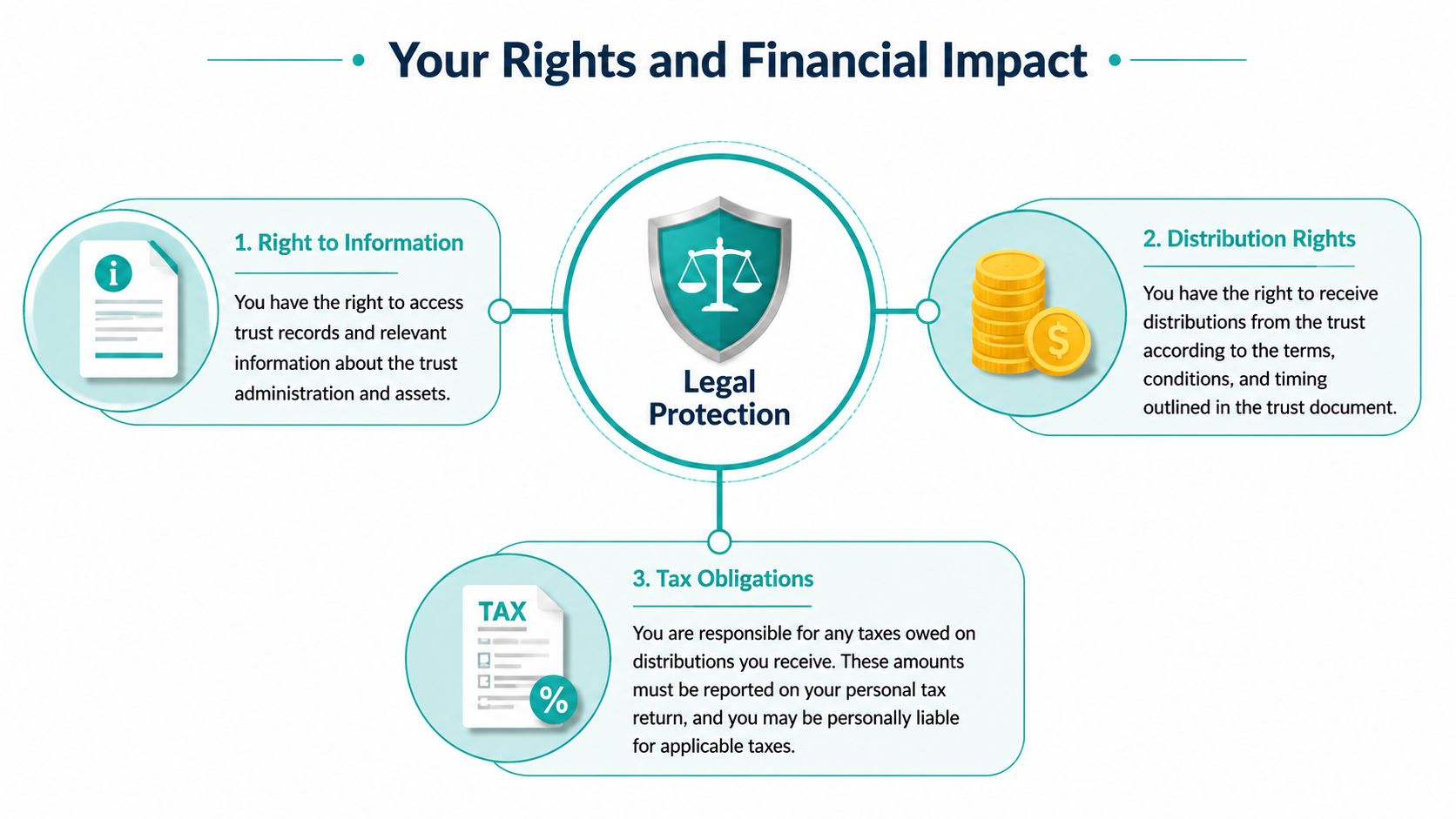
A beneficiary doesn't get to override the trust terms because they don't like a trustee's decision. But trustees do have obligations. They must administer the trust properly, keep appropriate records, and exercise discretion for a proper purpose.
If your concern is less about a simple disagreement and more about misuse of power, poor conduct by a decision-maker, or conflicts of interest, this article on how to spot financial misconduct is a useful general guide to fiduciary issues.
How the tax side actually works
Many beneficiaries get caught out in this situation. They receive money, assume it's tax-free because it came from a family trust, and only discover the problem at tax time.
In Australia, beneficiaries of discretionary family trusts sit within a specific tax framework under Division 6 of the Income Tax Assessment Act 1936. The verified data also notes a Section 102 test as a key technical specification in this context. From a planning perspective, advisers may use streaming resolutions under TR 2010/3 to direct franked dividends to lower-tax beneficiaries, with the verified data stating this can reduce overall family tax by up to 15% compared with a non-streamed approach. That same verified data states trustees must issue family trust distribution minutes by June 30 annually to avoid significant penalties.
Why trustee resolutions matter so much
The annual trustee resolution is not administration fluff. It determines who is entitled to trust income for the year and, in many cases, who carries the tax position attached to that income.
Done well, it can align distributions with the family's broader strategy. Done badly, it can create avoidable tax leakage, confusion, and challenge risk.
A clean year-end process usually includes:
- Reviewing the trust deed to confirm what the trustee can distribute and how.
- Identifying the likely beneficiaries for that year and their broader tax position.
- Preparing valid resolutions on time and keeping clear minutes.
- Matching accounting treatment to legal decisions so the paperwork and the numbers say the same thing.
Income isn't the same as capital
Another source of confusion is assuming every trust payment is the same. It isn't.
Some distributions reflect trust income. Others may be capital gains or capital distributions. Some carry franking credits or other tax attributes. The beneficiary needs to understand not just the amount received, but the character of what was distributed.
That's why I encourage beneficiaries to ask for proper annual documentation, not just a bank transfer and a casual explanation. The transfer tells you that money moved. The records tell you what happened legally and tax-wise.
Ask a simple question each year. “What was distributed to me, on what basis, and how should I report it?”
For many families, that question alone prevents years of muddled administration.
A related issue comes up on death benefits and estate flow. Trust planning often intersects with superannuation, and those assets don't automatically follow the same path as other estate assets. If that's part of your situation, it helps to understand what happens to super when you die.
Common Pitfalls and How to Avoid Them
Most trust problems aren't dramatic. They're administrative. A family keeps using the same structure for years, nobody reviews the deed, and a change in family circumstances makes the old setup unfit for purpose.
That's when a trust fund beneficiary discovers the difference between a structure that exists and a structure that works.

The mistakes I see most often
Outdated documents
A divorce, remarriage, business sale, or new child arrives, but the trust deed, appointor arrangements, or will stay untouched. The structure then reflects an old family, not the current one.Silent trustees
Trustees make decisions but don't communicate them clearly. Beneficiaries are left guessing whether they were considered, what they received, or why one year looks different from the last.Informal distributions
Money moves before decisions are documented, or family members blur personal and trust expenses. That creates trouble fast.Beneficiaries who ignore tax paperwork
Some beneficiaries focus only on cash received and overlook statements, resolutions, and return obligations. The tax issue doesn't disappear because the paperwork stayed unopened.
Better habits that protect families
The strongest trust arrangements usually follow a few basic disciplines:
Review after major life events
Don't wait for a dispute. Update structures when family, business, health, or succession circumstances change.Document every key decision
Trustees should record resolutions properly and keep accounts that match the legal position.Separate control from convenience
The person who is easiest to appoint isn't always the right long-term trustee or appointor.Treat beneficiaries like adults
Clear reporting reduces suspicion. Most family conflict grows in information gaps.
Good trust management is less about cleverness and more about consistency.
A simple beneficiary checklist
If you're a beneficiary, ask yourself:
- Do I know what type of trust I'm connected to
- Do I understand whether my interest is fixed or discretionary
- Have I received annual documentation that explains any distribution
- Do I know who controls the trust and who can replace them
- Have recent family changes made the current setup outdated
If the answer to several of those is no, the problem usually isn't the trust itself. It's that nobody has translated the structure into a practical governance process.
Your Next Steps with Wealth Collective
A trust fund beneficiary can benefit greatly from a well-built structure. They can also inherit unnecessary complexity if the trust is poorly drafted, badly governed, or never reviewed.
That is the fundamental dividing line. Trusts reward clarity. They don't reward assumptions.
If you're receiving money from a family trust, planning a testamentary trust through your will, or trying to work out how a beneficiary fits into your broader retirement and estate plan, it's worth getting advice before a small issue turns into a family or tax problem. Trusts touch investments, super, succession, control, and tax. They're too important to leave as a DIY afterthought.
The right next step is a short conversation that identifies what kind of trust you're dealing with, who controls it, what your rights may be, and where the tax risks sit.
If you'd like clear, practical advice specific to your situation, book a complimentary introductory call with Wealth Collective. Whether you're setting up a family trust, reviewing estate plans, or navigating life as a trust fund beneficiary, the team can help you make sense of the structure and move forward with confidence.