Business hours
Monday to Friday (8.30AM - 5PM)
Weekend (Closed)



You're sitting at the kitchen table in Perth, trying to work out whether extra money should go towards the mortgage, superannuation or insurance. Your partner is asking when you'll be able to retire, while you're wondering whether your current investment option still suits your family. A few searches produce plenty of opinions, but no clear answer for your circumstances.
That's the problem financial advice is designed to solve. It isn't a product recommendation or a complicated investment report. Good advice connects your goals, financial position and priorities into a practical strategy for building, protecting and eventually transferring wealth.

For a pre-retiree, the central question might be whether retirement in Western Australia is affordable and sustainable. For a young professional, it could be how to balance debt reduction with investing. For a family, the priority may be protecting income if illness or injury changes the plan.
This guide explains what is financial advice, where everyday guidance ends and regulated advice begins, and how to decide what level of help you need. It also shows how to assess digital tools, understand adviser regulation and prepare for an initial conversation with a Perth adviser.
Introduction to Financial Advice That Actually Makes Sense
Financial decisions rarely arrive one at a time. A new baby can change your insurance needs just as a mortgage changes your cash flow. A promotion can create new investment opportunities, while approaching retirement brings questions about superannuation, income and the Age Pension.
The difficulty isn't always a lack of information. Australians can find general explanations about budgeting, super, shares and insurance almost instantly. The difficulty is knowing which information applies to you, which decisions are connected, and when a seemingly simple choice could affect your longer-term security.
A useful starting point: financial advice should help you make better decisions, not make your money feel more mysterious.
Consider a couple approaching retirement near Perth. One person wants to keep working, the other wants to finish sooner. They have superannuation, a home, insurance and regular expenses, but they don't yet know how those pieces fit together. A general retirement article can explain concepts, but it can't assess their objectives, financial situation or needs.
That distinction matters because Australian regulation focuses on financial product advice, rather than treating every money conversation as the same type of service. Advice about superannuation, investments, insurance or retirement income may require a more formal process when it is designed for an individual.
Financial advice can also be useful much earlier than retirement. A young family might need help deciding whether to direct surplus cash towards the mortgage or super. A high-income earner may need an investment strategy that reflects their goals and risk tolerance. A small business owner may need personal insurance and a plan that separates business risk from household security.
The right approach isn't always a full financial plan. Sometimes education answers the question. Sometimes a general explanation gives you enough direction. Sometimes personal advice is worth paying for because the decision is significant, interconnected or difficult to reverse.
You'll finish this guide with a practical way to tell the difference and a clearer idea of what to ask before booking a conversation.
What Financial Advice Really Means in Australia
A Perth couple nearing retirement may face the same practical question from different starting points. One wants to keep working, while the other hopes to finish sooner. They have superannuation, a home, insurance and regular expenses, yet a general article cannot assess how those pieces fit their objectives, financial situation or needs.
Australian law draws an important boundary around financial advice. The phrase itself is not a defined legal term and can include conversations about budgeting, saving, investing, superannuation and possibly insurance. The regulated framework focuses on financial product advice, as explained in the Treasury's Quality of Advice Review.
A map and a GPS make the distinction clear. A map shows possible routes, but it does not know your starting point, destination or whether you need to avoid toll roads. A GPS uses that information to guide a particular journey.
Everyday money guidance works like the map. It can help you understand:
- Budgeting: how to organise income and expenses.
- Saving: how to build a cash reserve for known goals.
- Debt: how interest and repayments affect your choices.
- Education: what superannuation, insurance or investments generally do.
Financial product advice becomes regulated when a recommendation, opinion, interpretation or report is intended, or could reasonably be seen as intended, to influence a decision about a particular financial product or class of products. ASIC sets out this broad definition in Regulatory Guide 36.
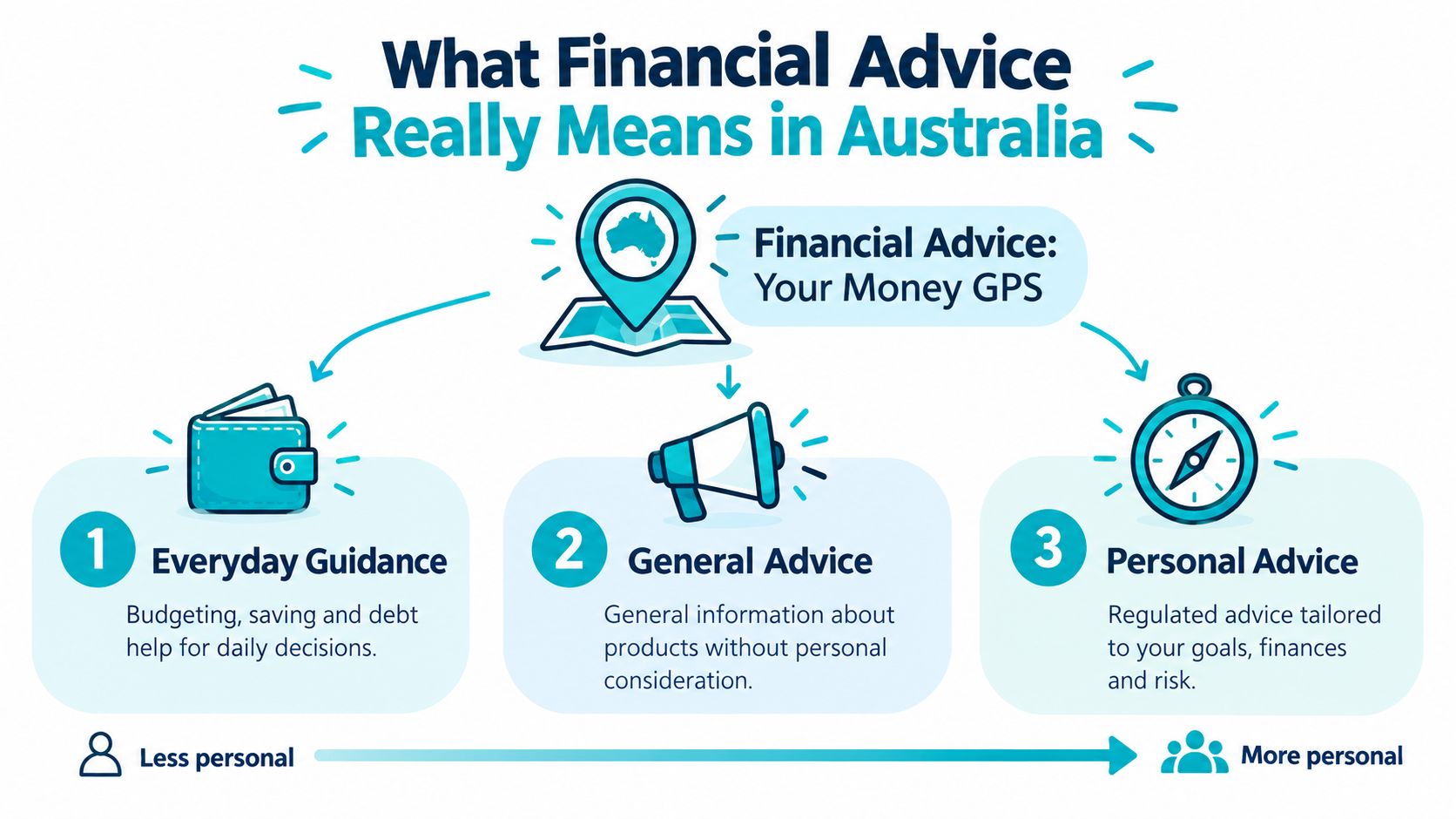
Three levels of help
Everyday guidance explains a financial topic and helps you organise your next question. It does not assess your circumstances, so it may be enough for learning or straightforward decisions. AI and general information can often serve this role.
General advice discusses a financial product without considering your objectives, financial situation or needs. It can explain how a product works, but you must decide whether it suits you.
Personal advice is specific to you. It considers at least one of your objectives, financial situation or needs and carries more formal obligations for the provider. It may be worth paying for when a decision affects several parts of your life, involves substantial money or would be difficult to reverse.
The same topic can fit different categories. “How does super work?” is educational. “Which option should I select for my circumstances?” may involve personal advice if the provider has considered your position.
Personal Advice Versus General Advice Explained
The most important question isn't whether someone is talking about money. Ask whether the provider has considered your objectives, financial situation or needs.
ASIC describes advice as personal when the adviser has considered at least one of those matters, or when a reasonable person would expect those matters to have been considered. All other financial product advice is general, according to ASIC's explanation of obligations when giving financial advice.
Consider two conversations about superannuation:
- A public presentation explains how investment options generally work. That's general information.
- An adviser reviews your age, balance, retirement timeframe and risk preferences, then recommends an option. That's personal advice.
The subject is similar, but the relationship between the information and your circumstances is different. The second conversation is designed to influence a decision for you.
Personal Advice vs General Advice at a Glance
| Feature | Personal Advice | General Advice |
|---|---|---|
| Personal circumstances | Considers one or more of your objectives, financial situation or needs | Doesn't consider those matters |
| Typical purpose | Recommends a strategy or product for your situation | Explains products or financial concepts broadly |
| Example | Assessing whether a retirement income strategy suits your goals | Explaining how retirement income products generally operate |
| Decision responsibility | The advice is tailored, but you still need to understand and agree with it | You decide whether the information is suitable |
| Documentation | Retail clients generally receive formal advice documentation where personal advice is provided | Documentation depends on the service and circumstances |
| Practical risk | The adviser must follow obligations relevant to the tailored recommendation | You may mistakenly treat broad information as a personal recommendation |
Retirement planning and strategic investment advice are commonly treated as personal advice because they depend on a client's objectives, situation and needs, as noted in Australian parliamentary material on adviser qualifications.
The distinction affects more than terminology. It changes the adviser's legal duties, disclosure requirements and the process used to assess suitability. It also helps you recognise when an online calculator, article or automated tool is providing education rather than telling you what to do.
Practical rule: if someone knows enough about your circumstances to recommend a specific financial product or strategy, ask what type of advice they're providing and what documentation you'll receive.
Who Benefits Most From Financial Advice and Why
A young Perth family may be weighing a mortgage, superannuation and insurance at the same time. A professional may be deciding how to use higher income during working years. Someone approaching retirement may be asking whether work can stop without creating an avoidable gap in income. The right level of help depends on the question, not on your age or wealth.
Australia has a substantial advice gap. ASIC's REP 224 found that fewer than 40% of Australian adults had ever used a financial planner, meaning about 60% did not access professional advice even using the most generous research estimates (ASIC REP 224). Separate Treasury evidence found that 27% of survey participants had previously received advice, 12% had done so in the previous 12 months, and 41% intended to seek advice in the future.
Industry evidence cited by the Financial Advice Association Australia also reported that 15.9 million Australians had unmet advice needs and 1.3 million planned to see an adviser within two years. These figures point to a practical problem: people often recognise a financial question before they know whether they need information, guidance or licensed personal advice.
Match the question to the help
Education may be enough when you are learning the basics. Reliable resources, calculators or AI tools can help explain super contribution types, insurance categories and common financial terms. They can prepare you for a conversation without deciding what is suitable for you.
Guidance may be appropriate for a straightforward decision that does not require a recommendation based on your complete circumstances. For example, you may need help preparing questions for your super fund or understanding terminology in a product document. You remain responsible for deciding what action to take.
Personal advice becomes more valuable when several choices affect one another. “Am I in the right investment option?” may depend on your timeframe, risk tolerance and retirement objective. “Can I afford to retire?” requires consideration of income, spending, assets and future needs. “Will I be eligible for the Age Pension?” depends on your circumstances and the relevant eligibility rules.
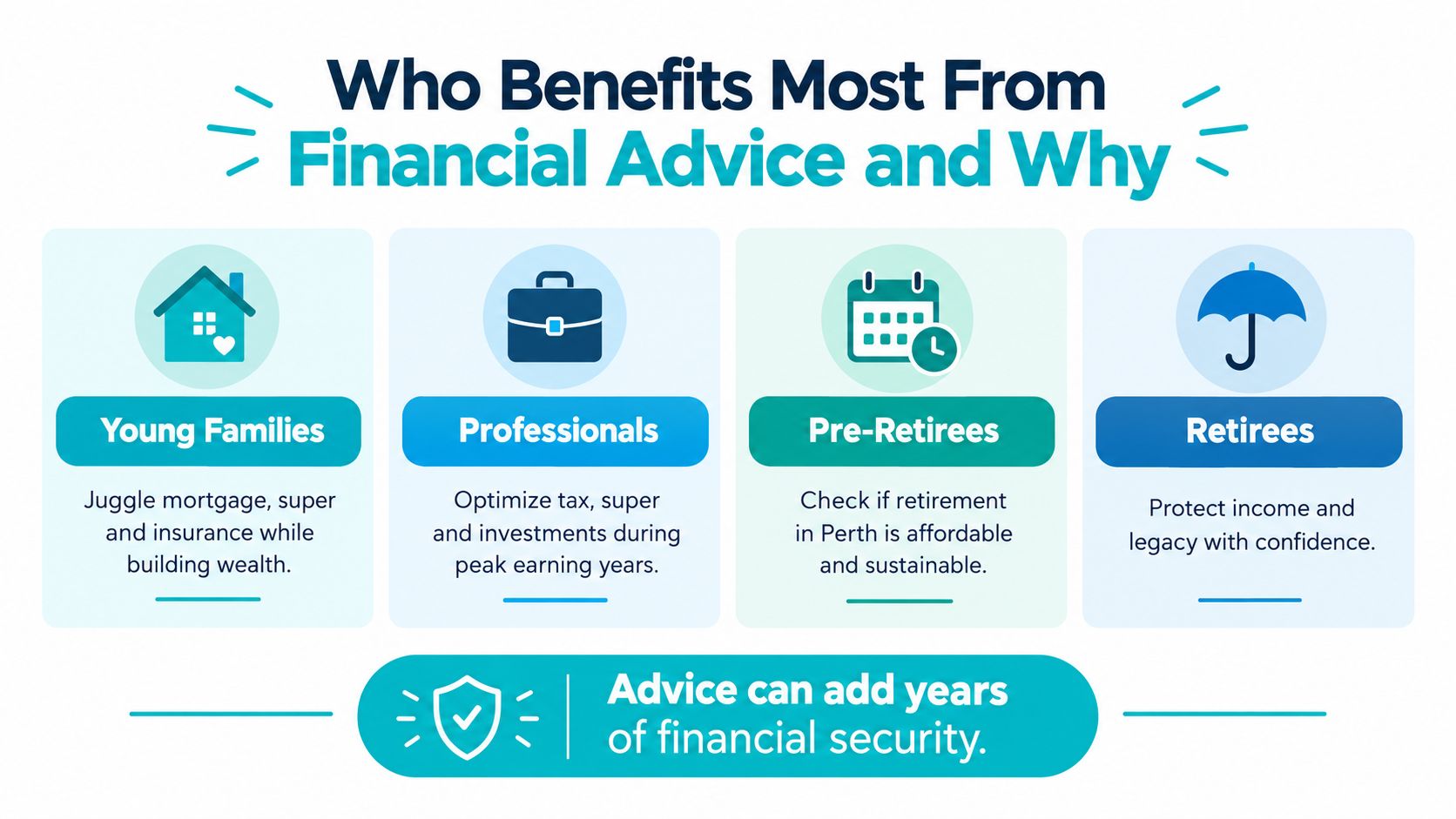
Personal advice earns its place when decisions are connected, consequential or difficult to assess calmly. A clear strategy can show the trade-offs between super, debt, insurance and retirement, rather than treating each choice as a separate task.
Wealth Collective's three service pillars, Protection Plus, Guided Growth and Retirement Roadmap, reflect these different needs. Start with the life question you are trying to answer, then choose the level of help that fits it.
What to Expect From the Wealth Collective Advice Process
A first conversation with an adviser shouldn't require you to arrive with a perfect financial plan. You only need a clear description of what's troubling you, what you're hoping to achieve and any decisions that feel urgent.
Wealth Collective's process begins with a free 10-minute introductory call. The purpose is to understand your needs and decide whether a more detailed conversation makes sense. You can use the call to explain that you're approaching retirement, trying to reduce debt, reviewing insurance or building an investment strategy.
From questions to a written strategy
The next stage is a discovery meeting and fact-find. An adviser gathers information about your goals, income, assets, debts, superannuation, insurance and relevant family circumstances. The detail matters because a recommendation about one area can affect another.
For example, increasing super contributions may need to be considered alongside mortgage repayments and cash-flow needs. Retirement planning may need to account for the timing of work, income requirements and access to relevant government support. Insurance recommendations need to reflect the people and obligations your income supports.
The adviser then develops a personalised strategy. Depending on your needs, it may cover:
- Protection Plus: personal insurance and protection against financial disruption.
- Guided Growth: superannuation, investment strategy and debt reduction.
- Retirement Roadmap: retirement timing, income planning and long-term sustainability.
The recommendations are presented in a Statement of Advice where required. This gives you a structured record of the strategy, the reasons for recommendations, relevant costs and important assumptions.
Implementation is a shared process
A written plan only becomes useful when you understand it and can act on it. The implementation stage may involve arranging applications, adjusting investments, reviewing insurance or putting a debt strategy into practice.
Ongoing support then helps you review the plan as your circumstances change. A new job, inheritance, relationship change, health issue or shift in retirement timing can all justify a fresh look.
You can read more about the financial planning process before making contact. Transparent communication and a satisfaction guarantee can also make the first step feel more manageable, especially if you're concerned about committing before you understand the service.
How Financial Advisers Are Regulated and Paid in Australia
Australian financial advice has become more formalised through major professional standards reforms. In 2017, the Financial Adviser Standards and Ethics Authority, known as FASEA, was established through the Corporations Amendment (Professional Standards of Financial Advisers) Act 2017 and declared the standards body in June that year. FASEA later ceased operation on 14 December 2021.
The reforms marked a modern shift towards higher education, ethics and professional standards for advisers. ASIC reported 15,663 registered advisers as at 1 March 2024, while its 2023–24 annual report listed 15,390 financial advisers. Treasury's Quality of Advice Review separately described the market as having about 16,000 advisers, as recorded in ASIC's financial advice sector report.
ASIC also oversees how advice businesses operate, including the boundary between general and personal advice. That supervision matters because consumers need confidence that recommendations are appropriately scoped and clearly explained.
Fees should be visible before decisions are made
For retail clients, personal advice generally requires a Statement of Advice. An ongoing fee arrangement can also trigger a Fee Disclosure Statement, which must be provided within 60 days of the disclosure day and must show the ongoing fees, the services the client is entitled to receive and the services received. The fee disclosure requirements are summarised in this financial services ethics and fee disclosure resource.
Ask an adviser to explain:
- what you'll pay for the initial advice,
- what ongoing services are included,
- whether implementation costs apply,
- how often reviews occur, and
- what happens if you stop the arrangement.
You can also review practical questions about financial advice fees in Australia before your initial conversation.
Where AI fits
Digital tools can help with education, calculations and organising questions. They can't automatically replace the judgement required for a personal retirement, insurance or investment decision.
Trust also varies by age. Australian research found that 68% of people aged 61 to 79 would not use an AI-powered financial advice tool, compared with 19% of people aged 18 to 28 (PwC Australia's advice gap research). For retirees, human discussion may be particularly important where income needs, Centrelink interactions, health concerns and legacy decisions overlap.
How to Choose the Right Financial Adviser for You
Start with the question you want answered. “Can I retire?” requires a different capability from “How should I review my insurance?” or “How do I build wealth while reducing debt?”
Use this checklist when comparing advisers:
- Relevant experience: Look for someone who regularly works with your life stage and financial decisions.
- Clear scope: Confirm whether the service covers superannuation, investments, insurance, debt or retirement planning.
- Transparent fees: Ask for the initial cost, ongoing cost and services included.
- Plain communication: You should be able to explain the proposed strategy back in your own words.
- Ongoing support: Find out how reviews work and who you'll contact when circumstances change.
- Professional standards: Check the adviser's authorisation, qualifications and disclosure documents.
Don't choose on price alone. The cheapest conversation may not address the decision that matters, while the most elaborate plan may be unnecessary for a narrow question. Fit, scope and clarity are more useful comparison points.
If your wider financial decisions include business structure or tax, it can help to compare accountants for your business alongside your adviser selection. For a focused guide to the adviser decision itself, see how to choose a financial adviser.
Before the initial call, write down your main question, your preferred timeframe and any documents or decisions causing concern. You don't need every answer prepared. A good first conversation should help identify whether education, guidance or personal advice is the sensible next step.
Wealth Collective helps Perth and Dunsborough clients connect superannuation, insurance, investments, debt and retirement planning through Protection Plus, Guided Growth and Retirement Roadmap. Visit Wealth Collective to book the free 10-minute introductory call and turn your most pressing money question into a clear next step.