Business hours
Monday to Friday (8.30AM - 5PM)
Weekend (Closed)



A lot of people first ask about an SMSF when they open their super statement and feel underwhelmed. The balance may be growing, but the investment options feel generic, the fees feel hard to unpack, and there's a nagging sense that someone else is making decisions that should matter more to them.
That instinct is understandable. Wanting more control over your retirement savings is not reckless. In many cases, it's the start of asking better questions. The important one isn't just whether you can move your super. It's whether you want to take on the work that comes with being in charge of it.
Taking Control of Your Super Your Introduction to SMSF
A common scenario looks like this. A couple in their fifties has built decent super balances across a few old funds. They're thinking seriously about retirement, maybe selling a business in coming years, maybe buying a premises through super, maybe wanting more say over shares, cash, or property exposure. They start searching for one answer: what is self managed superannuation fund, and is it the smarter option?
An SMSF, or self-managed super fund, is a private super fund run by its members, who also act as trustees. In Australia, an SMSF can have up to 6 members, and the sector is already a major part of the system. ATO-based figures reported by SuperGuide show 653,062 SMSFs in June 2025, with more than 1.2 million members and $1.05 trillion in assets, representing about 24% of the $4.33 trillion invested across Australian superannuation overall, according to these SMSF sector statistics.
That tells you two things.
First, SMSFs are not fringe. Plenty of Australians use them.
Second, popularity doesn't make them suitable for everyone.
An SMSF gives you control, but it also removes the buffer between you and the legal consequences of a poor decision.
That's the part many people miss. An SMSF is not a better version of a retail or industry fund by default. It's a different model entirely. You stop being a member who chooses from a menu, and you become part of the management team responsible for the whole structure.
For the right person, that can be powerful. For the wrong person, it becomes an expensive administrative project with tax and compliance risk attached. The difference usually comes down to temperament, balance size, investment purpose, and whether you're prepared to run your retirement savings with the discipline of a small regulated entity.
What an SMSF Really Is Beyond the Bank Account
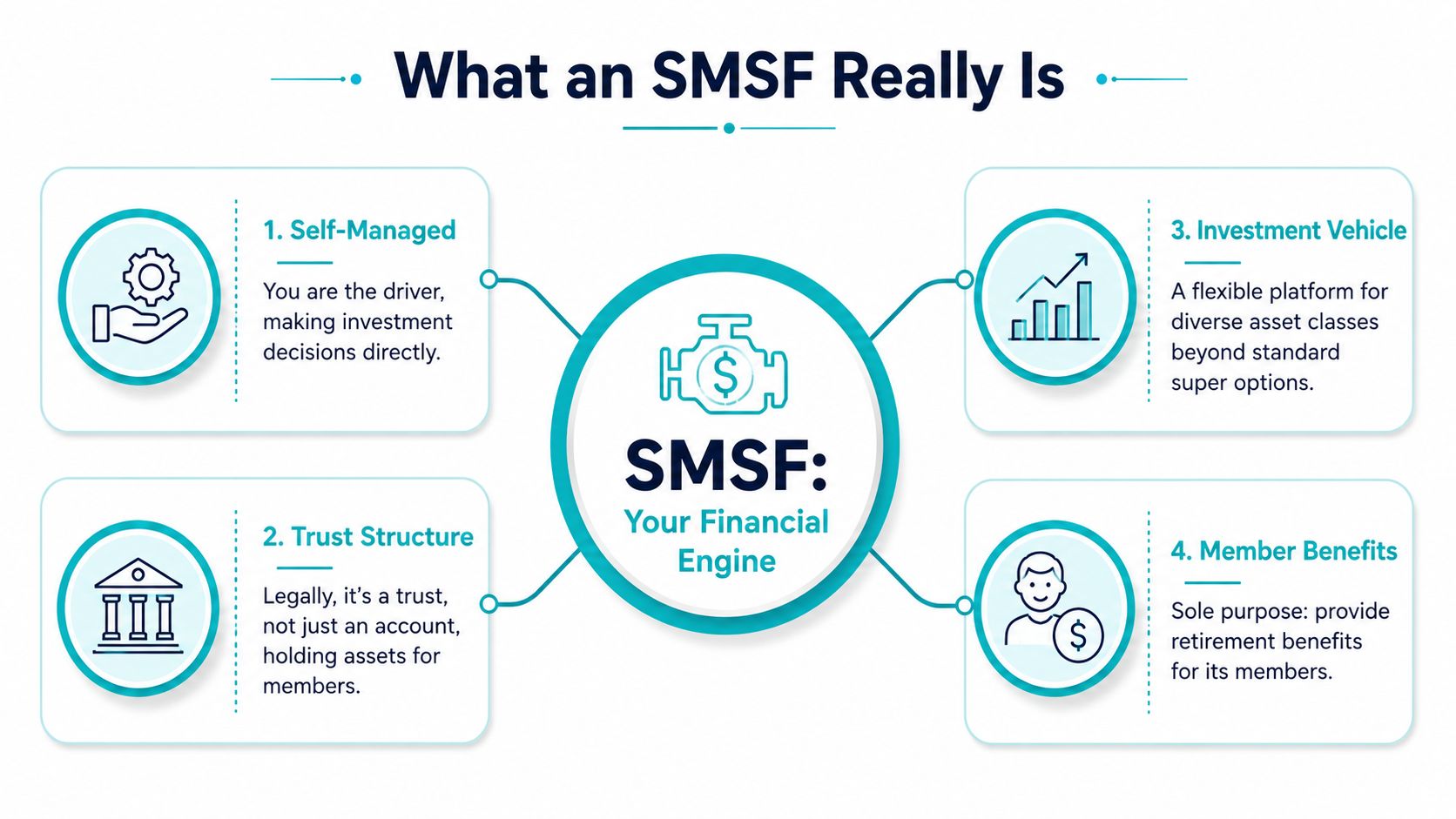
An SMSF is often described as a super fund. Legally and practically, that description is too thin. A better way to understand it is this: an SMSF is a small, tightly regulated trust structure you run for the sole purpose of providing retirement benefits.
That shift in framing matters. If you think of it as just another account, you'll underestimate the work. If you think of it as a structure you operate, the obligations make more sense.
Member and trustee are not the same job
In most super funds, you are the beneficiary and somebody else handles governance, reporting, administration, and regulatory oversight. In an SMSF, the same people who benefit from the fund also carry the responsibility for it.
Moneysmart explains that an SMSF is a privately run superannuation trust where members are also trustees, or directors of a corporate trustee. It also notes that an SMSF can have up to 6 members, and each member generally must act as a trustee or director. That means the people with the upside also carry the legal obligations around investments, reporting, and compliance, as outlined on Moneysmart's SMSF guide.
In plain English, you wear two hats:
- Member means you're entitled to the retirement benefits.
- Trustee means you're legally responsible for how the fund is run.
That second hat is the one people tend to gloss over.
The structure is the point
When someone says they want an SMSF, they often mean they want more investment choice. Direct property. Specific shares. More control over timing. A customized retirement income plan.
Those goals may be valid, but they sit inside a legal framework. The fund needs a trust deed. It needs trustees or a corporate trustee. It needs a bank account in the fund's name. It must operate under super law, keep records, and follow its own governing rules.
Practical rule: If the phrase “I just want control” is doing all the work in your reasoning, slow down. Control without governance is where SMSFs go wrong.
This is why I describe an SMSF as a retirement business. Not a business that sells goods or hires staff, but a business in the sense that there are records to maintain, rules to follow, decisions to document, and people accountable when something slips.
What changes when you move to an SMSF
The biggest change isn't the investment menu. It's your role.
With an industry or retail fund, you usually delegate most of the operational burden. With an SMSF, you become responsible for things such as:
- Investment governance by setting and reviewing an investment strategy
- Insurance decisions rather than defaulting to a fund's standard arrangements
- Administration flow including records, documents, and transactions
- Compliance oversight so the fund keeps meeting its obligations
Poor record-keeping, weak controls, or prohibited decisions can turn a useful structure into a compliance problem. That's why the question “what is self managed superannuation fund” is really a question about responsibility, not just access.
The Rules of the Game Investments Tax and Compliance
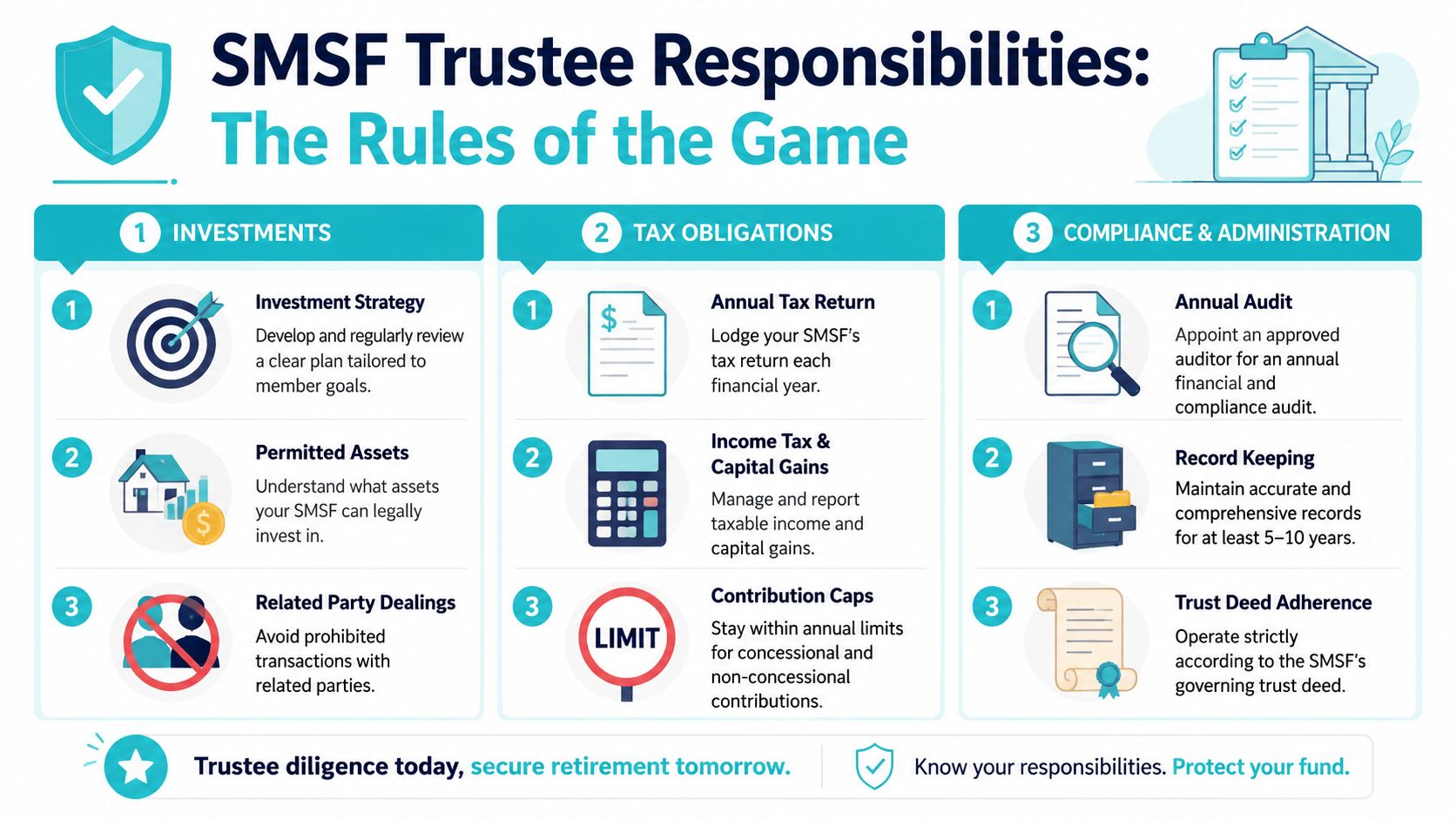
Once an SMSF is established, the day-to-day reality comes down to three moving parts. Investments, tax, and compliance. They're connected. A decision that looks smart from an investment angle can still fail if it breaches super rules or creates avoidable administration problems.
Investments need a legal purpose
An SMSF gives you flexibility, but not freedom to do anything you like. Trustees need to act within super law, the trust deed, and the fund's investment strategy. The central idea is that the fund must be run for retirement purposes, not for present-day personal benefit.
That matters most when people start looking at assets they can see and touch. Direct property often attracts strong interest because it feels concrete. It can make sense in some situations, but only if the structure, borrowing rules, related-party rules, liquidity position, and long-term strategy all line up. If property is on your radar, this guide to buying property in an SMSF is worth reading before you go further.
A practical mistake is choosing an asset first and trying to force the fund to fit around it. The safer approach is the reverse. Define the retirement objective, confirm the rules, then decide whether the asset belongs in the fund.
Tax rewards good structure, not shortcuts
Tax is one of the reasons people look at SMSFs, but it shouldn't be the only reason. A tax outcome is only useful if the fund remains compliant and the investment still makes sense commercially.
Good SMSF tax management usually depends on clean records, clear segregation between personal and fund affairs, and decisions made in the right order. Trustees who chase a tax idea without understanding the operational consequences often create more work than value.
That principle isn't unique to super. It's common to all trust structures. For readers wanting a broader trust perspective, especially if you've dealt with family trusts or estates overseas, this article on help for Texas families managing trusts is a useful parallel on how trusteeship is really about process, duty, and proper administration.
Compliance is the non-negotiable part
Many trustees often lose momentum. The investment side is interesting. The paperwork isn't. But the paperwork is what keeps the structure alive and effective.
An SMSF has an ongoing compliance cycle. That generally includes:
- Maintaining records so transactions, decisions, and valuations can be supported
- Preparing accounts and reporting for the fund each year
- Arranging an independent audit as part of the annual process
- Monitoring contributions, payments, and documentation so the fund operates properly
Good SMSF management is usually boring. The trustees who stay out of trouble are the ones who treat administration as part of the investment process, not an annoying extra.
If you're not prepared to run the back office properly, the investment flexibility won't save the structure.
Weighing the Decision Key Benefits vs Significant Risks
The appeal of an SMSF is real. So is the downside. Both need to be looked at carefully, because this is one of those financial decisions where the same feature can be both an advantage and a liability.
Where an SMSF can work well
Control is the obvious benefit, but the useful version of control is specific. Not abstract. The right trustee usually wants to choose exact investments, coordinate family balances within one structure, manage cash deliberately, and align the fund with a wider retirement plan.
That can be especially relevant when the goals don't fit neatly inside a standard menu. You may want a more deliberate asset mix, more visibility over transactions, or a strategy built around a known retirement timeline rather than a generic option selected years ago.
Other practical advantages can include:
- Customized investment implementation when off-the-shelf fund menus feel too restrictive
- Shared decision-making for couples or family members who want one structure to manage
- Clearer oversight of what the super fund owns and why it owns it
Those benefits matter, but only when the trustees have the discipline to use them properly.
Where people underestimate the risk
The least understood part of an SMSF is who carries the risk when something goes wrong. It's not a product issuer. It's not a distant trustee company. It's the members themselves.
Commonwealth Bank's guidance makes this point clearly. An SMSF is a private super fund run by its members, who are also the trustees, and they are legally responsible for decisions, compliance, record-keeping, and tax obligations. It also notes the practical burden of trusteeship, including the trust deed, the fund bank account, and the annual reporting and audit cycle, in this discussion of whether an SMSF is right for you.
That changes the risk equation. The upside of autonomy comes with concentrated accountability.
An SMSF is not simply an investment choice. It's an agreement to personally oversee a regulated structure.
The trade-off in plain language
Here's the cleanest way to think about it.
If you want convenience, broad diversification through managed options, and minimal administration, an APRA-regulated fund may be the better fit.
If you want to take responsibility for governance, can stay organised, and have a reason that goes beyond “I don't like fees”, an SMSF may be worth exploring.
A fuller discussion of SMSF pros and cons can help if you're somewhere in the middle and trying to test your own reasoning rather than just confirm a preference you already have.
Is an SMSF Right for You A Suitability Checklist
The right question isn't “Can I set up an SMSF?” In most cases, you can. The better question is whether the structure suits your balance, your habits, your goals, and your willingness to keep doing the work after the novelty wears off.
Start with the economics
The ATO reported that the median total annual cost of running an SMSF was $8,611 in 2020–21, and Australian Retirement Trust notes that many SMSF costs are fixed or semi-fixed. It also says independent research and industry analysis often identify around $200,000 as a minimum viable balance for better cost efficiency and investment flexibility, as explained in its overview of what an SMSF is.
That doesn't mean every fund below that level is wrong or every fund above it is right. It means the balance has to be large enough to carry the overhead without undermining diversification, liquidity, and flexibility.
Ask yourself:
- Can the fund absorb fixed costs comfortably without making the structure poor value?
- Will enough capital remain diversified after accounting for cash, tax, and expenses?
- Are you joining balances with another member for a clear reason, or just trying to reach a number?
Then test your operating style
A surprising number of unsuitable SMSFs start with a perfectly reasonable investment idea and fail on administration. The issue isn't intelligence. It's follow-through.
An SMSF may suit you if you're the sort of person who keeps records, reviews decisions, reads documents, and acts before deadlines become urgent. It may not suit you if you avoid paperwork, leave tax matters until late, or dislike ongoing financial administration.
A practical self-check:
Interest
Do you want to manage super decisions, or are you mainly frustrated with your current fund?Time
Are you prepared for recurring tasks, document requests, reviews, and sign-offs year after year?Decision quality
Can you separate conviction from concentration risk, especially when one asset or one idea feels compelling?Purpose
Do you have a genuine strategic use for an SMSF, such as a customized investment approach, family coordination, or a specific retirement objective?
Compare structure before emotion
The table below keeps the choice grounded.
| Feature | Self-Managed Super Fund (SMSF) | Industry / Retail Fund |
|---|---|---|
| Control | High control over investment decisions and fund operation | Limited to the options and settings offered by the provider |
| Legal responsibility | Members as trustees carry responsibility for decisions, records, and compliance | Provider and professional trustees handle most governance obligations |
| Administration | Ongoing trustee administration, reporting, and audit process | Most administration is handled for you |
| Cost structure | Costs tend to include fixed or semi-fixed components, so scale matters | Costs are generally embedded in the fund's fee structure |
| Investment menu | Broad flexibility, subject to super law and fund rules | Curated menu determined by the fund |
| Suitability | Better for engaged, organised trustees with a clear strategic reason | Better for people who prefer delegation and convenience |
A useful final filter
If your main motivation is “I want more choice”, pause there. Choice by itself isn't a strategy.
If your motivation is “I want a structure that fits a specific retirement plan, and I'm prepared to run it properly”, you're asking the right question.
That distinction matters more than enthusiasm. In practice, the strongest SMSF candidates tend to be people who understand that the structure isn't there to make super exciting. It's there to make retirement planning more deliberate.
Your Next Steps From Learning to Launching with Confidence
An SMSF can be a strong structure. It can also be the wrong one for people who want the benefits of control without the ongoing discipline of trusteeship.
That's why the setup decision matters so much. Once you establish the fund, open the accounts, move money, and start implementing the strategy, the structure becomes part of your broader financial life. Reversing a poor decision is usually harder than preventing one.

A sensible next step is to pressure-test the idea before doing anything formal. That means checking whether the fund size is workable, whether the investment reason is strong enough, whether insurance and estate planning have been considered, and whether the ongoing admin load matches how you operate.
For people who do want guidance through that process, Wealth Collective can help assess suitability and map the setup path, including the trust structure, investment framework, and the practical steps involved in getting a fund established. If you want to see what that process looks like, this guide on how to start a self-managed super fund is a useful place to begin.
The best SMSF decisions usually happen before the paperwork starts. Once the structure is in motion, clarity matters more than confidence.
If you're still weighing it up, that's not hesitation. It's good judgement. An SMSF should be chosen because it fits your retirement strategy and your capacity to run it well, not because it sounds more impressive than a standard super fund.
If you want to talk through your situation with a human adviser, book an initial call with Wealth Collective. It's a simple way to test whether an SMSF belongs in your retirement plan, or whether a different structure would serve you better.