Business hours
Monday to Friday (8.30AM - 5PM)
Weekend (Closed)


You probably already know estate planning matters. The sticking point is usually timing.
It often gets pushed aside until a parent gets sick, a friend dies unexpectedly, or someone in the family realises that no one knows where the documents are, who's in charge, or whether the super goes where everyone assumes it will. That's usually the moment people start searching for what's estate planning and discover it's much bigger than writing a will.
For most Australians, estate planning is less about legal theory and more about reducing pressure on the people you love. It gives clear instructions, names decision-makers, and helps your finances keep working the way you intended if life stops going to plan.
Estate Planning Is More Than Just a Will
Mark and Elise are in their early 50s. They've done many of the right things. They've built super, paid down the mortgage, and started talking about retirement. Then Elise's father has a health scare, and the family spends days trying to work out who can speak to the bank, who can make medical decisions, and where the paperwork is.
That's when the true meaning of estate planning clicks.
It isn't only about what happens after death. It's also about what happens if you're alive but can't act for yourself for a period of time. That could follow illness, injury, cognitive decline, or a sudden medical event.

The confusion most people have
Many people think estate planning means one document. In practice, that's where families get caught out.
A frequently missed angle is incapacity planning, not just death planning. The practical questions are often who can pay bills, manage superannuation, and make medical decisions if you lose capacity. That's why Australian estate plans commonly need powers of attorney and health directives alongside a will, as explained in this discussion of estate planning and incapacity planning.
Estate planning is a plan for decision-making, not just a plan for inheritance.
If you only have a will, you may have covered one part of the problem. You may still have left your family exposed during a living crisis.
A practical way to think about it
Think of estate planning as a set of instructions for two different seasons of life:
- If you die: who receives assets, who handles the estate, and how your affairs are wrapped up.
- If you lose capacity: who steps in to handle money, legal issues, health care, and day-to-day decisions.
- If your assets are complex: how super, insurance, property, and business interests line up with those instructions.
That's why a good plan feels less like paperwork and more like care. It saves your family from guessing. It reduces conflict. It gives people authority before they need to use it.
If you want to understand the practical fallout of leaving this undone, this article on what happens if you don't have a will is a useful starting point.
The Core Components of Your Australian Estate Plan
A complete estate plan works like a personal board of directors. You're choosing who gets authority in different situations, because no single document does every job.
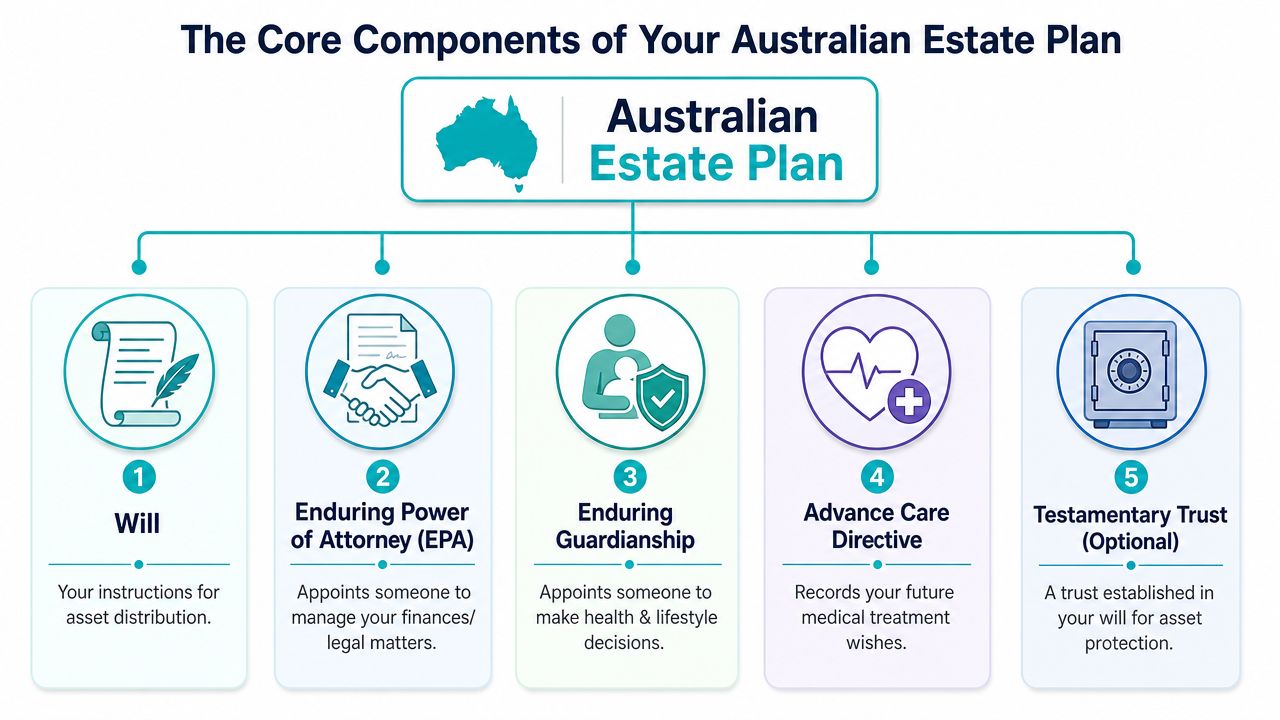
In Australia, the technical core of estate planning is not just a will. It's a coordinated set of documents that allocates decision-making across death and incapacity, typically including a will, enduring power of attorney, and health or medical directives, so control is maintained if a person can no longer act for themselves, as outlined in this overview of what estate planning involves.
Your will
Your will speaks after death.
It sets out who should receive your estate assets and who should act as executor. If you have children, it can also record guardianship wishes. This is usually the document people think of first, and it's important, but it doesn't give anyone authority while you're still alive.
A useful way to frame it is simple: your will is your after-death instruction sheet.
Your enduring power of attorney
Your enduring power of attorney deals with financial and legal decisions if you lose capacity.
That can include paying bills, signing documents, handling property matters, and dealing with institutions on your behalf. If no one has that authority when it's needed, families can find themselves blocked at exactly the wrong time.
This is one of the biggest mindset shifts in answering what's estate planning. It's not only about passing on wealth. It's about preserving control when you can't personally act.
Your health and medical directions
Your health directive and related appointment documents cover medical treatment and personal care decisions.
These documents help answer questions such as:
- Who speaks with doctors if you can't communicate clearly
- What treatment preferences matter to you if serious decisions arise
- Who can make lifestyle and care decisions if you need support over a longer period
For many families, this is the most emotionally valuable part of the plan because it removes guesswork.
Practical rule: If a loved one had to step in tomorrow, they should know both what you want and whether they have legal authority to do it.
Optional layers for more complex families
Some households need more than the basics. A testamentary trust, for example, may be considered where asset protection, control over distributions, or family complexity are bigger concerns.
That doesn't mean everyone needs every possible document. It means your plan should match your life. A single person with straightforward assets won't need the same structure as a business owner, a blended family, or a retiree with multiple asset types.
The simplest way to stay organised
If you're trying to get your head around the paperwork, a plain-English guide to estate planning can help you understand which documents usually sit together and why.
A strong estate plan isn't a pile of forms. It's a coordinated system where each document has a clear job, and each person you appoint knows their role.
Why Your Superannuation Needs Special Attention
Superannuation is where many Australian estate plans go off track.
People often assume their will controls everything they own. But super usually sits in a different legal structure. It's generally held by a super fund, and that means the payment process after death doesn't always follow the will in the way people expect.
Why a will may not control your super
This is the point that surprises people most. You can have a well-drafted will and still have a gap if your super arrangements don't match it.
Super is too important to treat as an afterthought. The Australian Taxation Office reported that super assets reached $4.1 trillion in the March 2025 quarter, which shows how large this pool has become for Australian households, as noted in this summary on the scale of superannuation assets.
That matters because for many people, super may be one of the largest assets they leave behind.
The role of the trustee
Your super fund trustee often has a role in deciding how death benefits are paid, subject to the rules of the fund and the governing nomination in place.
That means estate planning around super is often more technical than people expect. The will matters, but it may not be the controlling instruction for that asset.
A better way to think about it is this:
| Asset type | What often controls it |
|---|---|
| Estate assets | Your will |
| Superannuation | Fund rules and your nomination |
| Jointly held assets | Ownership structure |
That's why a family can be shocked to discover that “we covered that in the will” doesn't settle the issue.
What a binding nomination does
A Binding Death Benefit Nomination is designed to direct the trustee about who should receive your super death benefit, subject to the fund's rules and legal requirements.
If you haven't reviewed that nomination in years, or if your life has changed since you filled it out, your broader estate plan may not be saying what you think it is.
Common triggers for a review include:
- Relationship changes such as marriage, separation, divorce, or remarriage
- Family changes such as children, stepchildren, or dependants entering the picture
- Asset changes where super becomes a larger share of household wealth
- Retirement transition when income streams and beneficiary choices become more important
If you want a clearer explanation of the mechanics, this guide to what happens to super when you die is worth reading.
Superannuation isn't a side note in Australian estate planning. For many households, it's the centre of the map.
Common and Costly Estate Planning Mistakes to Avoid
The biggest estate planning mistakes usually don't come from bad intentions. They come from assumptions.
People assume a will covers every asset. They assume the forms they signed years ago still line up. They assume their partner or adult children can “just handle it” if something happens. That's where expensive messes begin.
The mismatch problem
For Australian households, the highest-risk failure mode is mismatched ownership structure. If asset registers, beneficiary nominations, and appointment documents aren't aligned, the estate can face delays, disputes, or unintended transfers because the legal pathway depends on how each asset is held, as explained in this article on estate planning workflow and ownership mismatch.
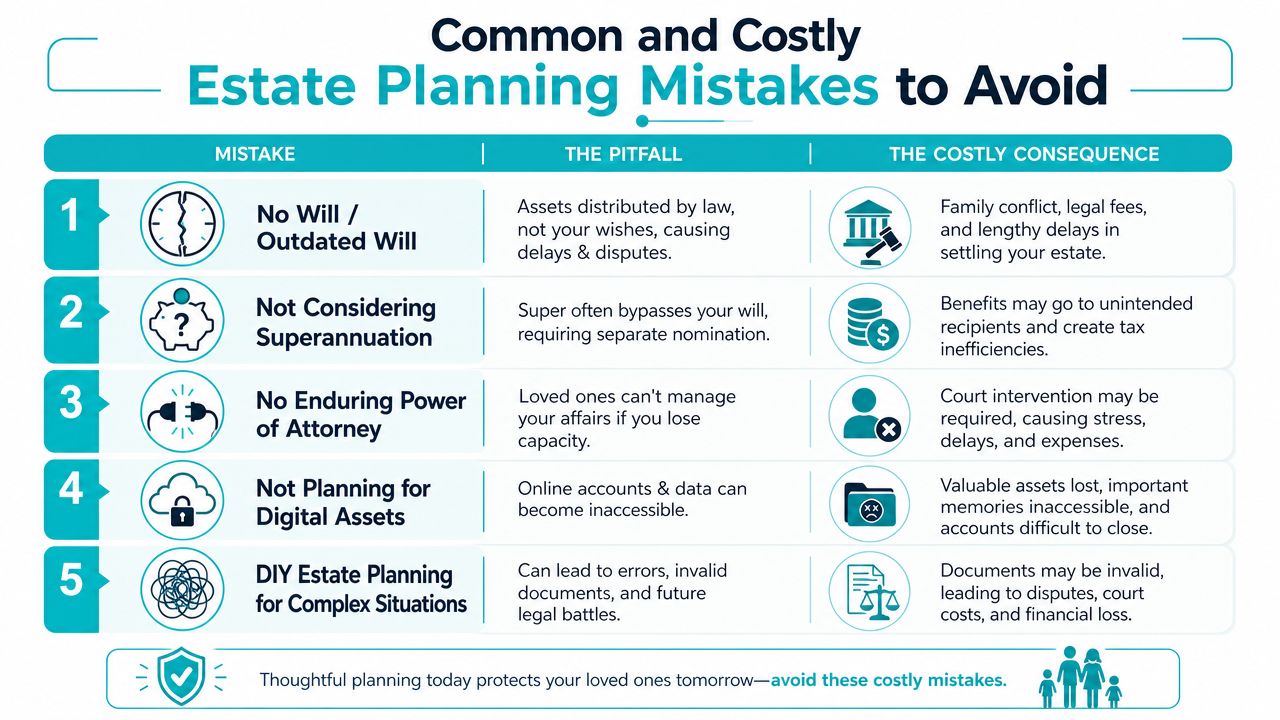
Here's what that looks like in plain English. Your will says one thing. Your super nomination says another. A property is owned jointly. An insurance policy has an outdated beneficiary. The family thinks the plan is simple, but the legal routes are all different.
Five mistakes that show up again and again
Relying on a DIY document for a non-DIY life
If you have a blended family, a business, meaningful super, or complex ownership, a basic template can miss important moving parts.Forgetting incapacity planning
A will does nothing for you during a medical crisis. If no one has authority to act, the family can be left scrambling.Choosing the wrong executor or attorney
The right person isn't always the eldest child or the nearest relative. You need someone organised, steady, and capable of following instructions.Failing to update after major life events
Divorce, remarriage, children, inheritances, property purchases, and business changes can all make an old plan unfit.Ignoring digital and practical records
If no one can find account details, passwords, policy documents, or your key contacts, even a good legal plan becomes hard to use.
A neat folder of outdated documents can create just as much trouble as having no folder at all.
A quick stress test
Ask yourself these four questions:
- Do my will and super nominations point in the same direction?
- Does someone have authority to act if I lose capacity?
- Have I reviewed my plan since my last major life event?
- Could my family find what they need?
If any answer is “not sure”, that's not a small issue. It's a sign the plan needs attention.
The cost of these mistakes isn't only financial. Families lose time, energy, and trust while trying to decode what should have been clear.
Why Estate Planning Matters at Every Stage of Life
A lot of people still think estate planning starts when you're older, retired, or wealthy enough to worry about “the estate”. That idea doesn't hold up in real life.
The better question isn't whether you have enough wealth. It's whether other people would need clear instructions and legal authority if something happened to you.
Young adults and growing families
If you're building your career, buying your first home, or raising children, estate planning already matters.
The issues are immediate. Who would step in for your children? Who could manage money if one partner became seriously ill? How would debts, insurance, and ownership be handled? Even if your balance sheet feels modest, your responsibilities may not be.
The same logic applies to people who think they're too young or their affairs are too simple. Age, health, and wealth aren't good reasons to delay. Life-stage triggers such as having children, buying a home, starting a business, or receiving an inheritance are often the key moments when planning becomes necessary, as outlined in this discussion of why you're not too young, poor, or healthy for estate planning.
Midlife and business ownership
By midlife, the picture usually becomes more layered.
You may have super, a mortgage, investments, insurance, school-aged children, ageing parents, or a business interest. That means your plan needs to do more than divide assets. It needs to support continuity.
A business owner might need succession planning. A couple in a second marriage may want to protect each other while keeping fairness across children from different relationships. A family with one high earner may need to focus on income protection and decision-making authority.
Pre-retirement and later life
Estate planning becomes even more visible as retirement approaches. In Australia, the 2021 Census counted 4.2 million people aged 65 and over, or 16.3% of the population, and the ABS has projected that this share will keep rising as the population ages, according to this summary of Australian estate planning and ageing trends.
That shift matters because more households are dealing with wealth transfer, capacity concerns, aged care decisions, and family support all at once.
If you or your parents are in a downsizing phase, practical organisation matters too. This guide on organizing for your senior move is useful because sorting belongings, records, and future living arrangements often reveals gaps in the broader estate plan.
The right time for estate planning is usually just before life gets more complicated, not after.
Your Simple Checklist to Get Started
The hardest part is usually starting. People assume they need all the answers before they talk to anyone. You don't.
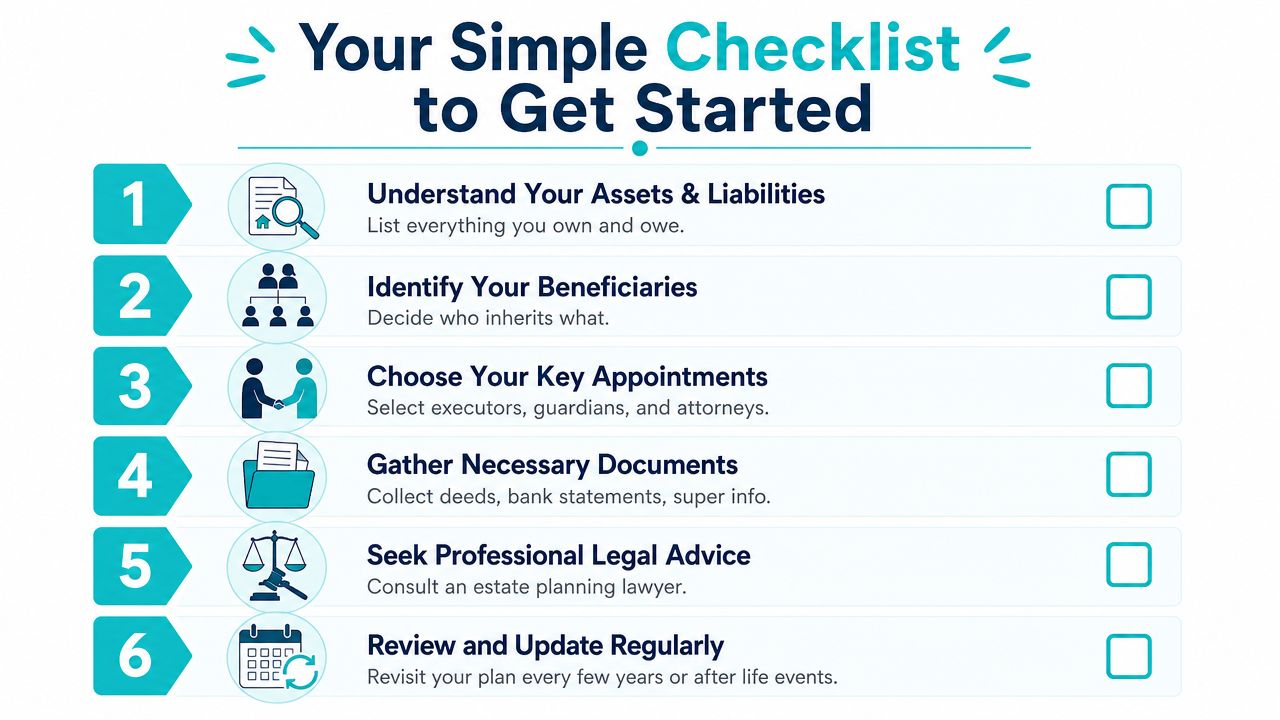
A useful first pass is to get organised. You're not trying to draft legal documents on your own. You're trying to make the next conversation productive.
Start with your facts
Write down a basic list of what you own and what you owe.
Include the obvious items such as your home, bank accounts, super, insurance, and investments. Then add the easy-to-miss items, such as business interests, online accounts, loans, and where key documents are stored.
Then think about people
Before legal wording comes decisions about trust.
Consider:
- Who would act as executor after your death
- Who could manage financial matters if you lost capacity
- Who could make health decisions if needed
- Who should benefit from your assets
- Who would care for children or dependants if that applies to you
These choices aren't only about closeness. They're about judgement, reliability, and willingness to act.
Write down your preferences
You don't need polished legal language. Plain notes are enough at this stage.
A short list might include:
- who you want to provide for
- whether certain assets should stay in the family
- any concerns about vulnerable beneficiaries
- your medical treatment preferences at a high level
- anything you definitely don't want to happen
Have one conversation
Talk to the people most likely to be affected.
That doesn't mean announcing every financial detail. It means reducing surprises. If someone may become your executor, attorney, or decision-maker, they should at least know you're considering them.
Book advice before there's urgency
Estate planning is much easier when no one is in crisis.
Bring your notes, questions, and rough list of assets. A good first meeting should leave you clearer, not more confused. The aim is to turn scattered intentions into a workable plan.
How a Financial Adviser Builds Your Complete Plan
Estate planning works best when it's treated as part of your financial life, not as a separate legal errand.
A financial adviser helps connect the moving parts. That includes your super, insurance, investments, cash flow, debt position, retirement goals, and the way assets are owned. Once those pieces are clear, legal documents can be structured to support them rather than accidentally conflict with them.
The adviser's role in the process
A good adviser often acts like a coordinator.
They can help you identify gaps, flag mismatches, prepare information for the solicitor, and make sure your nominations, ownership structures, and broader financial strategy are pulling in the same direction. That's especially helpful when retirement planning, risk protection, and intergenerational wealth transfer are all happening at once.
What a complete plan usually looks like
Rather than treating estate planning as one meeting and one document, a stronger process tends to include:
- Asset mapping so you know what sits inside and outside your estate
- Super and beneficiary review so your nominations support your wishes
- Risk review so insurance and emergency planning fit the family picture
- Retirement alignment so drawdown plans and transfer goals don't clash
- Ongoing review after major life changes
If you're still working out who to trust with that process, this article on how to choose a financial advisor can help you ask better questions.
Estate planning doesn't have to feel like a legal maze. When it's built into a broader financial plan, it becomes much simpler. It turns into a practical system for protecting people, preserving choices, and transferring wealth in a way that reflects your values.
If you want help turning scattered documents and good intentions into a coordinated plan, Wealth Collective can help. Their advisers work with Australians at every life stage to connect super, insurance, retirement planning, and wealth transfer into one clear strategy. If you're ready to get started, book a free, no-obligation 10-minute introductory call and begin with a simple conversation.