Business hours
Monday to Friday (8.30AM - 5PM)
Weekend (Closed)


If you own a business with one or more partners, there's a question worth answering before the next busy week, the next client issue, or the next health scare. What happens if one of you can't work tomorrow?
Not in theory. In real life.
A partner dies. A partner suffers a disabling injury. A partner survives a serious medical event and can't keep contributing. The invoices still need to go out. Staff still expect direction. Clients still want certainty. At the same time, someone's spouse or estate may suddenly own an interest in the business, and the remaining owners may need cash they don't have.
That's where buy sell agreement insurance stops being a technical insurance topic and starts being a business survival tool. Done properly, it acts like a business partnership parachute. You hope you never need it. But if the partnership hits violent air, it gives everyone a safer landing.
What Happens the Day Your Partner Cannot Work
You're sitting in the office on a normal Tuesday. One partner is due in at 9. Instead, you get a call from their family. There's been an accident. Or a diagnosis. Or worse.
Within hours, the emotional shock turns into commercial pressure. Who signs documents? Who controls the shares? Who pays the family for the partner's stake? If there's no plan, those questions don't stay theoretical for long.
I've seen business owners focus heavily on growth, tax planning, debt, staffing and expansion, yet leave this one issue vague. That's risky. If you don't have a written agreement and funding in place, the remaining owners may be forced to borrow, inject personal cash, negotiate under stress, or work alongside family members who never expected to be part of the business.
A properly structured buy sell arrangement changes that dynamic. It sets out what happens if an owner exits because of death, disablement or serious illness, and it provides a funding path so the transfer can happen.
If you're not sure where this sits within your broader cover needs, start with a practical review of small business insurance requirements in Australia. Most owners are underestimating how connected succession risk is to the rest of their protection planning.
Practical rule: If the business would struggle to buy out a partner without selling assets or taking on debt, you need this sorted now, not later.
Why Every Partnership Needs a Financial Safety Net
A business partnership without a funded exit plan is like flying without an emergency procedure. Everything feels fine until it isn't.
That's why I think of buy sell agreement insurance as a business partnership parachute. It gives owners a controlled way to land when one person is forced out unexpectedly. Without it, people improvise under pressure, and improvisation is expensive.
What this insurance actually does
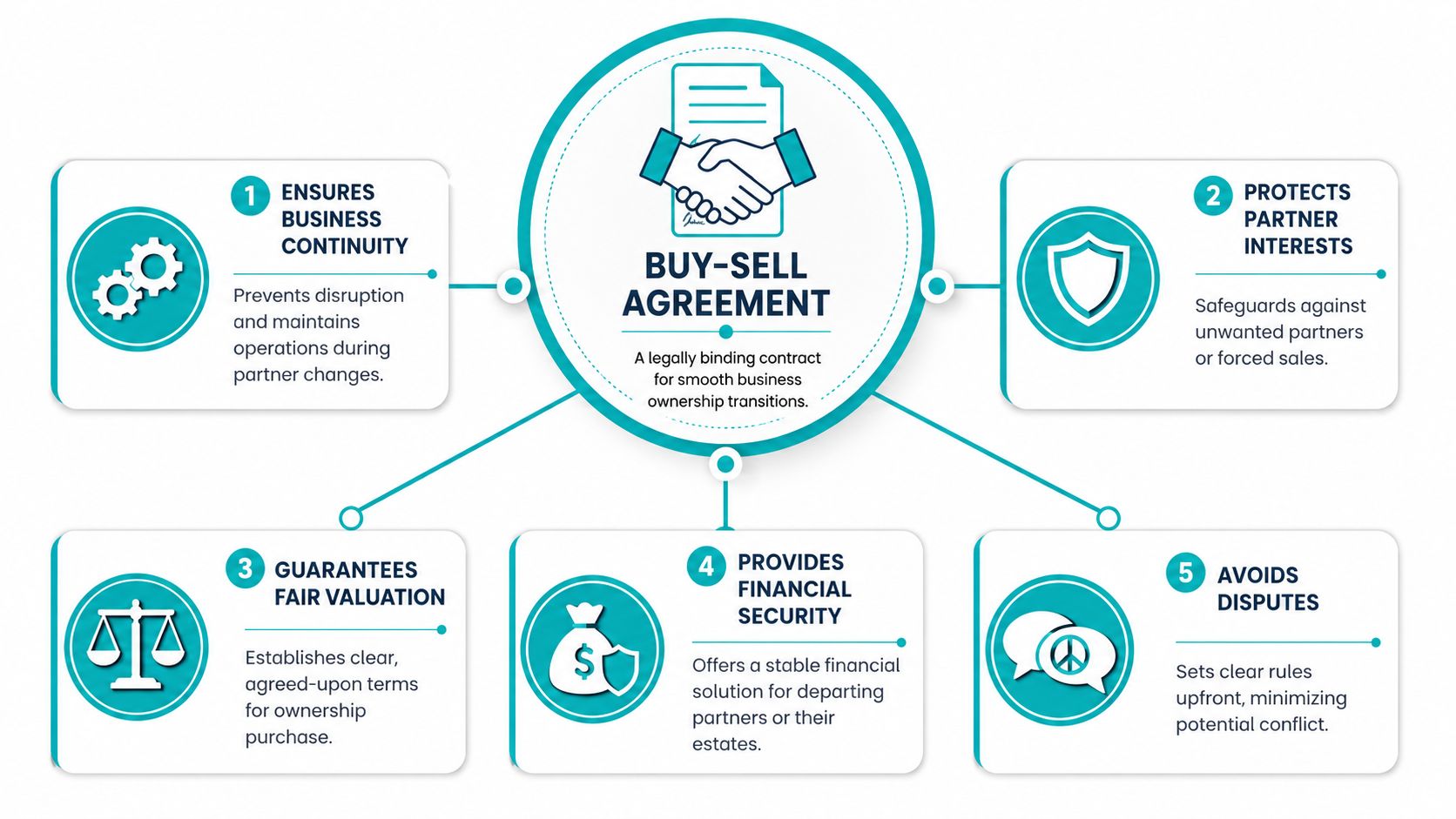
In Australia, buy-sell insurance is specifically designed to fund the transfer of a business share from a departing co-owner to remaining partners, covering three critical risk triggers: death, total and permanent disablement (TPD), and critical illness (trauma), ensuring the business continues with minimal disruption according to Arthur J. Gallagher Australia's buy-sell agreement overview.
That matters because a legal promise without money behind it is only half a plan.
The agreement says who must buy, who must sell, and how the price gets determined. The insurance provides the liquidity to make that happen when emotions are high and time matters.
The disasters it helps prevent
When owners skip this planning, the same problems show up again and again:
- Forced funding decisions: The remaining owners may need to borrow, sell assets, or tip in personal money just to complete a buyout.
- Unwanted ownership outcomes: A spouse, estate, or family member can end up holding equity in a business they don't run.
- Price fights: If no one agreed on valuation mechanics upfront, everyone argues when they're least able to think clearly.
- Operational drift: Leadership gets distracted by ownership conflict while the business still has to trade.
A good buy sell agreement protects both sides. The continuing owners get stability, and the exiting owner or their family gets a fair path to payment.
Why I call it non-negotiable
If you have multiple owners, this isn't optional admin. It's core risk management.
Its value isn't just the policy payout. It's the combination of clarity, liquidity and control. The remaining owners know what they have to do. The estate knows what it will receive. Staff and clients see continuity instead of chaos.
And there's another point many owners miss. This isn't only about death. A long-term disability or major medical event can be just as disruptive, and in some businesses more complicated, because the person is still alive, still an owner, but no longer able to contribute at the same level.
That's why every serious partnership should have a documented buy sell arrangement, proper insurance funding, and regular review. If you've built a business with someone, you owe each other more than goodwill and a handshake.
Funding Structures Cross Purchase vs Entity Redemption
Once you accept the need for a funded agreement, the next question is practical. Who owns the policy, and who receives the money?
Most arrangements sit in one of two camps. A cross-purchase agreement means the owners insure each other and buy the exiting owner's interest directly. An entity redemption agreement means the business owns the policies and buys back the departing owner's interest itself.
Neither structure is automatically right. The best one depends on your ownership mix, administration tolerance, tax advice, and legal drafting.
The practical difference
With a cross-purchase structure, each owner is directly part of the funding arrangement. That can work neatly in smaller businesses with a limited number of owners.
With an entity redemption structure, the business handles ownership of the cover and receives the proceeds. That's often administratively simpler, especially as the ownership group grows.
If you're also trying to understand the mechanics of ownership transfer itself, this guide on how to buy out a business partner gives a useful practical frame for the commercial side of the conversation.
Comparison of Buy-Sell Agreement Funding Structures
| Feature | Cross-Purchase Agreement | Entity Redemption Agreement |
|---|---|---|
| Policy ownership | Individual owners hold policies on each other | The business entity owns policies on the owners |
| Who buys the departing owner's interest | The remaining owners buy the shares or units directly | The business redeems or buys back the ownership interest |
| Administration | Can become more complex as owner numbers grow | Usually simpler to administer centrally |
| Premium handling | Premium cost can be uneven between owners depending on age and health | Premiums are generally managed by the business |
| Balance sheet impact | Proceeds typically stay outside the operating entity | Proceeds flow into the business before the buyout occurs |
| Best fit | Often suits smaller ownership groups | Often suits businesses wanting a centralised structure |
When cross-purchase makes sense
Cross-purchase is often cleaner where there are only a few owners and each person wants direct control over the arrangement.
It can also feel more intuitive. The surviving owners receive the funds and use them to acquire the outgoing owner's stake. There's a direct line between the insurance payout and the transfer of ownership.
That said, complexity grows quickly when more owners join. More people can mean more policies, more administration, and more moving parts to update when ownership changes.
When entity redemption makes sense
Entity redemption can be easier to manage day to day. The company owns the cover, pays the premiums, and acts under the agreement when a trigger event occurs.
That simplicity appeals to many business owners. But simple administration doesn't remove the need for strong legal and tax advice. Ownership, beneficiary design, premium treatment and the agreement itself all need to line up.
The right structure is the one that still works after a death, a diagnosis, a valuation dispute, and a tax review. Convenience at setup isn't enough.
My recommendation
Don't choose a structure because it sounds tidy. Choose one because it fits the business you run.
For a small group of founders, cross-purchase can be very effective. For a larger ownership base, entity redemption may be easier to manage. But whichever route you take, get the legal deed, insurance ownership and tax advice coordinated at the same time. Piecemeal planning is where expensive mistakes start.
Matching Insurance Policies to Trigger Events
A buy sell agreement doesn't fund itself. The engine behind it is usually a combination of insurance policies matched to specific trigger events.
That matching has to be deliberate. If the agreement says one thing and the insurance covers something else, the whole arrangement can fail when it matters most.
The trigger events that matter
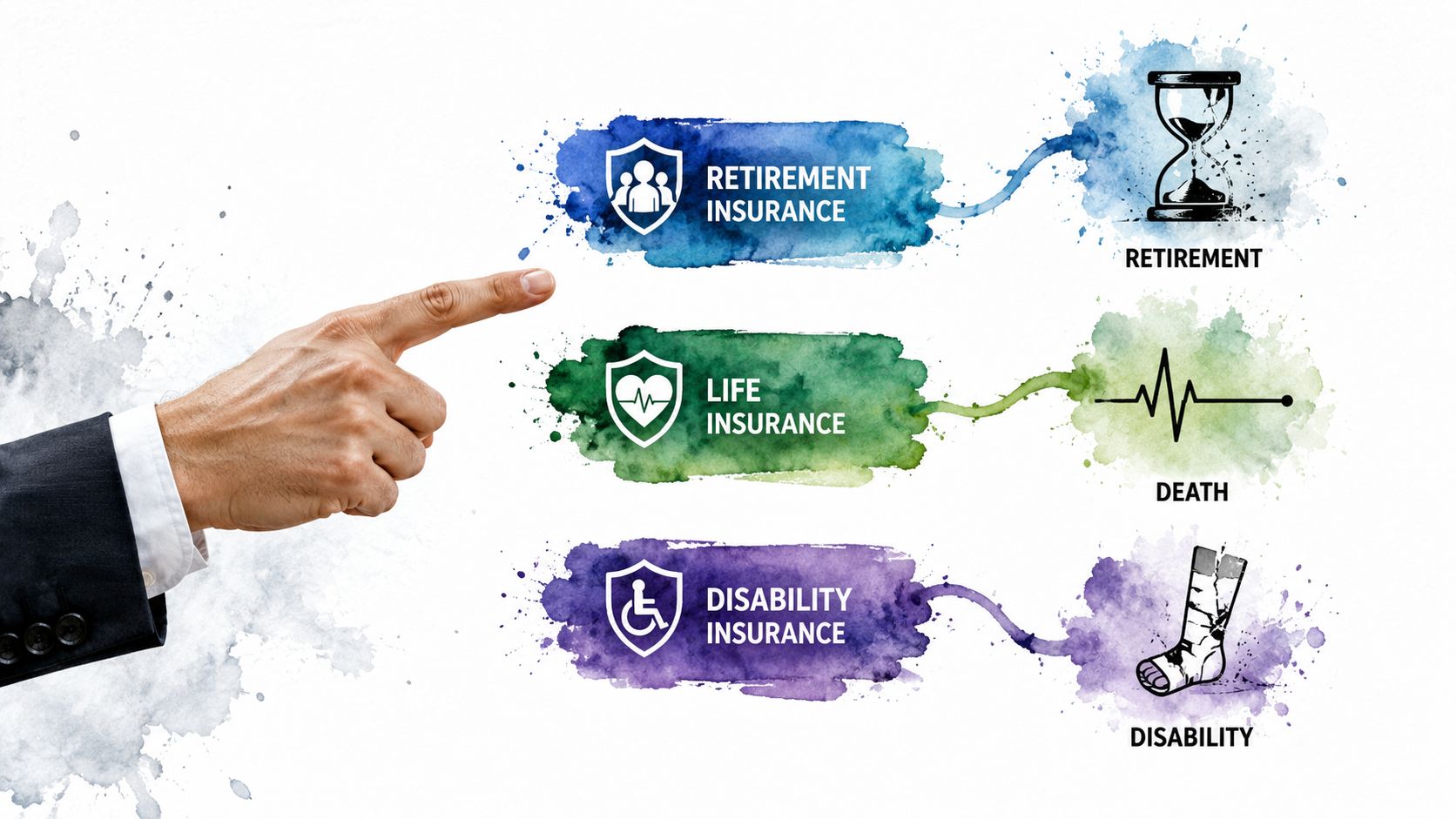
In Australia, the insurable events that commonly trigger obligations in an insurance-funded buy sell arrangement are death, terminal illness, total and permanent disability, and critical illness (trauma), as outlined in this CommInsure overview of buy-sell agreements.
Each trigger points to a different insurance need.
Which policy does what
- Life insurance covers the death of an owner. If a partner dies, the policy provides the cash needed to complete the buyout and pay the estate.
- TPD insurance responds when an owner is permanently unable to work due to illness or injury. In many businesses, this is every bit as disruptive as death.
- Trauma insurance helps fund a buyout after a serious medical event such as a major illness. It's designed for scenarios where the owner survives but can't continue in the same role.
A lot of owners only insure for death. That leaves a dangerous gap.
In practice, long-term disablement or serious illness can create more negotiation, not less. The owner may still need value extracted from the business, but the business still needs a clean path forward. That's why a broader insurance package usually makes more sense than relying on life cover alone.
Why alignment matters
The wording in the deed must line up with the policy terms. Trigger definitions matter. Ownership matters. Beneficiaries matter.
If you're also reviewing broader risk cover around founders and revenue protection, it's worth understanding how key person insurance works because it solves a different problem. Key person cover protects the business from the loss of a critical contributor. Buy sell agreement insurance funds the transfer of ownership. Both can matter, but they are not the same thing.
The cleanest arrangements treat insurance as a funding tool attached to a legal obligation, not as a standalone product purchase.
Valuation Tax and Legal Realities in Australia
Many arrangements look fine on paper and then break under scrutiny. The weak points are usually valuation, drafting, and tax structure.
Valuation needs discipline
In Australian buy/sell agreements, the sum insured must generally equal the current value of each owner's share of the business and requires an annual review to update this figure, according to this CommInsure buy-sell cover note.
That annual review isn't bureaucratic box-ticking. It's there to stop underfunding.
If the business grows and the cover stays stale, the payout may no longer be enough to buy the departing owner's share. The remaining owners then have to find extra capital, borrow, or renegotiate under pressure. None of those are good outcomes.
Trigger wording can make or break a claim
There's also a drafting issue that business owners often underestimate. The trigger events in the deed need to be clearly defined. One source notes that in Australian buy/sell agreements the trigger events are strictly defined as death, terminal illness, total and permanent disability, or critical illness, and that ambiguity in drafting can void the insurance payout and leave the estate without liquidity, as discussed in this Riskinfo resource on buy-sell cover.
That's a harsh outcome. It's also avoidable.
A loose deed, a policy that doesn't mirror the agreement, or a valuation formula no one updates can turn a sensible succession strategy into an ownership dispute.
SMSFs are not the shortcut
Many owners once looked at super as a neat funding path. The ATO shut that door.
The Australian Taxation Office (ATO) issued ATO ID 2015/10, explicitly ruling that Self-Managed Super Funds (SMSFs) cannot purchase life insurance policies to satisfy buy-sell agreement conditions if such a purchase contravenes the 'sole purpose' test of section 62 of the Superannuation Industry (Supervision) Act 1993 (SISA), as set out in ATO ID 2015/10.
That means you need to structure ownership outside the SMSF environment. Depending on the arrangement, that may be at shareholder level, entity level, or through another appropriate structure guided by legal and tax advice.
The grey area owners should confront early
One under-discussed issue is the idea of a growth cushion. Some guidance mentions covering projected growth over a future period, but there's often a lack of clarity around whether the policy funding and agreement mechanics will support that future value when a claim happens, as noted in this Affluens information sheet on buy-sell agreements.
That's why I prefer practical discipline over wishful drafting:
- Use a clear valuation method
- Review the business value regularly
- Match the insured amount to that value
- Test whether the legal wording and policy wording align
If you're thinking about succession more broadly, this is closely tied to your business exit strategy planning. A buy sell agreement isn't separate from exit planning. It's one of the most important parts of it.
A Practical Guide to Setting Up Your Agreement
You don't need to do this alone, but you do need to move it from “we should sort that someday” to a defined process.
Start with alignment between owners
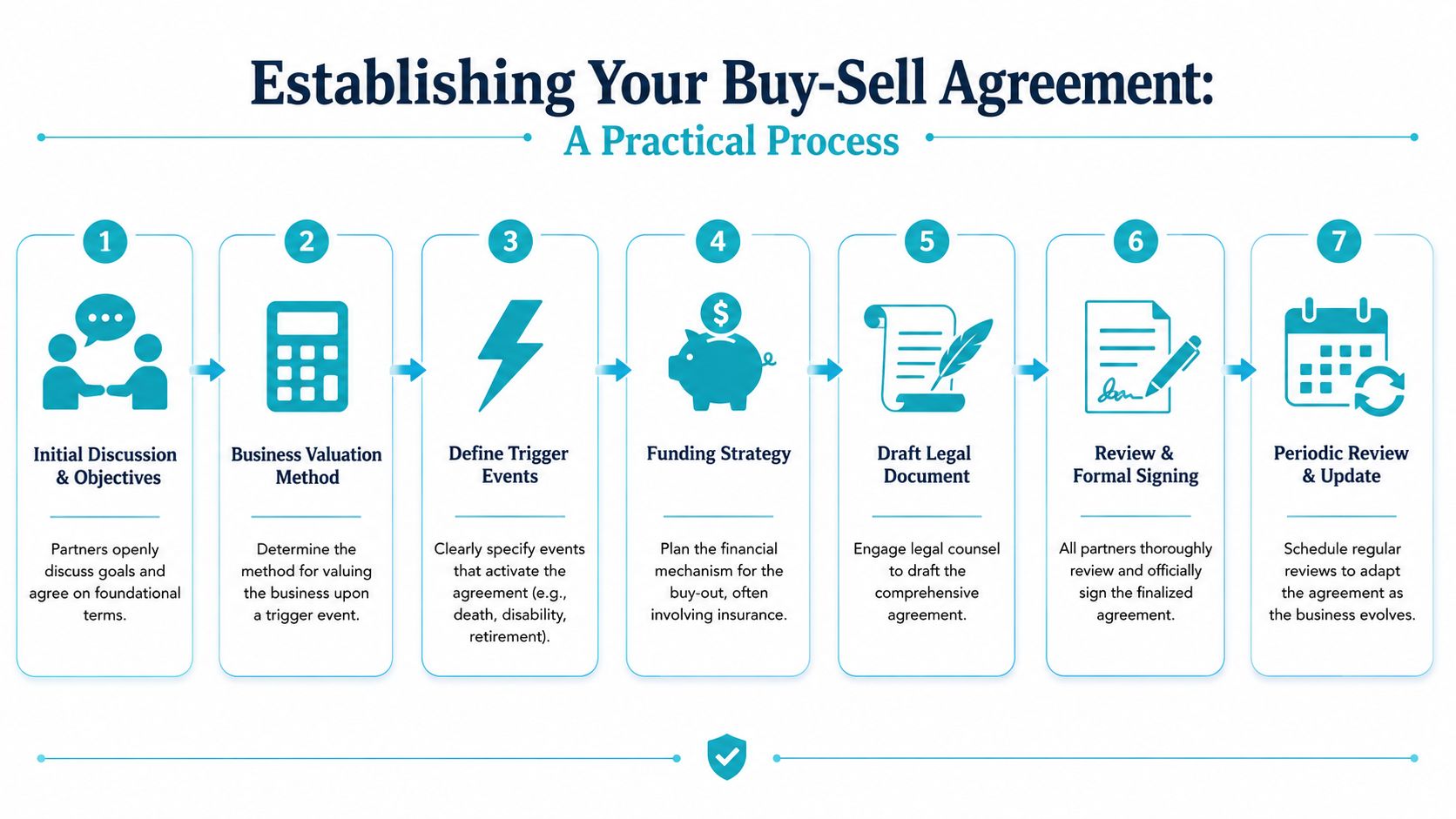
Before anyone speaks to an insurer, get the owners in a room and agree on the fundamentals.
Talk through what should happen if someone dies, becomes permanently disabled, suffers a major illness, retires, or otherwise exits. If the owners can't agree on principles, no legal document will save the process later.
Then build the structure properly
A solid setup usually follows this order:
Agree on objectives
Decide whether the main aim is continuity, family protection, fairness of price, control of ownership, or all of the above.Engage the right professionals
You need a financial adviser, a solicitor, and usually an accountant involved. This is not a DIY document download job.Determine valuation methodology
Decide how the business will be valued at a trigger event, and how often that valuation will be updated.Draft the legal deed
A standalone buy-sell deed is often preferred in Australia because it keeps insurance and option mechanics cleaner and allows detail around valuation methods, deferred payment interest rates, and security instruments like share pledges, according to Sprintlaw's guide to buy-sell agreements in Australia.
Put funding behind the document
After the legal framework is clear, implement the insurance.
That means applying for the right cover, making sure policy ownership matches the chosen structure, and checking the beneficiaries and trigger wording carefully. Rushing these steps often leads to arrangements failing.
Get the deed and the insurance built together. If you do one without the other, you risk ending up with paperwork that can't be funded, or policies that don't support the deed.
Review it before it goes stale
Once it's signed, schedule regular review points.
Businesses change. Profit changes. Ownership changes. Valuation changes. If the agreement and cover don't change with the business, the protection gradually weakens while everyone assumes it's still fine.
Secure Your Business Legacy with Expert Guidance
A buy sell agreement is one of those things that feels easy to defer because the trigger events are uncomfortable to think about. That's exactly why so many business owners leave it too late.
My view is simple. If you own a business with other people, a properly drafted and funded buy sell arrangement is part of responsible ownership. It protects your family, your partners, your staff and the business you've all worked hard to build.
It also needs to be done properly. Not vaguely discussed. Not half documented. Not funded with the wrong ownership structure. Properly.
That's where experienced advice matters. The legal document, insurance funding, ownership structure, valuation method and tax implications all need to work together. If one part is off, the agreement may not deliver when the pressure is highest.
For business owners who want this handled clearly and professionally, this kind of planning fits squarely within Wealth Collective's Protection Plus approach. The focus is practical: identify the risk, structure the solution, and keep it aligned as the business evolves.
If you're not sure whether your current setup would hold up under a real claim, that's the right place to start. A short conversation can often reveal whether you've got a solid parachute or just the appearance of one.
If you'd like clear advice on protecting your business, your family and your succession plan, book a free introductory call with Wealth Collective. It's a simple first step to work out whether your current buy sell agreement insurance is fit for purpose, or whether it needs attention before life makes the decision for you.