Business hours
Monday to Friday (8.30AM - 5PM)
Weekend (Closed)


You're close to retirement, your super balance is doing a bit better than it used to, and you don't want to spend evenings comparing shares, bonds, and property trusts one by one. That's exactly where a managed fund starts to make sense. It gives you a way to access a diversified portfolio without having to make every investment decision yourself, which is why it's so often part of retirement planning in Australia.
For many Australians, the question isn't whether managed funds exist. It's what is a managed fund, how does it work, and what are the hidden trade-offs behind the simplicity? The answer sits in the structure, the fees, the tax treatment, and the way the fund is run. Those details matter more as you get closer to retirement because small differences in cost, control, and reporting can affect the plan you eventually rely on.
Introduction to Managed Funds for Australian Investors
A lot of people first notice managed funds when they start trying to simplify their finances. They've built up super, maybe some savings outside super, and they want growth without turning investing into a second job. In that setting, a managed fund can look like a tidy solution, because one product can bundle diversification, professional oversight, and administration into a single structure.
That convenience is real, but it can also hide the details that matter most. A fund is not just “a basket of investments”. It is a legal and operational structure, and the way it is built affects ownership, pricing, tax reporting, and how much control you have over the assets inside it.
Practical rule: if a product sounds simple, check what you actually own, how the manager is paid, and how you're taxed before you commit.
For Australians who are planning retirement or still building wealth, that distinction is important. Wealth Collective's advice process often starts with the same question clients ask themselves, what role should a managed fund play in the wider plan? The answer depends on whether the fund fits your risk tolerance, cash flow needs, super position, and desired level of involvement.
This guide walks through the structure, the benefits and drawbacks, the tax and super implications, and how managed funds compare with ETFs and direct investing. It also connects those ideas back to practical planning, including where services like Protection Plus, Guided Growth, and Retirement Roadmap can help turn product choice into a broader strategy.
Understanding What a Managed Fund Is
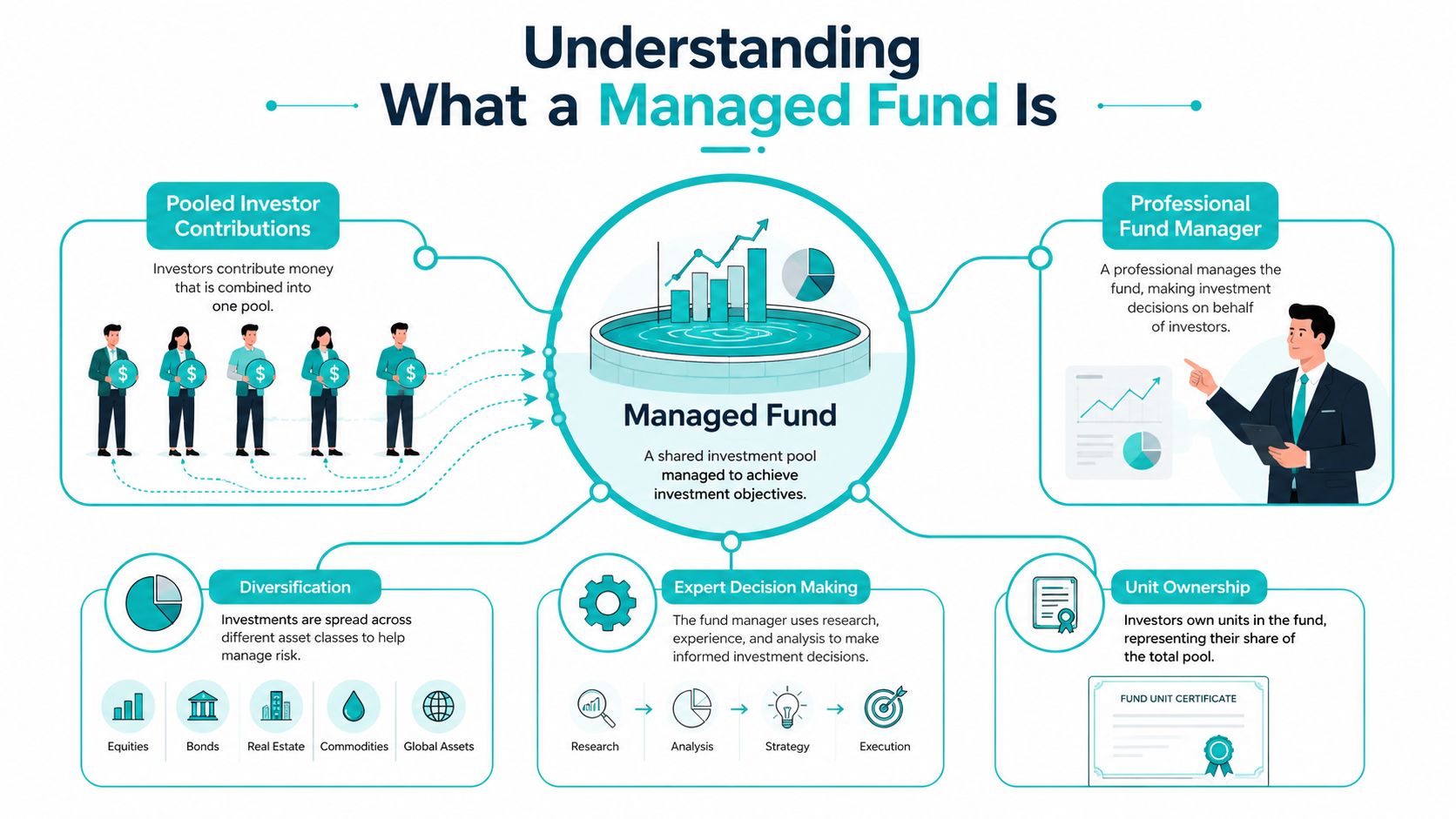
A managed fund is best understood as a pooled investment structure. Investors put their money together, buy units in the fund, and a professional manager makes the day-to-day investment decisions on their behalf. In Australia, that's the core model behind many professionally run investment vehicles. Investor.gov's glossary definition of an actively managed fund captures this well, the manager has discretion to select, buy, and sell holdings rather than mirror an index.
Imagine a shared garden. You and other households contribute to one large plot, but instead of each person deciding what to plant, a skilled gardener plans the layout, chooses the plants, and maintains the space. You still benefit from the whole garden, but you don't own each individual plant directly.
Units, NAV, and what you actually own
In a managed fund, you usually own units, not the underlying shares, bonds, or property held inside the portfolio. The unit price moves with the fund's daily net asset value, or NAV, which means the price reflects the value of the fund's assets after liabilities are taken away. MoneySmart's glossary entry on managed funds explains this unit-based setup clearly.
That matters because your exposure is to the fund's mix of assets, not direct legal ownership of each holding. If the manager owns a listed property trust or a fixed interest position, you're exposed through the unit price, not through direct title to the asset.
Why this model suits many Australians
This structure has become central to both retail investing and superannuation because it packages diversification, professional management, and portfolio administration into one vehicle. That's useful for people who want exposure to a broad set of investments without researching every holding individually. It's also why managed funds often show up in retirement portfolios, especially where clients want a simpler way to maintain balance across asset classes.
The key point is that a managed fund is not defined by a single performance number. It's defined by its operating model, pooled capital, unit ownership, and manager discretion. The outcome then depends on the manager's decisions and the broader market environment.
Exploring Managed Fund Structures and Types
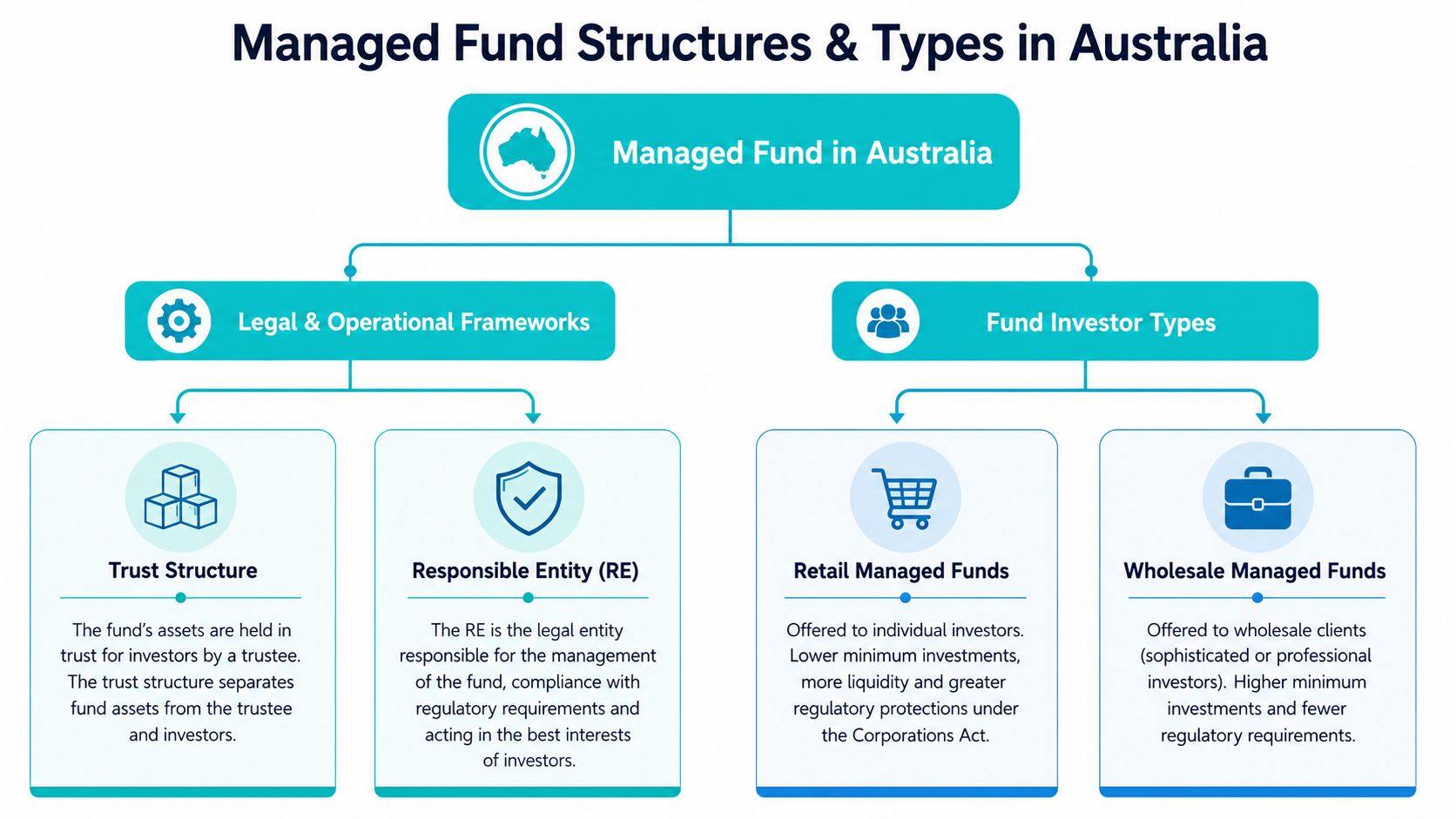
The word “managed fund” covers more than one product design, so it helps to separate the legal structure from the investment style. In Australia, a managed fund is typically structured as a trust, and the investor usually holds units in the fund rather than owning the underlying assets directly. BlackRock's explanation of fund structure reflects this trust-based model, where a trustee or responsible entity operates the fund under the fund constitution and the law.
That legal wrapper affects more than paperwork. It shapes how reporting works, how the fund is governed, and how the manager is allowed to act. For investors, the practical takeaway is that you're buying into a structure with rules, not buying individual assets one by one.
Trusts, responsible entities, and investor categories
A trust structure is common because it separates legal operation from day-to-day portfolio management. The responsible entity or trustee carries the legal duty to operate the fund properly, while the investment manager makes the portfolio decisions. That separation matters when you're trying to understand who is accountable for what.
In practice, the investor categories also matter. Retail funds are generally designed for everyday investors, while wholesale funds are aimed at qualifying investors. The differences usually sit in access, documentation, and cost structures. The fund might invest in similar asset classes, but the entry conditions and servicing model can be very different.
Active funds and index style options
The other major split is between active management and index tracking. Vanguard's investor education material describes the central debate well, active funds try to beat the market through stock selection, while index funds aim to match a benchmark. Vanguard's comparison of index and actively managed funds shows why this fork matters so much in fund design.
That debate shapes fees, expectations, and the level of manager discretion. It also explains why some investors use managed funds for specialist access, while others prefer low-turnover benchmark exposure. If you want a deeper look at pooled structures that go beyond plain-vanilla listed assets, this overview of private equity fund structures is a useful adjacent read because it shows how fund architecture changes when the assets are less liquid and more specialised.
The important distinction is simple. Not every managed fund behaves the same way, and not every “managed” product is active in the same sense. Your job is to match the structure to the purpose.
Evaluating Benefits and Risks of Managed Funds
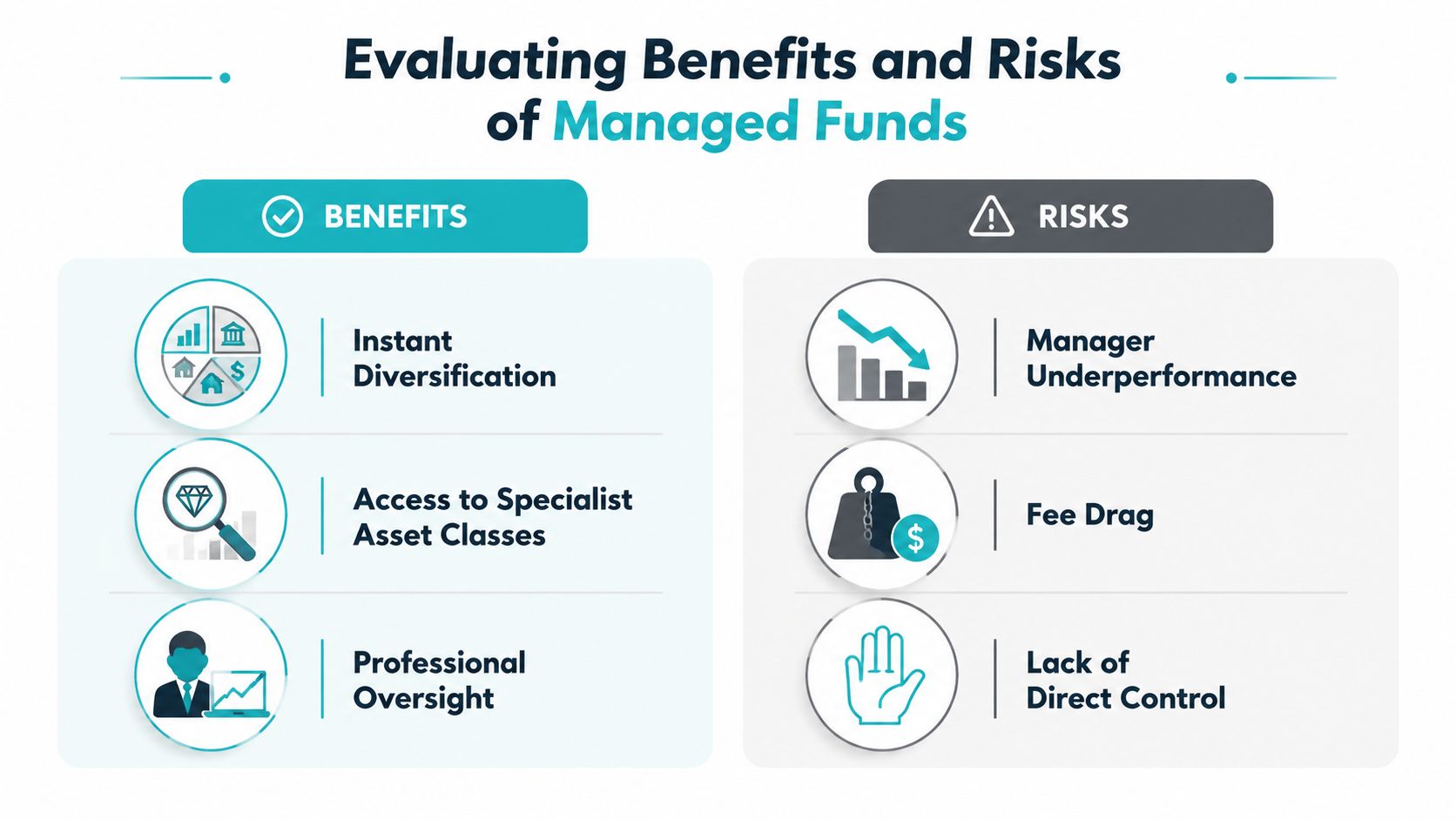
Managed funds are popular for a reason, but they're not magic. They solve a real problem, which is how to get broad exposure without building a portfolio from scratch. At the same time, they introduce manager dependence, fee drag, and less direct control over what's inside the vehicle. MoneySmart's guidance on choosing a managed fund recommends comparing performance, benchmark-relative outcomes, and fee impact before investing.
Bottom line: diversification is valuable, but you still need to ask whether the manager earns their keep after fees.
What you gain
The clearest advantage is instant diversification. A single fund can spread your money across different assets, sectors, or strategies without you having to buy each holding individually. That's especially useful when the underlying assets are capital-intensive or operationally awkward to hold directly, such as listed property trusts, fixed interest, or multi-asset strategies.
You also gain professional oversight. A skilled manager handles implementation, rebalancing, and security selection inside the mandate. For busy pre-retirees, that can reduce decision fatigue and make it easier to stay invested through market ups and downs.
What you give up
The trade-off is cost and control. Managed funds can charge fees that reduce returns over time, and performance depends on the manager's decisions. If the manager underperforms, you still pay for the service.
There can also be practical constraints on access and liquidity, depending on the fund's design. That's where reading the product disclosure statement and understanding how and when units can be redeemed becomes important. Managed funds also expose you to broader market risk, so understanding the kind of volatility your portfolio can tolerate is just as important as understanding the product wrapper. For a plain explanation of that broader concept, Colibri Trader's discussion of market risk is a helpful reference point.
If you're also weighing different asset mixes, Wealth Collective's overview of alternative investments in Australia can help you see where a managed fund sits alongside other portfolio building blocks.
Understanding Fees Tax and Superannuation Implications
Fees are where many investors misread managed funds. They see a fund's return and ignore the layers that came off along the way. A fund can look straightforward on paper, yet its actual effect on your plan depends on management fees, performance fees, entry or exit charges, and the way gains flow through to you over time.
The unit price itself is linked to the fund's daily NAV, which means value changes are reflected in what your units are worth rather than in a direct holding statement. MoneySmart's glossary explanation of managed funds is useful here because it ties the unit price to the underlying portfolio value. That structure also shapes tax reporting, since the fund's distributions and realised gains are typically passed through to unit holders under the trust arrangement.
What to check before you invest
Start with the fund's fee table, then read the tax notes in the disclosure documents. If the fund invests in assets that generate income or realised gains, the timing and character of distributions matter. Inside super, the tax environment can differ from investing outside super, so the wrapper you use can change the effective outcome even when the underlying fund is the same.
Practical rule: compare the fund's fees and tax treatment in the same conversation, not as separate decisions.
For Australians thinking about retirement, super is often where managed funds show up most often. That means the fund choice can interact with your contribution strategy, pension phase planning, and how you want income to be treated later. A good starting point for that conversation is Wealth Collective's explanation of whether superannuation is taxed, because the wrapper and the investment choice work together.
The other issue is reporting. Managed funds usually provide statements and distribution details that you'll need for your records and, if relevant, your tax return. That's one reason many pre-retirees prefer a structured advice process. Wealth Collective can help clients review fund holdings alongside super, cash flow, and retirement income planning so the investment choice doesn't sit in isolation.
Comparing Managed Funds with ETFs and Direct Investing
Managed funds, ETFs, and direct investing all aim to grow wealth, but they solve different problems. The main differences sit in control, administration, and how the portfolio is built. Vanguard's explanation of active versus index management helps frame the broad distinction between manager-led portfolios and benchmark-tracking options. Vanguard's index versus active guide is a good starting point if you're comparing styles.
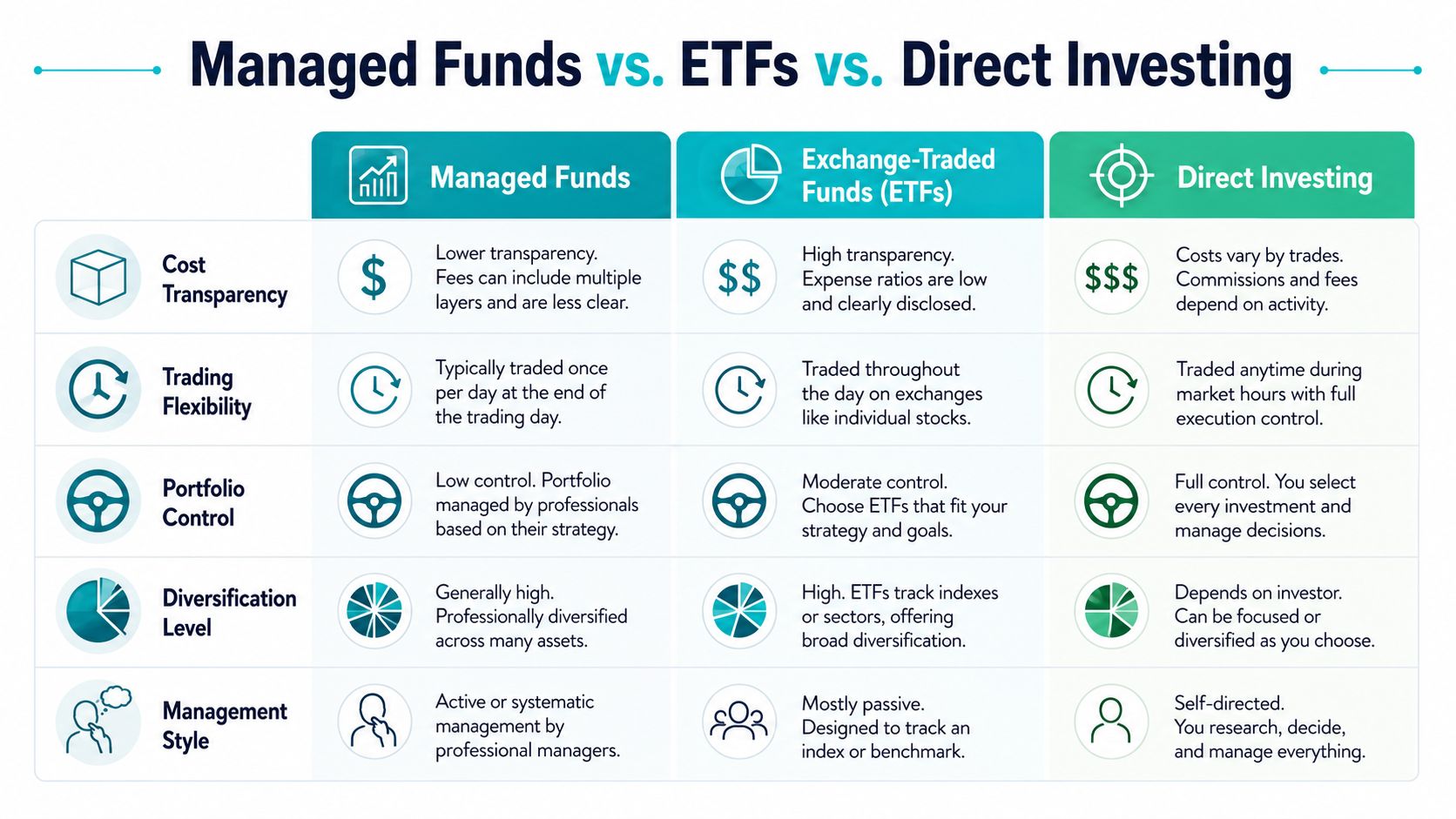
How the three options feel in practice
Managed funds are often better when you want a professionally run portfolio and are happy to let a manager make the decisions. ETFs suit investors who want listed-market trading and often prefer a more transparent, index-style approach. Direct investing gives the most control, but it also gives you the most work.
If you're building wealth and want a starting point for any of these routes, Wealth Collective's guide on how to start investing can help frame the early decisions before you choose a specific vehicle.
Where tokenised and listed products sit
It's easy to get lost in product names, especially as listed products keep evolving. A resource like CoinStats' overview of the iShares Core S&P 500 ETF Ondo tokenised ETF is useful for understanding how new wrappers are being discussed in the market, but the core questions still come back to cost, access, control, and what the product owns.
For pre-retirees, the right choice often isn't the one with the loudest marketing. It's the one that fits the time you have, the decisions you're willing to make, and the level of complexity you want to manage. Direct investing can work for confident investors, but if you want broad exposure without constant monitoring, a managed fund can still be the cleaner path.
How to Choose and Evaluate the Right Managed Fund
The best way to judge a managed fund is to look past the label and test the engine underneath. Start with the track record, but don't stop at headline returns. MoneySmart advises comparing 5- to 10-year performance, benchmark-relative results, and fee impact, because short-term numbers can hide weak portfolio construction or an expensive style. MoneySmart's managed fund selection guide is a practical benchmark for that process.
A simple checklist for decision-making
Use a fund-level checklist before you buy:
- Compare performance properly: Look at results over a longer period, not just the latest year.
- Check the benchmark: If the fund is active, ask whether it has added value after fees.
- Read the fee schedule: Management fees, performance fees, and transaction costs all affect your return.
- Review liquidity terms: Make sure you understand how easily you can redeem units and whether any restrictions apply.
- Assess the manager: A consistent process matters more than a glossy brochure.
- Match the fund to your plan: A retirement portfolio needs different settings from a growth portfolio for a younger investor.
Practical rule: if you can't explain why a fund belongs in your portfolio in one sentence, you probably haven't finished your review.
A lot of investors also forget that fund size is not just a vanity metric. It can affect operational efficiency, portfolio flexibility, and how the manager handles inflows and outflows. That's not always visible in the marketing material, so it's worth asking directly when you review the PDS or discuss options with an adviser.
The most useful question is still the simplest. Does this fund support the way you want to build, preserve, or draw down wealth? If the answer is fuzzy, the product may be fine, but it may not be right for you.
Actionable Next Steps with Wealth Collective
If managed funds are on your shortlist, the next step is to turn general knowledge into a decision that fits your situation. That usually starts with a short introductory call, where you can outline your super, savings, retirement timing, and any investments you already hold. From there, the advice process can look at protection, superannuation optimisation, investment strategy, and retirement income in one place.
Wealth Collective's service pillars are designed for that kind of sequence. Protection Plus helps with risk and personal insurance conversations. Guided Growth focuses on building a portfolio structure that suits your goals. Retirement Roadmap brings the pieces together for the phase when income and capital preservation matter most.
Bring a list of your current funds, super statements, and any recent product disclosure documents to the first conversation. That gives the adviser enough detail to compare fees, structure, and tax implications without guessing.
If you're in Western Australia and want to understand whether a managed fund belongs in your plan, book the introductory call and use it to test the fit, not just the product. A clear conversation now can save a lot of confusion later.
A CTA for Wealth Collective.