Business hours
Monday to Friday (8.30AM - 5PM)
Weekend (Closed)


You know the moment. The business is still healthy, but the easy decisions have stopped being easy. You're answering supplier emails at night, the BAS is always close, insurance gets renewed on autopilot, and the next growth move keeps sliding to “next week” because nobody else is there to pressure-test it with you. That's usually when a consultant for small business stops being a nice-to-have and starts being a way to get your head back above water.
The mistake most owners make is treating consulting like overhead. In practice, the right adviser reduces decision friction, sharpens the numbers, and gives you a clearer way to act without carrying every call alone. For a small operation, that matters because the business doesn't need more noise. It needs better judgement, faster.
When a Small Business Starts Outgrowing Its Owner
The pattern is familiar. Revenue is coming in, but the owner is still the one chasing invoices, checking cash, answering operational questions, and signing off on every move that matters. That's when a business starts to feel bigger than the person running it, even if the team is still small.
A Perth café owner might have started with tight controls and strong instincts. Then the menus expanded, the supplier terms changed, staff hours became harder to juggle, and tax dates arrived faster than decisions. Nothing dramatic broke, but the owner was spending more time reacting than steering.
That's a clear signal. A business can outgrow the owner's available bandwidth before it outgrows the market.
For Australian small business owners, the scale is not trivial. Small businesses make up 97.2% of all businesses and employ around 5.1 million people, which is about 42% of the private sector workforce, while the ABS reported about 2.66 million actively trading businesses in June 2024 (Australian small business scale and ABS business counts). That's why consulting demand isn't a niche curiosity. It sits inside a large part of the economy.
The smart move is to treat outside advice as a pressure release valve. The right consultant doesn't replace the owner. They clear the clutter so the owner can make the decisions that change the business.
What a Consultant for Small Business Actually Does
A good consultant for small business does three things well. They tighten the finances, sharpen the strategy, and reduce risk before it turns into interruption. Anything less is fluff.
Financial structure and cash flow
Many small businesses bleed cash. A consultant will look at pricing, spending patterns, invoice timing, and the way money moves through the business. In Australia, that often means timing purchases around the instant asset write-off rules, which for the 2024–25 income year allowed a $20,000 per asset deduction for eligible businesses with aggregated turnover under $10 million, provided the asset was first used or installed ready for use by 30 June 2025 (small business tax timing and write-off planning).
The point isn't to chase every tax angle. It's to line up spending, cash flow, and deduction timing so the business isn't overcommitting on equipment or software. That includes digital tools, because the Small Business Technology Investment Boost offered an additional 20% tax deduction on eligible digital expenditure, capped at AUD 100,000 per income year (technology investment planning for small businesses).
A consultant should also map the numbers to your actual decision calendar, not some abstract annual plan. If the figures can't support a purchase, the answer is no. If they can, the purchase needs a purpose.
Strategy and growth planning
Strategy for a small business should be plain English, not a deck full of buzzwords. A decent adviser helps you decide what to stop doing, what to prioritise, and which opportunities are worth the time.
Practical rule: if a recommendation can't be tied to cash flow, capacity, or customer demand, it's probably too vague to act on.
The best consultants work with the owner's constraints, not against them. A microbusiness doesn't need a grand transformation. It needs a clear next move that the team can carry out.
Risk protection through insurance and compliance
This is the boring part until it isn't. Australia's Cyber Security for Small Business guidance recommends controls like multi-factor authentication, offline backups, patching, and least-privilege access because small businesses are often targeted and usually don't have dedicated security teams (small business cyber controls). A consultant should translate that into an order of operations, starting with identity controls, then backup recovery testing, then patching.
That is the job. Not inspiration. Not generic advice. Better decisions, made faster, with less guesswork.
Benefits of Hiring the Right Consultant
The value of the right adviser shows up in the parts of the business most owners feel in their gut but don't always measure cleanly. Better pricing, cleaner supplier terms, sharper planning, and fewer last-minute scrambles are the obvious wins. The less obvious win is that you stop making every decision under pressure.
Better decisions, not just faster decisions
A consultant gives you a second brain. That sounds soft until you're the one deciding whether to buy equipment, lift prices, or hire again. With a structured outside view, you can compare options instead of reacting to the loudest problem in the room.
Owners often underprice the value of advice. The cost isn't just the consultant's fee. It's also the cost of staying stuck in your own limited view. When the business is owner-led, that limitation is real.
More useful implementation, less theory
Generic advice doesn't pay the bills. A consultant who can turn a recommendation into implementation is the one worth keeping. If you want a practical comparison point for bookkeeping-related support, the guide to thriving with bookkeeping consultants is a useful read because it shows how specialist advisory can translate into cleaner financial control.
The benefit is sharper still when the business needs something specific, not broad. If the issue is tax efficiency, a focused resource like small business tax reduction strategies is more relevant than a general “grow faster” pitch. That's the difference between advice that sounds good and advice that changes the numbers.
Decision confidence under stress
Consulting also matters when the owner is tired. Tired owners postpone decisions, and postponed decisions get expensive. A good adviser reduces that drag by giving you a clearer line between what matters now and what can wait.
If you're weighing whether to use outside help, it helps to think in categories. Some owners need strategy. Others need financial control. Others need compliance and risk support. The benefit isn't the label. It's the clarity.
Signs You Need a Consultant Right Now
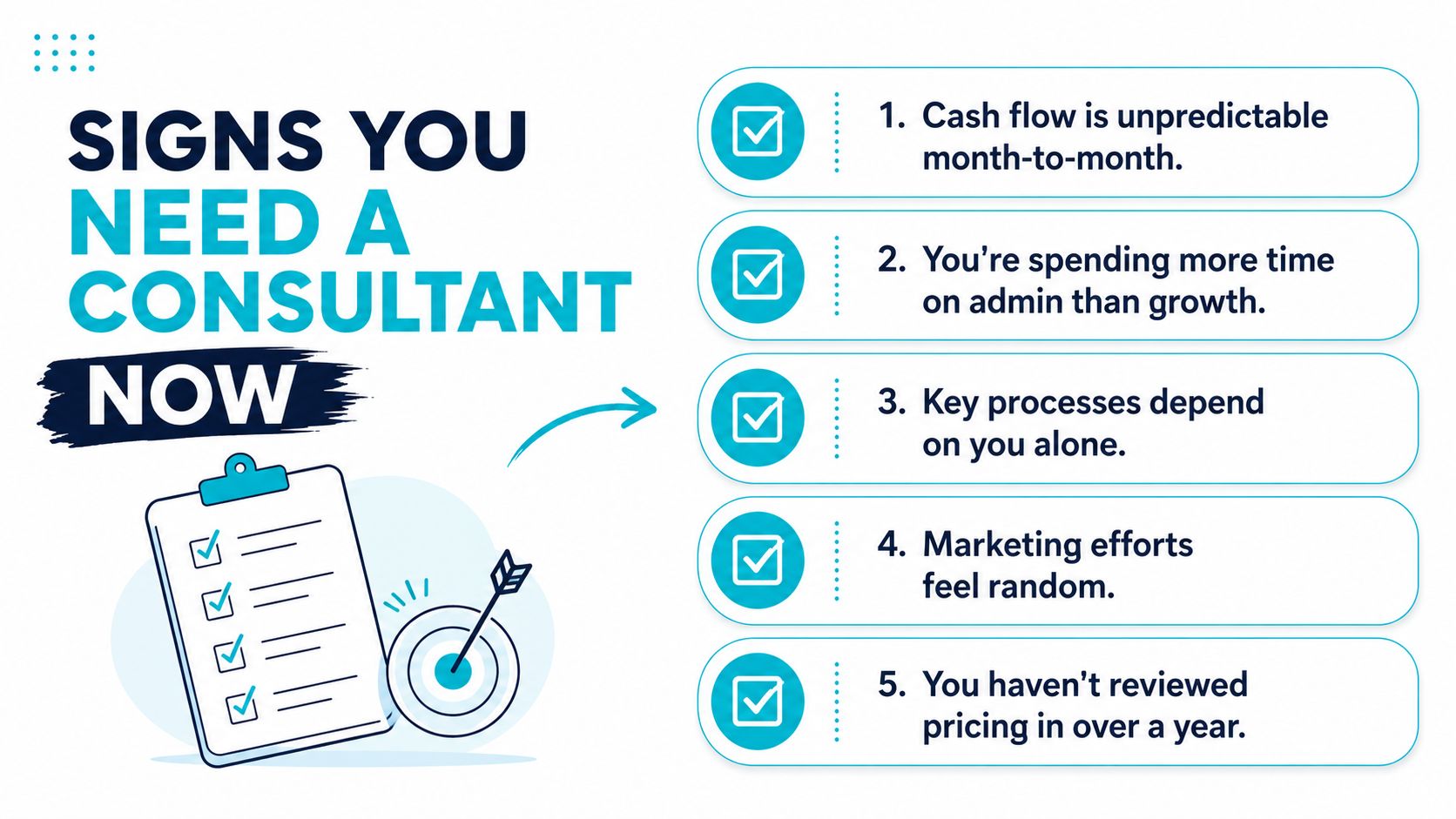
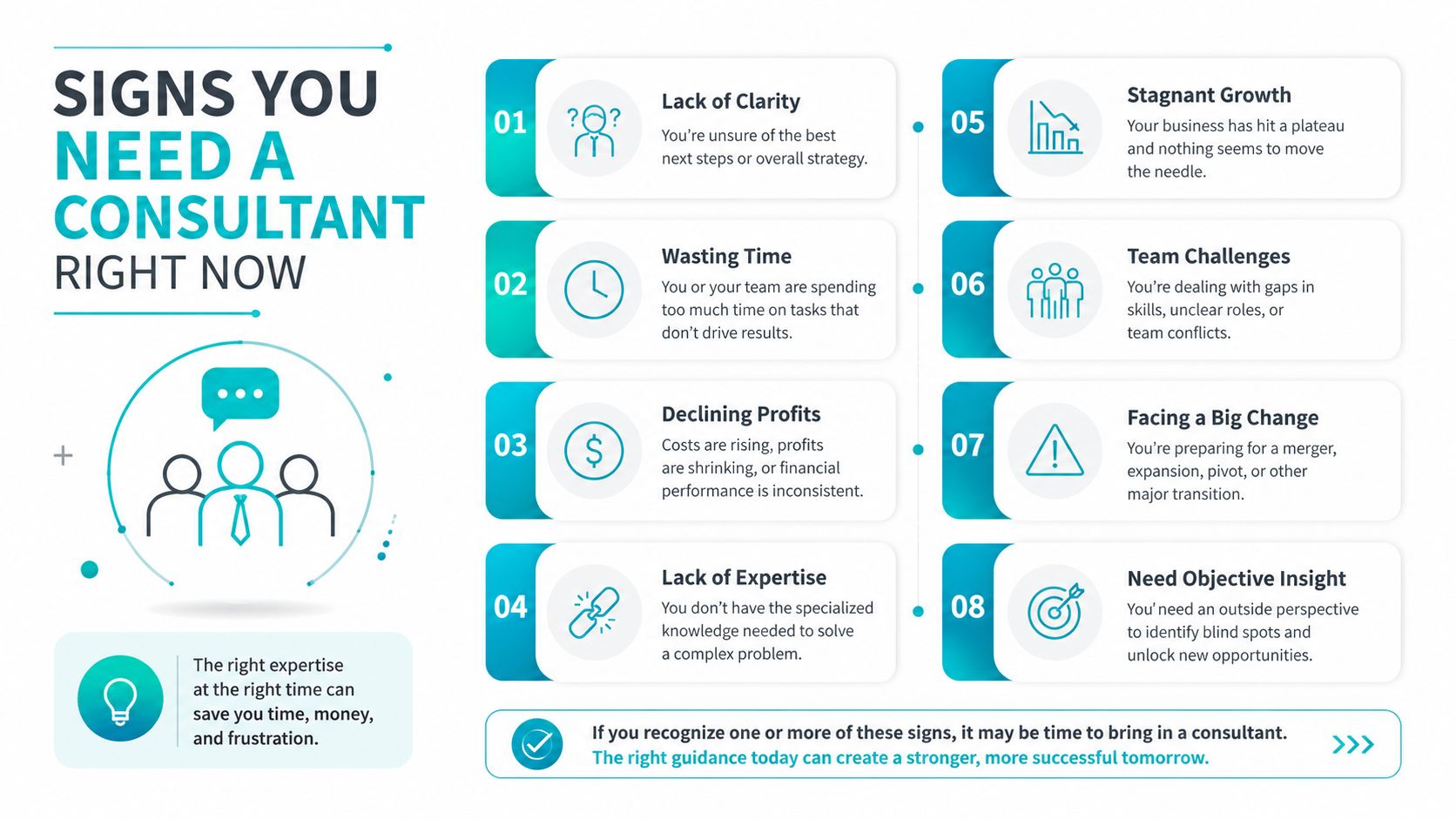
If you're still trying to decide whether this is urgent, run a blunt test. If the business is growing but profit isn't improving, if your insurance hasn't been properly reviewed in over a year, or if you only have a loose plan beyond the BAS, you're already behind. The longer you wait, the more expensive the fixes tend to get.
The questions that cut through the noise
Ask yourself these three things:
- Are major decisions being delayed because no one else has the full picture?
- Are you spending too much time on work outside your expertise?
- Would one outside conversation make this month's priorities clearer?
If the answer to any of those is yes, a consultant is probably overdue.
A lot of owners resist help because they think it means admitting weakness. That's the wrong frame. The weakness is paying for indecision with time, margin, and energy. For many small firms, delay is the hidden cost that compounds.
A business owner who keeps saying “I'll sort it next quarter” is usually signalling a capacity problem, not a discipline problem.
The right response depends on the issue. If it's tax structure, get a tax-aware adviser. If it's payroll and staffing cost pressure, get someone who understands labour settings. If it's cyber risk or systems, choose technical help that speaks plain business language.
The owners who are most resistant are often the ones who need the clearest outside view. That's not a moral point. It's just how overloaded businesses behave.
Engagement Types and Pricing Models Explained
The wrong engagement shape can wreck a good advisory relationship. If you need a one-off diagnosis, don't sign up for a long retainer. If you need ongoing accountability, don't buy a single workshop and hope it sticks. Match the format to the problem.
Compare the common models
| Engagement Type | Best For | Pricing Approach | Typical Duration |
|---|---|---|---|
| Diagnostic review | Quick clarity on one problem | Fixed fee | Short project |
| Project-based work | A defined outcome with a finish line | Fixed fee or hourly | Set project period |
| Monthly retainer | Ongoing advice and accountability | Monthly fee | Rolling support |
| Fractional engagement | Part-time access to senior expertise | Fixed monthly or hourly | Part-time ongoing |
That structure matters more than the marketing language. A fractional CFO, for example, is not the same as a general consultant, and a business coach is not the same as an implementation adviser. Buy the role you need, not the title that sounds impressive.
Pricing should make sense against the scope. Fixed fees work best when the deliverable is clear. Hourly pricing suits ad hoc work but can become inefficient if the problem is broad. Value-based pricing can work when outcomes are measurable, but only if both sides agree on what success looks like.
For HR-related advisory pricing, the benchmark HR consulting costs resource is useful context when you're comparing supplier quotes and trying to tell a fair range from a padded one.
A bad engagement usually has vague scope, no written deliverables, and too much dependence on the consultant's time instead of the client's outcome. That's a bad trade for a small business. You want precision, not billable fog.
How to Choose and Vet a Consultant
Start with proof, not charm. Good consultants can explain what they do, how they work, and what the client will get. Weak ones hide behind jargon, broad promises, and shiny slides.
What to check first
Credentials matter less than relevance. If you need help with cash flow, tax structure, or retirement planning around a business sale, an adviser with direct small-business experience is worth more than a big-name CV with no practical fit. That's why it helps to compare the proposal against your actual problem, not against a generic checklist.
Use the first meeting to test for precision. Ask what they would look at first, what they would ignore, and what the first deliverable would be. If they can't answer clearly, they're not ready to work with a time-poor owner.
What a good fit sounds like
The best consultants don't just “understand small business”. They listen properly, ask sharp questions, and translate complexity into action. That point matters for micro and owner-led firms, where the work has to fit the owner's real bandwidth and cash flow, not an abstract ideal.
If you're comparing advisers, a useful reference point is how to find a good accountant, because the same principles apply. You want clear communication, practical examples, and a process that doesn't force you into unnecessary complexity.
Disqualifying behaviour is easy to spot. Walk away if the consultant refuses to put deliverables in writing, won't share a sample statement of advice or scope, or keeps dodging questions about how results will be measured.
Good test: if they can't explain the work in plain language, they probably can't deliver it cleanly either.
Choose the adviser who lowers friction. The one who makes the next step obvious is usually more useful than the one with the biggest vocabulary.
A Step-by-Step Engagement Roadmap
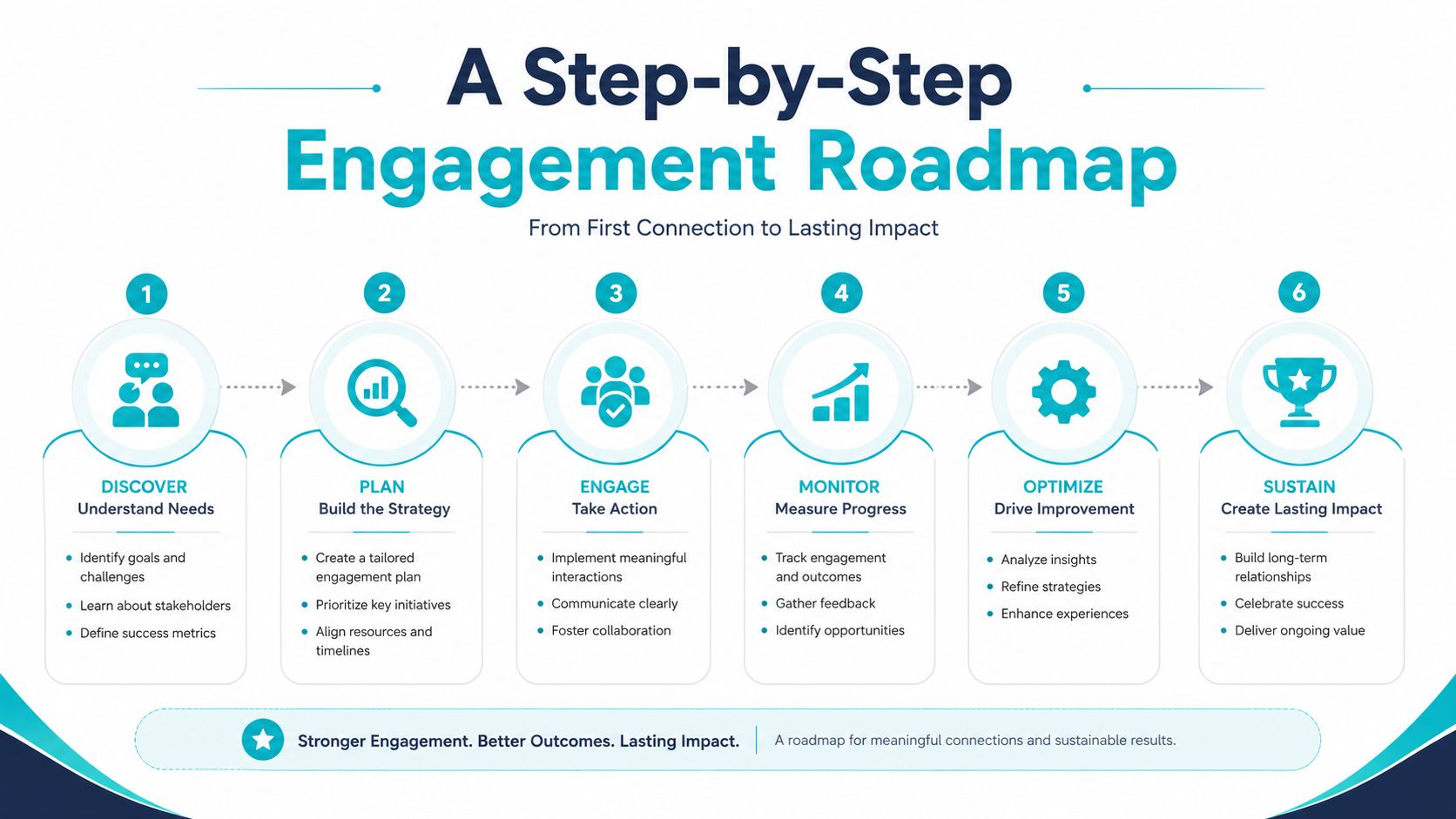
A well-run consulting engagement should feel calm, not chaotic. In Western Australia, that matters because small business owners are already dealing with tax timing, super changes, and regular compliance pressure. The process should reduce noise, not add to it.
What the owner should expect
The first conversation should be about diagnosis, not selling. A good consultant asks what's happening, what's already been tried, and where the decision pressure sits. If they jump straight to a package, that's a sign they're optimising for their process, not your business.
From there, scope should be specific. The consultant should state what they'll review, what they'll produce, and what the owner needs to provide. That way, no one wastes time guessing what “support” means.
Delivery should produce something usable. That might be a decision memo, a cash-flow review, a structure recommendation, or an implementation plan. Review should be built in so you can see whether the work changed anything meaningful.
This is the point where a local adviser can be more effective than a remote one. A WA-based consultant is more likely to understand the pace of local business, the practical realities of travelling from Perth to regional centres, and the rhythm of owner-led operations in places like Dunsborough. If you need broader support, business advisory services can be the right category to explore because it sits closer to implementation than abstract strategy.
The engagement is working when decisions get easier and follow-through improves. That's the milestone that matters.
Western Australia and Local Considerations
Western Australia runs on its own tempo, and small businesses feel that pressure every day. A consultant who understands the local market knows the owner may be dealing with uneven demand, tight hiring conditions, and too much responsibility sitting on one desk. Generic advice falls apart fast in that setting.
Tax and payroll settings deserve close attention. The instant asset write-off threshold for the 2024–25 income year was $20,000 per asset for eligible businesses under $10 million turnover, and the asset had to be first used or installed ready for use by 30 June 2025. The superannuation guarantee rose to 12% of ordinary time earnings from 1 July 2025 after the legislated increase from 11.5% (superannuation planning for employers). Those settings shape spending decisions, wage planning, and owner remuneration, so they need to be built into the advice from the start.
Compliance matters just as much. Equity incentives may look attractive on paper, but the ASIC employee share scheme rules place real limits on who can receive offers, what disclosure is required, and how much can be offered without full prospectus-style documentation (equity incentive compliance). If a business is using equity for retention or succession, it needs proper advice, not guesses dressed up as strategy.
Fit matters too. A remote adviser can be perfectly capable and still miss the local context. A WA-based consultant is more likely to understand regional seasonality, distance costs, and the way owner-led teams operate when there is no extra management layer to absorb the load.
At Wealth Collective, the work is built around that reality. The firm's small business advisory approach sits alongside planning for tax, liquidity, and protection, which is useful when the owner wants one adviser to see the whole picture instead of separate fragments. For a small business owner, that joined-up thinking often removes more friction than another spreadsheet ever will.
If you need broader support, business advisory services are the appropriate category to explore because they sit closer to implementation than abstract strategy. Use three filters before you commit. Does the consultant specialise in small-business work, do they start with a diagnostic, and can they point to measurable outcomes from past clients? If the answer is yes, book a short introductory conversation and see whether the fit holds up.
If your business feels stuck between too much responsibility and too little time, Wealth Collective can help you turn that pressure into a clearer plan. Their small business advisory support is built to simplify decisions around protection, growth, and cash flow, then turn those decisions into action. Visit Wealth Collective and book an initial call if you want a practical conversation about what needs fixing first.