Business hours
Monday to Friday (8.30AM - 5PM)
Weekend (Closed)



Residential aged care is 24/7 supported accommodation for older Australians who can no longer live independently, and in 2023–24 about 254,049 people lived in permanent residential aged care while 82,480 used residential respite care, with 235,977 operational residential and flexible aged care places at 30 June 2024 (Gen Aged Care Data). The bigger question for most families isn't what it is, it's what it costs, who pays, and whether the family home, super and pension will hold up once the paperwork starts.
I've sat with enough WA families to know the moment this becomes urgent. It's usually after a fall, a dementia diagnosis, or a spouse running out of steam. Suddenly, the conversation shifts from “Can Mum stay at home a bit longer?” to “What happens now, and how do we avoid making an expensive mistake?”
The Real Moment Families Start Asking About Residential Aged Care
A Perth family usually doesn't wake up one morning and decide to move a parent into care. It happens after weeks of worry, hospital discharge pressure, missed medications, or a partner who can't keep lifting, bathing, and supervising anymore. The adult children are often juggling work and kids, and the person at the centre of it all is exhausted, frightened, and not keen on leaving home.
That's the point where what is residential aged care stops being a theory question. It becomes a decision about safety, dignity, money, and time. Residential care exists for older people who can't live independently at home anymore, and it provides accommodation plus personal care around the clock with access to nursing and general health care services (Australian Government).
In plain English, it's not just a room with meals. It's a high-support setting for people whose needs have moved beyond what family, a visiting carer, or standard home support can realistically cover. That's why the sector sits at the centre of Australia's aged care system, not on the fringe of it. In 2023–24, about 254,049 people lived in permanent residential aged care, while 82,480 used residential respite care (Gen Aged Care Data).
What families usually miss
They focus on the care question first, but the money question is usually the one that bites hardest.
Practical rule: if a family is only asking whether the person “needs care”, they're already too late on the financial planning side.
That's the right reframe. The core issue isn't whether residential aged care exists. It's whether it fits the person's care needs, cash flow, assets, and retirement plan without forcing bad decisions later.
What Residential Aged Care Includes
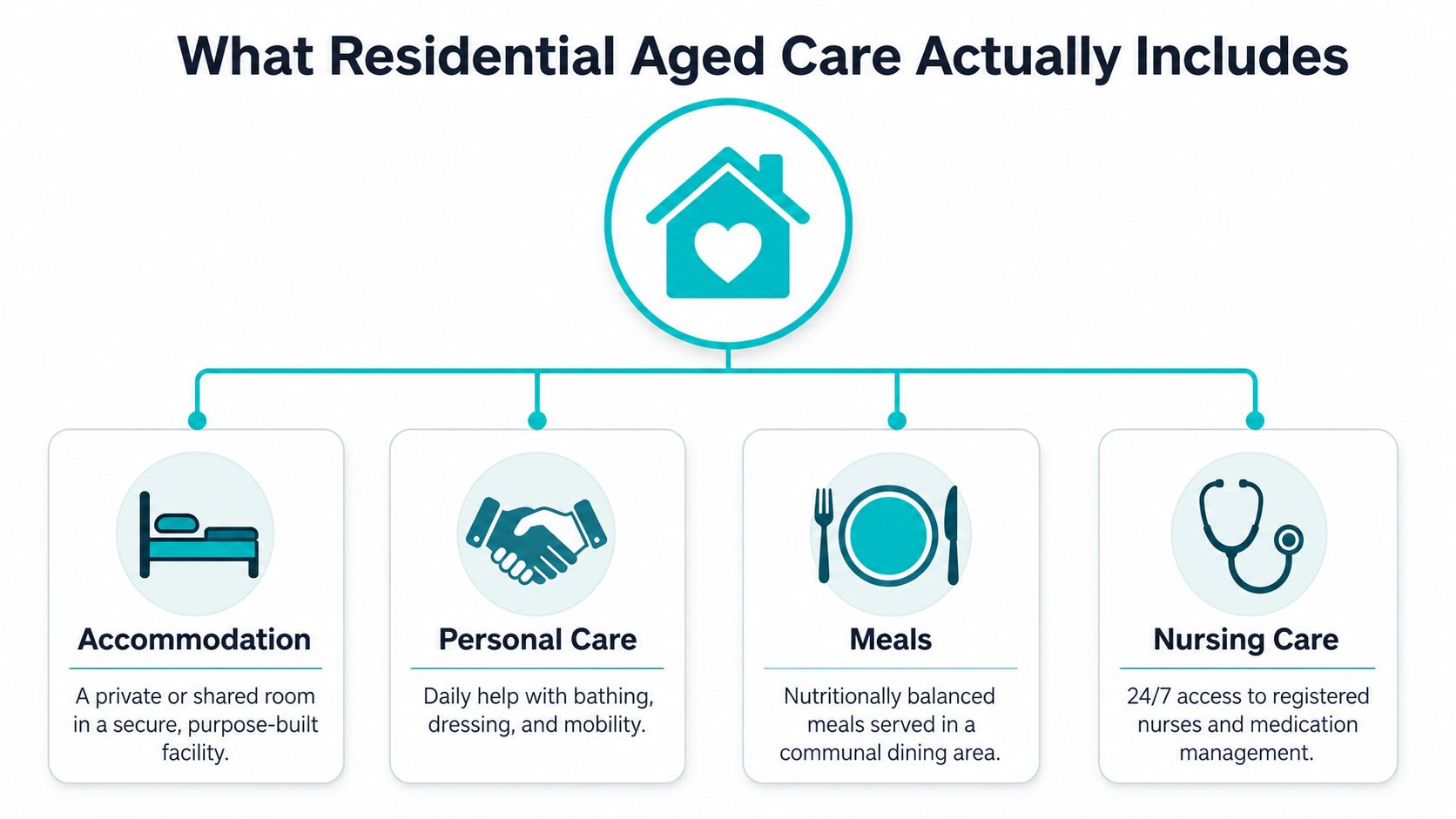
Residential aged care is the high-support end of the aged care system. It brings accommodation, meals, personal care, nursing oversight, and other day-to-day support together in one regulated setting, so the older person is not left to manage at home with patched-together help. The Australian Government describes it as a subsidised care service for people who need ongoing support, which is why it sits well apart from retirement living, where residents usually remain largely independent and organise more of their own help (Australian Government).
The money side matters just as much as the care side. Families often start with the health question, then discover the cost comes down to means testing, assets, income, and how the family home is treated. That is the trap. Residential care is not just a room with meals. It is a financial decision about how much of the cost the resident pays, how much the government subsidises, and whether the person can afford to stay in the right place without blowing up the rest of their retirement plan.
Permanent care and respite care are not the same
Permanent residential care is the long-term arrangement when someone cannot safely return home. Respite care is temporary, often used after hospital, when a carer needs a break, or when the family wants to test whether the setting is the right fit before making a longer commitment.
That difference has real financial consequences. Families who start with respite sometimes assume the charges and ongoing costs will roll over in the same way if the stay becomes permanent. They usually do not, so this is the point where you need to stop guessing and check the fee structure properly.
The staffing side shows why residential aged care is more than accommodation. Australian residential aged care providers were required to deliver an average of 202.21 total care minutes per resident per day in 2023–24, including 40.17 minutes per resident per day delivered by a registered nurse (Australian Government). That tells you the model is built around active care, not just housing with a meal plan.
Bottom line: if a facility cannot clearly explain how it delivers nursing, personal care, and daily support, do not assume the care will be there when the pressure is on.
Residential Aged Care Compared with Home Care and Retirement Living
Residential aged care only makes sense when you put it beside the other choices. Home care and retirement living both get mixed into the same conversation, but they solve different problems. If you confuse them, you can end up paying too much, moving too early, or delaying a move until the home environment becomes unsafe.
Here's the clean comparison.
| Option | Care intensity | Typical user | Government subsidy | Best fit |
|---|---|---|---|---|
| Home care | Lower to moderate | Someone who can stay home with support | Yes, for eligible care services | Stays at home safely with regular help |
| Residential aged care | High, 24-hour | Someone who can't live independently at home | Yes, substantial subsidy | Needs round-the-clock support and supervision |
| Retirement living | Low, mostly independent | Active older adult | No aged care subsidy | Wants simpler living without daily care needs |
The practical question is never just, “What sounds nicer?” It's whether the person can remain safe at home, whether the carer is still coping, and whether medical complexity has reached the point where a facility makes more sense than patching together services.
A useful comparison for families weighing support models in other countries is the guide on families choosing elderly care in the UK. The systems are different, but the decision tension is the same, stay at home with support, or move into a setting that can handle higher needs.
The mistake I see all the time
People treat retirement villages as if they're a halfway house into aged care. They're not. They're usually independent living, and they don't solve the care problem if someone needs 24-hour supervision, medication support, or help overnight.
If the issue is primarily lifestyle, retirement living can work. If the issue is safety and care intensity, residential aged care is the right conversation.
The ACAT Assessment and How Access Works
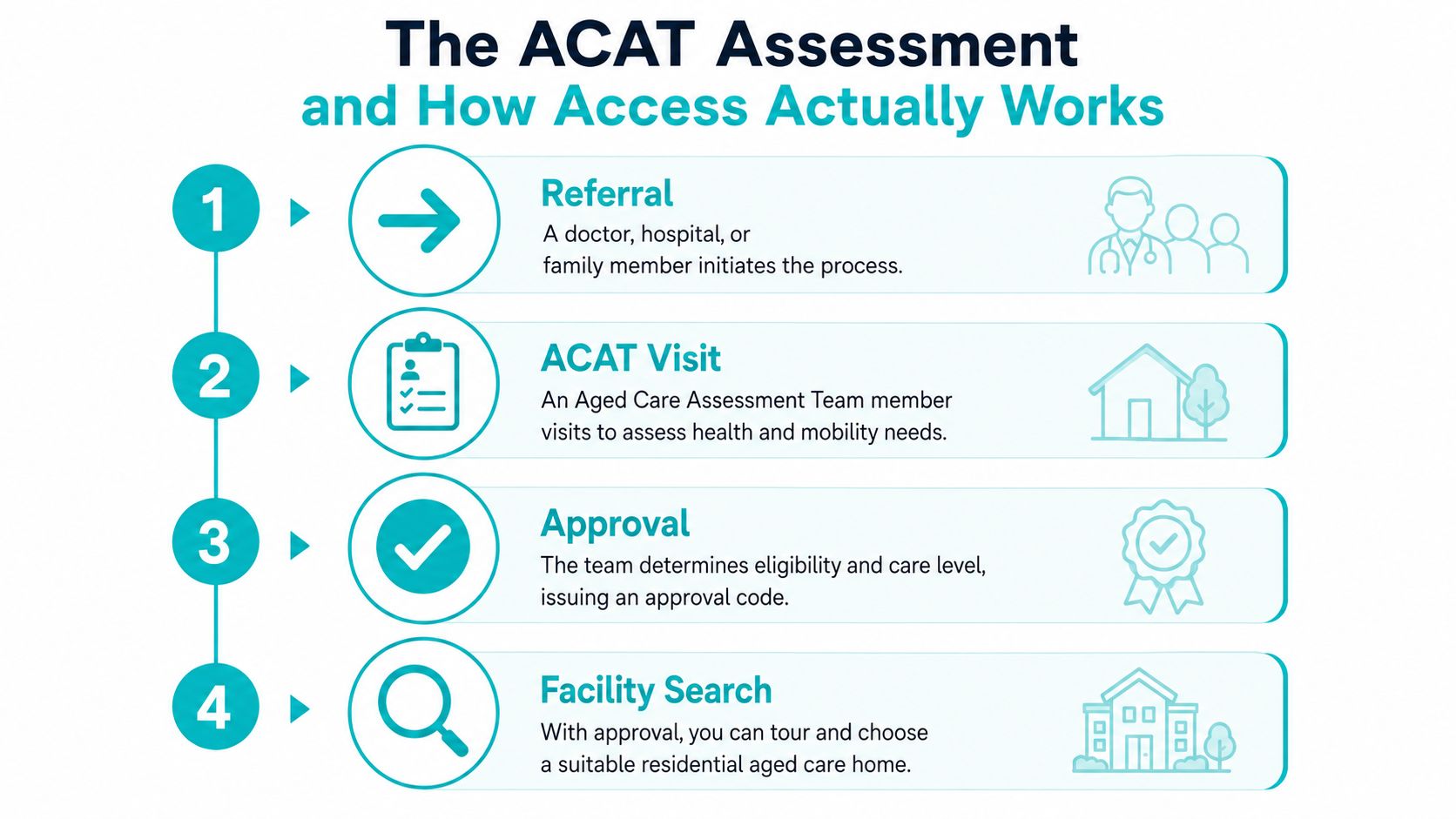
A family can ring every facility in town, but that does not get anyone into permanent care. The system starts with an assessment, and that assessment decides whether the person is approved for subsidised residential aged care. In Australia, access usually depends on an Aged Care Assessment Team (ACAT) assessment.
ACAT looks at health, mobility, cognition, safety, and the support needed for daily living. The outcome is a formal approval that sets out what level of aged care the person can access. If the assessor decides home support is enough, that is the pathway they will point to. If the person needs more than that, the approval opens the door to residential care.
The point is simple. Families should not be shopping for a bed first and asking questions later. They need the assessment before they can make sensible decisions about cost, timing, and the type of care that fits.
What to prepare before the assessment
- Medical history: recent hospital discharge notes, diagnoses, medication lists, and GP summaries.
- Functional examples: falls, missed meals, wandering, toileting issues, or times the person has been unsafe at home.
- Carer information: who helps now, what they do, and where the strain is showing.
- Identification and contact details: keep it simple, but don't turn up unprepared.
The assessment is the gateway. Without it, families are guessing. With it, they can plan.
Treat ACAT as the first planning checkpoint, not a piece of paperwork to get through and forget. It tells you whether the person needs home support, respite, or permanent residential care, and it stops families from locking in a facility before the system has confirmed the need.
If you want to test the numbers before you make any commitment, use the Centrelink asset test calculator and then fit the care decision around the likely means test outcome.
For families trying to map the care decision with the money side at the same time, Wealth Collective's aged care planning service brings care needs, assets, and decision rights into the same conversation.
What Residential Aged Care Really Costs After Means Testing
Most official explainers go soft, and families get burned. Residential aged care isn't one price. It's a stack of charges, and the outcome changes depending on income, assets, home ownership, and whether the person is single or part of a couple.
The fee architecture usually comes down to four moving parts, the basic daily fee, the means-tested care fee, the accommodation payment, and any extra services charges. That structure matters because the public subsidy is large, but it doesn't erase the resident contribution. Australian Government spending on residential aged care reached nearly 60% of total aged care expenditure in 2023–24, which means resident means testing still carries a significant share of the cost (Australian Institute of Health and Welfare).
Why the family home is not a free pass
Many families assume the home is automatically protected. Sometimes it is, sometimes the financial outcome is still painful, and timing matters a lot. The right answer depends on whether a spouse stays put, whether the home is sold, and how the assets and income tests land once permanent care starts.
A homeowner couple can often face a very different result from a single homeowner, because the household balance sheet changes when one person moves into care. A renter may avoid accommodation dynamics tied to the family home, but that doesn't mean they escape means testing. There's no universal shortcut.
If you want to test your likely position before signing anything, use the Centrelink asset test calculator as a starting point, then have an adviser check the result against the aged care rules.
The trap I'd flag first
Don't make the accommodation decision before you understand the means-test outcome. Families often focus on the facility they like and only later realise the cash flow doesn't match the chosen payment method.
Money rule: in aged care, a “nice room” can become an expensive mistake if it pushes the payment structure beyond what the retirement plan can comfortably carry.
If you're also checking the impact on pension entitlement, the Age Pension eligibility calculator is the right companion tool, because aged care, pension and asset treatment all move together.
How Pensions, Super and the Family Home Interact with Aged Care Fees
A move into residential aged care is usually a financial event first and a care event second. It changes cash flow, asset treatment, and who pays what. The rules sit across pensions, super, and the family home, so families who treat it like a simple accommodation decision often get caught out.
The Age Pension, super drawdown strategy, and the family home all affect the outcome once someone enters permanent care. If a spouse stays in the home, the household position changes. If super is drawn earlier, income changes. If the home is sold, the asset picture shifts again. The result can be very different depending on who moves first, who stays put, and when the paperwork is lodged.
If you want a quick read on where the pension side may land, the Age Pension eligibility calculator is a sensible starting point before you commit to any aged care contract.
Why advisers get involved early
Centrelink timing matters. So does the decision to keep the home, rent it, or sell it. Families in WA and elsewhere often leave these calls too late, then try to make them after admission when everyone is tired and the facility wants signatures.
Aged care decisions also affect estate planning. If one spouse remains at home, rental income, pension treatment, and asset ownership all sit in the same conversation. If both spouses move into care, the numbers change again, and the room for error gets smaller.
Residential aged care decisions are rarely just care decisions. They are retirement income decisions with a care overlay.
That is why a financial adviser earns their keep here. Someone who understands super, pension timing, cash reserves, and fee structure can often improve the outcome before the first signature goes on the admission paperwork.
How to Choose the Right Residential Aged Care Facility
At 30 June 2025, Australia had 224,493 operational residential aged care places, up from 195,825 in 2016, and the national occupancy rate was 89.9%, the highest since 2018 (Productivity Commission). In plain terms, good places can fill quickly, so choosing well is about more than the first polished brochure you're handed.
The best filter is a simple one. Start with location, then care quality, then fees, then culture. If a facility fails on any of those four, keep looking.
What to inspect on a tour
- Location and access: how close it is to family, familiar medical services, and the routines that matter to the resident.
- Care and staffing: ask how they deliver nursing and personal care, and how they manage more complex needs.
- Fees and contracts: read every payment condition, extra service charge, and accommodation term before agreeing.
- Culture and daily life: food quality, activities, language fit, pet rules, and whether the atmosphere feels calm or chaotic.
A family shouldn't be seduced by fresh paint and a cheerful receptionist. Ask what care minutes look like in practice, how complaints are handled, and what happens overnight when the building is quieter and staff ratios matter even more.
If you want a broader checklist on how to plan for the paperwork, the contracts, and the emotional side of end-of-life decisions, find clarity with end of life planning can help frame the larger conversation.
The short version is this. Pick the place that can handle the person's needs now, not the place that just looks pleasant on tour day.
Practical Next Steps and Where This Fits in Your Retirement Plan
A family usually gets serious about residential aged care after a fall, a hospital discharge, or a home setup that has stopped working. At that point, the decision is financial first and care second. You are not just choosing a room and a meals package, you are choosing how much capital to tie up, what fees will keep coming, and how the rest of the retirement plan holds together.
Start with My Aged Care, then get the ACAT assessment booked, then gather the financial records before anyone signs a contract. After that, test the means-tested fees under at least two entry-date scenarios, because timing can change the result. Then shortlist facilities and review the decision each year, not just once.
The money side needs proper attention. Use Wealth Collective's aged care planning service if you want help lining up pension timing, super drawdown, estate questions and aged care costs in one place instead of trying to solve them separately.
The families who do best usually do not rush. They make a plan, check the numbers, and keep asking what the move means for the rest of the household balance sheet. The families who wait until discharge day or admission day often pay for the delay in stress, lost options, or unnecessary fees.
If you're trying to work out what residential aged care means for your own family, Wealth Collective can help you test the numbers before you commit. Book an initial conversation through Wealth Collective and get clear on the care, pension and asset decisions before the contracts are signed.