Business hours
Monday to Friday (8.30AM - 5PM)
Weekend (Closed)



“Maximise super first” is tidy advice, and it's often wrong for executives. Once your income, equity compensation, household debt, insurance needs and super balance become substantial, the problem isn't just accumulating more. It's deciding which dollar belongs in super, which belongs in a taxable portfolio, and which needs to remain liquid, while controlling tax and reducing the number of financial decisions you need to make personally.
That's the core purpose of financial planning for executives. You need a governance system for bonuses, shares, debt, protection and retirement, not another product recommendation. The framework below is designed around the way senior professionals earn and hold wealth in Australia, including the policy changes applying from 1 July 2026.
Why Executive Financial Planning Is Different
Senior professionals rarely have a simple financial life. A salary may sit beside a bonus, long-term incentive plan, restricted stock units, employee share purchase arrangements, carried interests, several super accounts, investment property and a complex family structure. Each component may be manageable on its own. The difficulty lies in how they interact.
Generic advice usually starts with accumulation. Build a budget, increase super contributions, invest regularly and review insurance. Those ideas have value, but they miss the executive problem. A high-income earner can accumulate assets while still carrying excessive employer-stock risk, insufficient liquidity, poorly coordinated tax payments or insurance that bears little relationship to actual household commitments.
Australia's compulsory super system has become increasingly embedded in remuneration structures. The superannuation guarantee rate was 9% from 1 July 2002 to 30 June 2013, then increased to 9.25% for 2013–14 and 9.5% from 1 July 2014, where it remained through 2015, as recorded in ABS superannuation data. That history matters because employer contributions, salary packaging and contribution timing are now central parts of executive remuneration, not optional add-ons.
The executive planning question: “What should I do with the next dollar?” is more useful than “How do I maximise every account?”
The hidden cost of complexity
Financial stress doesn't disappear when someone becomes senior. A national wellness report recorded 19% of Australian employees as financially stressed in 2018, down from 22% in 2016, equivalent to about 2.44 million workers. The same report found that financially stressed employees spent an average of 6.4 years under pressure, while the estimated employer cost was about $31.1 billion annually. It also reported that 70% of employees worried about or spent time dealing with money at work, with one in four spending at least two hours per week on financial concerns. Those figures are set out in the Superannuation and the Self-Employed report.
For an executive, the issue often presents as decision fatigue rather than an obvious budgeting problem. You may have enough income, but no agreed rule for what happens when a bonus arrives, shares vest or a loan is refinanced. That creates repeated decisions, inconsistent action and avoidable tax leakage.
The Wealth Collective process is built around discovery, strategy and implementation. The point isn't to add more products. It's to organise the balance sheet, establish decision rules and keep the plan aligned as remuneration and policy change.
Mapping Your Compensation and Setting Real Goals
Start with a one-page compensation map. Until every source of remuneration is visible, investment and tax decisions are based on partial information.
List each component separately:
- Base salary: Record the contractual amount, payment frequency and employer super arrangements.
- Superannuation guarantee: Identify what your employer contributes and whether any remuneration sits above the maximum contribution base.
- Annual bonus: Note the performance period, expected payment date and the tax withholding position.
- LTIP and carried interest: Record vesting conditions, performance hurdles, forfeiture terms and likely liquidity.
- RSUs, ESOPs and ESPPs: Separate unvested awards from shares you already own, then record vesting and exercise dates.
- Other income: Include investment income, rental income, distributions and business interests.
A bonus isn't the same as spendable cash. Convert each item into an after-tax cash-flow estimate, then assign the money before it arrives. One portion can fund near-term spending, another can reduce expensive debt, another can build liquidity and the remainder can be directed to long-term investments. For practical guidance on the mechanics, use this resource on calculating tax on bonuses.

Turn ambition into a testable target
“Build wealth” isn't a financial goal. It doesn't tell you how much, by when or what the money needs to do.
Write goals in a format that a plan can test:
| Goal | Useful specification |
|---|---|
| Financial independence | Target retirement date, required annual income and preferred lifestyle |
| Taxable investments | Target portfolio value, ownership structure and access date |
| Debt reduction | Loan to be repaid, repayment priority and desired end point |
| Family funding | Beneficiary, purpose, timing and funding source |
| Career flexibility | Liquidity required if you change roles, take leave or start a business |
A useful example is, “Hold a $1.5 million taxable investment portfolio by age 52.” That target is specific enough to model. It also forces important questions. How much must be invested outside super? Should employer shares count? Does the target include the family home? What happens if a bonus is lower or equity falls before the target date?
The template to complete tonight
Write down your current assets, liabilities, annual spending, expected remuneration and the next major financial decision. Then add three goals, each with an amount and a date. Finally, identify the decision you keep postponing, such as selling employer shares, reviewing cover or consolidating super.
That single page gives an adviser something far more useful than a collection of account statements. It also creates the foundation for decisions about contribution limits, equity diversification, insurance and retirement timing.
Superannuation and Tax Optimisation Under the 2026 Rules
Super remains valuable, but executives should stop directing every surplus dollar into it. Retirement-purpose money may belong in super. Capital needed for career changes, family commitments or early retirement may need a taxable portfolio or family structure instead.
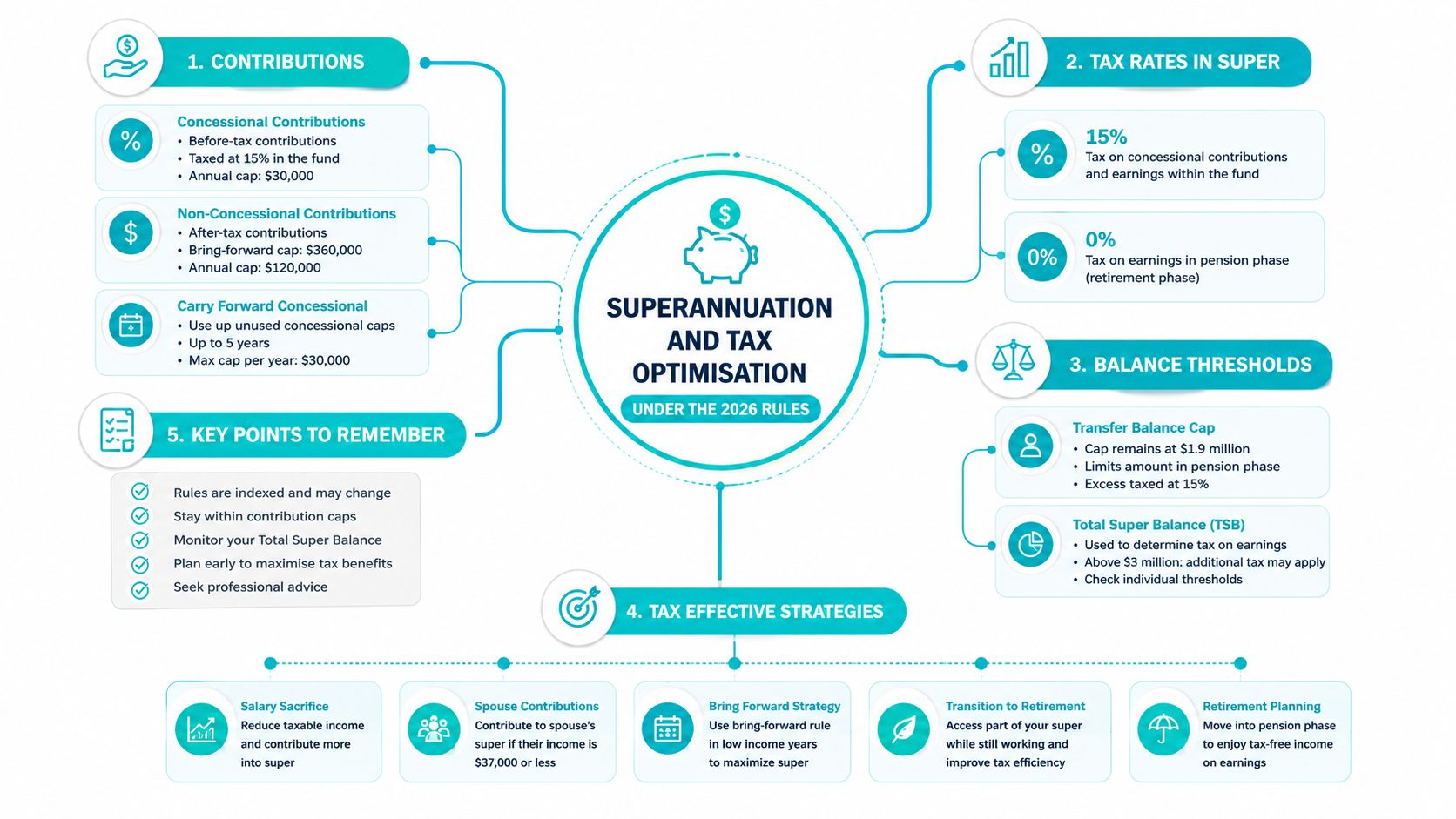
For 2026–27, the general concessional contributions cap is $32,500, and the non-concessional cap is $130,000, according to the ATO contribution caps guidance. The non-concessional cap becomes nil when your total super balance is $2.1 million or more at 30 June 2026. The general transfer balance cap rises to $2.1 million from 1 July 2026. New Division 296 earnings tax rules also apply to very large balances above $3 million from income years beginning on that date, as outlined in Colonial First State's summary of the 2026 changes.
Start with the contribution map
Add every concessional contribution before setting salary sacrifice:
- Employer super guarantee.
- Salary sacrifice.
- Personal deductible contributions.
- Concessional amounts tied to bonuses or other remuneration.
- Defined-benefit or legacy arrangement amounts, where relevant.
Test the total against the cap and your total super balance. Carry-forward eligibility may create additional scope, but check the rules rather than assuming it applies. The same discipline applies to non-concessional bring-forward rules. A strategy that looks efficient alone can fail because of the balance test or timing requirement.
Division 293 is the next calculation. If income plus concessional contributions exceeds $250,000, an additional 15% tax can apply to relevant concessional contributions, taking the effective tax on those contributions to 30%. The ATO explanation of Division 293 tax explains the trigger and treatment. For a practical examination of the calculation, read our Division 293 tax guide.
Salary sacrifice therefore requires a calculation. Compare its tax benefit with the marginal tax outcome from investing outside super. Then assess liquidity, access restrictions, future policy risk and the job the money must perform.
The decision rule
Use super for retirement money when the contribution fits within the relevant limits and the after-tax result remains attractive after Division 293. Give a taxable portfolio or family structure priority when you need access before retirement, additional contributions produce weak after-tax value, or your super balance increases exposure to future concession changes.
Review the arrangement each financial year. The ATO indexes the concessional cap in $2,500 steps, so an unattended salary-sacrifice instruction can become unsuitable. Coordinate employer contributions with bonus and LTIP timing. Remuneration above the $270,830 maximum contribution base does not attract additional super guarantee.
Handling Equity, RSUs, and ESPPs as an Australian Executive
Employer equity is compensation first and an investment second. Treating vested shares as a vote of confidence in the company is how executives end up with a balance sheet tied to the same organisation that provides their income.
For most Australian employees, RSUs and similar equity awards create an income-tax event around vesting or acquisition under the applicable employee share scheme rules. The exact treatment depends on the plan documents, restrictions and whether the arrangement is Australian or offshore, so the first step is to obtain the scheme rules, vesting schedule and tax statements. Don't rely on the platform's default tax withholding as proof that the final Australian tax position is correct.
Create a written diversification policy
Use a policy rather than an emotional decision at each vesting date. Set a target maximum for employer stock, define the cash reserve you want, and decide in advance what happens when the holding exceeds the target.
A practical policy can sell shares in stages when the holding reaches 20%, 40% and 60% of the target holding. Those percentages are decision points, not forecasts. The purpose is to prevent loyalty, optimism or a busy reporting period from overriding your risk limit.
Your one-page equity playbook should record:
- Vesting dates: Know when shares become available and when trading restrictions apply.
- Tax funding: Reserve cash for the actual tax liability, not merely the amount withheld.
- Diversification action: State how many shares will be sold and where the proceeds will go.
- Trading compliance: Follow blackout periods, insider-trading policies and any required pre-clearance.
- Offshore reporting: Identify foreign income, currency conversion and reporting obligations.
Certain offshore plans can involve deemed-disposal mechanics or other tax treatments that don't match the intuitive “I haven't sold, so I don't owe tax” assumption. Get the plan reviewed before the first major vesting event.
Coordinate equity with the wider plan
A vesting event may be the right time to fund a tax payment, reduce debt, invest outside super or review concessional cap space. It may also be the wrong time to make an additional contribution if employer super and salary sacrifice already fill the available room.
Your adviser and tax agent should coordinate the calendar. The objective isn't to eliminate every tax bill. It's to avoid being forced to sell shares, borrow money or miss a contribution opportunity because nobody connected the dates.
Building an Investment Allocation That Matches the Executive Balance Sheet
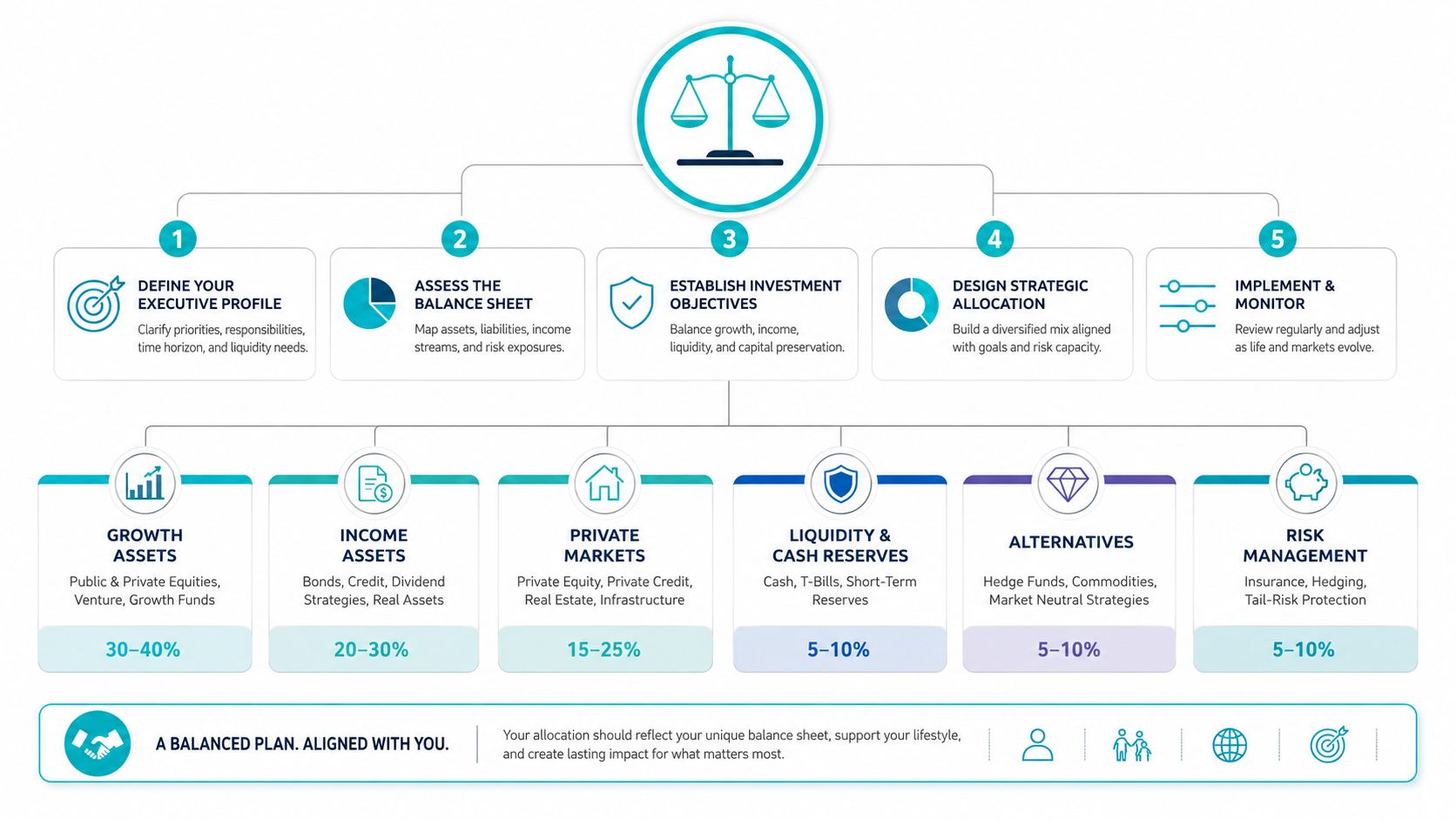
A generic balanced portfolio doesn't reflect an executive balance sheet. Your real exposure includes employment income, employer equity, super, property, debt and future remuneration. The investment portfolio should offset those exposures, not blindly replicate them.
Consider an executive aged 45 earning $400,000, with $1.2 million in super and $600,000 in taxable assets. If employer stock represents a large share of the taxable assets, the first allocation decision isn't whether to add another growth fund. It's whether the household already has too much exposure to one company, one sector or one economic outcome.
Allocate by purpose before asset class
Separate the money into jobs:
| Portfolio role | Typical purpose |
|---|---|
| Liquidity reserve | Near-term spending, tax, employment transition and planned purchases |
| Defensive assets | Stability and funding for goals that shouldn't depend on share markets |
| Growth assets | Long-term wealth creation across diversified markets |
| Concentrated holdings | Employer equity managed under a defined risk limit |
| Opportunity capital | Business, property or other investments with a clear decision framework |
The exact percentages should come from the balance sheet, time horizon and risk capacity. An executive with high employer-stock exposure may need the diversified portfolio to carry less single-company risk. Someone with large property debt may need a different defensive allocation from someone with no debt.
Make the tax structure serve the goal
Super can provide tax-effective long-term investing, but it has access rules. Taxable investments provide flexibility, while a family trust may help with ownership and distribution decisions where the family circumstances, tax advice and trust administration justify it. A trust isn't a magic tax reduction tool, and it shouldn't be established without considering cost, control, record-keeping and future beneficiaries.
Franking credits can influence the placement of Australian shares, but they shouldn't dictate the entire portfolio. Use ETFs or managed funds where they provide diversification, transparency and implementation efficiency. Use gearing only when the debt, cash flow and downside risk have been tested. Borrowing to invest is not a substitute for a coherent allocation.
Set rebalancing rules that account for tax. New savings, dividends and vesting proceeds can move the portfolio towards target without selling everything immediately. Sell when concentration breaches the agreed limit, when the investment case changes or when the household's objectives change. Don't trade merely because a spreadsheet moved.
Insurance, Risk Management, and Estate Structures That Actually Protect You
Your income is often your largest asset, and your employer equity can be one of your most concentrated risks. Yet many executives carry default insurance inside super that was designed for a broad membership base, not for a household dependent on senior-level earnings.
Insurance should be sized against actual obligations and the income your family needs after tax. Review income protection, total and permanent disablement cover and life insurance separately. Check waiting periods, benefit periods, definitions, exclusions, indexation, ownership and whether the policy responds to your occupation rather than a generic role.
Protection principle: A policy isn't adequate because it exists. It's adequate only if it responds when your household's financial plan needs it.
Build the minimum viable protection suite
- Income protection: Model the household cash flow if you can't work, including debt repayments, education costs and investment commitments.
- TPD cover: Consider whether your occupation, policy definition and benefit amount match the skills that generate your income.
- Life cover: Include debt, dependants, future funding needs and the cost of replacing household services.
- Trauma cover: Consider the liquidity required after a serious diagnosis, particularly where an executive's remuneration includes irregular or equity-based income.
- Business and key-person risks: Separate personal protection from risks attached to a company, partnership or ownership interest.
Ownership affects premiums, claims and tax outcomes. Personal ownership, super ownership and trust ownership each have different consequences. Get the structure reviewed before applying, because changing ownership later can create tax and underwriting complications.
Estate planning is part of executive planning
At minimum, maintain a current will, enduring power of attorney and binding death nominations for super. Review beneficiary arrangements after marriage, separation, a new child, a major asset purchase or a change in business ownership.
A testamentary trust may help protect inherited assets and manage distributions, but it needs carefully drafted legal advice. For a useful comparison of how advisers approach asset protection and succession in another jurisdiction, see this resource on Texas business estate planning. The legal rules aren't interchangeable with Australia, but the underlying planning question is relevant: who controls assets, who benefits and what happens when relationships or family circumstances change?
Australian families should obtain Australian legal advice through a coordinated estate planning service. Protection isn't complete until the documents, ownership structures, nominations and insurance policies all tell the same story.
Retirement Timing, the Age-60 Transition, and Drawdown Order
Retirement isn't a birthday. It's a decision about work, identity, liquidity, tax, health, family commitments and the level of control you want over your time.
The first distinction is between preservation age and pension age. The Commonwealth preservation age is 60 for anyone born from 1 July 1964 onward, while earlier birth cohorts have preservation ages from 55 to 59, depending on date of birth. Preservation age determines when super access conditions may be met. It's separate from Age Pension age, which is a different test and shouldn't be used as a shortcut for retirement planning. The ATO's super withdrawal guidance explains the preservation-age rules.
The age-60 transition deserves particular attention because the ATO states that super payments may be tax free from age 60. That doesn't mean every withdrawal strategy is automatically optimal. It means preservation, contribution timing, taxable and tax-free components, pension commencement and drawdown order need to be modelled together.
Compare retirement dates, don't guess
Take a 58-year-old executive considering retirement at 60, 62 or 65. The correct answer depends on spending, health, employment satisfaction, super components, taxable investments, debt, insurance and the desired treatment of employer equity. The plan should model each date rather than assume that working longer is always financially superior.
For each scenario, calculate:
- Required income: Define the annual amount needed for core living costs, travel, gifts and large planned expenses.
- Funding source: Identify which cash, taxable investments, super account or pension stream will fund each stage.
- Tax position: Compare the treatment of taxable income, realised gains, dividends and super payments.
- Super access: Check preservation conditions, retirement status and the timing of any transition-to-retirement arrangement.
- Policy exposure: Test the impact of changing super concessions, particularly for large balances.
- Lifestyle outcome: Include the value of time, flexibility, health and family commitments.
A transition-to-retirement strategy can help an eligible person reshape cash flow while continuing to work. It may involve drawing an income stream from super and directing part of employment income back into super, but the result depends on the governing rules, contribution limits, preservation conditions and personal tax position. It should be modelled, not adopted because the phrase sounds tax efficient.
Choose the drawdown order deliberately
The common mistake is withdrawing from the most convenient account. Convenience is not a tax strategy.
A stronger process is:
- Estimate the minimum retirement income and the amount required for discretionary spending.
- Separate taxable and tax-free super components.
- Identify which taxable investments should be sold, retained or used for income.
- Check the transfer balance cap before commencing or increasing retirement-phase pensions.
- Consider whether drawing from one source preserves flexibility in another.
- Revisit the order when markets, employment or family circumstances change.
The $2.1 million transfer balance cap for 2026–27, the $32,500 concessional cap and the $130,000 non-concessional cap form the key contribution architecture for the period. The ATO's super and retirement planning guidance also highlights the importance of checking total super balance, contribution eligibility and withdrawal arrangements.
Large balances require an additional policy review. New Division 296 earnings tax rules apply to balances above $3 million from income years beginning 1 July 2026, and the policy direction makes “maximise super first” a poor universal rule for some high-income Australians. The practical response is to compare super with taxable investing and suitable family structures, while accepting that tax outcomes depend on personal circumstances and future legislation.
Select an adviser who can implement
A retirement model is only useful when someone maintains it. Ask an adviser how they're paid, who owns the practice, what products they can recommend, how conflicts are managed and what ongoing service includes. Check the adviser's Australian Financial Services licensing and authorisations through the relevant public register, then read the engagement agreement before proceeding.
A salaried banker may provide valuable guidance within the bank's product and advice framework. An independent adviser may offer a broader product range, but “independent” should still be tested against the adviser's stated ownership, remuneration and product arrangements. The label matters less than the documented scope and the quality of the process.
Your first meeting should answer five questions:
- What decisions will you help me make?
- What information do you need before recommending anything?
- How will you coordinate with my accountant, solicitor and employer equity provider?
- What will I receive, and when?
- How will you measure whether the plan is working?
Use a 90-day implementation plan
The first three months should create visible order:
- Days 1 to 30: Gather remuneration documents, super statements, equity-plan rules, debts, insurance policies, wills and beneficiary nominations.
- Days 31 to 60: Confirm cash-flow targets, review contribution limits, model retirement dates, assess concentrated equity and identify protection gaps.
- Days 61 to 90: Implement agreed insurance, consolidate suitable super accounts, establish investment rules, execute equity sales, update estate documents and document the investment policy statement.
Digital systems can help, but don't mistake software for governance. Deloitte's 2025 CFO Sentiment report noted that only 3% of CFOs reported extensive use of digital financial reporting, which reinforces the practical need for clearer visibility and automation even among finance leaders. The system should show what is owned, what is owed, what is due and what decision comes next.
Wealth Collective's three service pillars, Protection Plus, Guided Growth and Retirement Roadmap, connect insurance, superannuation, investment strategy, debt reduction and retirement planning into an organised advice process. Start with the free 10-minute introductory call to decide whether the firm's approach fits your situation.
Wealth Collective helps executives coordinate protection, superannuation, investments, debt and retirement timing through a structured advice process rather than a product-first review. Visit Wealth Collective to book the free 10-minute introductory call and bring your compensation map, super statements and most pressing financial decision to the conversation.