Business hours
Monday to Friday (8.30AM - 5PM)
Weekend (Closed)


You've done the work, the bonus has landed, and the payslip still looks wrong. The gross figure feels generous, then tax, Medicare levy, and sometimes HELP withholding take a bigger bite than you expected, so the number in your bank account misses the mark. That gap is exactly why calculating tax on bonuses properly matters.
A bonus in Australia isn't taxed under some special bonus-only tax rate. It's folded into your ordinary taxable income and withheld through PAYG, which means two people can get the same bonus and walk away with very different take-home amounts because their total income sits in different parts of the tax scale (TurboTax Australia bonus tax guide). If you've ever looked at your pay and thought the payroll team had made a mistake, the issue is usually the calculation method, not the existence of a secret bonus tax.
Why Your Bonus Tax Withholding Feels Surprising
A lot of people expect a bonus to be taxed like a separate payment with its own neat percentage. That's not how Australian PAYG withholding works. The employer adds the bonus to your taxable income for the pay period, then withholds tax using your income scale and the ATO's withholding formulas, so the result can look harsher than a simple estimate (TurboTax Australia bonus tax guide).
Sarah, a senior admin manager, might see a bonus paid in the same fortnight as her salary and wonder why the withholding spikes. Jason, on a lower income, could receive the same dollar bonus and see a much smaller deduction because the bonus doesn't push him as far up the marginal rate ladder. The point is simple, withholding follows your total income, not just the bonus on its own (TurboTax Australia bonus tax guide).

Practical rule: treat the bonus withholding figure on your payslip as an estimate, not the final tax outcome.
The Australian Taxation Office's resident individual rates for 2024–25 start at 0% up to $18,200, then move to 16% from $18,201 to $45,000, 30% from $45,001 to $135,000, 37% from $135,001 to $190,000, and 45% above $190,000, plus the 2% Medicare levy for most taxpayers (TurboTax Australia bonus tax guide). Those thresholds are why the same bonus can feel gentle for one worker and painful for another.
If you're a business owner or payroll lead, a plain-English overview like the Nexist small business tax guide is useful for seeing how bonus treatment sits inside broader business tax decisions. If you're checking your own year-to-date figures, the right starting point is your PAYG summary and earnings record, not a guess from a flat-rate calculator, and our guide on how to get a PAYG summary helps with that.
Understanding Bonus Tax Definitions and PAYG Rules
A bonus is just extra pay on top of ordinary salary or wages. In Australian payroll, that extra payment is usually treated as part of gross income for withholding purposes, which is why there is no separate bonus tax rate sitting outside the PAYG system (TurboTax Australia bonus tax guide).
The key distinction is between withholding and final tax liability. Withholding is what the employer takes out at payment time, while your actual tax position is settled when the year is done. That's why a bonus can look overtaxed on the payslip and still be correct once your total income, offsets, Medicare levy, and any loan obligations are taken into account (ATO Schedule 5 tax table).
Under the ATO framework, employers don't just slap on a fixed percentage and move on. They compare tax on regular pay with tax on regular pay plus the bonus, then withhold the difference. In practice, that means the employer is estimating what your year-end tax will look like using current earnings, not applying a standalone bonus tax rule (YouTube payroll method reference).
The cleanest way to think about bonus withholding is this, your employer is trying to avoid under-withholding, not guarantee that the bonus amount feels tidy.
That distinction matters when people use online tools without checking the assumptions underneath. A calculator can be useful, but it won't tell you whether the payment is being treated as a true bonus, a back payment, or a commission, and those labels can change the withholding method under Schedule 5 (ATO Schedule 5 tax table). It also won't know whether your employer is calculating on a weekly, fortnightly, or monthly basis, which changes the pay-period math.
The practical takeaway is blunt. If you want to understand your bonus tax properly, you need the payroll method, not just the gross amount. Once you know that, the payslip starts to make sense instead of looking like a mistake.
Step-by-Step Method to Calculate Bonus Withholding
Start with the simplest version of the ATO approach. Add the bonus to your regular pay, work out the tax on the combined amount, then work out the tax on your regular pay alone. The difference is the amount withheld from the bonus, which is the logic behind the aggregate method used in bonus payroll calculations (YouTube payroll method reference).
The calculation sequence
- Combine the pay amounts. Add your bonus to the ordinary pay for that period.
- Annualise the result. Use the pay frequency to translate the payment into an annual estimate.
- Calculate tax on the combined amount. Apply the relevant PAYG withholding method.
- Calculate tax on regular pay only. Use the same payroll context without the bonus.
- Withhold the difference. That gap is the bonus withholding amount.
Why this works: it matches how PAYG withholding tries to approximate your end-of-year tax position instead of guessing a bonus-only rate.
A worked example helps. Assume a worker is paid regularly and gets a bonus in the same pay period. Payroll first calculates the expected tax on the usual wages plus the bonus, then repeats the calculation using regular wages only. If the tax on the combined pay is higher, the extra amount gets withheld from the bonus. Cents can be ignored at several steps in the ATO method, so tiny differences between a calculator and a payslip are normal under the Schedule 5 approach (ATO Schedule 5 tax table).
That matters most for larger bonuses paid near year-end. The bonus may push your current pay into a higher marginal band even if your full-year tax outcome later settles differently, and that is exactly why payroll teams use the aggregate sequence instead of a flat bonus percentage (YouTube payroll method reference). It reduces under-withholding risk for the employer and lowers the chance of a nasty surprise for the employee when tax time arrives.
If you are checking your own payslip, don't stop at the bonus amount. Look at year-to-date pay, pay frequency, and whether the bonus was paid separately or alongside normal wages. Those three items often explain most of the difference between expected and actual withholding.
How Bonuses Interact with Medicare Levy and HELP Debts
The bonus itself is only part of the picture. For many Australians, the core question is how much of that bonus survives once Medicare levy and HELP or VSL withholding are layered in. The ATO's withholding framework doesn't stop at gross earnings, it also factors in offsets, Medicare levy adjustments, and student loan repayments after the base pay calculation is done (pay calculator bonus tax guide).
That's why high earners and dual-income households get caught out. A bonus can tip combined income into a higher tax band, increase withholding, and change what lands in the bank account, even though the final tax bill may settle differently later. The changed Stage 3 tax brackets that took effect on 1 July 2024 and continue to affect 2026 withholding make this even more relevant for current bonus planning (pay calculator bonus tax guide).
| Metric | Threshold (2024-25) |
|---|---|
| Resident individual marginal rate | 0% up to $18,200 |
| Resident individual marginal rate | 16% from $18,201 to $45,000 |
| Resident individual marginal rate | 30% from $45,001 to $135,000 |
| Resident individual marginal rate | 37% from $135,001 to $190,000 |
| Resident individual marginal rate | 45% above $190,000 |
| Medicare levy | 2% for most taxpayers |
The table above shows why a bonus can feel more heavily taxed than expected, because the levy sits on top of ordinary income tax for most taxpayers (TurboTax Australia bonus tax guide). For someone with a HELP or VSL debt, the withholding outcome can be even tighter because student loan deductions are layered into the payroll estimate, not left until the end of the year (pay calculator bonus tax guide).
If you've also got private health cover questions, our guide on Medicare levy and private health insurance is a useful companion piece. The practical point is straightforward. A bonus should be measured against your full tax picture, not just the gross amount.
Common Pitfalls and Smart Planning Tips for Bonus Tax
The biggest mistake is trusting a simple percentage calculator to do a job that the payroll system is doing through formulas. Australian bonus withholding under Schedule 5 is formula-driven, not a flat-rate shortcut, and the result can differ depending on whether the payment is a bonus, a commission, or a back payment (ATO Schedule 5 tax table). If the pay item is classified wrongly, the withholding can land off target.
The traps I see most often
- Assuming one flat bonus rate applies. The bonus is usually added to income and taxed at your marginal rate through PAYG withholding.
- Ignoring pay frequency. Weekly, fortnightly, and monthly payroll each produce different estimates because the annualised amount changes.
- Forgetting year-to-date earnings. A bonus paid late in the year can have a very different withholding outcome from the same bonus paid earlier.
- Treating withholding as final tax. It's only an estimate until your return is lodged.
- Missing the role of cents. Small rounding differences can appear because the ATO method ignores cents at multiple steps (ATO Schedule 5 tax table).
If you run payroll, the right software matters because it reduces manual errors and handles the difference between wage types more cleanly. A practical overview like the Cloudvara payroll software guide is worth reading if your business pays bonuses and you want fewer surprises at reconciliation time.
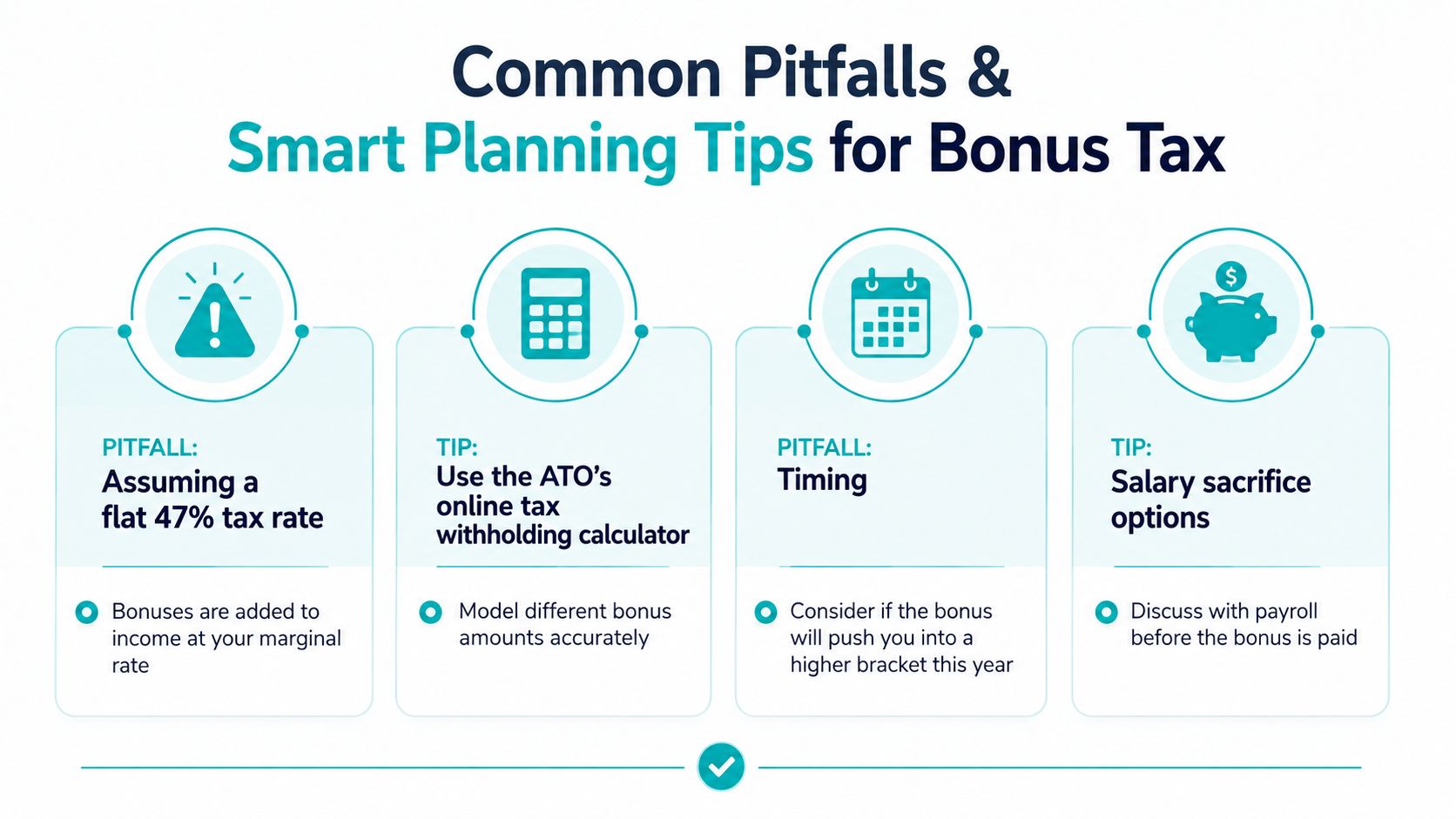
Smart planning is more direct than you might think. Check whether the bonus is being paid before or after a bracket change, because timing can alter cash flow even if the final tax position later evens out. If you're salary sacrificing or making additional super contributions, line that up before the bonus lands so payroll can process the right taxable base from the start.
Keep records of the bonus payslip, your year-to-date earnings, and any HELP or VSL deductions. When tax time arrives, those records make the reconciliation much easier and help you see whether the withholding was too high, or incorrect. That's the difference between guessing and managing your tax position properly.
Next Steps When to Seek Professional Advice
If your bonus is routine and your income is simple, payroll maths may be enough. If you're on a higher income, carrying HELP debt, planning debt reduction, or trying to direct money into super, a specific strategy is smarter than relying on an estimate. Bonus timing can affect cash flow, but a broader plan can also change what you do with the money after it lands.
That's where professional advice pays for itself. Wealth Collective has more than 50 years of combined experience helping Australians turn complex financial rules into plain-English action, with advice that connects bonus planning to superannuation, debt reduction, insurance, and retirement strategy. Their service pillars, Protection Plus, Guided Growth, and Retirement Roadmap, are built for people who want decisions that fit the rest of their financial life, not just this pay run.
If you're trying to work out whether your bonus should go towards debt, investing, super, or a tax-efficient cash buffer, talking to the right adviser is the fastest way to stop second-guessing yourself. The earlier you do that, the easier it is to avoid a year-end scramble, especially if your tax position is already influenced by multiple income sources or a loan repayment obligation. For help choosing an adviser, their guide on how to find a good accountant is a sensible place to start.
If you want a clear view of what your bonus really means for your cash flow, tax position, and long-term goals, book a free 10-minute introductory call with Wealth Collective. They can help you turn bonus withholding confusion into a practical plan that fits your income, debt, super, and retirement strategy.