Business hours
Monday to Friday (8.30AM - 5PM)
Weekend (Closed)



Sarah earns $65,000 as a teacher. Mark earns $130,000 as an electrician. They're building a life together, but Sarah's super balance has fallen behind after time away from work. Mark contributes $3,000 to Sarah's super and expects a tax offset of up to $540.
That sounds simple. It isn't.
The contribution may be useful, but only if Sarah's income, super balance, residency, contribution caps and retirement objectives all line up. The right question isn't “Can we claim the offset?” It's “Does putting money into Sarah's super create a better outcome for both of us than using that money elsewhere?”
Why Spouse Superannuation Contributions Deserve a Closer Look
For Sarah and Mark, the obvious appeal is the tax relief. Mark contributes after-tax money to Sarah's super, and if Sarah meets the income requirements, Mark may claim the spouse contribution tax offset in his own tax return. The maximum is $540, calculated at 18% of the lesser of $3,000 or the amount remaining after the relevant income reduction, under the ATO spouse super contribution rules.
The more important benefit is broader. The lower-earning spouse's retirement savings start working harder, while the higher earner receives tax relief for helping build that balance. That matters when one partner has taken time out for children, worked part-time, changed careers or had limited access to salary sacrifice.
Practical rule: Treat the offset as a bonus attached to a retirement-planning decision, not as the reason to contribute by itself.
A spouse contribution can also be relevant where salary sacrifice isn't available or where the higher earner's income creates additional super tax considerations. However, the contribution doesn't automatically solve an imbalance. Money placed into Sarah's account becomes Sarah's super. It's not a temporary family bank account, and you shouldn't make the payment casually if ownership, estate planning or access arrangements haven't been considered.
The decision behind the payment
Mark should compare three uses for the same cash:
- Top up Sarah's super, potentially receiving the offset.
- Use his own available contribution strategies, where those strategies better suit his tax position.
- Keep the money outside super, if the couple needs liquidity or has higher-priority debt.
The couple also needs to check whether Sarah's income is low enough for a full or partial offset. A contribution made without that check may still build Sarah's balance, but it could provide no tax benefit. That's why spouse superannuation contributions deserve a proper review rather than a rushed end-of-year payment.
Eligibility Rules Couples Need to Get Right First
The tax offset is not the starting point. First confirm the relationship, residency, receiving account and payment timing. A contribution that misses one requirement may still increase super, but it can fail to deliver the intended tax result.
The rules cover married and de facto couples, including same-sex couples. Both spouses must be Australian residents when the contribution is made, and they must not be living separately and apart on a permanent basis. The ATO's eligibility guidance also sets out the age and balance conditions.
Check the receiving spouse
The receiving spouse must be under 75 when the contribution is made. Their total super balance at the previous 30 June also needs checking. Under the current rules, the relevant transfer balance cap test uses a $2 million threshold. Reaching that limit can affect whether the payment qualifies as a non-concessional contribution.
The offset has a separate income test. Add the receiving spouse's:
- Assessable income
- Reportable fringe benefits
- Reportable employer super contributions
For 2025–26, the full offset applies below $37,000. It tapers through the range up to $40,000 and cuts out at $40,000, according to the ATO 2026 tax return instructions.
Check the payment timing
The fund must receive the contribution in the intended financial year. Processing banking details, member information or compliance checks can delay a payment, particularly near 30 June. Pressing “pay” does not determine the tax year.
Check the fund's cut-off time well before year-end. If the contribution arrives late, it may fall into the next financial year and produce a different result from the one used in your planning. This timing check is simple, and it prevents an avoidable mistake.
Contribution Types and Caps That Apply Each Year
The tax offset is attached to a contribution made on behalf of a spouse, but the contribution itself still has a tax character. That distinction matters because the same $3,000 payment can use different caps depending on where the money comes from.
A contribution made with after-tax money is generally treated as non-concessional for the receiving spouse. It doesn't create a personal tax deduction for the contributing spouse, but it may allow that spouse to claim the spouse contribution offset. The receiving spouse's non-concessional cap and total super balance must be checked before payment.
A deductible personal contribution is different. If Mark claims a tax deduction for the $3,000 he pays into Sarah's fund, it counts towards his $30,000 concessional cap and is generally subject to 15% contributions tax inside super. Sarah may still be the spouse receiving the contribution, but Mark's deduction and the spouse offset need to be modelled together. In many cases, the tax effects can largely wash against each other, which makes the after-tax route more straightforward when the primary goal is the spouse offset.
For a wider explanation of the relevant annual limits, see Wealth Collective's guide to concessional contribution limits.
Worked comparison
Mark has $3,000 available and wants to build Sarah's super.
- If he contributes after-tax cash, the payment lands as a non-concessional contribution in Sarah's account. It uses Sarah's non-concessional capacity, subject to her eligibility.
- If he makes a deductible personal contribution, the payment is concessional for Mark and uses his concessional capacity. The fund applies contributions tax, while Mark considers the deduction and spouse offset in his tax return.
| Feature | Concessional (Deductible) | Non-Concessional (After-Tax) |
|---|---|---|
| Funding source | Before-tax treatment through a personal deductible contribution | Cash already taxed outside super |
| Cap affected | Contributing spouse's concessional cap | Receiving spouse's non-concessional cap |
| Contributions tax | Generally applies at 15% | Generally not applied as contributions tax |
| Spouse offset | May be available if the conditions are met | May be available if the conditions are met |
| Main planning question | Is the contributing spouse's concessional cap available? | Is the receiving spouse eligible for a non-concessional contribution? |
Don't label a payment “spouse contribution” and assume the cap treatment is settled. Confirm the source of the money, the notice requirements and both spouses' existing contributions before transferring funds.
How the Spouse Contribution Tax Offset Actually Works
The calculation has three moving parts. The offset is 18%, it applies to the lesser of the contribution amount or $3,000, and it reduces as the receiving spouse's relevant income rises above $37,000. It disappears when the combined relevant amount reaches $40,000, according to the ATO's spouse tax offset rules.
The income test isn't limited to salary. Assessable income, reportable fringe benefits and reportable employer super contributions all matter. Net investment losses can also affect the relevant income calculation, so a couple shouldn't rely on the receiving spouse's payslip alone.
Two practical examples
Sarah earns $30,000. Mark contributes $3,000 to her super. The lesser amount is $3,000, so the offset is 18% of $3,000, producing the maximum $540 offset.
Sarah earns $38,500. She is $1,500 above the full-offset threshold. The amount used for the offset calculation reduces from $3,000 to $1,500. Mark therefore receives an offset of 18% of $1,500, or $270.
The offset is claimed by the contributing spouse, not the spouse whose account receives the money. Mark claims it in his tax return. Sarah doesn't claim the same amount just because the contribution went into her super.
The contribution must be received by the fund before the end of the financial year for the offset to apply in that year. A payment left until the final days can miss the fund's processing cut-off, so timing needs to be treated as part of the strategy.
| Receiving Spouse Income | Contribution Made | Offset Rate | Tax Offset Received |
|---|---|---|---|
| $30,000 | $3,000 | 18% of $3,000 | $540 |
| $38,500 | $3,000 | 18% of $1,500 after the income reduction | $270 |
| $40,000 or more | $3,000 | No spouse contribution offset | $0 |
Use the spouse contribution tax offset guide to understand the calculation, but don't stop at the headline maximum. The partial-offset range is where many middle-income couples make poor assumptions.
Spouse Contributions Compared With Contribution Splitting
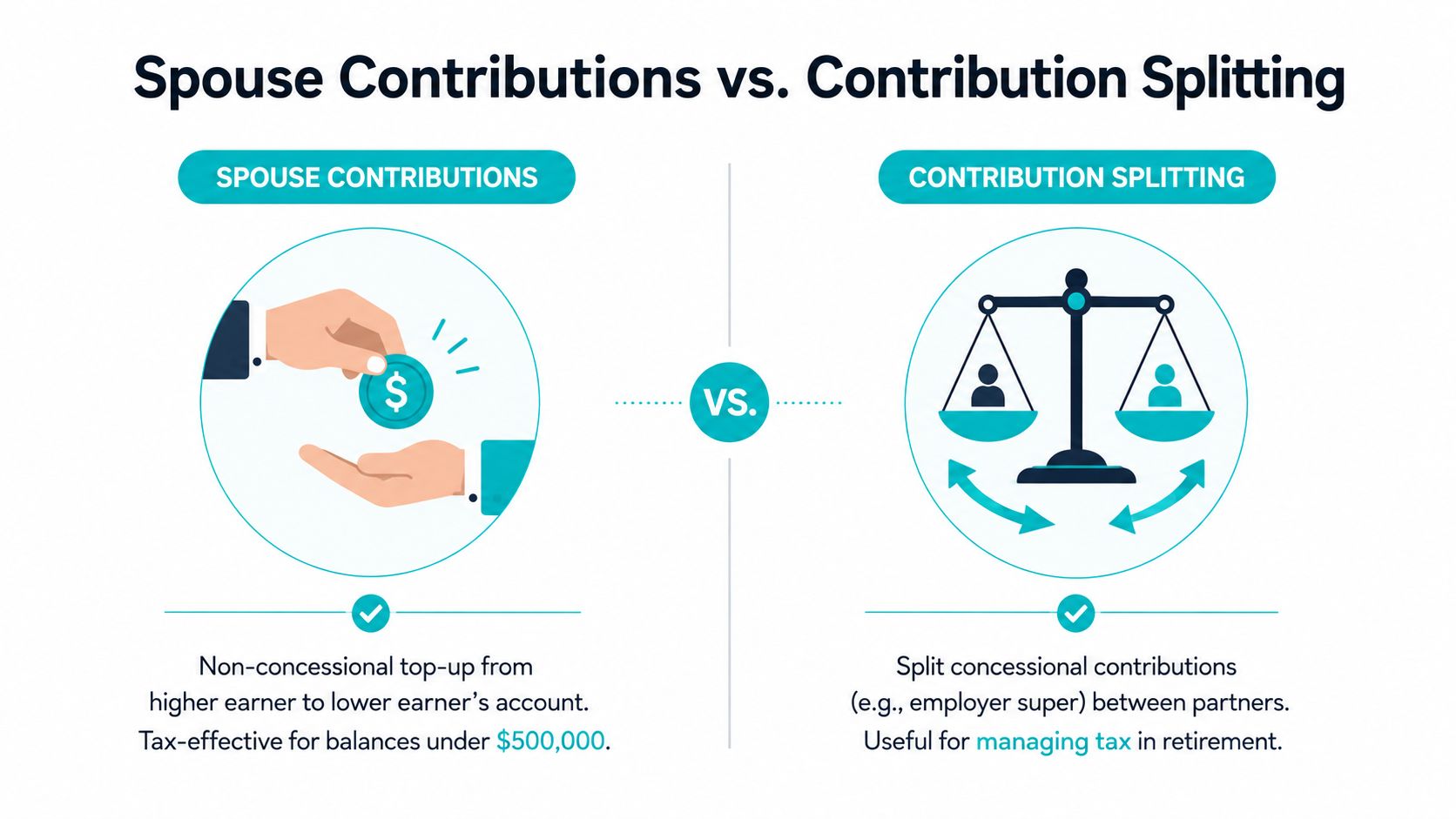
Spouse contributions and contribution splitting both increase the lower-earning partner's super balance, but they move different types of money and solve different problems.
A spouse contribution is usually an after-tax top-up funded by the higher earner. The money goes directly into the lower earner's account, and the contributing spouse may receive the tax offset if the eligibility conditions are met.
Contribution splitting reallocates eligible before-tax contributions, such as employer super guarantee or salary sacrifice. Australian Retirement Trust explains that a member can split up to 85% of eligible before-tax contributions, generally only once each financial year for each super account, using its spouse contribution splitting guidance.
Choose based on the objective
| Planning objective | More suitable starting point |
|---|---|
| Build the lower earner's balance using spare after-tax cash | Spouse contribution |
| Capture the spouse contribution tax offset | Spouse contribution |
| Move employer or salary sacrifice contributions between partners | Contribution splitting |
| Reduce concentration of super in one member's name | Contribution splitting or spouse contribution, depending on caps |
| Manage retirement-phase balance positions | A broader balance and pension review |
Contribution splitting generally relates to the previous financial year and must follow the fund's process. It isn't a second version of the spouse offset, and a split contribution doesn't qualify for the spouse contribution tax offset.
The practical distinction is simple. Use a spouse contribution when you're adding new after-tax money for the lower earner. Use contribution splitting when you're reallocating eligible concessional contributions already made for the higher earner.
When the Strategy Stops Making Sense
A spouse contribution isn't automatically clever because a tax offset is available. If the receiving spouse's relevant income is $40,000 or more, the offset is gone. The payment may still improve balance equality, but the tax benefit no longer helps justify the decision.
The non-concessional cap is another constraint. A contribution can consume the receiving spouse's available non-concessional capacity and may affect the couple's ability to use a bring-forward arrangement. The current verified guidance refers to $120,000 as the annual non-concessional cap and $360,000 as the bring-forward headroom relevant to the planning scenario, so those figures must be tested against the applicable financial year and the member's history before money moves.
The real cost isn't always the tax you miss. It can be the contribution capacity you use up.
Cases where cash may work harder elsewhere
Be cautious when:
- The higher earner has unused concessional capacity: A deductible contribution for the higher earner may produce a stronger tax result than a non-concessional payment into the spouse's account.
- The lower earner already has sufficient super: If their retirement income and lifestyle objectives are covered, further equalisation may add little value.
- The receiving fund holds important insurance: The payment may be motivated by maintaining cover rather than building retirement savings. That requires an insurance review, not an automatic contribution.
- Access timing is mismatched: A younger spouse may not be able to access the money when the older spouse expects to retire.
- The receiving spouse is drawing a transition-to-retirement income stream: Additional contributions can interact with pension strategy, balance limits and cash-flow needs.
Couples should also consider relationship breakdown, estate planning and binding death benefit nominations. Once the money enters the receiving spouse's super, it belongs to that member's account. Don't use spouse contributions to solve an ownership problem without getting advice on the wider legal and financial consequences.
Putting It All Together With Wealth Collective
A sound process is short, but it has to be completed in the right order.
- Confirm eligibility: Check the relationship, residency, age, income and total super balance requirements.
- Select the contribution type: Decide whether after-tax money or a deductible contribution fits the caps and tax position.
- Model the outcome: Calculate the likely offset, the contribution-cap impact and the projected balance effect.
- Make the payment early: Allow time for the receiving fund to process and acknowledge the contribution.
- Complete the tax paperwork: Claim the offset in the contributing spouse's tax return and retain the fund records.
- Review at year-end: Check whether income, employment, contributions or balance changes have altered the strategy.
Couples often confuse a notice of intent to claim a deduction with the paperwork for the spouse offset. They're separate issues. If a deductible contribution is involved, the relevant notice must be lodged with the fund and acknowledged before the deduction is claimed. The fund's acknowledgement can take time, so leaving the paperwork until the tax return is due is poor practice.
Wealth Collective's superannuation financial adviser service can help couples review balances, contribution caps and offset projections as part of a broader retirement strategy. The initial call should include both partners where possible, along with current super statements, recent income details, contribution records, insurance information and any pension or retirement-income documents.
The aim isn't to force a contribution. It's to determine whether the payment supports the couple's retirement roadmap, protects flexibility and uses available tax concessions intelligently.
Wealth Collective helps couples assess spouse superannuation contributions alongside super optimisation, investment strategy, insurance and retirement planning. Visit Wealth Collective to arrange an initial conversation and map the potential offset against your broader financial plan.