Business hours
Monday to Friday (8.30AM - 5PM)
Weekend (Closed)


Jan and Rob, a 65-year-old couple in Perth, have stopped work and can see a sizeable super balance on their latest statements. Their question isn't whether they need income. It's whether they should start an account based pension now, leave their super in accumulation, or combine a pension with another retirement-income option.
The practical question is simple: how does an account based pension work, when should you start one, and how do you draw income sustainably? The answer requires more than selecting a payment frequency. You need to coordinate tax, investment risk, mandatory withdrawals, the transfer balance cap, Centrelink considerations, beneficiary arrangements and the possibility that retirement could last for decades.
What an Account Based Pension Is and Why It Matters Now
An account based pension is a superannuation income stream purchased with your accumulated super balance. You move eligible super from accumulation into a retirement-phase account, then draw regular payments while the remaining balance stays invested. It isn't a guaranteed lifetime pension. Your balance rises and falls with investment returns, fees and withdrawals.
Think of Jan and Rob's super as capital that must now serve two jobs. It needs to pay for groceries, travel, health costs and household bills, while also remaining invested to support their later years. Starting too aggressively can reduce the capital available in their 80s and 90s. Waiting too long can leave them with an unnecessarily inefficient structure or no clear income plan.
The account based pension has become Australia's dominant retirement income product. APRA data cited in Treasury's Super System Review showed that by 2017, account based pensions represented 634,000 pension member accounts, or 39.0% of pension member accounts, with $176.988 billion in pension member benefits and $11.287 billion in annual pension benefit payments. Those figures imply an average member benefit of about $279,374 and an average annual payment of about $17,816 in the APRA-regulated system. Treasury's retirement-income analysis illustrates how central these accounts have become.
The decision matters more as retirement-phase assets expand. APRA reported $2.83 trillion across 23.4 million retirement-phase member accounts at 31 December 2025, while Treasury estimated that about 2.5 million Australians would move into retirement phase over the next 10 years. APRA's December 2025 superannuation publication makes the direction clear, more Australians are moving from saving to drawing.
My view: An account based pension is a flexible tool, not a complete retirement plan. The right starting balance, investment mix and withdrawal rate matter more than simply opening the account.
How an Account Based Pension Works in Practice
Use a rainwater tank to understand the mechanics. Accumulation super is the tank filling up while you work. An account based pension turns on a regulated tap, sending income to your bank account while the remaining water stays invested for future use.
The process usually follows these steps:
- Confirm eligibility. You must meet a condition of release, such as reaching preservation age and retiring, or turning 65.
- Choose the amount to transfer. You can move some or all eligible super into retirement phase, subject to your personal transfer balance cap.
- Select investments. The balance remains invested through your super fund or SMSF. The investment menu might include cash, fixed interest, diversified options, property and shares.
- Set the payment schedule. Payments can generally be made regularly, such as monthly or quarterly, provided the annual minimum is met.
- Monitor the balance. Withdrawals, returns, fees, tax components and market movements change how long the capital may last.
The key difference from accumulation super is the purpose of the account. Accumulation is designed to build retirement savings. An account based pension is designed to turn those savings into income while the unused capital remains invested.
Earnings in a retirement-phase pension account are generally tax-free. MoneySmart also explains that, for individuals aged 60 and over, payments from an account based pension have been tax-free since July 2007, although annual withdrawals must remain within legislated minimum and maximum levels. MoneySmart's account based pension guidance sets out the broad operating rules.
You can usually take additional lump sums, or commute part of the pension back to accumulation or out of super, where the rules allow. That flexibility is valuable for a car purchase, home renovations or an unexpected medical expense, but every extra withdrawal reduces the capital available for later income.
The balance remains yours. It may be paid to beneficiaries after death, but the result depends on the transfer balance cap, the pension's terms, reversionary arrangements and super death benefit rules. Treat beneficiary nominations as part of the pension design, not as paperwork to complete later.
Eligibility, Commencement and When You Can Stop
Eligibility depends on age and the condition of release you satisfy. For someone born after July 1964, preservation age is currently 60. A member who has reached preservation age can generally start an account based pension after permanently retiring, while anyone who turns 65 can commence regardless of whether they continue working.
The removal of the work test from 1 July 2025 for people under 75 changes the practical conversation for some older workers. The maximum age for starting an account based pension has also been abolished, so an eligible member can commence once the relevant preservation and retirement conditions are met.
| Trigger | Rule | Effective Date |
|---|---|---|
| Reaching preservation age | Currently 60 for people born after July 1964, with retirement required to access retirement phase before age 65 | Current rule |
| Turning 65 | Pension commencement is available regardless of work status | Current rule |
| Work test | Removed for people under 75 | 1 July 2025 |
| Maximum pension start age | Maximum commencement age abolished | Current rule |
| Commencement process | Instruct the super fund and lodge the required Pension Commencement Notification with the ATO | At commencement |
Commencement isn't automatic. You need to tell the fund how much you want to transfer, select the pension account, nominate the payment arrangement and ensure the fund reports the event correctly. An SMSF trustee must also document the decision and retain the supporting records.
Stopping a pension can happen in several ways. You might withdraw the full balance, partially commute an amount, transfer money back to accumulation where permitted, or continue the pension until death. A partial withdrawal can help fund a one-off expense, but it also changes the account's future income capacity.
Death requires separate planning. A reversionary pension can continue to an eligible dependant, subject to the governing rules and transfer balance limits. Alternatively, the trustee may pay a lump-sum death benefit to a dependant or the estate. Adult children can face different tax outcomes from a spouse or financially dependent beneficiary, so a standard beneficiary nomination isn't enough on its own.
Drawdown Rules, Tax Treatment and the Transfer Balance Cap
The ATO calculates the minimum annual pension by applying an age-based percentage to the account balance at 1 July. If the pension begins part way through the financial year, the minimum is generally prorated. The minimum must be paid by 30 June each financial year. ATO guidance on payments from super provides the applicable schedule for 2025–26 and 2026–27.
| Age Band | Standard Minimum % | 2024–25 Notes |
|---|---|---|
| Under 65 | 4% | Standard minimum applies |
| 65–74 | 5% | Standard minimum applies |
| 75–79 | 6% | Standard minimum applies |
| 80–84 | 7% | Standard minimum applies |
| 85–89 | 9% | Standard minimum applies |
| 90–94 | 11% | Standard minimum applies |
| 95 or older | 14% | Standard minimum applies |
The temporary 50% minimum drawdown reduction applied between 2020 and 2023. The standard schedule has now resumed. That matters because the mandatory payment rises with age, even if your lifestyle spending doesn't.
Tax depends on your age, fund type and the taxable or tax-free components of the benefit. For a taxed fund, earnings in a retirement-phase account are generally taxed at 0%, and payments can also be tax-free once you're 60 or over. Untaxed components can produce taxable amounts, and a transition-to-retirement pension that hasn't entered retirement phase can have a different tax outcome. MLC's explanation of tax on super pensions outlines these distinctions.
Practical rule: Don't assume the whole pension has the same tax character. Check the taxable and tax-free components before commencing, commuting or drawing an unusual amount.
The transfer balance cap limits how much super can move into retirement phase, where investment earnings receive the retirement-phase tax treatment. The general cap was $2.0 million in 2025–26 and rises to $2.1 million from 1 July 2026. Your personal cap may differ if you started a retirement-phase pension earlier, because previous entrants can have a lower personal cap than the current general cap. This transfer balance cap guide explains why personal cap history matters.
Exceeding the cap can require a commutation of the excess and may create additional tax consequences, including tax on notional earnings linked to the excess amount. Keep commencement documents, payment records, commutation instructions, fund reports and beneficiary paperwork. If the ATO issues a commutation direction, act promptly. The ATO's material states that the minimum payment deadline is 30 June, and missing the required payment can jeopardise the pension's tax-favoured status.
Account Based Pension vs Annuities and Other Retirement Income Options
An account based pension gives you control. A lifetime annuity gives you certainty. Neither is automatically superior.
| Option | Income certainty | Flexibility | Longevity coverage | Estate outcome |
|---|---|---|---|---|
| Account based pension | Depends on balance and returns | High | Requires active management | Remaining capital may pass under death benefit rules |
| Lifetime annuity | High for the contracted lifetime income | Lower | Strong | Depends on guarantees and product terms |
| Account-based annuity | Contracted income linked to the account | Moderate | Product dependent | Depends on contract terms |
| Transition-to-retirement pension | Supports income while still working | Moderate to high | Not a complete longevity solution | Depends on balance and nominations |
| Ad hoc lump sums | No regular certainty | Very high | None | Remaining assets may pass through super or the estate |
A lifetime annuity can suit someone who prioritises a dependable income stream and worries about living into advanced age. In exchange, you usually give up investment control and may reduce the capital available to beneficiaries. An account based pension keeps capital in your hands and can remain invested in growth assets, but you carry market risk and the risk of exhausting the balance.
An account-based annuity can sit between those approaches. It may provide a defined payment structure while retaining some connection to an investment account, depending on the product. Read the contract carefully. Fees, withdrawal rights, guarantees and death benefit provisions vary.
A transition-to-retirement pension can suit someone who has reached preservation age but continues working. It may help reshape cash flow, but it isn't the same as a full retirement-phase pension. A lump sum offers maximum control, yet ad hoc withdrawals can make a long-term income plan difficult to maintain.
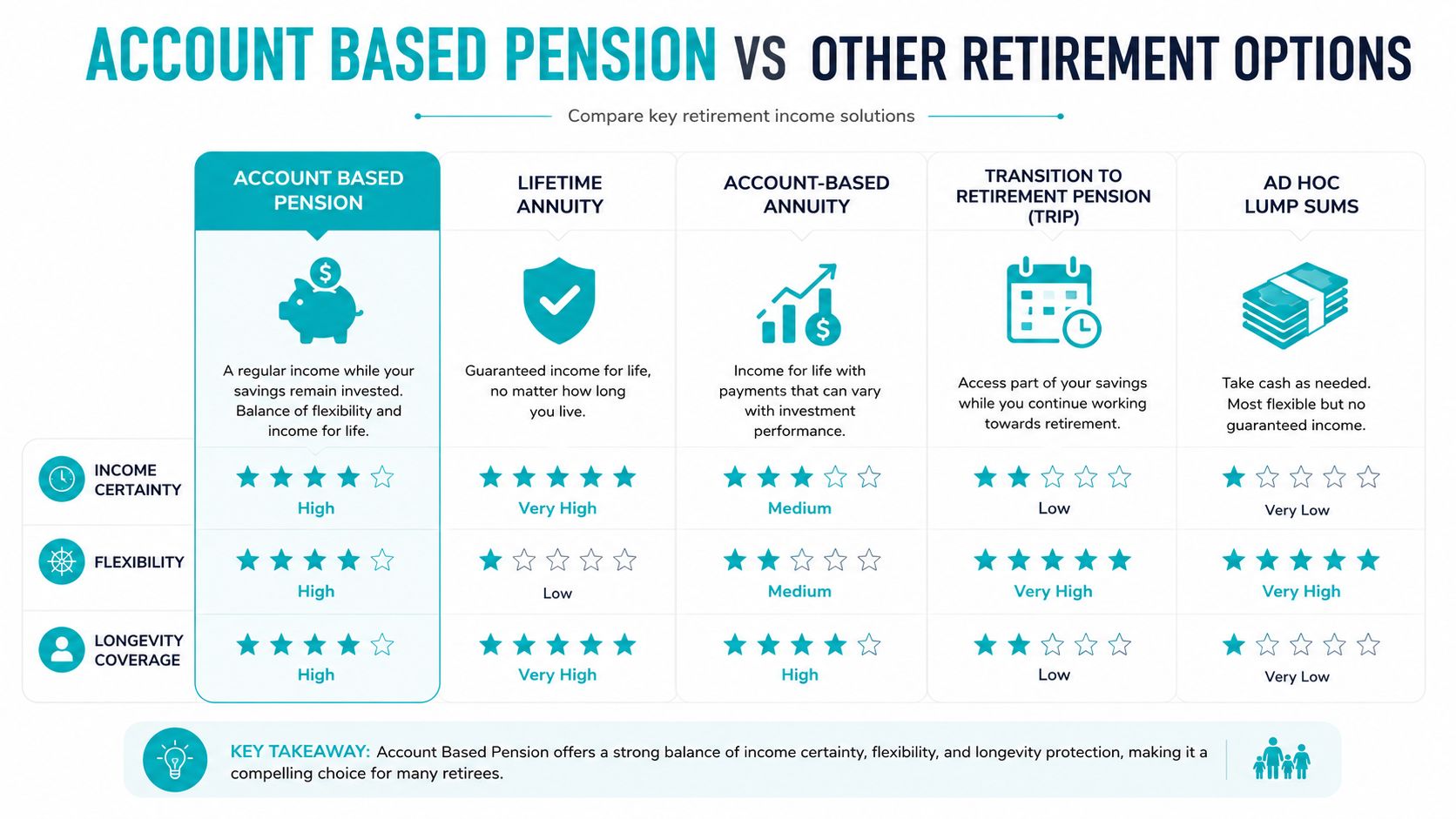
Health, family history and market tolerance should drive the choice. Someone with strong longevity in the family may value guaranteed income more highly. Someone with substantial assets outside super may prefer flexibility and estate control inside an account based pension.
Your broader retirement-income structure matters too. Review retirement income streams alongside the pension, Age Pension prospects and household spending. If future care needs are a concern, resources such as how Medicare covers dementia can help you understand why health-related costs deserve a place in the cash-flow plan.
Worked Drawdown Examples at Different Ages
A minimum payment is a compliance floor, not a guaranteed sustainable spending rate. The following examples show how the required percentage changes with age and why investment returns cannot be treated as a straight line.
Example one, age 67. A retiree with a $600,000 account based pension balance reaches the 65 to 74 age band. The standard minimum is 5%, producing a gross annual payment of $30,000. If the account earns 6% a year and inflation is 3% a year over 20 years, the balance may be broadly preserved or gradually grow under a simplified model, depending on the timing of returns, fees and payments. Real markets won't deliver a smooth return, so this isn't a promise.
At the same age, drawing 7% rather than 5% increases current income but removes more capital during the early retirement years. That can leave less invested for later life and may affect future Age Pension calculations. The decision should be tested against essential spending, discretionary spending and the income required if markets fall early.
Example two, age 82. A retiree with $400,000 faces the 80 to 84 minimum of 7%, while the 85 to 89 minimum rises to 9%. A drawdown of 9.5%, as sometimes used in a modelling scenario, would equal $38,000 before investment returns and fees. If the market falls 15% in year three, withdrawals continue while the balance is reduced, creating sequencing pressure and a heightened risk that capital could run down well before age 95.
These examples support a firm recommendation: model the pension under smooth, weak and severely adverse return sequences. Don't choose a withdrawal rate based only on what the account can pay this year.
Investment Risks, Longevity Risk and How to Manage Them
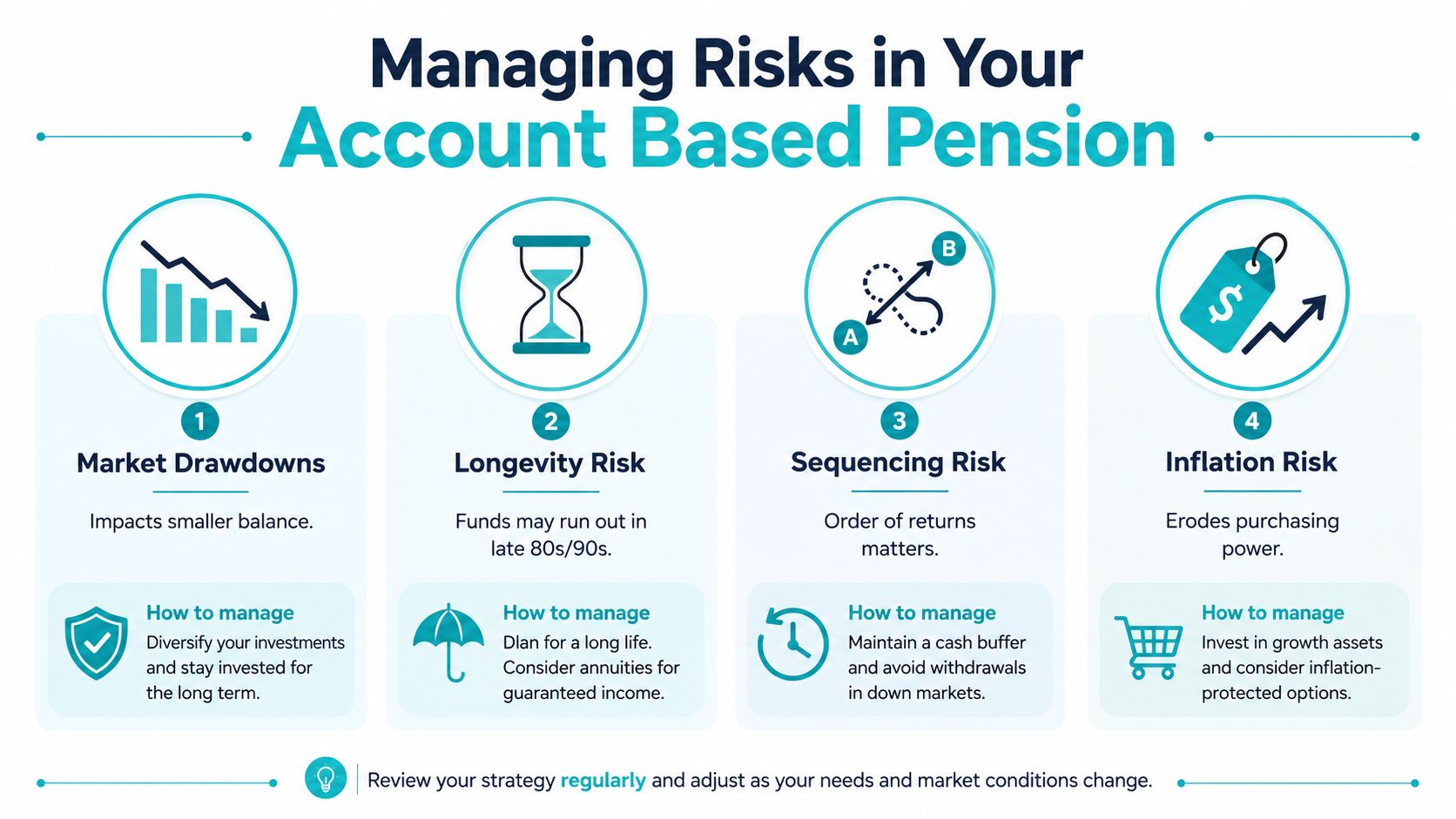
A retiree can face falling markets, rising costs and a longer life at the same time. An account based pension needs a plan for each risk, not a reaction to the latest market headline.
- Market drawdowns: Withdrawals leave fewer dollars invested when markets fall.
- Longevity risk: Income may be needed well into the late 80s or 90s.
- Sequencing risk: Poor returns early in retirement can do more damage than the same returns later. Read our analysis of sequence of returns risk before setting a withdrawal strategy.
- Fee and inflation drag: Fees reduce the balance available to compound, while rising prices weaken purchasing power.
Set a written investment policy covering cash, defensive assets, diversified growth and higher-risk investments. A glidepath can move the portfolio from greater growth exposure in the 60s towards more balanced and defensive holdings through the 70s and 80s. The allocation must match the household's spending horizon, capacity for loss and need for income.
Keep enough cash for near-term payments. That reduces the pressure to sell growth assets after a market fall. A dynamic drawdown policy can reduce payments from discretionary capital after negative returns while protecting essential spending where possible. Rebalance when an asset class moves materially from its target, rather than waiting for a fixed calendar date.
The strongest pension plan is a process, not a product. It sets out what to do before markets fall, when fear can otherwise drive poor decisions.
Review the pension against adverse return sequences, chosen and minimum drawdowns, investment fees, beneficiary and reversionary arrangements, and possible future care costs. Health planning belongs in the same discussion. Resources such as Understanding Ageing's heart guide can help families consider how changing health may affect spending and care decisions.
Wealth Collective's Retirement Roadmap service brings cash flow, investment selection, pension structure and longer-term contingencies into one documented process. Use it to make assumptions visible, test whether income can last, and revisit the strategy as circumstances change.
Your Next Steps and Common Account Based Pension Questions
Take these actions this week:
- Gather current statements: Record balances, investment options, fees, taxable components and existing beneficiary nominations.
- Confirm cap space: Ask the fund or adviser to check your personal transfer balance cap, including any previous retirement-phase pensions.
- Request illustrations: Ask the fund to show the minimum, half-minimum where available under applicable rules, and your preferred payment rate.
- Review beneficiaries: Check whether a reversionary pension or lump-sum death benefit better suits your spouse, dependants or estate.
- Stress-test the plan: Model weak early returns, higher health costs and a longer retirement.
What happens when the owner dies? The balance doesn't disappear. It may continue as a reversionary pension for an eligible dependant or be paid as a lump-sum death benefit, with tax depending on the recipient and benefit components.
Can unused transfer balance cap space be reinstated? Sometimes, but personal cap calculations depend on prior credits and debits. Don't rely on the general cap alone. Have the account history reconciled.
Can spouses split pensions for Centrelink purposes? A couple may consider how super and pension interests are structured between them, but Centrelink treatment depends on age, relationship status, account ownership and the relevant assessment rules. Get the structure checked before transferring money.
What records should you keep? Retain commencement notices, payment confirmations, balance calculations, commutation documents, ATO correspondence and beneficiary records. Good records make it easier to prove that minimums were met and that any additional withdrawal was correctly processed.
For broader estate-planning context, securing your golden years with a plan is a useful reminder that retirement income and wealth transfer should be considered together, not in separate silos.
Wealth Collective helps Perth and Dunsborough retirees build a Retirement Roadmap covering account based pension commencement, drawdown sustainability, investments, tax considerations and beneficiary planning. Visit Wealth Collective to book an initial call and turn your super balance into a retirement-income plan you can monitor with confidence.