Business hours
Monday to Friday (8.30AM - 5PM)
Weekend (Closed)


You've spent decades building super, paying down debt and making sensible investment decisions. Then retirement arrives, and the question changes. You're no longer asking, “How do I grow this balance?” You're asking, “How do I turn it into dependable income without selling too much after a market fall, losing flexibility, or running out later in life?”
That's why investment strategy in retirement starts with cash flow, not a pie chart. Your withdrawal needs, account structure, tax position, Age Pension eligibility and longevity risk should determine how much growth exposure you hold, not the other way around.
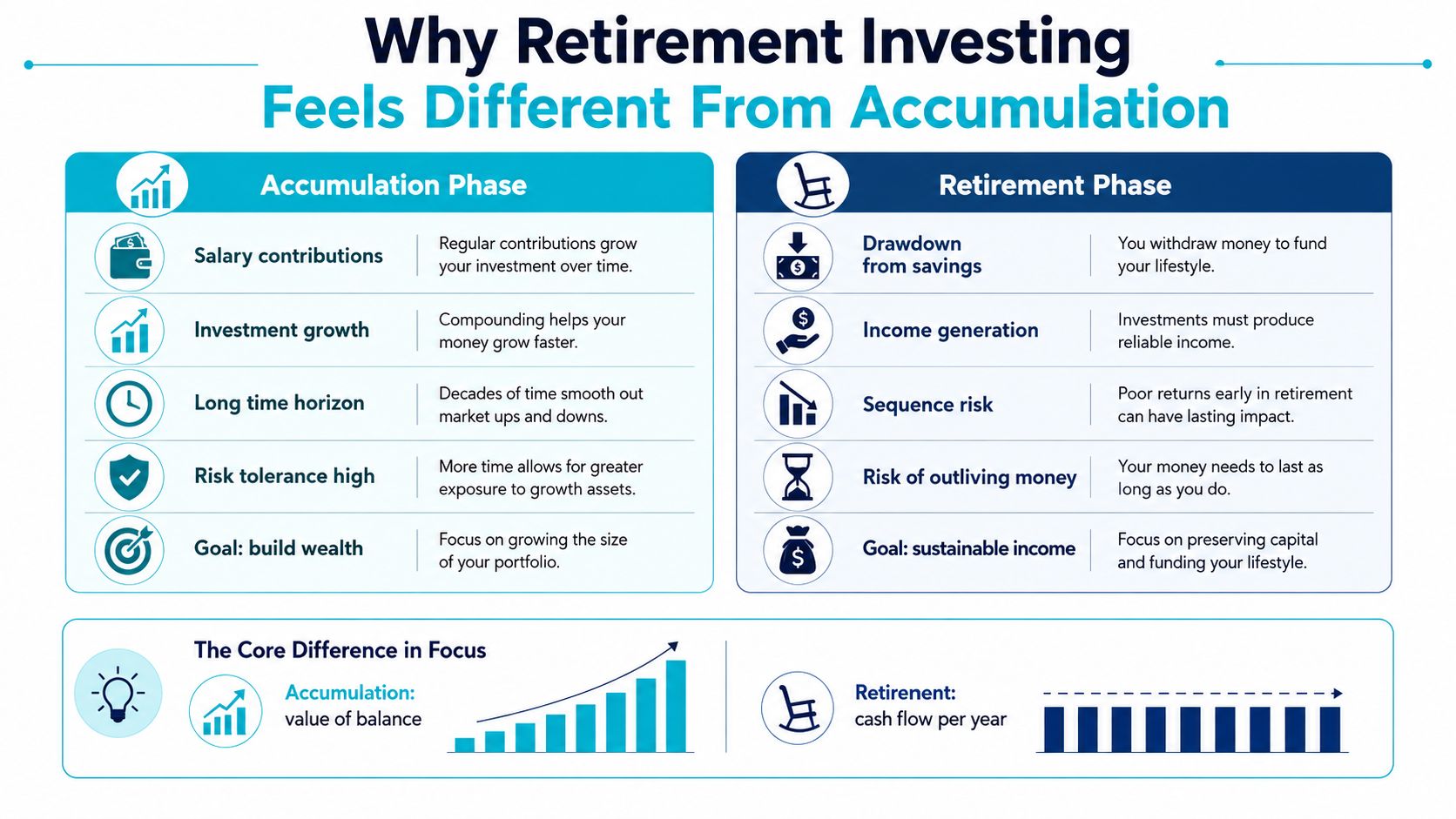
Why Retirement Investing Feels Different From Accumulation
Margaret and David are 67. Between them, they've built a $1.4 million super balance, paid off much of their mortgage and expect retirement to last for decades. Their challenge isn't choosing investments. They need to convert capital into a reliable income stream, keep pace with rising living costs and avoid exhausting their savings while they're still healthy enough to enjoy them.
Accumulation and retirement require different decisions. During accumulation, salary contributions and time do much of the heavy lifting. A temporary market decline can often be absorbed because employment income continues and the portfolio has years to recover. During retirement, withdrawals can force you to sell assets at precisely the wrong time.
Australia's super system has become central to this transition. The Superannuation Guarantee was introduced in 1992 at 3% of ordinary time earnings, later increased to 9.5%, and was legislated to rise to 12% by 1 July 2025. Treasury's Retirement Income Review recorded 15.6 million Australians with a super account by June 2018, showing how many households now rely on super as a core retirement asset.
Three decisions shape the outcome
You need clear answers to three questions:
- How much will you draw each year? Your lifestyle spending, government payments and super minimums all matter.
- Which account will fund the next dollar? The order of withdrawals can affect tax, Centrelink assessments and the longevity of each pool.
- How much growth exposure can you tolerate? You need enough growth assets to address inflation and a long retirement, but not so much volatility that a market fall disrupts essential income.
The distinction matters because fund outcomes can vary by structure and balance size. In the 2023–24 financial year, the median SMSF return was 7.2%, compared with 8.6% for APRA-regulated funds, while mean returns were 8.4% for SMSFs and 8.3% for APRA funds, according to the SMSF Association's performance report. Those figures don't tell you which structure is right. They reinforce the point that structure, costs, diversification and implementation all deserve attention.
Practical rule: In retirement, a portfolio isn't successful because it has the highest return. It's successful when it funds the life you planned without forcing bad decisions at bad times.
Setting Retirement Goals and a Realistic Cash-Flow Plan
Start with spending, not investments. Write down what your retirement needs in today's dollars, then separate expenses into three groups:
- Essential costs: housing, food, utilities, insurance, healthcare and transport.
- Lifestyle costs: travel, hobbies, dining and family support.
- Discretionary costs: irregular upgrades, large gifts and optional projects.
Build those figures forward using an inflation assumption that reflects your circumstances. The planning notes for this strategy use a conservative 2.5% to 3% annual inflation range, but the right assumption depends on your spending mix. Healthcare and aged-care costs may not move in line with general household expenses.
Build the income bridge
Next, identify income that doesn't depend directly on selling investments:
- Estimate your Age Pension position through Services Australia.
- Check whether you have a defined benefit pension.
- Consider whether a lifetime annuity or another longevity-protected income stream has a role.
- Calculate the annual gap that must come from super and personal investments.
An account-based pension usually provides the flexibility needed for this bridge. However, super pension payments must respect legislated minimum drawdown rates. CSIRO's retirement-income research summarises the schedule as 4% under age 65, 5% at 65–74, 6% at 75–79, 7% at 80–84, 9% at 85–89, 11% at 90–94, and 14% over 95.
| Age | Minimum drawdown | Worked example on $500,000 |
|---|---|---|
| Under 65 | 4% | $20,000 |
| 65–74 | 5% | $25,000 |
| 75–79 | 6% | $30,000 |
| 80–84 | 7% | $35,000 |
| 85–89 | 9% | $45,000 |
| 90–94 | 11% | $55,000 |
| 95 and over | 14% | $70,000 |
The worked amounts are simple applications of the legislated percentages to a $500,000 opening balance. Actual payments depend on the relevant account balance and pension rules.
A sensible starting withdrawal rate should be tested against your needs rather than selected because it appears in a generic article. CSIRO's research compares the legislated minimums with a real-return rule based on 4% of the initial balance and a minimum-plus-1% approach. The lesson is important: minimums can preserve capital, but they may also leave money unspent. Your plan should model spending changes, market conditions, asset allocation and longevity together.
Don't approve an investment portfolio until you can answer this: what pays for the next several years, and what remains invested for the years after that?
Designing an Asset Allocation Around Your Drawdown Years
A retirement portfolio shouldn't be built around one permanent label such as “balanced” or “conservative”. Those labels hide the question that matters most, which is when each dollar will be spent.
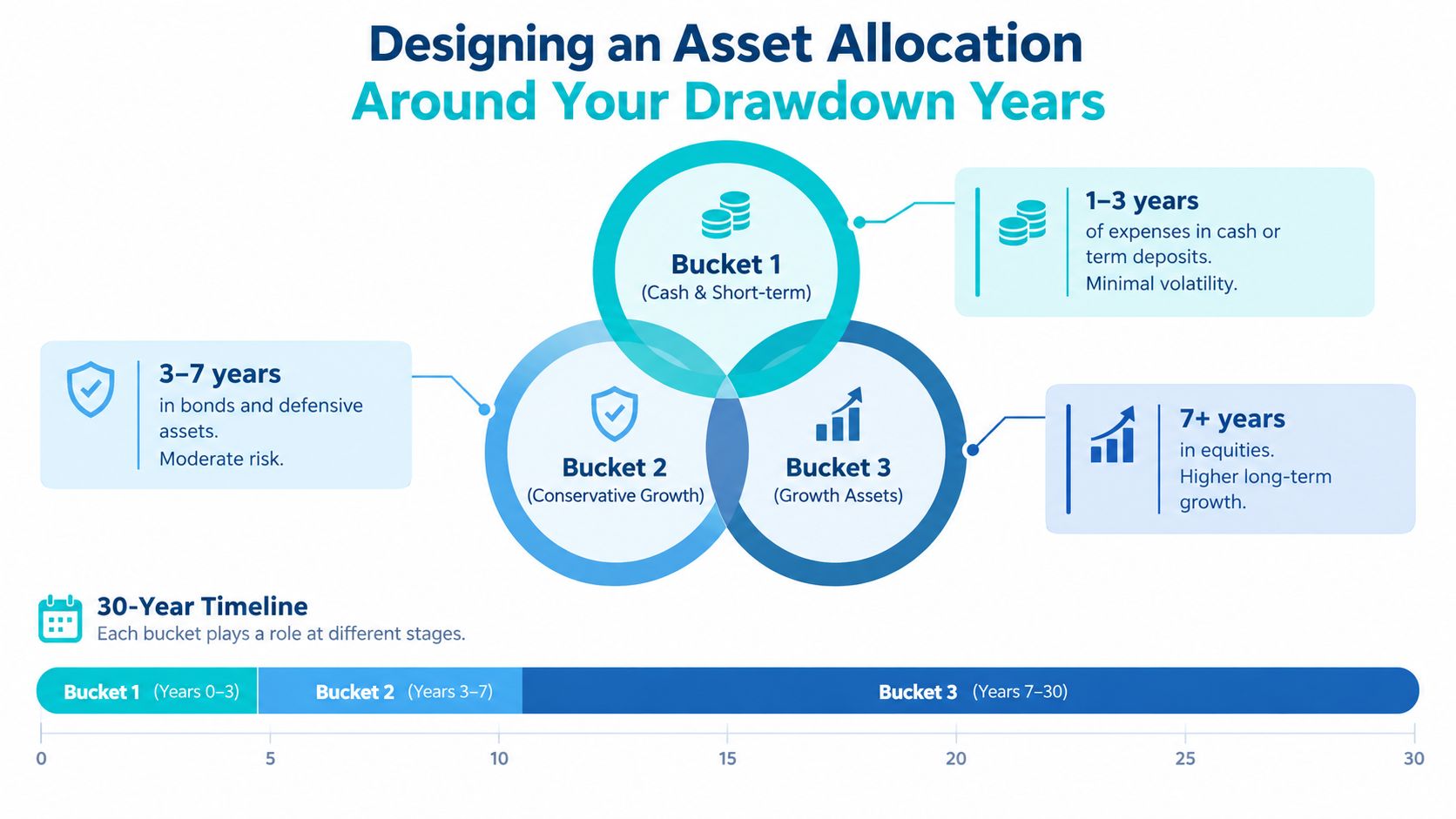
A bucket structure makes the timing visible. The first bucket protects near-term spending. The second supports medium-term withdrawals. The third remains invested for the years when inflation and longevity become the bigger threats.
Three buckets, three jobs
Bucket 1, near-term liquidity. Hold roughly one to three years of planned income in cash, high-interest savings and short-dated term deposits. This money isn't there to maximise returns. It's there to reduce the chance that you'll sell growth assets during a sharp fall.
Bucket 2, medium-term stability. Allocate the next several years of planned withdrawals to diversified fixed income, bonds and moderate-risk investments. The objective is a smoother path than an equity portfolio, while retaining some capacity to grow.
Bucket 3, long-term growth. Keep the money intended for later retirement invested across Australian and international shares, listed property and suitable growth alternatives. This sleeve carries more volatility, but it has the job of addressing inflation and the possibility that retirement lasts longer than expected.
Age can inform the starting point, but it shouldn't dictate the final answer. A 65-year-old with a strong Age Pension entitlement, good health and modest spending may need a different mix from a 75-year-old drawing heavily from investments. Conversely, a healthy retiree with limited guaranteed income may need meaningful growth exposure well beyond a simple age-based rule.
The proposed starting points in this framework are 40% growth and 60% defensive at 65, moving towards 30% growth and 70% defensive at 75. Treat those figures as discussion points, not automatic prescriptions. Your withdrawal timing, health outlook, account structure and tolerance for losses should determine the final allocation.
APRA-regulated funds provide broad reporting on asset allocation and performance, while an SMSF gives trustees direct control and responsibility. That distinction matters. An SMSF can make the bucket structure more explicit, but it also requires disciplined liquidity management and investment governance.
Choosing the Right Investment Vehicles for Retirement Income
At retirement, the first question is how much cash must arrive, and when. Choose the vehicle around that schedule, not around its recent return. Your account structure must support legislated minimum drawdowns, remain within the transfer balance cap where relevant, and leave enough liquidity for the years ahead.
| Vehicle | Income stability | Flexibility | Longevity protection | Typical cost | Estate treatment |
|---|---|---|---|---|---|
| Account-based pension | Variable | High | Limited on its own | Varies by provider and investments | Remaining balance may pass to beneficiaries, subject to rules |
| Term deposits | High for the agreed term | Moderate | None | Usually transparent, with opportunity-cost risk | Capital generally remains part of the estate |
| Lifetime or fixed-term annuity | Contractually structured | Lower | Strong for lifetime products, limited for fixed-term products | Embedded in product pricing | Depends on guarantees, reversion and product terms |
| Listed investments or managed funds | Variable | High | None on their own | Management, administration and transaction costs vary | Generally transferable or redeemable, subject to ownership and tax |
Match the vehicle to the withdrawal horizon
An account-based pension usually provides the flexible core. It supports regular payments and investment choice, but its balance moves with markets. Withdrawals must also meet the legislated minimum drawdown schedule, so your cash-flow plan needs to account for payments even when returns are poor.
Term deposits suit money set aside for near-term spending. They provide a known interest term and capital stability, but early access may be restricted. Their fixed return can also fall behind inflation, making them a poor choice for every retirement dollar.
A lifetime annuity or group self-annuity can cover income that must continue for life. Treasury analysis compared a minimum-drawdown account-based pension with a longevity-hedging GSA, finding average annual real income of about $19,200 versus expected annual real income of about $27,000 for life, without increasing the risk of outliving savings, as outlined in Treasury's retirement-income product analysis. Check how the product interacts with your transfer balance cap, death benefits, guarantees and access to capital before committing.
Listed investments and managed funds suit the growth portion of the plan. They provide access to Australian and global markets, but they do not guarantee income. If you are assessing overseas equity exposure, use this guide to compare S&P 500 index funds. Then assess currency exposure, tax treatment, concentration and the fund's role in meeting later-life withdrawals.
A practical mix might use an account-based pension for flexible payments, term deposits for scheduled near-term withdrawals, a longevity product for lifetime spending and diversified funds for later growth. Set the proportions from the cash-flow plan, drawdown rules and transfer balance position, not from a product sales pitch. For help structuring super-based income, government support and personal investments, review Wealth Collective's retirement income streams guidance.
Managing Sequencing Risk and Longevity in a Volatile Market
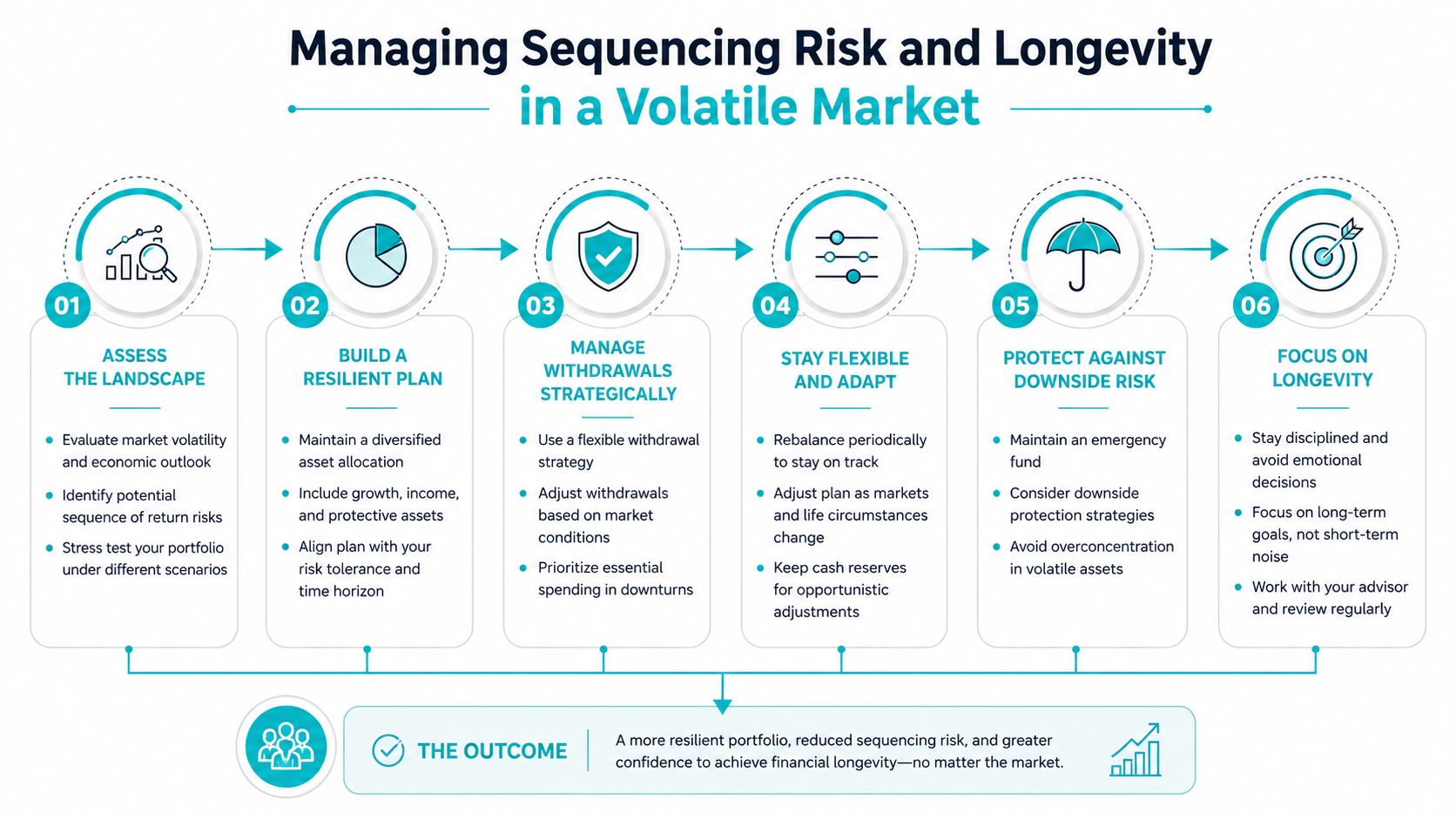
Retirement investing is a cash-flow problem before it is an allocation problem. Sequencing risk arises when poor returns occur while you are withdrawing money. Two retirees can earn the same average return yet reach very different outcomes if one suffers losses early in retirement.
You cannot control the order of market returns. You can control whether an essential payment forces you to sell volatile assets at a poor price. Set the cash-flow plan against the legislated drawdown schedule, then decide how much liquidity and growth exposure each year requires. For a deeper explanation, read our guide to sequence of returns risk.
Three practical defences
- Protect the essential layer. Keep one to three years of essential expenses in cash and short-dated defensive assets. Refill the reserve when markets are favourable instead of selling growth assets automatically after a fall.
- Write rebalancing rules. Set percentage bands around your target allocation. Written rules reduce emotional decisions and create a repeatable process for buying underweight assets and trimming overweight assets.
- Insure the long tail. A GSA or lifetime annuity can provide income for life, reducing the share of essential spending that depends on market returns.
A retiree facing an early bear market can draw from cash and short-term defensive buckets while leaving the growth sleeve invested. The portfolio still carries the market loss, but the retiree avoids crystallising it to pay an essential bill. Replenish the reserve after recovery under the agreed rebalancing policy.
The transfer balance cap also matters. It limits how much can move into retirement-phase income streams, so coordinate pension settings with the drawdown schedule rather than treating the entire super balance as one pool.
APRA data shows why this discipline matters as pension outflows grow. In the year to December 2025, pension payments reached $62.3 billion, up 10.8% year on year, while total benefit payments reached $139.9 billion, according to Superannuation Australia's retirement statistics. The same source reports a five-year annualised super return of 7.2% and an annual return of 8.7% for the year to December 2025. Strong returns in one period cannot repair a poorly timed withdrawal plan.
Longevity requires sustainable spending, liquidity and income that does not rely entirely on markets.
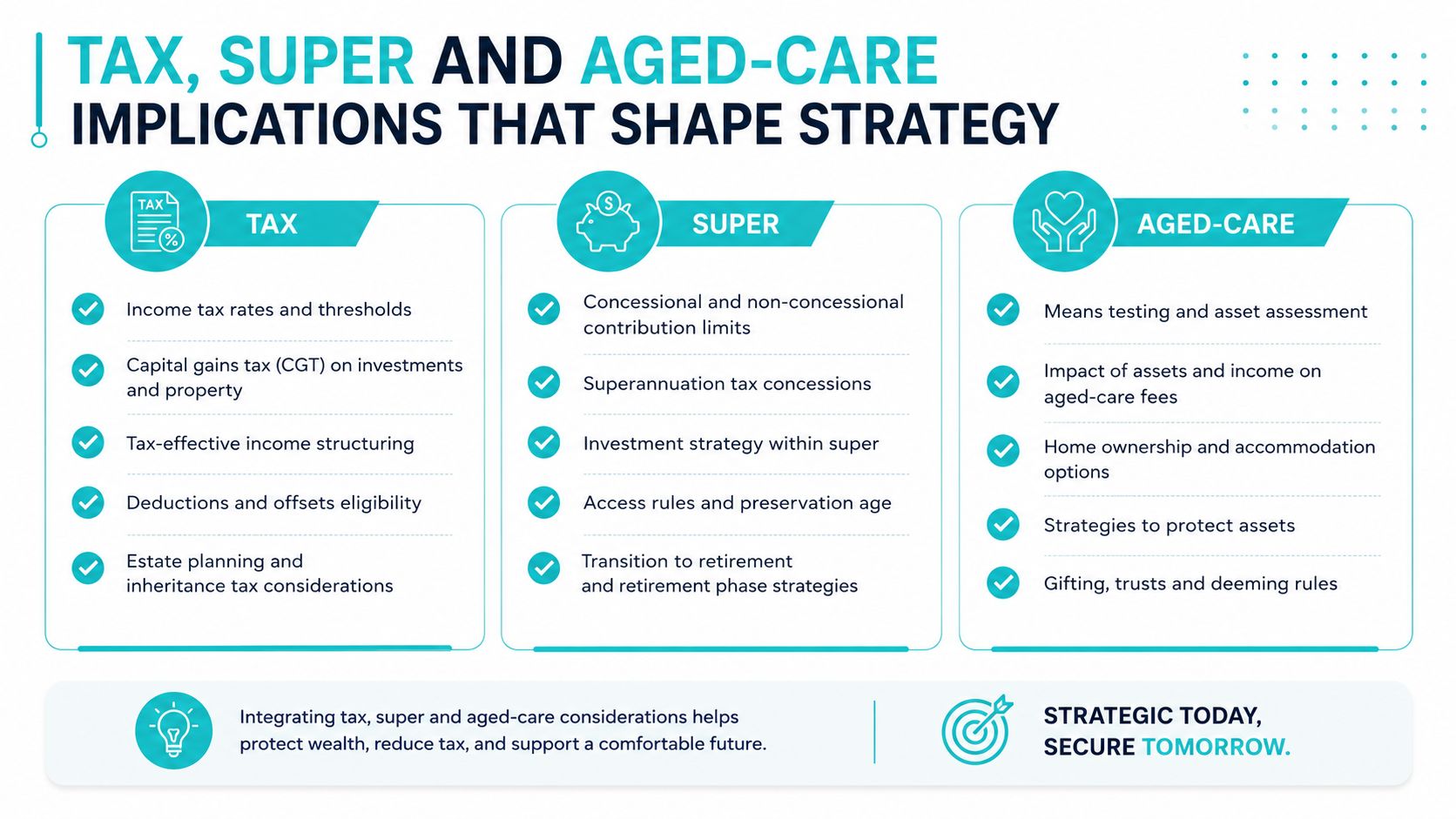
Tax, Super and Aged-Care Implications That Shape Strategy
Investment selection is only half the retirement decision. The location of each asset, the way income is withdrawn and the effect on government assessments can change the amount you keep.
The first major constraint is the transfer balance cap. The ATO states that the general cap is $2.1 million for the 2026–27 financial year, up from $2.0 million in 2025–26, and that the cap limits how much can move into retirement-phase income streams. Higher-balance clients need to structure pension and accumulation accounts carefully rather than assume the entire super balance can sit in one tax setting. The ATO transfer balance cap guidance should be checked before making a pension commencement or commutation decision.
Make the account structure do useful work
Preservation age controls when super can generally be accessed after retirement. The ATO says preservation age is 60 for people born after 30 June 1964, while people born between 1 July 1963 and 30 June 1964 have a preservation age of 59, according to ATO superannuation income stream guidance.
That timing affects whether you're still accumulating, starting a transition-to-retirement arrangement or drawing a retirement-phase pension. It also affects how you coordinate super withdrawals with employment income, cash reserves and taxable investments.
The Age Pension asset and income tests need to be modelled alongside the portfolio. Term deposits, shares, managed funds and super can produce different income and assessment outcomes. Don't assume that a tax-efficient investment is automatically Centrelink-efficient, or that maximising an Age Pension entitlement is always the best long-term result.
Aged care adds another layer. The Department of Health states that the means-tested care fee has a daily cap set at 135% of the single basic age pension, and the fee resets to zero until the next anniversary after the annual cap is reached, as explained in the residential aged-care fee guidance. DVA guidance states that the means-tested care fee has a $25,000 annual cap and a $60,000 lifetime cap, both indexed, and that Home Care fees count towards residential-care caps if a person later transfers settings, according to CLIK's means-tested care fee information.
Review these settings annually, especially after a super contribution, pension conversion, Centrelink change or health event. For a plain-English explanation of super tax treatment, see whether you get taxed on superannuation.
Rebalancing, Reviewing and Bringing It All Together
Retirement reviews should start with cash flow. Check whether your planned withdrawals still cover essential, lifestyle and discretionary spending, then test the investment mix against the legislated minimum drawdown for your age. The schedule, your transfer balance cap and sequencing risk should anchor every allocation decision.
Use a one-page review checklist:
- Confirm spending: Recalculate each income need and separate required costs from optional spending.
- Check drawdowns: Compare the income you want with the legislated minimum for your age.
- Review guaranteed income: Update Age Pension estimates, annuity payments and defined benefit income.
- Test liquidity: Confirm near-term withdrawals can be funded without forced sales.
- Compare allocation: Measure actual holdings against target growth and defensive ranges.
- Rebalance deliberately: Consider action when an asset class moves more than 5 percentage points from its target, if that rule still suits the plan.
- Record decisions: Note the reason for each change, the assumptions used and who is authorised to act.
Review sooner after a relationship breakdown, a partner's death, children returning home, a Centrelink change or a market move of more than 15%. These events can alter spending, tax, beneficiary arrangements or the cash reserve needed to avoid selling growth assets after a fall.
Keep the plan accessible to adult children and your enduring power of attorney. Record where accounts are held, how income is generated, which bills must be paid and which decisions require advice. Clear instructions reduce rushed investment changes during a health crisis.
Judge fund performance against the job each holding must perform. A defensive reserve may be doing its job even when growth assets lead the market, while a strong return may still be unsuitable if it leaves the next withdrawals exposed to a downturn. APRA's superannuation statistics show the scale of retirement cash flows, but national totals cannot determine what any individual household should hold.
Use this common retirement investment mistakes checklist to identify blind spots. Your review should return to three decisions: how much to draw, which account to draw from and how much growth exposure the remaining capital can carry.
Wealth Collective's Retirement Roadmap is designed for Australians aged 50 and over who need to coordinate super, investments, income, tax, Centrelink and sequencing decisions. The result should be a documented cash-flow plan, an investment structure and clear review triggers, rather than a portfolio selected in isolation.
Wealth Collective helps Australians coordinate super and investments through personalised advice, scenario modelling and ongoing reviews. Visit Wealth Collective to arrange an initial call and test your retirement cash flow, drawdown structure and allocation against the life you want to fund.