Business hours
Monday to Friday (8.30AM - 5PM)
Weekend (Closed)



An investment strategy is a rules-based plan that turns your goals, time horizon and risk tolerance into a target mix of assets. In Australia, more than 60% of household financial assets are held through superannuation, so a useful strategy must cover both super and non-super money.
You may be asking the same question many Perth households ask: should you add to super, pay down the mortgage or invest more in shares? The wrong way to approach that decision is to search for a single “best” investment. The right way is to decide what each dollar needs to do, when you'll need it and how much loss your household can withstand without abandoning the plan.
That makes investment strategy a coordinated system, not a shopping list of funds, shares or property. It brings together superannuation, investments outside super, cash reserves, debt, tax, insurance and the behaviour you're likely to show when markets fall.
The Real Meaning of Investment Strategy
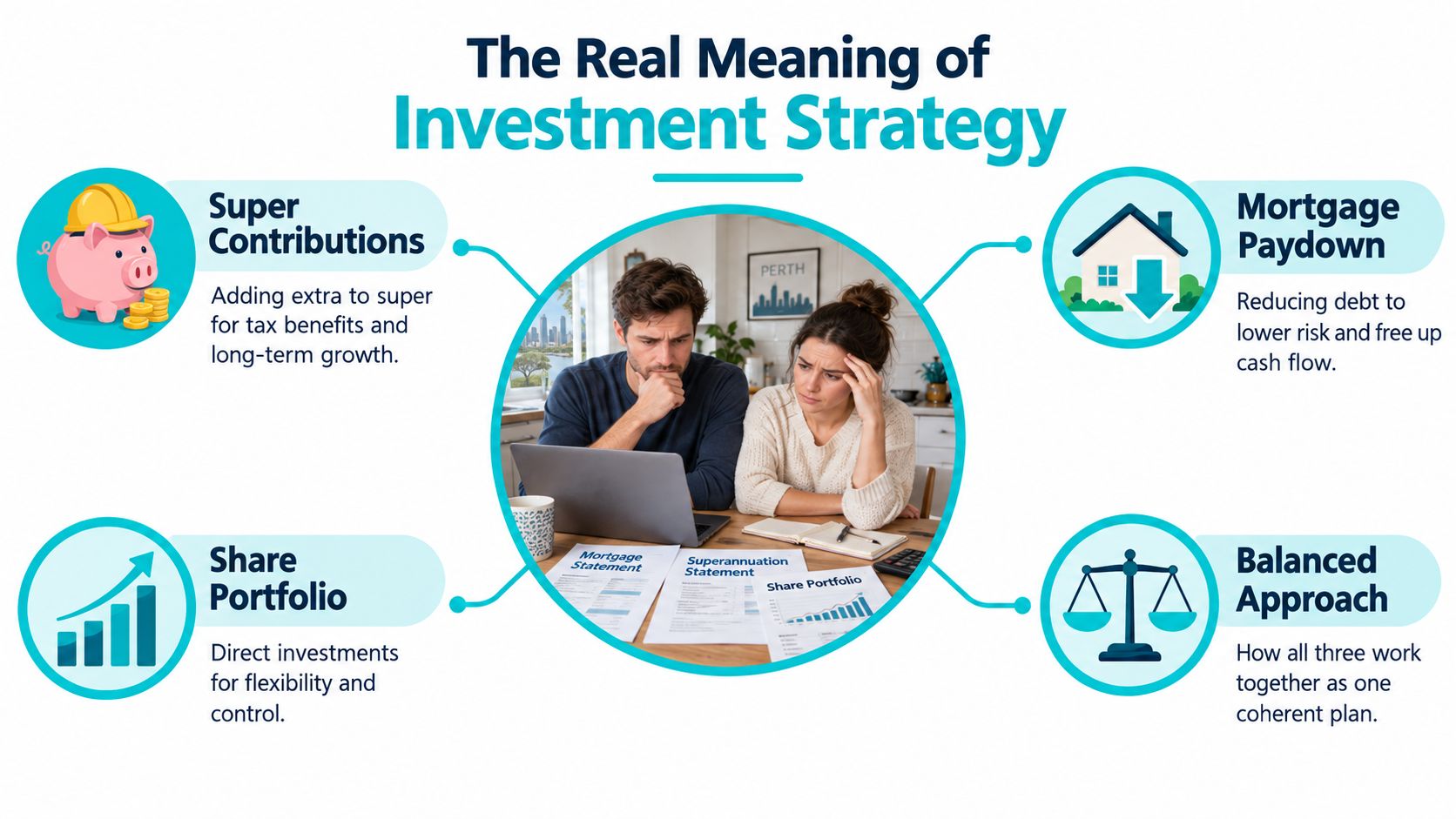
A couple at their kitchen table in Perth might have a mortgage, two super accounts and a share portfolio that grew during strong markets. One partner wants to salary-sacrifice more into super. The other wants to reduce the home loan. They're also considering adding to Australian shares because the portfolio feels too small for their retirement goals.
None of those choices is automatically right or wrong. The answer depends on their objectives, time horizon, liquidity needs, tax position, risk capacity and existing exposure across the household balance sheet.
ASIC describes an investment strategy as a framework that converts an investor's objectives, time horizon, liquidity needs and risk capacity into a target portfolio, usually using asset allocation, diversification, rebalancing and product selection. You can read a useful explanation of related property and investment terminology in the Pie Assets investing glossary.
A strategy is a set of decisions
A buy list says what to purchase. A strategy explains why the investment belongs in the portfolio, what job it performs and what would cause you to change it. It should answer practical questions such as:
- Purpose: Is the money for retirement, a home, education, financial independence or near-term spending?
- Access: Can you lock the money away in super, or might you need it before retirement?
- Risk: How much can the portfolio fall before your lifestyle or behaviour is affected?
- Maintenance: When will you review the mix, and when will you rebalance?
- Ownership: Is the investment more suitable inside super, outside super, in an offset account or through another structure?
The Australian context makes this broader than many overseas explanations. Superannuation has access restrictions and its own tax treatment. A mortgage can offer a risk-free interest saving when paid down, while cash provides flexibility that a long-term investment may not. Insurance can protect the income that funds the entire plan.
A sound strategy is therefore a living framework. Your objectives change, your debts reduce, your income rises or falls and your retirement date gets closer. The portfolio must change deliberately with those circumstances, not reactively after a market headline.
The six essential components are objectives, time horizon, asset allocation, diversification, risk tolerance, and income versus growth. Once those are clear, the choice between super contributions, mortgage reduction and share investments becomes a planning decision rather than a debate about which asset is fashionable.
The Six Components That Shape a Sound Strategy
A strategy becomes useful when each decision has a defined role. These six components give you the vocabulary to test whether the portfolio fits your life.
Objectives come first
Start with the job the money must perform. Building retirement capital requires a different plan from saving for a house deposit or funding a child's education. A household may have several objectives, but they shouldn't all be forced into one undifferentiated portfolio.
Write the objective in practical terms. “Build wealth” is too vague. “Create retirement income while retaining access to capital for health and lifestyle costs” gives the strategy something it can act on.
Time horizon sets the investment runway
The date you need the money matters as much as the target amount. A young professional with decades before retirement can generally tolerate more short-term movement than someone already drawing regular income. That doesn't mean the younger investor should take every available risk. It means the plan has more time to recover from market setbacks.
A 25-year-old and a 58-year-old shouldn't automatically hold the same defensive weighting. The 58-year-old may need to fund withdrawals soon, while the younger investor may be able to leave growth assets untouched through several market cycles.
Asset allocation controls the portfolio's character
Asset allocation is the split between growth assets, such as shares and some property exposures, and defensive assets, such as cash and fixed interest. It usually has a larger effect on the portfolio's behaviour than choosing between similar products within one asset class.
The allocation should be expressed clearly. Broad ranges can conceal a major difference in risk. ASIC has cautioned that ranges such as 25% to 75% may be too imprecise if they allow unsuitable exposure for the investor. A practical plan should identify target allocations and acceptable limits.
For a detailed explanation of how these decisions fit together, see Wealth Collective's asset allocation strategy guide.
Diversification spreads the consequences of being wrong
Holding several Australian shares isn't the same as diversifying across asset classes and regions. ASIC considers a portfolio highly diversified only when it spans multiple asset classes, because investments within one asset class may still respond to the same economic shock.
That principle also applies to specialist assets. If you're considering how to diversify crypto holdings, treat crypto as one exposure within the wider risk budget, not as a substitute for broad diversification.
Risk tolerance must be matched by risk capacity
Risk tolerance describes how you feel about volatility. Risk capacity describes how much loss your finances can survive. They're different.
An investor might say they're comfortable with market falls, but that confidence may disappear if they need to sell shares to cover a job loss, mortgage payment or medical cost. A strategy should reflect both the emotional response and the household's actual ability to wait.
Income and growth serve different stages
Accumulation focuses on building capital. Retirement focuses on converting capital into sustainable income while managing the risk of selling growth assets during a downturn.
A retiree may value reliable income, liquidity and tax-aware ownership more heavily than a younger investor. Franking credits can matter, but they shouldn't override the need for diversification, accessible reserves and appropriate capital growth.
Mental checklist: Decide what the money is for, when you'll need it, how much growth you require, how widely risk is spread, what loss you can survive and whether the portfolio is building wealth or funding income.
Why Australian Strategy Has to Span Super and Non-Super
An Australian investment strategy can't be assessed by looking only at the share portfolio visible in a brokerage account. Superannuation often represents the largest investment pool in the household, and its asset allocation may already create substantial exposure to Australian shares, global shares, property or defensive investments.
Reserve Bank of Australia research found that Australian households held more than 60% of their financial assets through superannuation funds. The same research reported that superannuation and life-insurance assets grew from $29.9 billion in 1981 to $131.4 billion in 1989, a nominal increase of 339%, after employer-funded superannuation benefits entered industry awards in 1986 and compulsory superannuation followed in 1992. The Reserve Bank's analysis shows how policy reshaped household investment behaviour.

The portfolio is the whole balance sheet
Suppose your super is heavily invested in growth assets and your personal portfolio is also concentrated in Australian shares. Adding another Australian share fund might look diversified because it has a different name, but the household could still be increasing the same underlying risk.
A complete review maps:
- Superannuation: Investment option, fees, insurance, tax treatment and access rules.
- Non-super investments: Shares, managed funds, property and other assets held personally or through a structure.
- Cash and debt: Emergency reserves, mortgage balance, offset arrangements and other liabilities.
- Future income needs: Retirement date, expected withdrawals and the assets available to fund them.
The location of an asset matters. Super may provide tax advantages and long-term structure, but it isn't a substitute for accessible cash. Non-super investments may offer flexibility, but the tax outcome and ownership structure need to be considered. Insurance inside super can be convenient, but the level and definitions may not suit every household.
Near retirement, sequencing risk becomes central. Selling growth assets after a market fall can permanently reduce the capital available to fund future withdrawals. A strategy should therefore separate money needed in the near term from assets intended to grow over a longer period.
For a plain-English explanation of the vehicle that sits at the centre of many Australian plans, Wealth Collective's guide to what superannuation is in Australia is a useful starting point.
The Case for Building Resilience Before Chasing Returns
Many investors start with the wrong question: “How can I get a higher return?” The better first question is: “What could force me to sell at the worst possible time?”
A cash buffer, manageable debt and appropriate insurance can matter more than squeezing extra return from a portfolio. Job loss, illness, a business downturn, mortgage refinancing or a major household expense can turn a sensible long-term investment into an emergency asset sale if the foundations are weak.
The contrarian recommendation is simple: invest less at first if your household isn't resilient enough to stay invested.
Put the foundations in order
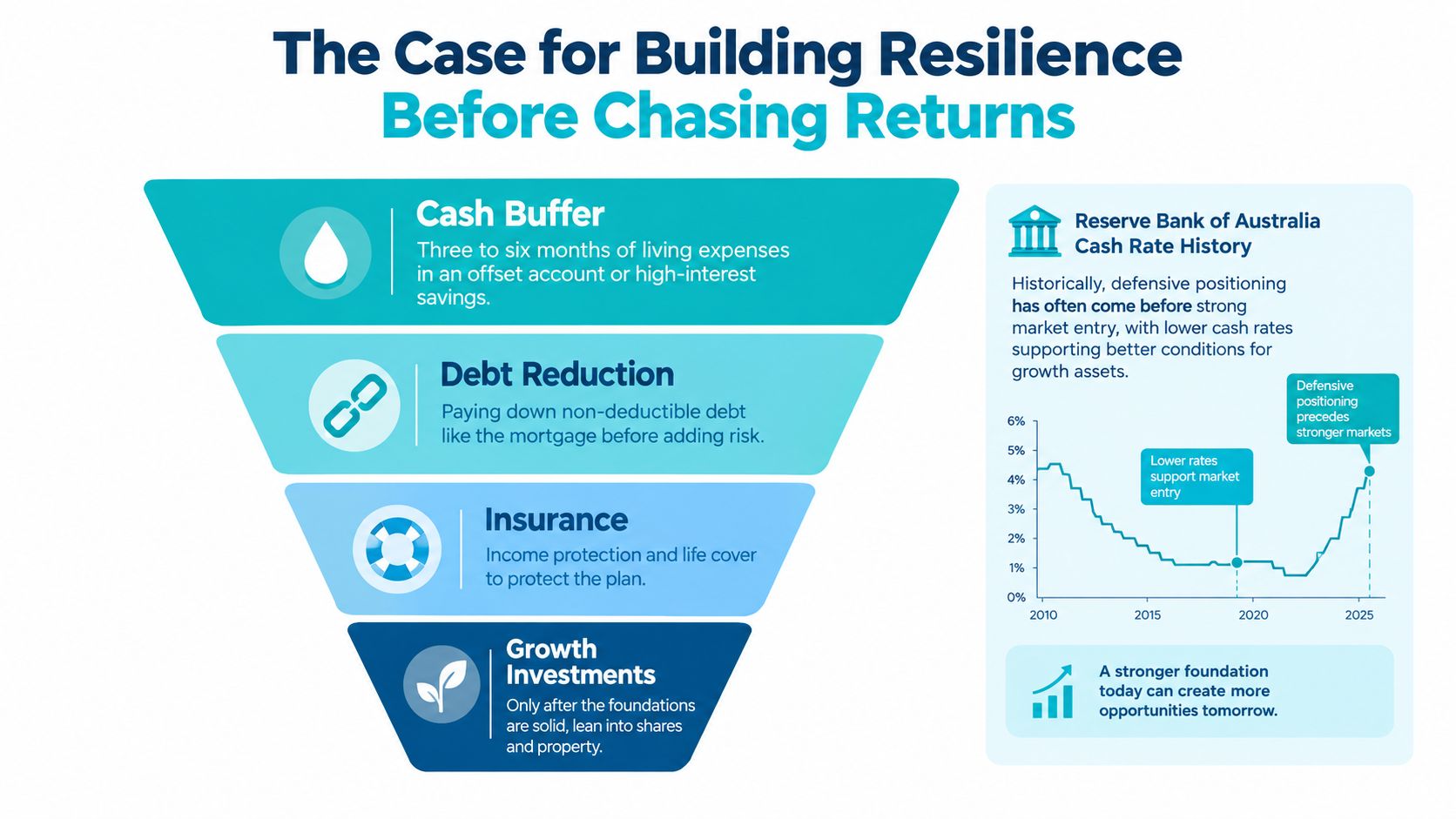
A practical priority sequence is:
- Build accessible cash. Keep a reserve that matches your household's income stability and commitments. An offset account can be useful where it reduces mortgage interest while preserving access to funds.
- Manage expensive or non-deductible debt. Paying down debt offers a known financial benefit and reduces the amount of income required to maintain the household.
- Check personal protection. Review income protection, life cover and other insurance against the people who depend on your income.
- Set the growth allocation. Once the household can absorb disruption, direct surplus capital towards a diversified long-term portfolio.
This isn't an argument for holding excessive cash indefinitely. It's an argument for matching liquidity to the risks that could derail the plan.
The Reserve Bank reported that real household income per capita rose 1.7% year-on-year to the March 2025 quarter, with households largely directing the increase towards saving. That creates an opportunity to strengthen cash reserves and reduce financial fragility before increasing market exposure. The figure is reported in the Reserve Bank's economic conditions update.
History also shows how investors can change direction under pressure. APRA data reported that net outflows from households' direct equity holdings totalled about $67 billion between 2008 and 2011, during the global financial crisis period. The lesson isn't that shares should be avoided. It's that a strategy must be designed for the behaviour you can sustain when markets are falling.
How the Strategy Looks Across Four Common Profiles
The same investment principles produce different decisions at different life stages. A young professional may prioritise long-term growth, while a retiree may prioritise access to capital and reliable withdrawals. Neither strategy is universally superior.
The table below gives a starting comparison. “Typical growth weighting” is a qualitative guide, not a recommendation, because income security, debts, health, objectives and existing assets can change the answer.
| Profile | Time horizon | Typical growth weighting | Super priority | Dominant risk |
|---|---|---|---|---|
| Young professional | Long term | Higher growth allocation may be appropriate | Choose a suitable investment option, consolidate where useful and monitor fees | Panic selling or ignoring insurance |
| Dual-income family | Long term, with competing medium-term needs | Balanced growth allocation shaped by mortgage and cash needs | Coordinate contributions with childcare, debt and accessible savings | Investing money needed for family costs |
| Pre-retiree | Shorter path to retirement | Reduce avoidable concentration and build defensive capacity | Test fees, asset mix, insurance and withdrawal readiness | Sequencing risk and insufficient liquidity |
| Retiree | Retirement income horizon | Blend growth with defensive assets and accessible reserves | Align investments with withdrawals and pension-phase needs | Selling growth assets after a fall |
Young professional
A young professional often has the longest runway but the thinnest margin for financial shocks. The priority is usually to establish a cash reserve, protect earning capacity and choose a diversified super option before building a separate share portfolio.
The common mistake is chasing individual companies while neglecting fees, insurance and contribution coordination. A portfolio breakdown such as Finzer's portfolio example can help explain how holdings fit together, but a list of holdings isn't a strategy unless it connects to objectives and risk.
Dual-income family
Families with two incomes may have strong saving capacity but significant competing demands. Mortgage repayments, childcare, parental leave, school costs and irregular expenses can make liquidity more valuable than an extra contribution to a locked structure.
The priority order should be deliberate. Maintain accessible savings, review protection, use the mortgage and offset strategically, then direct long-term surplus towards super and diversified investments. The key risk is investing money that the household will need before the market has time to recover.
Pre-retiree
A pre-retiree should stop judging the portfolio solely by its long-term return. The plan must show where near-term spending will come from and how the household will respond if markets fall shortly before retirement.
APRA describes MySuper products as default super products using single, diversified investment strategies, and its reporting compares returns, fees, costs and performance-test outcomes across MySuper, trustee-directed and externally directed products. That makes the actual investment design more important than a fund's brand or recent ranking.
Retiree
A retiree needs a withdrawal plan that coordinates super, personal investments, cash and other income. Holding only defensive assets can weaken long-term purchasing power, while holding too much growth exposure can make withdrawals uncomfortable during a downturn.
The right balance depends on spending needs, other income, health, estate objectives and the capacity to reduce discretionary spending. The dominant risk is not volatility. It's running out of suitable assets to fund the years ahead.
Building, Reviewing and Stress-Testing Your Strategy
A written strategy should specify target ranges for Australian shares, international shares, defensive assets, property or infrastructure and cash. It should also set concentration limits, because a portfolio can appear diversified while still relying heavily on one country, sector, employer or property market.
Rebalancing turns the document into a set of instructions. If an asset class rises above its target range, trimming it can restore the intended risk level. If it falls below target, adding to it can enforce a disciplined buy-low and sell-high process instead of leaving decisions to headlines.
Super contributions require coordination
For the 2025–26 financial year, the general concessional contribution cap is $30,000, including employer and deductible personal contributions. The non-concessional cap is $120,000, provided the relevant total super balance condition is met. Contributions across multiple funds are added together, so splitting payments doesn't create separate allowances. The ATO explains these rules in its guidance on concessional and non-concessional contributions.
Concessional contributions are generally taxed in the fund at 15%. Division 293 tax may apply where income plus concessional contributions exceeds $250,000. Salary sacrifice, employer payments and personal deductible contributions therefore need to be reconciled before making an additional payment.
Use objective checks, not recent returns
ASIC's diversification guidance supports reviewing the asset mix across multiple asset classes rather than counting securities. APRA's Choice Heatmap adds a practical test for super options. Among investment options with an eight-year history, one in five significantly underperformed relevant benchmarks. For a member with a $50,000 balance, median annual administration fees were $350 for closed Choice products, $177 for open Choice products and $143 for MySuper products. These findings are set out in APRA's Choice Heatmap insights.
Review net returns, benchmark methodology, strategic asset allocation, fees, insurance, liquidity and suitability together. Wealth Collective's financial planning process reflects the broader point: a strategy should be built from the household's circumstances, then reviewed as those circumstances change.
Putting Your Own Strategy Together and What Comes Next
A useful one-page strategy should let you answer five questions without opening a fund comparison website:
- What is the money for? Separate retirement, near-term spending and other goals.
- When will you need it? Match each objective to an investment horizon and liquidity requirement.
- What loss can you tolerate and survive? Consider both emotional tolerance and financial capacity.
- What do you already own? Map super, shares, property, cash and duplicated exposures.
- What competes for the next dollar? Include debt reduction, insurance, tax and accessible savings.
That framework prevents the most common mistake, treating super, investments, cash and debt as separate decisions. They're parts of the same household system. A high-return investment can still be unsuitable if it forces you to sell during a downturn, leaves your family underinsured or locks away money needed for a foreseeable expense.
Bring your super statements, investment details, debts, insurance policies and a clear description of your goals to an initial conversation. The point isn't to arrive with a perfect answer. It's to test the assumptions and identify which decision deserves attention first.
A free 10-minute introductory call with Wealth Collective can turn this framework into a discussion about your actual circumstances, whether you're building wealth, reducing debt or preparing for retirement. Taking that first step gives you something more valuable than another investment tip: a clear basis for deciding what to do next.
Wealth Collective helps Australians coordinate superannuation, investments, debt reduction, insurance and retirement planning through personalized advice and ongoing support. Visit Wealth Collective to book a free 10-minute introductory call and start pressure-testing your investment strategy.