Business hours
Monday to Friday (8.30AM - 5PM)
Weekend (Closed)



You open your annual accounts and find a larger liability than you expected. The business hasn't borrowed more, the premises haven't changed and the rent payment still leaves the bank account as usual. Yet your accountant is discussing a right-of-use asset, lease debt and a different EBITDA figure.
That's the practical challenge with AASB 16 Leases. Understanding the entries matters, but owners also need to know what changed economically, what changed only in the accounts, and which figures their lender or financial adviser should use.
What AASB 16 Leases Mean for Australian Entities
Consider an owner reviewing accounts for a business that leases its shopfront, vehicles and equipment. The business already had contractual payment obligations, but the balance sheet didn't necessarily show those operating-lease commitments as recognised liabilities. Seeing them appear can feel like discovering new debt, even when nothing new has been signed.
AASB 16 changed how lessees report those obligations. It generally requires a lessee to recognise a right-of-use asset, representing the right to use the leased asset, and a corresponding lease liability, subject to limited recognition exemptions.
Why Australian lease reporting changed
The Australian Accounting Standards Board made AASB 16 in February 2016, with mandatory application for annual reporting periods beginning on or after 1 January 2019. It replaced the previous lessee model under which many operating leases remained off the balance sheet, as reflected in ASIC's financial reporting guidance on the major accounting changes.
ASIC identified significant potential effects on reported financial position and performance, together with changes to systems, processes and disclosures. It grouped AASB 16 with AASB 9 and AASB 15 among the largest reporting changes since Australia adopted IFRS in 2005, noting that those other standards applied from 1 January 2018, before the lease standard's commencement, in that same guidance.
For owners, the important distinction is between recognising an existing commitment and taking on a new commitment. A lease obligation may become visible in reported debt without the business receiving new loan proceeds or agreeing to higher rent.
Practical rule: An increase in reported lease liabilities doesn't, by itself, mean the business has borrowed more or become less capable of meeting its payments.
What the balance sheet does and doesn't tell you
The right-of-use asset isn't a statement that the business owns the building or vehicle outright. It records the contractual right to use that underlying asset. The liability records the measured obligation associated with unpaid lease payments.
That creates different questions for different readers:
- The accountant needs to establish which contracts qualify and measure them correctly.
- The owner needs to understand the continuing cash commitments.
- The lender needs figures prepared under the definitions in the lending agreement.
- The financial adviser needs to understand how business commitments affect the owner's wider plans.
The accounts can therefore show higher total assets and liabilities while the underlying lease economics remain unchanged. Classification, measurement and interpretation each matter, but they answer different questions.
Lease Categories and Recognition Exemptions
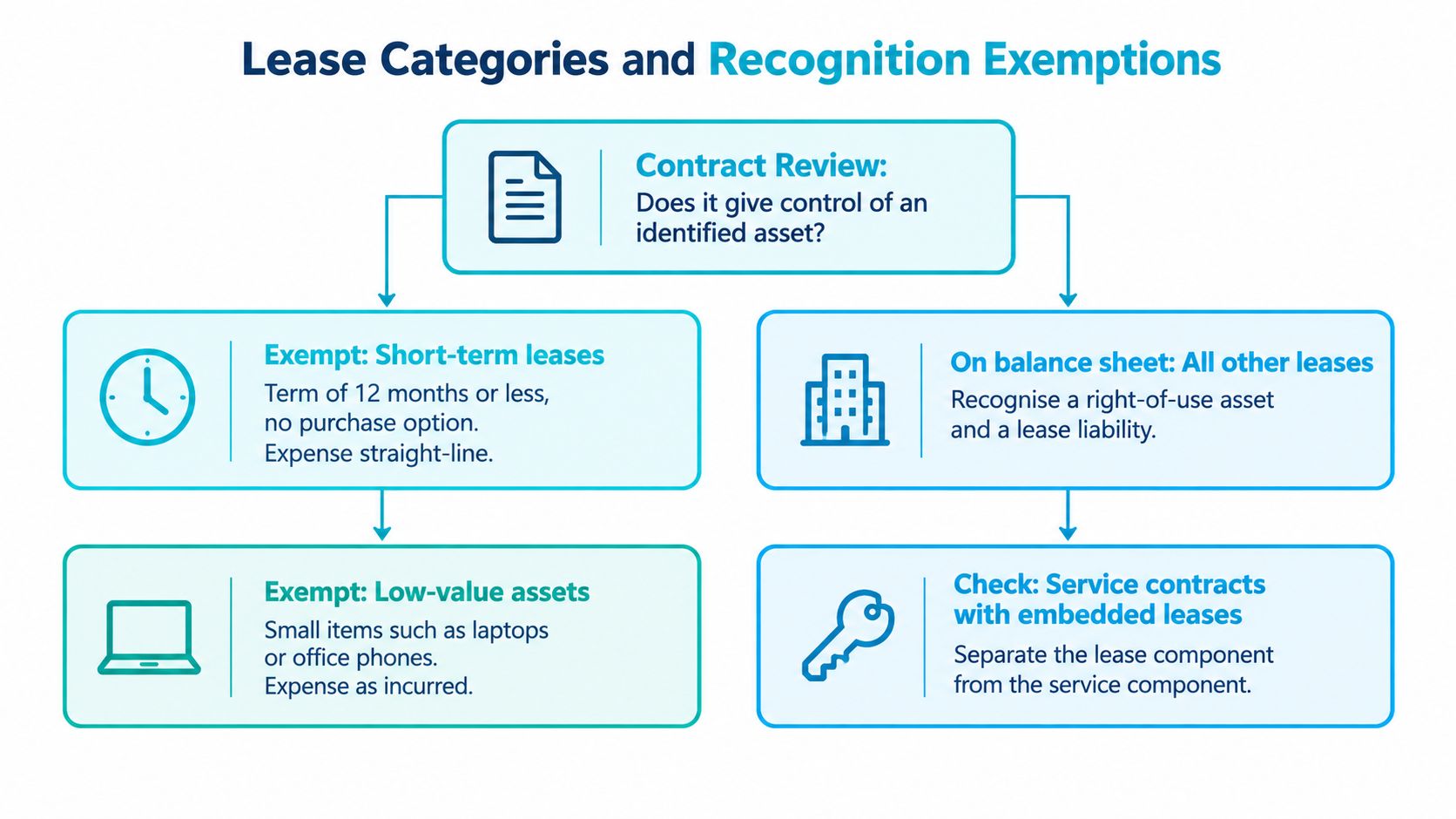
Start by sorting contracts, not by opening a discounting spreadsheet. An arrangement might require balance-sheet recognition, qualify for an exemption, or need further investigation because it could be a service rather than a lease.
For recognised leases, the basic outcome is an asset and liability. For an eligible lease where a recognition exemption is applied, the accounting generally follows a simpler expense pattern instead.
Separate the recognition categories
Under the AASB 16 explanatory statement on recognition and lease terms, leases with terms of more than 12 months generally require recognition unless the underlying asset is low value, while qualifying short-term leases of 12 months or less can generally be expensed over their term.
| Arrangement | Initial classification question | Likely accounting direction |
|---|---|---|
| Multi-year shopfront or warehouse | Does the contract contain a lease? | Generally on balance sheet |
| Vehicle fleet with extension rights | What lease term follows from the option assessment? | Assess recognition using the supported term |
| Equipment that qualifies as low value | Is the underlying asset eligible for the exemption? | An expense-based treatment may be available |
| Pop-up premises arrangement | Does it genuinely meet the short-term definition? | Short-term exemption may be available |
These are screening categories, not automatic conclusions. A small payment doesn't establish that an asset is low value, and a short contract heading doesn't resolve the lease-term assessment.
Read the options before deciding
Lease term isn't the same as an asset's useful life. A vehicle could remain usable well beyond the business's contractual right to use it. Conversely, renewal provisions may require a closer look than the initial expiry date suggests.
Your accountant needs to assess extension and termination options, including break clauses, when determining the enforceable term. Don't assume every optional renewal is included, or that every break clause automatically ends the accounting period.
For a business with several premises, record the conclusion separately for each agreement:
- Contract term and options: Identify expiry dates, renewal rights and termination provisions.
- Recognition conclusion: Explain whether the arrangement is recognised or an exemption is applied.
- Supporting judgement: Keep the reasoning with the contract rather than only in someone's email.
Portfolio accounting isn't a shortcut for ignoring contractual differences. It's available only where the result wouldn't materially differ from accounting for leases individually, a condition also addressed by the contract-identification guidance discussed below.
A contract that passes into the on-balance-sheet category needs a commencement measurement. A contract whose status remains unclear needs the embedded-lease screening process before any calculation begins.
Measuring the Lease Liability and Right-of-Use Asset
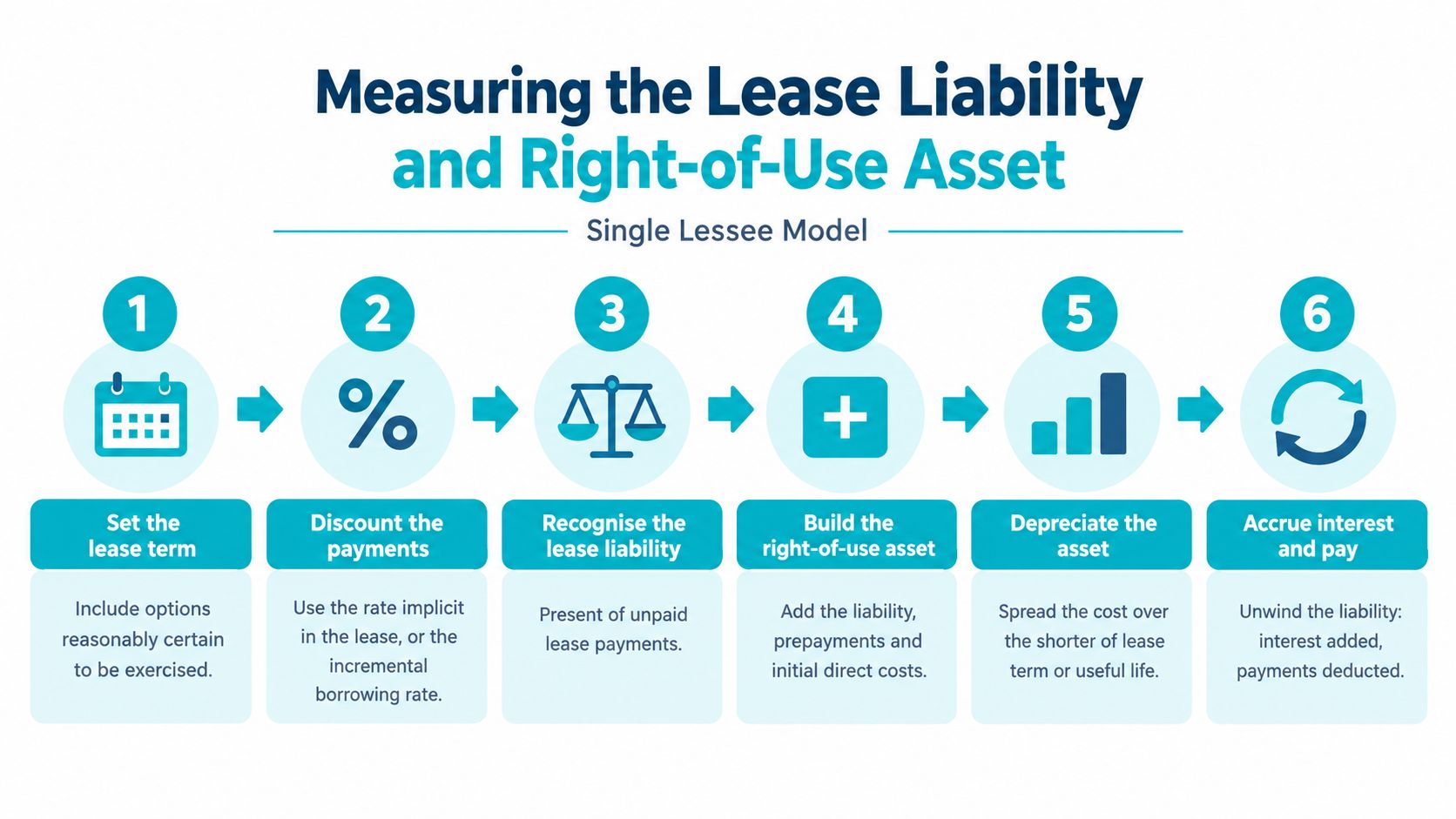
The opening balances are related, but they aren't necessarily identical. The liability measures unpaid lease payments at present value; the asset starts from that amount and incorporates other relevant commencement costs and adjustments.
The AASB 16 recognition and measurement requirements establish the discount-rate hierarchy, present-value measurement and components of the initial right-of-use asset.
Establish the term and discount rate
Begin with a supported lease term and payment schedule. If renewal or termination assumptions are wrong, an otherwise accurate spreadsheet will still produce the wrong opening balance.
Use the interest rate implicit in the lease when it's readily determinable. Otherwise, use the lessee's incremental borrowing rate. That isn't permission to select whichever rate produces the most convenient liability.
A defensible borrowing-rate methodology should reflect:
- Lease term: Match the financing period to the obligation being measured.
- Currency and economic environment: Use assumptions relevant to the arrangement.
- Security: Consider the security characteristics relevant to the borrowing-rate assessment.
Once the rate is established, discount the unpaid lease payments to their present value. In ordinary language, that converts a stream of future payments into a measured obligation at commencement.
Two leases with the same annual rent can therefore produce different liabilities. A different lease term changes the payment stream, while a different discount rate changes its present value.
Build the asset and preserve the evidence
The initial right-of-use asset generally comprises the initial liability, payments made at or before commencement less lease incentives received, initial direct costs, and estimated restoration or removal costs. Don't force the asset to equal the liability if the contract facts require adjustments.
A practical control file should include the signed contract, payment schedule, option assessment, rate support and asset calculation. Keep a central contract inventory and search property and service arrangements for embedded leases, rather than limiting the register to documents labelled “lease”.
This matters when premises, vehicles and equipment sit across Australian locations. Local managers may negotiate changes that the finance team won't identify from the original register alone.
For vehicle decisions, a lease car calculator can support an initial affordability discussion. It shouldn't replace the contract-specific rate, term and recognition assessment required for statutory accounting.
AASB 16 also addresses presentation and disclosure. Treat those as part of the reporting process, not as an afterthought once the opening journal balances.
Journal Entries from a Five-Year Building Lease
A published example makes the distinction between the liability and asset easier to follow. In the AASB building-lease illustration, a five-year lease has annual payments of CU100 in arrears, an advance payment of CU15, initial direct costs of CU5, and a 5% incremental borrowing rate because the implicit rate isn't readily determinable; the resulting initial liability is CU435 and the right-of-use asset is CU455.
CU means currency units. The figures are an accounting illustration, not a quotation for an Australian commercial property.
Opening balances in the five-year building example
The following components come from that published illustration.
| Component | Amount (CU) | Where it is recognised |
|---|---|---|
| Present value of unpaid annual payments | 435 | Lease liability and starting component of the asset |
| Advance payment | 15 | Added to the right-of-use asset |
| Initial direct costs | 5 | Added to the right-of-use asset |
| Total initial right-of-use asset | 455 | Asset balance, not an additional liability |
The advance payment isn't part of the unpaid payment obligation. It still contributes to the cost of obtaining the right to use the premises, which explains why the asset exceeds the liability.
The opening posting recognises a debit to the right-of-use asset and a credit to the lease liability for the discounted unpaid payments. The advance payment and qualifying direct costs are incorporated into the asset against cash or the relevant accounts already used to record them.
That last distinction matters. If the advance payment is already sitting in a prepayment account, the commencement entry should transfer it appropriately rather than record another cash payment.
Subsequent entries follow different paths
After commencement, the liability and asset move for different reasons:
- Interest accrual: Debit interest expense and credit the lease liability using the effective-interest method.
- Lease payment: Debit the lease liability and credit cash when the scheduled payment is made.
- Depreciation: Debit depreciation expense and credit accumulated depreciation for the right-of-use asset.
The asset is normally depreciated on a straight-line basis over the relevant lease term unless another systematic basis better reflects consumption. The liability increases through interest accrual and decreases through payments.
The cash payment, interest expense and depreciation charge are different accounting measures. They shouldn't be expected to match in every reporting period.
This produces a typically front-loaded total expense profile: interest is greater while the outstanding liability is higher, alongside the depreciation charge. It replaces the former single straight-line operating-lease expense pattern.
For finance teams designing posting controls, Loopfour's resource on auditable recurring journal entries offers a related workflow reference. The lease model should remain supported by contract-specific calculations and review.
After posting, reconcile the lease subledger to the contract register, assess modifications and index-linked changes, and validate tax separately. Tax deductions may not follow the accounting carrying amounts.
How AASB 16 Leases Change Debt and EBITDA
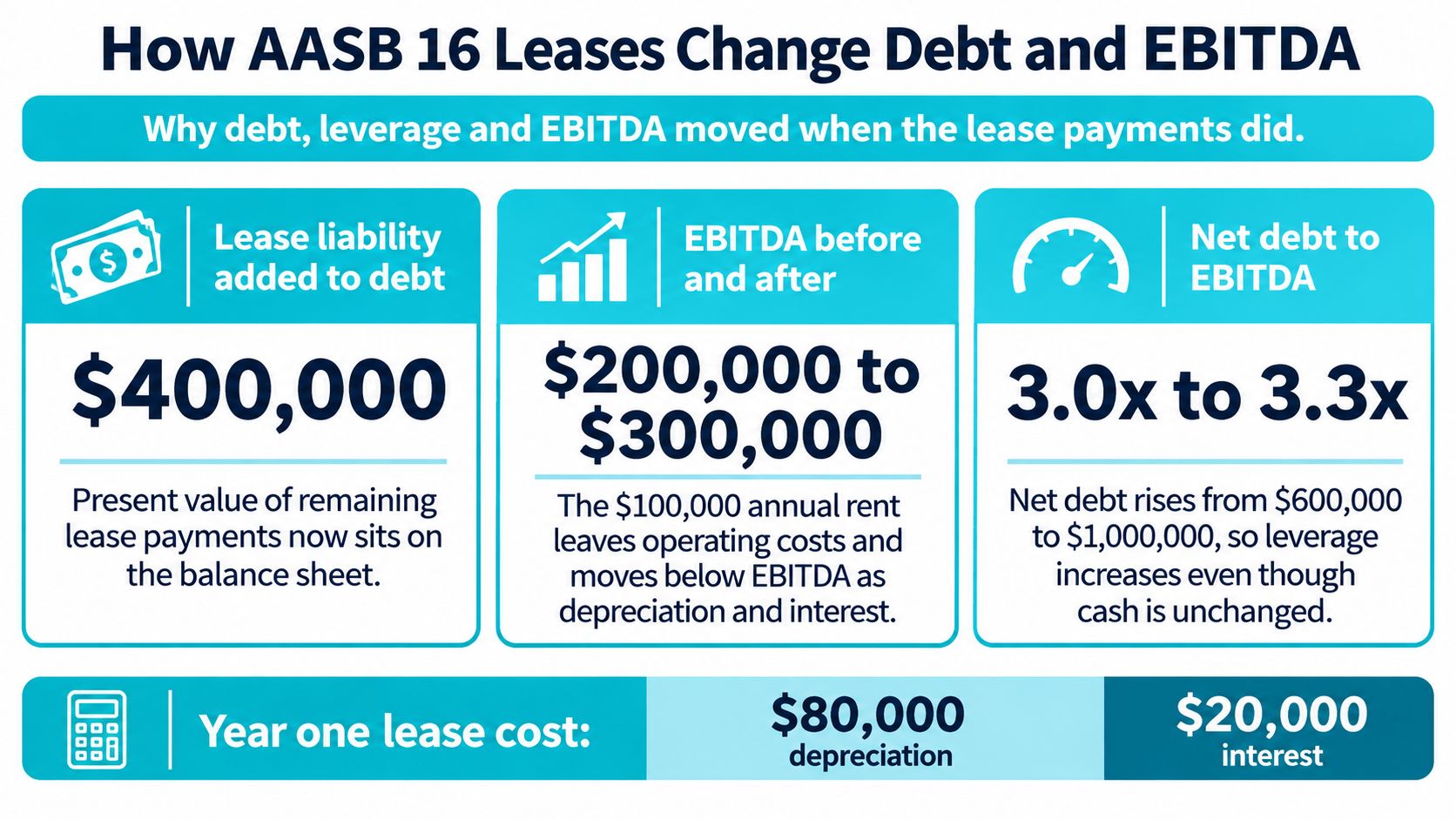
A business can make the same lease payments and report different EBITDA after adopting AASB 16. Previously, an operating lease expense reduced EBITDA. Under AASB 16, depreciation and interest replace that expense, and both sit outside EBITDA. The reported measure rises, but customer receipts and contractual payments do not change. A higher figure alone is not evidence of stronger trading.
The balance sheet changes too: it recognises a lease liability, which can increase reported debt and affect gearing ratios. The AASB's lease-standard literature review discusses international literature on IFRS 16's effects. Its findings should not be treated as Australian evidence or as a forecast for every private business. For private owners, the practical point is that accounting definitions can change how financial capacity appears.
Reconcile the figures before discussing capacity
An owner, accountant and bank may all use the word “debt” but mean different calculations. Prepare a reconciliation before discussing borrowing capacity, business performance or value.
| Measure | Question to resolve |
|---|---|
| Statutory lease liability | What amount appears in the financial statements? |
| Management performance measure | How does the business track trading and lease cash commitments internally? |
| Lender covenant measure | Does the signed agreement include lease liabilities, or make related adjustments? |
A bank's calculation may differ from the balance-sheet figure. Confirm the definition in the signed lending agreement rather than relying on an earlier conversation about bank loans.
The visual below illustrates how accounting definitions can affect reported debt, EBITDA and gearing. It is an illustration, not evidence of a particular business's performance.
Use consistent measures in lending and sale discussions
Ask the lender to confirm how lease liabilities are treated in covenant calculations, and ask your accountant to retain the reconciliation. If you use adjusted EBITDA, record each adjustment and apply the same method consistently.
For a sale or valuation, consider earnings and lease obligations together. A buyer's earnings measure can change depending on its treatment of lease costs, so choosing whichever combination gives the highest apparent value can mislead.
Keep a separate view of contractual cash outflows for day-to-day decisions. Practical small-business cash-flow management helps distinguish cash available to meet commitments from changes in reported earnings.
Recognition exemptions affect which arrangements appear in these accounting measures. For tax reporting, reconcile allowable deductions separately from the lease liability and right-of-use asset carrying amounts. Tax deductions may not follow the accounting figures.
The statutory numbers remain useful, provided everyone understands what they include before using them to assess borrowing, investment or a sale price.
Screening Contracts for Embedded Leases
A supplier contract doesn't need “lease” in its title to contain one. Equally, paying regularly for access to equipment or premises doesn't automatically establish a lease.
The Australian Government's guidance on identifying a lease explains the central test: a contract must convey control over the use of an identified asset for a period in exchange for consideration. That guidance also addresses substantive substitution rights, economic benefits, direction of use and separating components.
Follow the asset and control
Use the contract and operational facts together:
- Identify the asset: Is a particular space, vehicle or item of equipment specified or otherwise identified?
- Examine substitution rights: Can the supplier substantively substitute another asset, rather than merely having a protective or impractical contractual right?
- Assess economic benefits: Does the customer obtain substantially all the economic benefits from using the asset?
- Determine direction of use: Who controls how and for what purpose the asset is used during the relevant period?
A logistics agreement might purchase delivery capacity without giving the customer control of a particular vehicle. Warehouse capacity could similarly differ from the right to use a specified warehouse area. The contract label doesn't settle either question.
Managed office space needs the same careful reading. Access to a particular office may require a different analysis from access to whichever workspace the provider makes available.
Separate the service from the asset
Bundled arrangements deserve deliberate attention. IT hardware supplied with support, vehicles with maintenance, and equipment supplied with an operator can combine asset access with ongoing services.
Lease and non-lease components are generally separated unless the lessee elects the practical expedient to combine them by class of underlying asset. That election can change the payments included in lease measurement and the resulting expense presentation, so it shouldn't be buried in a spreadsheet assumption.
Escalation point: If you can't explain who controls the identified asset, don't force the contract into a standard lease template.
Recognition exemptions remain available where their conditions are met, and the portfolio condition described earlier still applies. Neither removes the need to establish what the arrangement actually contains.
Application questions remain active, including the Board's request for stakeholder feedback on possible changes to the standard. For an unusual arrangement, give your accountant the signed agreement, amendments, description of actual use, substitution provisions and details of bundled services.
Ask for a documented conclusion on identification, control and component separation. That's more useful than a yes-or-no answer that nobody can reconstruct at the next reporting date.
Choosing Advice When Lease Numbers Affect Wealth
A business may report more debt and higher EBITDA after adopting AASB 16, even though its lease payments have not changed. That difference can matter when an owner seeks new borrowing, faces a covenant review, considers selling or passing on the business, or makes personal decisions about debt and super. The accounting figures are part of the discussion, not a substitute for checking the cash commitments and the lender's definitions.

Match the review to the decision
For a new loan or covenant review, bring the latest financial statements, lease schedule, payment forecasts and lending agreement. Ask the accountant to explain how lease liabilities and expenses are presented, then ask the lender which debt and earnings definitions it uses. A reported ratio and a covenant ratio may not be calculated on the same basis.
For a proposed sale or succession, bring the lease agreements, renewal and termination terms, remaining payment schedule, and any expected transfer or assignment requirements. These help advisers assess the commitments a buyer or successor may inherit, alongside the business's forecast cash needs.
Personal decisions need a related, but distinct, review. If the owner is considering personal debt repayment, super contributions or retirement income, bring a household balance sheet, personal debt details and planned business drawings. Ask the financial adviser to test those choices against the business's cash forecast, rather than treating an increase in the accounting liability as cash newly spent.
A changed presentation does not itself change the lease economics. It can, however, affect how a lender or buyer reads the accounts. Reconcile the accounting numbers with the decision-maker's definitions before acting.
Bring the right advisers the right information
Start with the accountant for recognition, measurement, disclosures and tax treatment. A guide to finding accounting support for a small business can help owners prepare for that discussion. For personal goals, take the same lease schedule and cash forecast to a financial adviser, together with the personal information relevant to the decision.
Wealth Collective lists Protection Plus for personal insurance and risk cover, Guided Growth for superannuation, investment strategy and debt reduction, and Retirement Roadmap for planning around retirement income. The useful question is which advice, if any, fits the decision at hand. Ask each adviser to state what information they used and how the lease commitments affect their recommendation.
AASB 16 Leases Quick Reference and Next Step
A lease can change reported debt and EBITDA even when the payment schedule stays the same. Use these terms to pinpoint what needs checking, then bring the relevant contracts and lender definitions to your adviser.
A compact glossary
| Term | Plain-language meaning and reference |
|---|---|
| Right-of-use asset | The recognised value of a lessee's right to use an asset during the lease term. See the measurement section. |
| Lease liability | The present value of lease payments still owed under the lease. See the measurement section. |
| Short-term and low-value exemptions | Options to expense qualifying short-term leases and leases of low-value assets instead of recognising a right-of-use asset and lease liability. See lease categories. |
| Building illustration | A worked example of a five-year building lease showing how the recognised asset and liability are recorded and why their amounts can differ. See journal entries. |
| EBITDA | Earnings before interest, tax, depreciation and amortisation. AASB 16 can change its reported amount because lease expense may be presented as depreciation and interest. See financial impacts. |
| Leverage | A measure of debt relative to earnings, equity or another financial base. The result depends on which debt and earnings figures are included. |
| Covenant definition | The lender's agreed method for calculating the financial measures a borrower must meet. |
| Identified asset | The specific asset, or a physically distinct part of one, that a customer has the right to use under a contract. See contract screening. |
| Substitution rights | A supplier's right to replace an asset. It affects lease assessment only when the right is substantive. |
| Non-lease components | Contract elements for services or other items separate from the right to use an asset. They are generally accounted for separately unless an applicable combining election is made. |
Take a focused review list to your adviser
Bring these points to your accountant or adviser:
- Contract inventory: Include signed agreements, amendments and service contracts that may contain a lease.
- Lease-term options: Ask which renewal and termination assumptions support the recognised lease term.
- Discount-rate basis: Request the reasoning behind the rate used to measure the liability.
- Lender treatment: Confirm whether lease liabilities enter the covenant calculation and how any earnings adjustments are made.
- Tax treatment: Check whether tax deductions follow the accounting amounts or need a separate reconciliation.
Keep the accounting calculation distinct from the planning decision. Your accountant can determine what the financial statements should report. A financial adviser can help assess how those commitments fit your personal circumstances.
An introductory advice call can identify the appropriate service and information needed for a fuller review. It is not a review of lease journals. The discussion can clarify whether protection, wealth-building or retirement planning is the priority.
For Western Australian pre-retirees, families, executives and small-business owners, compare the reported liability with the cash available before taking on another commitment. A higher reported liability does not, by itself, mean the lease costs more or that a business has less cash.
Wealth Collective offers coordinated advice through Protection Plus, Guided Growth and Retirement Roadmap, helping you connect business lease commitments with insurance, debt reduction, superannuation and retirement goals. Visit Wealth Collective to book a free 10-minute introductory call and discuss which service fits your circumstances before your next borrowing, investment or retirement decision.