Business hours
Monday to Friday (8.30AM - 5PM)
Weekend (Closed)



You're at the dealership, the sales rep has found a car you like, and the monthly figure looks manageable at first glance. Then the questions start. How much is really being financed, what happens at the end of the term, and why do two calculators give very different answers for what seems like the same car?
A lease car calculator helps you answer those questions before you sign anything. Used properly, it's not just a payment widget. It's a way to see how the vehicle price, lease term, interest rate, residual value, and repayment frequency change the total cost of using a car, and, in Australia, those settings can mean very different outcomes depending on whether you're looking at a standard lease or a novated lease.
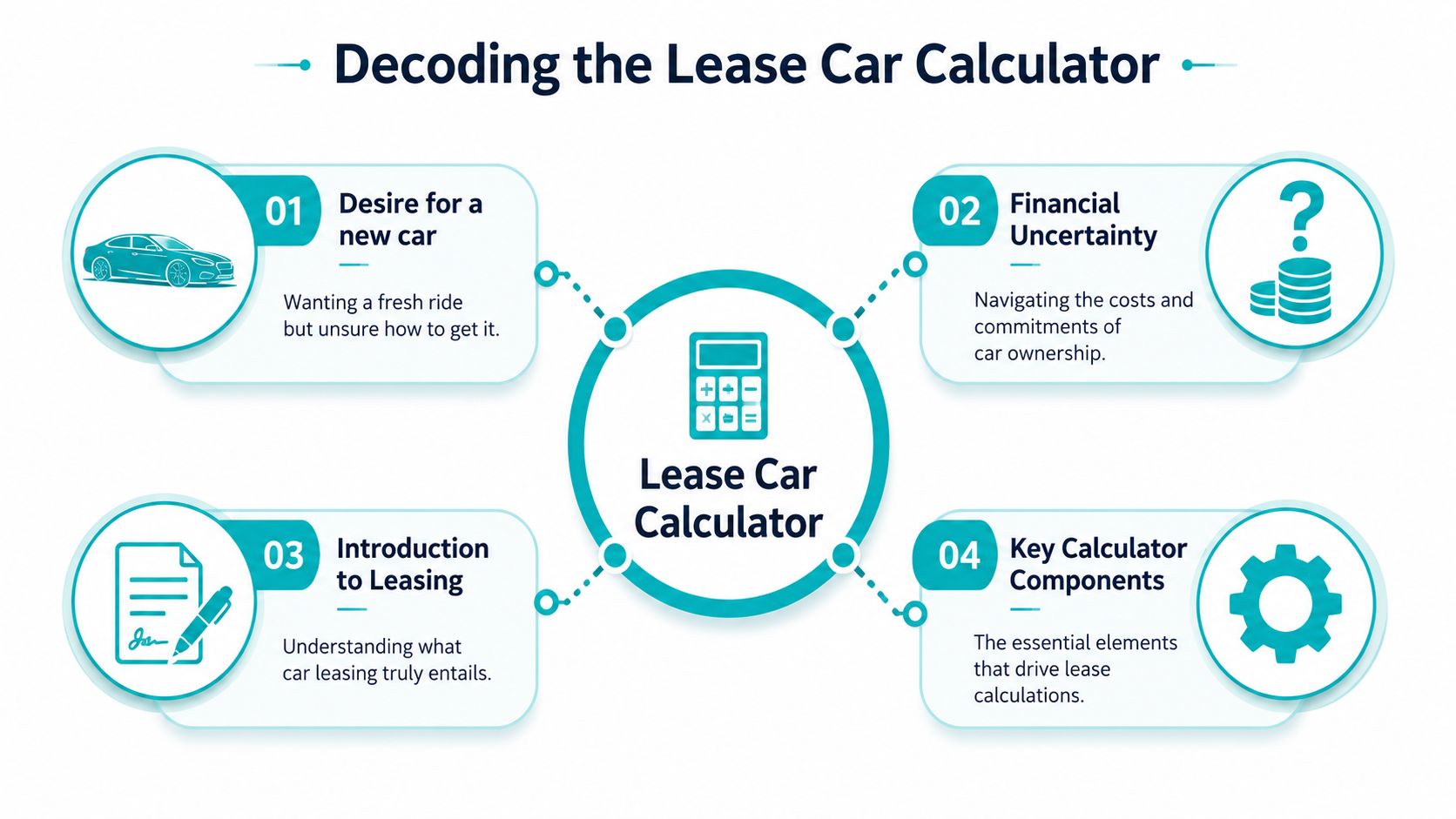
Decoding the Lease Car Calculator
A lease can feel a lot like renting a home instead of buying one. You pay for the right to use the asset for a set period, then hand it back or deal with a buy-out at the end. That's very different from buying outright, where every payment pushes you toward ownership.
That's why a lease car calculator matters early, not late. It helps you test the structure before you commit, so you can see whether a lower periodic payment is coming from a longer term, a larger residual value, or both. Australian calculator providers note that common lease terms range from 1 to 7 years, and that you can model payments monthly, fortnightly, or weekly to see how term length changes cash flow and end-of-lease exposure (Finder car lease calculator).
Standard lease versus novated lease
A standard lease calculator and a novated lease calculator don't answer the same question. The first is usually focused on the finance structure itself, while the second has to account for salary packaging, tax effects, and running costs. If you want a broader view of how lease rules vary across markets, Latest UK automotive leasing rules is a useful contrast point, even though Australia's tax treatment is different.
In Australian practice, the main difference is simple. A standard lease calculator is about the cost of using the car, while a novated lease calculator is about the cost of using the car through payroll and tax settings as well. That difference is why people often get confused when they compare two tools with the same vehicle and see very different outputs.
Practical rule: if a calculator only shows a payment number, you still don't know the whole story.
The Core Inputs Behind the Calculation
A lease payment is not one number pulled from thin air. It is the result of several inputs working against each other, so a small change in one field can shift the outcome more than people expect. The calculator is most useful when you treat it like a balance sheet for the lease. One side is the cost of using the car now, the other is the amount left standing at the end.
Vehicle price and lease term
The vehicle price sets the starting point. A higher-priced car usually means more value has to be covered through the lease, so the regular payment tends to rise unless another input pulls it back down. The lease term changes how that cost is spread out. A longer term can reduce each payment, but it also keeps the agreement alive for longer and leaves you exposed to the end-of-lease amount for more time.
That trade-off matters because a lease calculator is not only showing a monthly figure. It is also showing how much of the car's cost is being paid down through the regular instalments and how much is being left for later. For a household budget, that distinction matters as much as the headline payment, because lower instalments can be helpful now while still leaving a larger commitment at the end. If you are comparing a lease against other salary-based decisions, a tool such as the salary sacrifice super calculator can help you see how one commitment affects another part of your cash flow.
Interest rate and residual value
The interest rate is the finance charge built into the arrangement. A higher rate means more of your payment goes toward borrowing costs rather than reducing the lease obligation itself. That is why two people can choose the same car and the same term, yet see noticeably different repayment estimates.
The residual value, often called the balloon payment, works in the opposite direction. A higher residual pushes more of the car's value to the end of the lease, which can make the regular payment look lighter. The trade-off is simple. A lower payment today can mean a bigger decision later, because you must be ready either to pay the residual, refinance it, or hand the car back under the lease terms.
Residual value is the expected end-point value left to pay if you want to keep the car at the end of the lease.
That is the part many people underestimate. A calculator can make two vehicles look similar on paper while the end-of-lease exposure is very different, because the residual setting changes how much cost is deferred rather than removed. In practice, that means the payment figure should be read together with the residual, not separately from it.
Running a Manual Calculation Step by Step

A good way to understand the calculator is to strip it back to the logic. First, part of the vehicle's value is being used up across the lease term. Then, finance costs are added on top of that usage component. The result is the regular payment estimate you see on screen.
If you want a useful comparison point for your broader household finances, it can help to look at other salary-based tools as well, such as the salary sacrifice super calculator. That kind of comparison helps you see that a car lease is not just a transport choice, it sits inside the wider cash flow picture.
A simple way to think about the math
Use this sequence when you're checking any estimate.
- Set the vehicle price. This is the starting amount the lease is based on.
- Choose the lease term. A shorter term usually means higher regular payments, because the cost is spread over fewer periods.
- Apply the residual. A larger residual leaves more value to deal with at the end, which can lower the regular payment but raise end-of-term exposure.
- Add the interest cost. This is the finance charge for using the lender's money across the term.
- Convert the result to the frequency you want. That might be weekly, fortnightly, or monthly, depending on how you budget.
The point isn't to hand-calculate every figure perfectly. The point is to know what the calculator is doing in the background, so you can tell whether a lower payment is better or just deferred pain.
Novated Leases and Tax Implications
A novated lease changes the numbers because payroll and tax sit inside the calculation. In Australia, the employer deducts the pre-tax lease payment from gross salary before income tax is worked out, so taxable income falls and tax paid can fall with it. The calculator also has to include any post-tax contribution used to cover the FBT obligation, along with finance payments, stamp duty, running costs, and the vehicle's exit value (VeerCal novated calculator).
That is why a novated lease calculator should not be treated like a simple repayment tool. It is closer to a pay-and-tax model, because the figure on screen depends on the car, the lease structure, and the way salary packaging changes take-home pay. Australian calculators now ask for the vehicle price, annual salary, yearly kilometres, and lease term so they can estimate repayments, running costs, residual value, and take-home pay impact rather than only a headline payment figure (Novated Lease Guide calculator). Some tools go further and show the difference in pay, tax savings, and annual running costs, which is closer to how these arrangements are judged in practice.
Why salary packaging changes the answer
A standard lease calculator can miss the variables that shape the actual outcome. Australian novated calculators often rely on salary and location because tax benefits and running-cost estimates depend on the person, not just the car. That matters for WA audiences in particular, because pre-retirees, dual-income households, and executives can end up with very different net results from the same vehicle depending on marginal tax rate, salary packaging access, and whether the employer supports novated leasing (Fingo novated lease calculator).
A useful way to test the question is to compare the lease result with your broader pay setup. A plain-English discussion of that decision is available in is salary sacrifice worth it, which helps you see why the tax result matters as much as the car payment itself.
The EV exemption that changes the picture
One rule can materially change the numbers. The EV/FBT exemption applies only to a battery-electric or hydrogen fuel-cell car, not a plug-in hybrid. The car must have been first held and used on or after 1 July 2022, and it must be priced below the fuel-efficient luxury car tax threshold of $91,661 for the 2026 to 2027 FBT year (Wage Calculator novated lease calculator).
That is why novated lease calculations need care. Two cars can look similar on a showroom floor, yet the after-tax outcome can be very different once FBT treatment, payroll deductions, and running costs are added in. If you want the tax angle broken down further, EndureGo Tax on car deductions is a useful reference point for how vehicle deductions sit inside the wider tax picture.
Plain-English version: novated leasing is about the car, the payroll file, and the tax settings all at once.
Common Pitfalls and Calculator Gotchas
The biggest mistake is chasing the lowest payment and ignoring the rest of the structure. A low weekly or monthly figure can look comforting, but it may be hiding a large residual at the end of the term. If you don't plan for that amount, the lease can feel affordable right up until the final decision arrives.

Costs calculators often leave in the background
The other common blind spot is running costs. For novated leasing, it's essential to separate the finance cost from annual running costs such as fuel, servicing, and insurance to estimate the full after-tax cash flow impact, because the finance component alone does not capture the vehicle's true operating expenses (Autopia calculator).
That same logic applies to ordinary lease decisions too. Registration, insurance, servicing, and other ownership expenses still matter even if they sit outside the finance line item. If you only compare the lease repayment, you're comparing half a picture.
How to read the rate properly
A headline rate also needs context. A lease payment calculator can use a simple interest input, but that doesn't always tell you the full cost of the arrangement once fees, running costs, and end-of-term obligations are considered. In practice, the payment figure is a starting point, not a verdict.
Don't let the calculator make the decision for you. Let it show you the structure, then check the parts that sit outside the screen.
If a tool doesn't make the residual obvious, doesn't separate running costs, or doesn't explain how your pay affects the result, treat the output as a rough guide rather than a final answer.
Loan Calculator vs Lease Calculator A Head to Head Comparison
A loan calculator and a lease calculator can both show a monthly figure, but they answer different questions. One is about ownership, the other is about usage. That difference changes the inputs, the end result, and the meaning of the payment itself.
For a broader finance comparison mindset, it can also help to see how vehicle funding sits alongside other balance-sheet decisions, such as the mortgage offset account calculator, because cash flow trade-offs rarely live in one bucket alone.
| Input/Feature | Lease Calculator | Loan Calculator |
|---|---|---|
| Main purpose | Estimate the cost of using a vehicle over a fixed term | Estimate the cost of buying a vehicle and paying it off |
| Key inputs | Vehicle price, lease term, interest rate, residual value, repayment frequency | Loan amount, term, interest rate, repayment frequency |
| End result | Regular payments plus a residual at the end | Regular payments until the debt is repaid |
| Ownership outcome | Use of the car during the term, with end-of-term conditions | Full ownership once the loan is cleared |
| Cash flow focus | Payment timing and residual exposure | Debt reduction and final ownership |
A good example is a buyer who only wants short-term use of a car for business or salary packaging reasons. For that person, a lease calculator may be more relevant. Someone who wants to own the car outright and keep it for as long as possible will usually find the loan calculator more aligned with their goal.
Why the same car can look different
The same vehicle can produce a lower-looking payment under a lease because part of the value is deferred into the residual. A loan calculator, by contrast, is designed to move the borrower toward zero debt and full ownership. That's why the comparison isn't just about monthly affordability, it's about what happens at the end.
If you're comparing finance structures for a higher-value car, Understanding Tesla loan choices is a useful example of how different funding pathways can change the decision.
Your Next Steps From Calculator to Confident Decision
A lease car calculator turns a rough idea into a working set of numbers. That is useful, but only if you read those numbers in context. A payment on screen can hide tax treatment, employer rules, cash flow strain, and the effect the decision has on your broader wealth plan. As noted earlier, generic lease tools often miss Australian salary-packaging eligibility and employer-specific constraints, so the same car can lead to very different net outcomes for WA pre-retirees, executives, and dual-income families.
The key point is simple. The best option is not the lowest figure on the page, it is the structure that fits your income, your household budget, and the role you want this car to play in your finances over time. A calculator cannot choose that for you, but it can give you the numbers needed to ask sharper questions.
The hidden issue many people miss is residual value risk. A lease can look lighter each month because part of the car's value is pushed to the end, like leaving a final bill for later rather than paying the full amount upfront. That is why the end-of-term outcome matters as much as the monthly payment, especially if you may want to keep, sell, or refinance the vehicle later.
Once you understand that trade-off, the next step is to compare your options against your real-world circumstances, not just the quote in front of you. If you are considering a lease, a novated lease, or another financing path, book a free 10-minute introductory call with Wealth Collective. We can help you turn the calculator output into a clear decision that fits your wider financial life.
A CTA for Wealth Collective.