Business hours
Monday to Friday (8.30AM - 5PM)
Weekend (Closed)


The median annual cost of ongoing financial advice in Australia was A$3,960 in 2024, and one-off advice is priced by scope rather than a flat rate, so your price depends on what you buy. Treat that figure as a market middle, not a quote with your name on it.
The cost of financial advice only makes sense once you can point to a dated piece of work and a dollar effect on your money. A fee that buys a super drawdown model, a cover gap closed, or a debt plan you follow can earn its place. A fee that buys a relationship you never use does not. Advice is a purchase. It has to earn the money back.
How Financial Advice Fees Are Structured
Advice fees are set by how the work is charged and how much of your situation it covers, so there is no single price. Two people can sit with the same adviser and leave with very different invoices, because one bought a single decision and the other bought a full plan plus a year of reviews.
Think of a mechanic. A quick service and a full engine rebuild both happen in the same workshop, and nobody expects the same docket. Advice works the same way.
| Fee structure | How it is charged | Typical cost pattern | Usually suits |
|---|---|---|---|
| Fixed fee, one-off | Flat fee agreed before work starts | Set once for the defined scope | One decision, such as an insurance or super review |
| Comprehensive plan fee | Flat fee for a full financial plan | Higher than limited advice; set by scope | Major life changes, such as retirement or a business sale |
| Ongoing annual fee | Fixed dollar amount paid each year after written consent | Fixed each year and reviewed annually | Continuing monitoring and regular reviews |
| Percentage of balance | Percentage of funds under advice, charged yearly | Rises as the balance rises | Larger portfolios with active management |
| Superannuation deduction | Adviser fee paid from super with explicit member consent | Dollar or percentage based | Super-focused advice and retirement income |
| Hourly rate | Charged per hour of adviser time | Scales with the hours used | Short, ad hoc questions |
| Product-based fees | Built into the product, such as admin, management, entry or exit fees | Shown in the product disclosure | Checking what a product already costs |
| General advice | Information not tailored to your situation | Usually free | Broad education before you decide |
Scope sets the price
Moneysmart is clear that limited or single-issue advice is generally cheaper than full advice. General advice is usually free, because it does not take account of your objectives, financial situation or needs. A podcast or a fund fact sheet can teach you the rules. It cannot tell you which option fits your tax, your dependants, or the year you want to stop work.
A percentage of the balance feels small until the balance grows. One percent of a modest account is a modest dollar amount. The same rate on a much larger account is a much larger bill, even if the adviser's hours barely change. Product fees sit beside that bill, not inside it. Administration, management, and entry or exit charges belong to the product. They are not the advice fee, and paying one does not cancel the other.
Before you agree, ask for a written fee summary. It should state the scope, the total cost, the payment method, and whether the relationship is one-off or ongoing. At Wealth Collective, a short introductory conversation is how we sort that scope first. You might need Protection Plus, Guided Growth, Retirement Roadmap, or a tighter piece of work. You should know which one you are buying before any plan fee is locked in.
Average Costs of Advice Across Australia
Averages hide a wide spread, so use only the figure that matches the service you need. A fee becomes meaningful when it is tied to a dated service: a one-off review, a year of reviews, modelling, or implementation. The median annual cost of ongoing advice in Australia was A$3,960 in 2024, according to Adviser Ratings' 2024 Australian Financial Advice Landscape Report, as reported by Canstar.
The Treasury Quality of Advice Review found consumers were willing to pay about A$600 on average, compared with approximately A$1,760 for limited advice and A$3,060 for a broader scope of advice. The same review notes 2025 industry data in which the median ongoing advice fee rose 18 percent to A$4,668. Those figures are not rival prices for one product. They are readings from different shelves: a single question, a defined project, and a continuing relationship.
| Measure | Figure | Period or year | Source |
|---|---|---|---|
| Median annual cost of ongoing advice | A$3,960 | 2024 | Adviser Ratings, reported by Canstar |
| Reported median ongoing advice fee | A$4,668, up 18 percent | 2025 | Treasury Quality of Advice Review |
| Average consumer willingness to pay, general | About A$600 | Quality of Advice Review | Treasury Quality of Advice Review |
| Consumer willingness to pay, limited advice | About A$1,760 | Quality of Advice Review | Treasury Quality of Advice Review |
| Consumer willingness to pay, broader-scope advice | About A$3,060 | Quality of Advice Review | Treasury Quality of Advice Review |
Read the label on the number
A median is the middle of the market. Half of arrangements sit above it and half sit below. It is not the price you will be charged. A figure only means something once it is matched to scope.
Say you hold a quote for a one-off insurance and super review near the A$1,760 limited-advice benchmark, and another quote near the A$4,668 median ongoing fee. Those two numbers measure different services. Comparing them as if they were the same product will make the cheaper quote look like a bargain and the larger one look like a rip-off, when one might be a single decision and the other a year of reviews, modelling, and implementation.
Practical rule: Put every quote on the same scope and the same annual basis before you compare, and check whether each quote states a one-off fee or a recurring fee.
The advice invoice is one line in a household budget, not the whole budget. For the wider spending picture, HearSmart's money topics sit beside the invoice, but they do not set the advice fee.
How Advice Fees Come Out of Your Super
Advice does not always leave your transaction account. It can be deducted from superannuation, and every dollar taken out is a dollar that no longer compounds toward retirement income.
ASIC's 2024 review of superannuation trustees measured what left member accounts. Between 1 April 2022 and 31 March 2023, A$990.4 million in advice fees were deducted from 476,452 member accounts linked to advisers from 1,803 licensees. Across those accounts, that is about A$2,079 for the 12 months.
That average is not a typical bill. Balances, advice arrangements, and charging structures differ widely. A small account with a one-off super question and a large account on a percentage fee can both sit inside the same total.
A percentage you can redo at home
Take a hypothetical 1 percent annual adviser fee on a A$300,000 balance. Year one is A$3,000. If the balance grows and the fee stays a percentage, the dollar amount grows with it. A balance of A$330,000 at the same rate is A$3,300, before you add any extra work. The advice did not necessarily take more hours. The invoice did.

ASIC's superannuation calculator lets you model adviser service fees as a dollar amount or a percentage of the balance. It assumes percentage-based fees are charged mid-year and increase with inflation. Run your own balance through it before you sign. A fee that looks modest on this year's statement can change the balance you draw on later.
Keep adviser fees separate from what the product already charges. Administration, investment management, and entry or exit fees belong to the fund or the investment option. Our superannuation advice in Australia work starts by splitting those layers so you can see which dollars pay for advice and which dollars pay the product.
Before any deduction is set up, ask for two things in writing: the dollar cost and the projected effect on your super balance. Then confirm you have given explicit consent to that deduction. A trustee can only take advice fees from your account inside the super rules, and only with the permission those rules require.
Testing Whether Advice Is Worth the Price
Advice does not automatically pay for itself. A fee that is fair for one household can be a poor trade for another, because the value depends on the decisions the advice changes and the dollars attached to them.
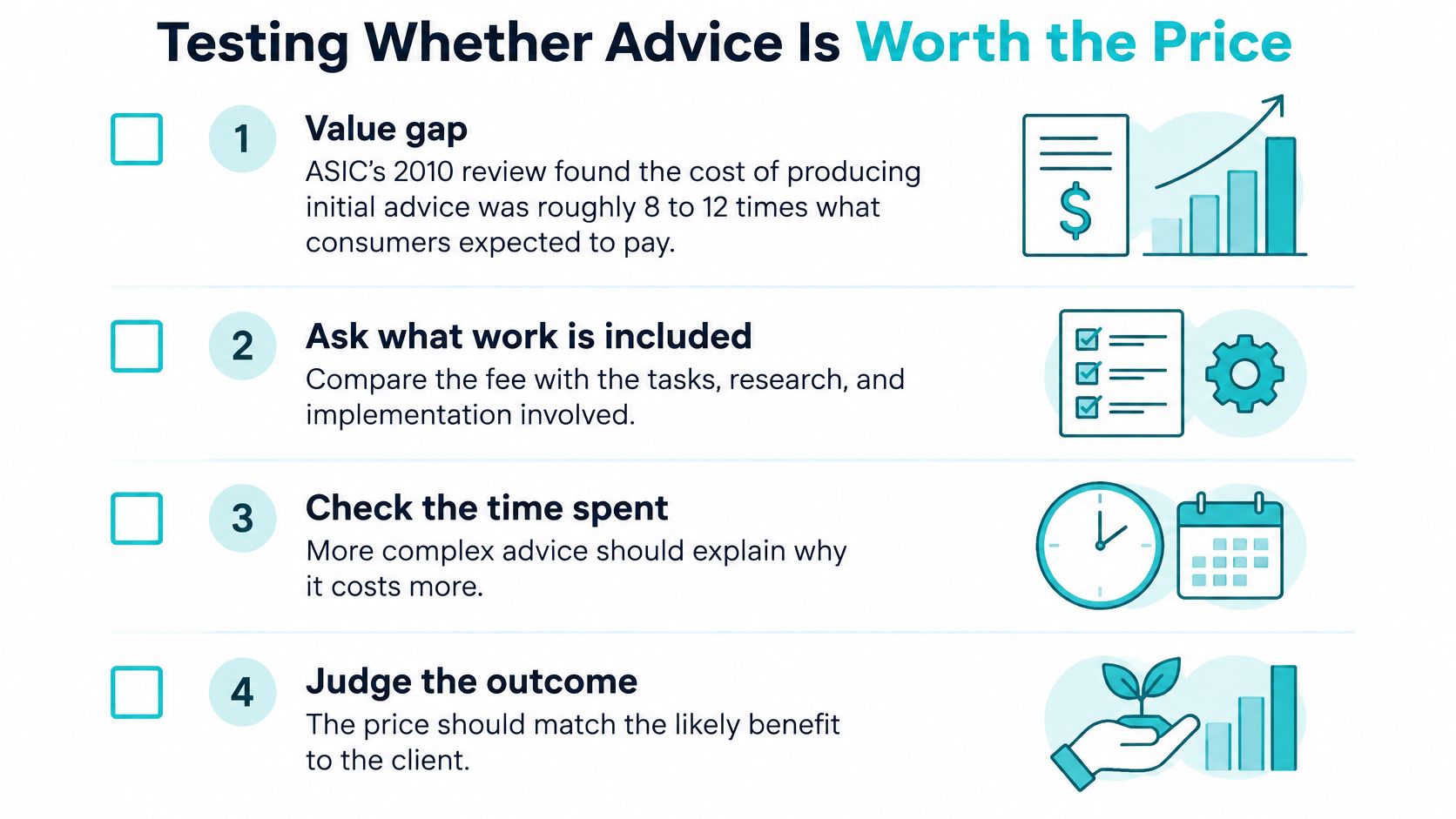
ASIC's 2010 review of access to financial advice found consumers expected an initial consultation to cost A$301 on average, and ongoing advice A$298 a year, while 22 percent thought the first consultation should be free. Licensees reported an average cost of A$2,500 to A$3,500 to provide advice, roughly 8.3 to 11.6 times the consumer figure for initial advice and about 8.4 to 11.7 times the figure for annual ongoing advice. ASIC's later look at the demand for advice found that 35 percent of surveyed people who had not sought advice named expense as the most common reason. That gap does not prove advice is overpriced. It shows buyers and providers often picture different amounts of work, and the value test has to settle the difference.
Replace the slogan with a test
A gym membership is only good value if you use it. An ongoing advice fee works the same way. Before you pay, ask what you receive at each review, which decision it will change, and how the fee compares with the dollars at stake. A fee of A$3,000 on a drawdown choice worth tens of thousands is a different purchase from the same fee spent restating a strategy you already follow.
Map every recurring fee to a dated service. That might be an annual strategy review, retirement-income modelling, an insurance reassessment, or implementation support. If a line on the invoice has no date and no deliverable, you are paying for a promise. Ongoing fees can also be charged without the reviews that were promised, which is why each payment needs something specific behind it. Our financial planning process is built so each stage has a job, rather than a standing charge with nothing attached.
Use this checklist on any quote:
- Defined scope: One page that says what is in and what is out.
- Named deliverables: The documents, models, or product changes you will receive.
- A review date: When the work is redone, not “as needed”.
- Yearly confirmation: You still want the service before the next fee is taken.
If you cannot name the decision the fee will change, you are not ready to buy it.
Ways to Lower Advice Fees Without Losing Quality
You can cut the bill without cutting the thinking, if you change what you buy and how prepared you are. Advice is based on the information you provide and our professional expertise, so a thin file often means more hours, not a cheaper plan.
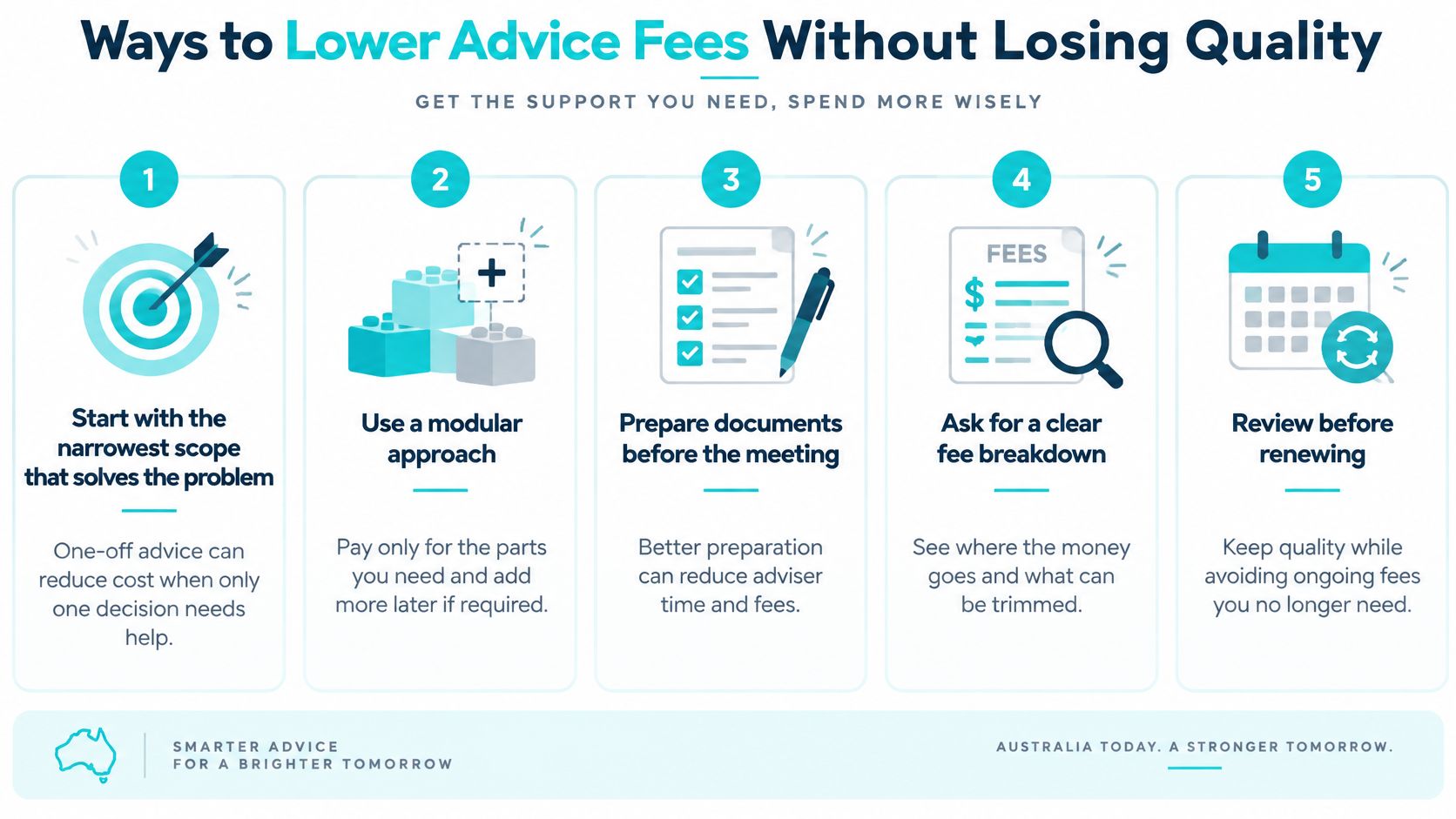
Start with the narrowest scope that solves the problem. A one-off review of insurance or super can cost less than a full wealth plan when you only have one decision in front of you. The trade-off is that a narrow job will not rebuild your whole balance sheet. It should still flag the risks you are exposed to. Lower fees do not mean less analysis of the question you asked.
Prepare the file before the first meeting. Bring super statements, insurance policies, loan details, payslips, and a written list of goals. You control this step. A prepared file shortens discovery, and shorter discovery is fewer hours if you are on an hourly or tightly scoped fixed fee. The trade-off is your time on a Sunday afternoon, which is usually cheaper than adviser time.
Split product costs from advice costs. Consolidating duplicate super accounts can remove a second set of administration fees where the insurance and investment fit still works for you. Those product fees sit outside the adviser's charge. You and the fund control this, not the advice invoice. The trade-off is losing insurance inside an old fund if you roll over without checking it first. Our notes on how to choose a financial adviser cover the questions that keep that check honest.
Use the yearly consent as a price check
Moneysmart sets the rule for ongoing fees. Each year the adviser must get your written opt-in before charging again, state the fees for the coming year, and specify the services you are entitled to receive. Consent can be electronic or in person. Where an ongoing fee is paid, the adviser should also review your situation and meet you at least annually.
That meeting is your checkpoint. Compare the amount paid with the reviews, strategy updates, and implementation you received. If you did not use the ongoing service, decline it. You control the yes. The adviser controls the service list. The fund only moves the money if you have agreed.
A narrower scope should still name the risks you carry. Cheap and silent is not a saving.
When Paying for Advice Pays Off by Client Segment
The same fee can be money well spent for one reader and a waste for the next. Match the cost to the decision in front of you, not to a slogan about portfolios.
| Client segment | Usually worth paying when | A narrower review may be enough when |
|---|---|---|
| Pre-retirees and retirees | Super is about to be drawn down or income timing is unclear | The balance is small and one simple income product covers needs |
| Young professionals and dual-income families | Debt is high and insurance and super contributions need coordinating | Income is simple, cover is adequate and debt is low |
| People needing insurance or super optimisation | Cover gaps, several super accounts or unclear premium costs | The existing policy and super option were reviewed recently |
| High-income earners and executives | Portfolio complexity, tax structuring or equity remuneration | Holdings are simple, such as cash and index funds, with low tax complexity |
| Small business owners | Business and personal assets overlap or key person risk exists | The business is a sole trader with no debt and basic cover |

Where each service fits
Retirement Roadmap simplifies retirement planning and gives you a clear path to financial security. It suits a pre-retiree who needs to decide how to draw super and when income starts. If one simple income product already covers a small balance, a single review is often enough.
Protection Plus simplifies personal insurance and superannuation so you can get better coverage and lower fees. It fits when cover gaps, several super accounts, or unclear premiums are the problem. If that policy and that super option were checked recently, you may not need a new engagement.
Guided Growth turns income and assets into a customized engine for building wealth, based on your goals and life circumstances. A dual-income family juggling a mortgage, insurance, and super contributions is the usual fit, and so is an executive with tax structuring or equity pay. A simple income, adequate cover, and low debt point back to a targeted review instead.
Portfolio size is a weak test on its own. A modest super balance with a messy drawdown can justify more work than a large cash holding with one obvious choice. Judge the dollar value of the decision, then use a short intro conversation to confirm which of the three services matches it.
Book a Free Intro Call to Confirm Your Costs
Confirm the cost and the scope before you commit to any plan. Prospective clients can book a free 10-minute intro call, and we take care of the rest.
Bring a short list, not a perfect file:
- Your goals, in a few lines, including the decision you want help with.
- Current super and insurance details, even if they are last year's statements.
- Debts, with the rate and the balance you know today.
On the call, ask what the fee covers, whether it is one-off or ongoing, what you will pay in the first year, and how it is charged (fixed, percentage, or from super). Ask what is reviewed each year, and how you end the arrangement if you no longer want it.
After that call we research and model your options and build a detailed plan. In the plan presentation we walk you through that plan and answer your questions, including the fee line, before you decide to go further.
General information on this website is not personal financial advice. Consider your own circumstances and consult one of our qualified financial advisers before you act on it.
Book the intro call if you want a written fee outline for your own situation, rather than a market median that was never meant to be your invoice.
Wealth Collective helps Australians price advice against a defined job, whether that is insurance and super through Protection Plus, a wealth-building plan through Guided Growth, or a retirement path through Retirement Roadmap. If you want the cost of financial advice tied to your own scope before you commit, visit Wealth Collective and book a free 10-minute intro call. You will leave with a clearer fee outline and a straight answer on whether the work is worth buying.