Business hours
Monday to Friday (8.30AM - 5PM)
Weekend (Closed)



A bad year is not an instruction to move your super, and a good year is not a reason to stop checking. The most popular advice treats should I change my super investment option as a personality quiz: pick balanced if you feel moderate, growth if you feel brave, conservative if the headlines scare you. That shortcut ignores the two different decisions sitting inside one label. You can leave the money already invested where it is, and you can send tomorrow's contributions somewhere else. After a volatile year, doing nothing, or changing only future contributions, is often the better trade.
Stay, Redirect or Switch Your Super Option
Four actions cover almost every member. Stay when your horizon, the fall you can hold, the fees and the five- to eight-year results still match the option's stated objective. Redirect only future contributions when the mix you want from here is wrong, but selling now would lock in a fall. Split the balance when pension payments start within one to three years and a defensive cash reserve is needed beside a longer pool. Switch fully only after persistent underperformance against the product disclosure statement (PDS) benchmark, when fees or the asset mix fail the comparison, and insurance will survive the move.
| Situation | What to check | Action |
|---|---|---|
| One weak or strong year only | Horizon, risk and fees still match | Stay invested |
| Future mix is wrong but markets have fallen | Where new contributions are directed | Redirect future contributions only |
| Pension payments due within 1–3 years | Cash for withdrawals versus long-term pool | Partial switch to a defensive reserve |
| Five or more years below the PDS benchmark | Fees, asset mix and insurance elsewhere | Consider a partial or full switch |
| Lifecycle option already shifting with age | Glide path versus your retirement date | Usually stay unless fees or cover fail |
| High-pressure pitch or unrealistic returns | Product complexity and lost insurance | Do not switch on the sales call |
Why the label is not the decision
Choice products are most of what retail members hold, so option quality varies and deserves a review rather than an automatic move. APRA's September 2023 statistics, cited in ASIC's review, found that choice products represented 79% of funds under management in retail funds. That spread is a reason to read the option, not a reason to jump because one statement looked ugly.
A single strong year and a single weak year answer the same question: they don't. Match five- to eight-year results with the option's own benchmark, its fees and the risk you can actually hold.
Doing nothing, or changing only where new money goes, is often the prudent call once the noise of the year fades.
How to Review the Option Before You Move
A rough year is a reason to check your super, not a reason to switch it. Compare the option with your needs and the fund's own benchmarks, then stay put if the evidence shows no mismatch.
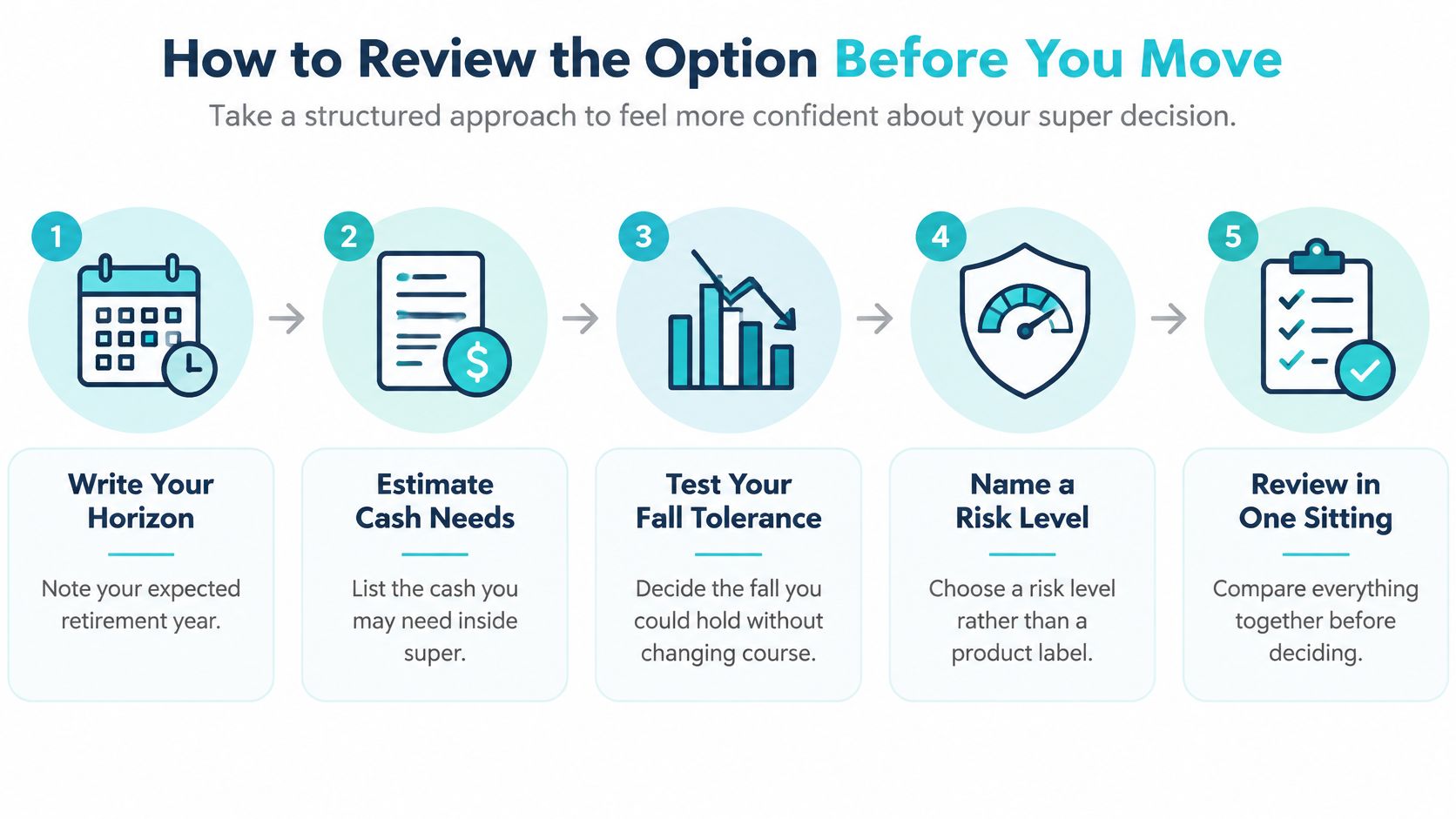
- Write down your investment horizon, expected retirement year, likely cash needs inside super and the size of a fall you could tolerate without changing course.
- Assess the option's actual risk rather than relying on its label: cash, conservative, moderate, balanced, growth or high growth. A defensive label does not guarantee the unit price will hold steady.
- Compare the product disclosure statements and their strategic asset allocations across shares, property, fixed interest and cash. Check diversification, the use of derivatives or unlisted assets, and how often unit prices are calculated. This guide to asset allocation strategy can help you understand the mix.
- Compare five- to eight-year returns after fees with each option's own benchmark. Short-term league tables can distract from whether the option has delivered against its stated objective.
- Compare administration, investment and indirect costs. A higher return is not a better result if higher fees erase the difference.
- Check insurance, any tax consequences, buy-sell spreads, transaction costs and switching restrictions. General guidance is to consider how a change fits your goals and circumstances, and what it means for cover, fees and tax.
- Decide whether to stay, redirect, partially switch or fully switch. A change from accumulation to drawdown may justify a fresh look at risk. Check whether a lifecycle option already adjusts its mix as you age; a fixed balanced or growth option will not.
- If you decide to move, confirm the processing date and check that employer contributions will still go to the intended option.
What the review is protecting
Super is generally preserved until you meet a condition of release, so choose an option for your actual time horizon, not as if you will spend the balance next month. Switching after a fall can lock in losses and leave you with less exposure if markets recover. Defensive assets can also lose value when interest rates or credit conditions change, while growth options can fluctuate sharply over shorter periods.
Use the eight checks to distinguish a genuine mismatch from a bad year. If your horizon, risk tolerance, option settings and costs still fit, staying invested is a sound decision.
Redirect Contributions Without Selling the Balance
Members often treat one switch form as if it did two jobs. It doesn't. There are two levers, and they belong to different problems.
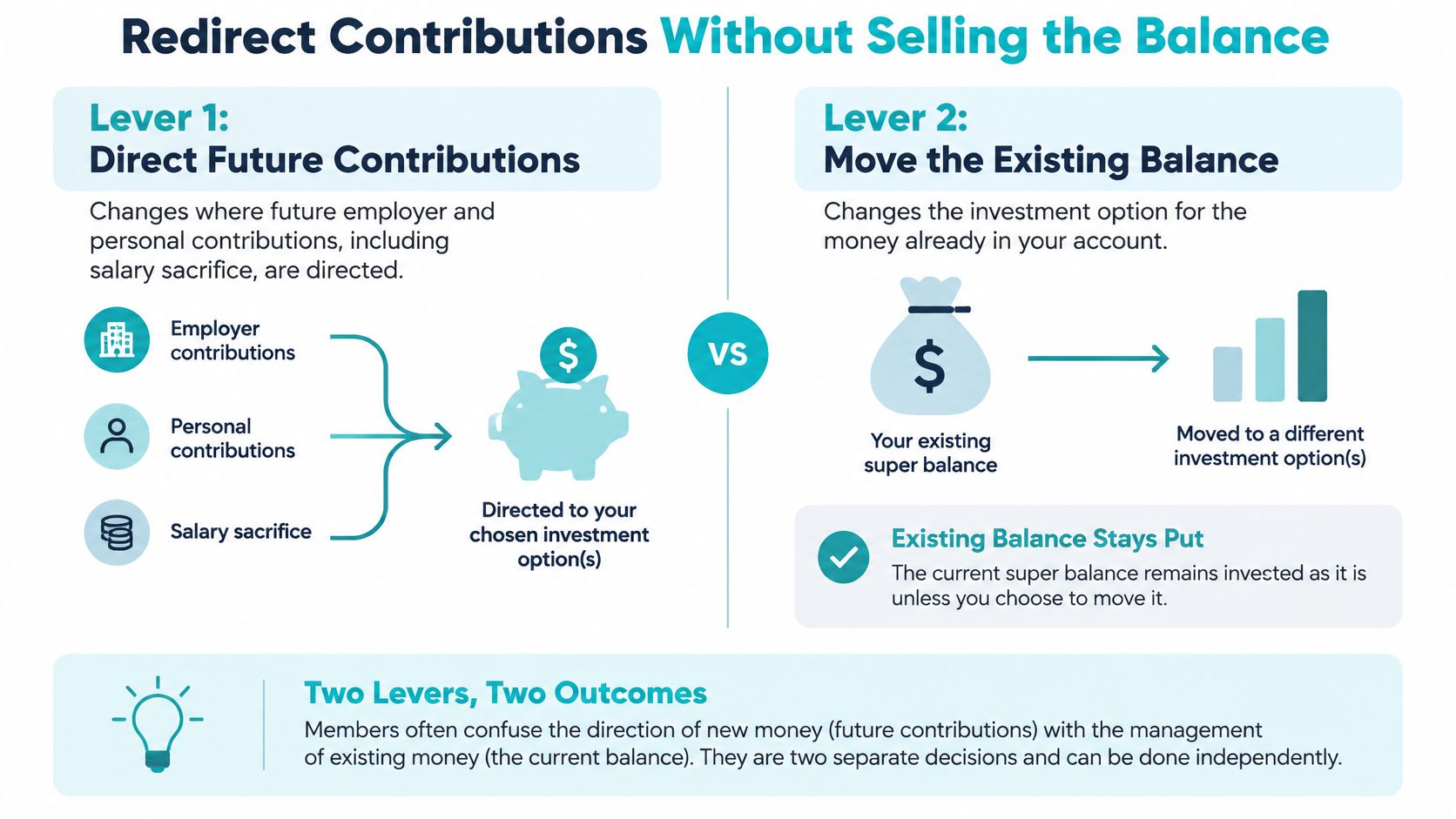
Lever one changes where future employer contributions, personal contributions and salary sacrifice are directed. The existing balance stays invested. Lever two sells units in the current option and buys the new one with money already in the account.
Which lever fits the problem
After a market fall, lever one is the tool. You stop adding to a mix you no longer want, without locking in the drop or sitting out a recovery. Lever two is the tool when the balance itself sits in the wrong option for its horizon, and it should follow the full review, not a weekend of market commentary. A partial move can also build a one- to three-year cash reserve inside the same fund while the longer pool stays diversified. Many funds let you split across cash, conservative, balanced, growth and high growth rather than forcing one strategy on the whole account.
ASIC has noted that some members remain in weak options because contributions are sent there automatically. Check the contribution setting even when the balance does not move. Short-term underperformance alone is not a reason to switch, and ASIC's 2025 warning highlights high-pressure sales, clickbait and promises of unrealistic returns aimed at retirement savings.
Say the current option still fits your horizon, but the last twelve months have rattled you. Leave the balance untouched and change only the contribution setting. That is often enough. Doing nothing is the right outcome when fees, asset mix, insurance and multi-year results still line up, and the worry is recent volatility.
A change of option inside the fund is not a rollover to a new fund. Moneysmart warns that money moved between funds may be out of the market briefly, that you can lose insurance attached to the old account, and that a full rollover will usually close that account. Give your employer the new fund details if the fund itself changes, so contributions don't keep landing in the account you just closed.
Fees, Tax and Costs That Change the Result
Leave the invested balance alone if the fee gap is small and the scare is last year's market. Selling what you already hold is a different decision from sending future contributions somewhere else. After a volatile year, staying put is often the better trade.
Moneysmart's superannuation calculator uses long-term return assumptions, stated as net of tax and investment fees: 3.7% a year for cash, 5.0% for conservative, 5.8% for moderate, 6.2% for balanced, 6.6% for growth and 7.0% for high growth. These are assumptions, not forecasts.
| Option | Assumed net return | Main trade-off |
|---|---|---|
| Cash | 3.7% a year | Inflation can erode purchasing power |
| Conservative | 5.0% a year | Still not loss-proof; longevity risk if held too long |
| Moderate | 5.8% a year | Less growth than balanced over long horizons |
| Balanced | 6.2% a year | Meaningful falls in bad share years |
| Growth | 6.6% a year | Larger short-term swings |
| High growth | 7.0% a year | Highest volatility and longest recovery risk |
That gap is the trade. More growth can build a larger balance over decades, and it can fall harder in a bad year. Do not score a growth option against cash on the headline rate. Adjust for risk, asset mix and what the money is for. If those still line up, keep the balance invested and change only where new contributions go, or change nothing.
Who actually feels a fee gap
A 0.50 percentage-point annual cost difference cuts the net compounding rate every year. It matters most for a professional with 30 years of contributions still ahead, and much less for a retiree already drawing capital. Model the current balance, employer contributions, salary growth and years left under low, central and high return assumptions, using each option's administration, investment and indirect costs. A small modelled gap against a noisy year is a reason to stay, not a reason to sell the balance.
Australian rules prohibit entry and exit fees, and for accounts below $6,000 the combined administration, investment and indirect-cost charges are capped at 3% of the balance, with excess amounts required to be refunded, as set out in the superannuation regulations the ATO publishes. That cap does not remove buy-sell spreads, advice fees or insurance premiums.
Check these before you treat "no exit fee" as free:
- Duplicated charges: two accounts can each carry administration and insurance you don't need twice.
- Cover terms: changing funds can alter exclusions, waiting periods and whether you must reapply.
- Tax inside the fund: it is already in the net return story, so don't add a second emotional penalty on top.
- Timing of a transfer: the balance can sit briefly out of the market, so the day you lodge is part of the cost. Redirecting contributions avoids that sale. Moving the existing balance does not.
Compare fees, insurance, performance and investment options together. Ranking on one measure, return or cost, will push the wrong switch.
How to Make the Switch Without Costly Mistakes
Once the review says redirect, partial or full switch, the order of the paperwork matters more than the speed of the click.
- Pull the current PDS for the target option and confirm its asset mix, fees, buy-sell spreads and any switching restrictions. If the document can't answer those four items, you don't have a target yet.
- Confirm insurance on the current account, and whether cover, exclusions or waiting periods change on the target. Don't discover a new waiting period after you have already moved.
- Decide the amount: all future contributions, part of the balance, or the full balance. Write the dollar split before you open the form.
- Lodge the change through the fund's member portal or form, and record the processing date the fund confirms. Until that date passes, the old option is still what you own.
- If the fund itself is changing, give the employer the new fund details the same week. Choosing a fund is a separate job from choosing an option inside it, which is why how to choose a super fund belongs in this step and not in the investment-option debate.
- After processing, check the first contribution and the balance allocation against the plan. A form that "went through" can still send salary sacrifice to the old mix.
- Book the next review date, yearly or after a major life change, rather than reacting to each quarterly statement.
The stop rule
Before you sign anything, stop if a sales call cannot show fees, asset mix, downside and insurance effects in writing. A verbal promise of a better return is not a PDS. Excessive switching and performance-chasing are how a sound option becomes an expensive habit.
Lodge the change only after the processing date and the contribution setting are both written down. Selling first and checking later is how people end up in the wrong option with the right story.
Accumulators and Retirees Need Different Switches
After a volatile year, doing nothing can be the right call. The right decision depends on whether you are building your balance or drawing from it, and whether you need to change future contributions, existing investments, or both.
For an accumulator with a long investment horizon, a market fall does not automatically justify moving to cash. Redirecting new contributions to another option is different from selling the balance already invested. Before doing either, check whether your current option still matches your goals and risk tolerance. Switching after a fall can lock in losses and leave long-term savings exposed to inflation.
For someone drawing a pension, the timing of withdrawals matters more. A fall near the start of retirement can mean selling investments at lower prices to fund payments. Consider how withdrawals will be funded and whether a defensive reserve suits your circumstances, while keeping the longer-term investment strategy diversified. A lifecycle option's automatic shift may not match when you expect to start drawing. Check its investment mix and timing against your retirement plans.
The sequence of returns risk in retirement explains why the order of investment returns and withdrawals can affect how long savings last.
Checks that stop a panic switch
Regulators have warned that people may be persuaded to switch super after being told their current fund is underperforming, sometimes into complex or high-risk investments. A poor recent return alone is not a reason to switch. Check the option's longer-term performance against its own benchmark, alongside its costs, investment mix and suitability for your circumstances.
Refuse the pitch if any of these fail:
- Fees in writing: Check administration, investment and indirect costs.
- Asset mix in writing: Check shares, property, fixed interest and cash, not just the option's name.
- Downside in writing: Ask how the option has performed in a bad year, not only its best year.
- Insurance impact in writing: Confirm what cover could end and whether you would need to reapply.
A calm review can end with no change. It can also lead to redirecting future contributions while leaving the existing balance invested. Treat those as separate decisions, and do not let a performance claim make them for you.
Book a Review Before You Switch
Match the next action to the verdict, not to how anxious the last statement felt.
If the table says stay, leave the option alone and diarise a review in 12 months or at the next life change. That is a decision, not a delay. If the verdict is redirect, partial or full, but insurance, tax or pension cash flow is still unclear, book a call before any change is lodged. Selling first and explaining later is the expensive order.
Wealth Collective, a Western Australia advice firm, starts with a free 10-minute intro call, then researches and models the options into a detailed plan that balances financial structure, money success and lifestyle. Guided Growth suits members still building a balance. The same process covers retirement cash flow for people close to drawing, through the wider advice we provide on superannuation and retirement planning. Bring your latest statement, the option names, the fees, the insurance held inside super, and the year you expect the first withdrawal. The call should confirm whether you stay, redirect contributions, or move part or all of the balance, and it should name the processing date before anything is sold.
General information on this page is not personal financial advice. Consider your own circumstances and speak with one of our qualified financial advisers before you act.
Wealth Collective helps Australians decide whether to stay in a super option, redirect future contributions, or move part of the balance, with the insurance, fees and retirement date checked before anything is sold. If you're weighing a switch after a volatile year, a free intro call is the cleanest way to get a documented stay, redirect or switch answer. Visit Wealth Collective and book that call before you lodge a change.