Business hours
Monday to Friday (8.30AM - 5PM)
Weekend (Closed)


$63,339 is the median superannuation balance across the 18,493,379 Australians who held a super account in 2023–24, according to ATO individuals taxation statistics. The average balance in the same dataset is $182,781. The distance between those two numbers is the most useful thing to understand before you touch an investment option: a small number of very large accounts pull the average up, so the average describes almost nobody and makes a poor target for your own plan.
Investing superannuation well isn't one decision about balanced versus growth. It's a chain of decisions that have to line up: the outcome you're funding, the fund and menu you use, the caps that govern new money, the fees that compound against you, the overlap between what you hold inside super and outside it, and the way the portfolio changes when contributions stop and withdrawals start. Break one link and the others can't compensate. A well-chosen option inside a fund with layered costs still disappoints, and a cheap option that duplicates your share portfolio isn't diversified.
Nothing here is personal financial advice. Weigh it against your own circumstances, goals and timeline before you act on any of it.
The Three-Stage Process to Invest Your Super
Changing a super investment option in response to a bad quarter, a headline, or a conversation at a barbecue is tempting. A repeatable process beats that, because it pushes every decision through the same gates no matter what markets are doing.
The process has three stages, and they run in order. Jumping straight to stage two is the standard mistake, because comparing products is easy and defining the outcome is hard.
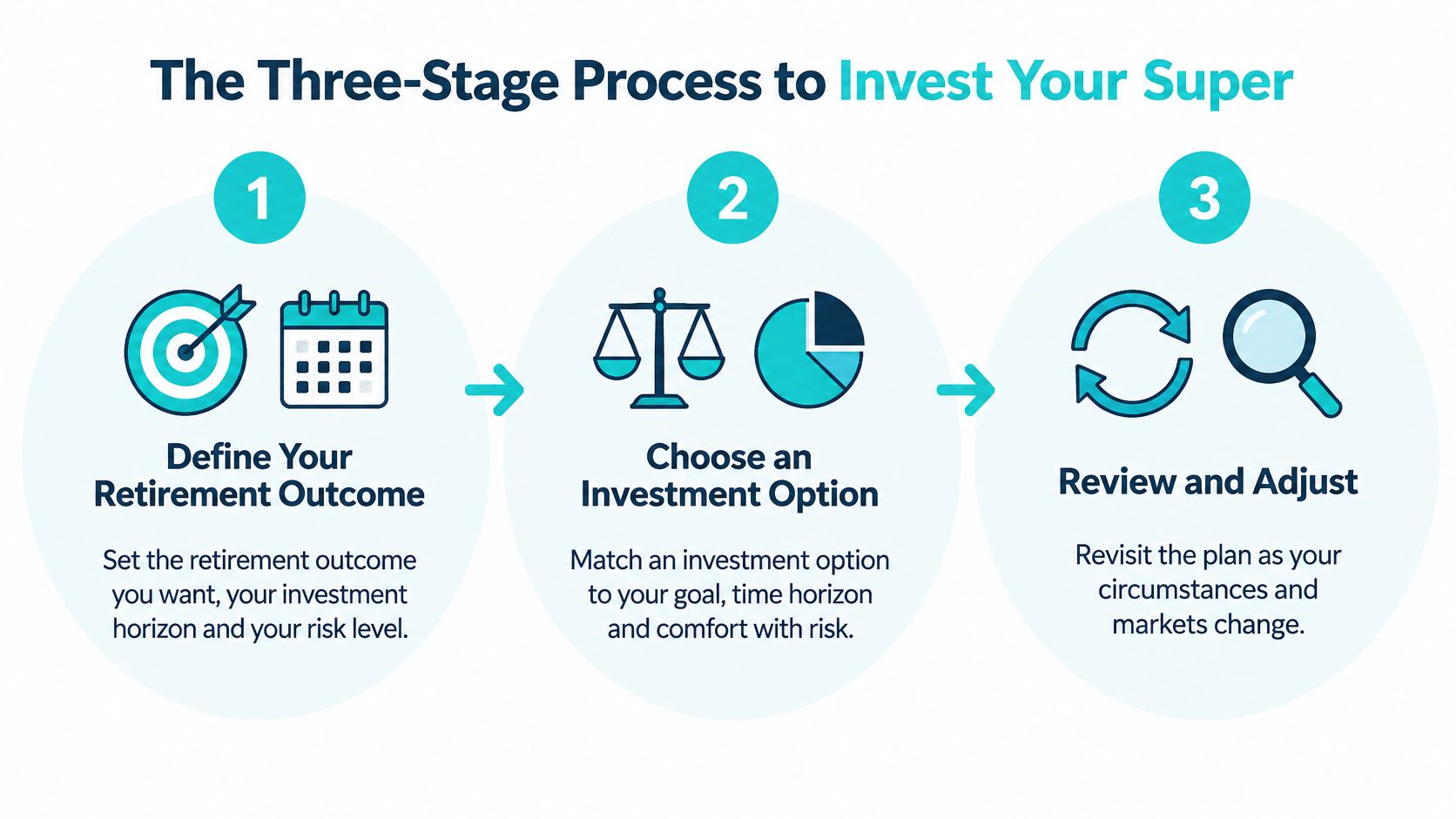
1. Define the retirement outcome, the horizon and the loss you can wear. Write down the income you want, the year you expect to start drawing on super, and the largest percentage fall in your balance you could sit through without selling. That third number is the one people get wrong. It isn't what you think you'd do in a downturn; it's what you've already done in one.
2. Compare like-for-like options, not last year's winner. The ASIC Moneysmart guide to choosing a super fund is blunt about this: a single recent year can mislead, and five years or more of net performance is the minimum worth examining. It also lists the costs that sit outside the investment fee, including administration, transaction, switching, advice and insurance costs. Two options carrying the same label can hold very different risk profiles, so match on risk level before you compare returns.
3. Review at least annually, and after any material change. A new job, a pay rise, a mortgage, a health diagnosis or a shift in retirement timing all change the answer. A calendar reminder is a better risk control than willpower.
Practical rule: choose the highest growth exposure you can hold through a drawdown, not the option with the best trailing return. ASIC's indicative diversified-option data shows what the higher target costs you in discomfort: a growth-heavy portfolio should expect several negative years across any 20-year stretch.
The pitfalls sit right next to the steps. Switching after a short-term fall locks in the loss. Comparing options with different risk profiles compares nothing. Ignoring insurance premiums inside the fund hides part of the price. Treating a good run as a guarantee is how people end up in the wrong option at the worst time. If you're close to retirement, the last check is a cash-flow stress test: several years of withdrawals against poor returns, run before you move materially toward defensive assets.
Write the three stages on one page, add your next review date to the calendar, and only then start looking at options.
Set Your Goal, Time Horizon and Risk Level
A national benchmark is the wrong yardstick. The ATO's 2023–24 income breakdown shows why: the median super balance for people earning $18,200 or less was $19,874, while the $120,001 to $180,000 band sat at $187,763 and those earning more than $180,000 held a median of $330,893. Those balances reflect different earnings, contribution histories and time in the system. Investment skill is only one part of the result, and often not the main part.
That makes the first stage personal. Your age, income, contribution history and the date you first need income set the answer far more than any published average. General information cannot substitute for personal financial advice, so treat the following as a way to structure the decision, not a recommendation.

What time horizon actually means
Horizon isn't the years until you retire. It's the years until you start drawing on a specific slice of the money.
Someone who finishes work at 65 but needs income from 66 has a one-year horizon for the first tranche and a 25-year horizon for the rest. That split matters because money needed soon cannot absorb a downturn in the same way as money that stays invested for decades. Treating the whole balance as one horizon pushes some people too defensive too early and others too aggressive too late.
A useful review question is: which dollars will I spend first? Map those dollars to a shorter horizon. Then map the remaining balance to the years it can keep working.
Turning drawdown tolerance into a risk level
Risk tolerance is behavioural, not mathematical. It's the fall you can watch on a statement without selling. ASIC's Moneysmart comparison assumptions show the trade-off: a higher growth allocation carries a higher return target before fees and more negative years across a 20-year period.
| Option | Growth assets (approx.) | Return target before fees | Negative years in 20 |
|---|---|---|---|
| Growth | About 85% | 5.0% | About 4 to 5 |
| Balanced | About 70% | 4.8% | About 2 to 3 |
Comparison assumptions for two diversified options; not forecasts.
The gap between 5.0% and 4.8% looks small on paper and feels larger in a bad year. That's the trade-off. The extra return is payment for tolerating extra volatility, and it is only earned by people who stay invested.
Two scenarios make it concrete. A 38-year-old with $90,000, 27 years before drawdown and no history of selling in a downturn can usually treat volatility as background noise. A growth-heavy option is a reasonable starting point for that time frame, subject to the actual fund menu and total costs.
A 62-year-old who needs income within five years faces a different problem. The same growth-heavy option exposes the money spent first to a fall there may be no time to recover. Part of that balance belongs in more defensive assets, with the rest still priced against a longer horizon.
Write the expected fall in dollars before you commit. On $90,000, even a 20% fall is $18,000 before contributions, fees or withdrawals. If that number would change your behaviour, the option is too aggressive for you, whatever its long-term target says.
The practical rule is simple: pick the highest growth exposure you can hold through a drawdown, not the one with the best recent return. Then set the review trigger before markets move. A change in retirement timing, income, debt or health changes the horizon, and the risk level should be checked again.
Check Fund Types, Menus and Overlap
A broad Australian index option plus three large bank shares can be the same bet twice. That is why this review starts with the menu rather than the label.
Superannuation isn't a single investment product. Large regulated funds, industry funds, retail funds and self-managed super funds (SMSFs) differ in their investment menus, cost structures, governance arrangements and the level of responsibility carried by the member.
| Fund type | Investment menu | Governance and costs | Your responsibility |
|---|---|---|---|
| Large regulated fund | Options set by the fund | Governance set by the fund; compare total costs | Choose an option and review it |
| Industry fund | Fund-managed options | Costs set by the fund; compare total fees | Choose an option and review it |
| Retail fund | Broad menu, often including platforms | Platform, product and advice costs can vary; compare after-fee returns | Choose an option and review it |
| Self-managed super fund | Any allowable asset you select | You carry costs and compliance | Strategy, compliance and records |
The first three rows place you inside someone else's menu. The fourth makes you responsible for building and defending the menu yourself.
Compare the menu, not the label
Five checks do most of the work before you consider moving anything.
1. Confirm who sets the menu. In a large fund you choose from a list. In an SMSF you write the list, and you also own the investment strategy, the compliance and the audit. That extra control is real, but so is the administrative load.
2. Match on risk level, not on name. A "balanced" option at one fund and a "balanced" option at another can hold different growth allocations. Compare the actual asset mix before treating two labels as equivalent.
3. Test whether cheap is diversified. A low-fee single-sector option can concentrate risk in one market or one asset type. Low cost plus narrow exposure is not a bargain.
4. List every holding across every option. Add up what you own through each option, plus any separately selected shares or direct assets, and look for duplication. An investor holding a broad Australian index option who then adds three large bank shares has increased their banking exposure without noticing.
5. Ask how fast you could sell. Direct property and private assets can take months to exit. If you might need the money, liquidity is part of the return.
The SMSF statistics make concentration concrete. In 2020–21, SMSFs held $28.682 billion in Australian residential property under limited-recourse borrowing arrangements, equal to 3.4% of total SMSF assets and held by 8.0% of SMSFs, with all limited-recourse borrowing investments totalling $52.859 billion, or 6.3% of SMSF assets, across 11.5% of funds, per the ATO's SMSF statistical overview.
Property inside an SMSF is a legitimate strategy. The trade-off is that one large asset can dominate the fund, take time to sell and leave the member carrying the strategy, compliance and record-keeping work at the same time.
Choice is not the same as a better outcome
The menu has become enormous. APRA's December 2025 industry data, summarised by Moneysmart's superannuation overview, counts 23.4 million member accounts across 892 products, including 17,103 choice single-sector options, 7,336 multi-sector options and 34,163 direct-asset options, with choice products holding $1.5 trillion, of which $424.2 billion sits in platform products.
More options create more ways to chase recent performance, duplicate exposure and lose track of the total cost. They do not improve the outcome by themselves.
More choice doesn't improve outcomes on its own. It raises the value of knowing exactly what you already own.
Overlap also hides inside screening. Two funds can both market themselves as ethical or values-based and hold different assets because one screen excludes a company another screen keeps. The methodology questions are the same in other screened investing: Akinda on Shariah screening methodology differences outlines how screening rules can be framed differently even inside one values-based approach. For a super option, read the exclusion rules and the actual holdings rather than relying on the label.
The decision rule is simple. Stay where total cost, menu and governance suit you, and move only after an after-fee, after-tax comparison. Then ask the question that ties it together: does super complement your wider portfolio, or duplicate it?
Check Contribution Caps Before You Invest
Before you decide where new money goes, confirm how much can go in and what counts toward each limit. The ATO's guidance on personal super contributions sets the general concessional cap at $30,000 for 2025–26, covering employer superannuation guarantee amounts, salary sacrifice and personal contributions claimed as an income tax deduction.
| Cap | 2025–26 limit | What counts | Key rule |
|---|---|---|---|
| Concessional | $30,000 | Employer SG, salary sacrifice, deductible personal contributions | Generally taxed at 15% in the fund; carry-forward may apply |
| Non-concessional | $120,000 | Generally after-tax personal contributions | Bring-forward up to $360,000 where eligible |
Three checks before you contribute more
1. Add employer contributions to your salary sacrifice before deciding the amount. Concessional contributions are generally taxed inside the fund at 15%, which is often below a marginal rate, but the cap still binds. An employee who salary-sacrifices a large amount can't assume the rest of the cap remains available, because compulsory employer contributions have already used part of the $30,000.
2. Confirm the financial year. The ATO's non-concessional contributions cap history shows the annual limit was $110,000 in 2023–24 and $120,000 in both 2024–25 and 2025–26. Eligible members may bring forward up to three years of the cap, potentially $360,000, though prior non-concessional contributions reduce what remains.
3. Check whether carry-forward applies. Unused concessional cap from up to five previous years may be available where your total super balance is below the applicable threshold. The ATO's explanation of concessional and non-concessional contributions sets out what is counted, which matters most when income changes, bonuses land or you hold more than one job.
Exceeding a cap creates extra tax, so verify the numbers against your own contribution record before you increase anything. If you're mapping out how much room you have across both caps, our guide to how much you can contribute to super each year walks through the calculation.
Work Out What You Really Pay in Fees
A headline return hides its cost. The most expensive comparison error in super is putting one fund's investment fee against another fund's total cost, because percentage fees, flat administration charges, buy and sell spreads and embedded transaction costs all land in different places on the statement.
| Cost | What it covers | What to compare |
|---|---|---|
| Administration | Running the account, charged flat or as a percentage | The dollar figure at your balance, not the percentage |
| Investment | The fee on the option you've chosen | Net return after this fee, over five years or more |
| Transaction | Buying and selling inside the fund, including costs embedded in the unit price | The amount disclosed in the fund's product disclosure statement |
| Switching | Moving between investment options | Whether you'll pay it, and how often you've switched |
| Advice | Fees for personal advice deducted from your account | The amount, and who receives it |
| Insurance | Premiums for death, disability or income cover | The cover you need against the premium you're paying |
A flat administration fee punishes small balances and barely registers on large ones. That's why the third column above pushes you toward dollars at your balance rather than percentages on a brochure.
The steps that produce a real number
1. Record everything on your latest statement. Balance, employer contributions, salary sacrifice or personal deductible contributions, and each fee line. Two years of statements is better than one, because fee changes show up as a step.
2. Compare the same option at the same risk level. List administration, investment, transaction, switching, advice and insurance costs for your current option and for the one you're considering. A growth option against a balanced option is not a comparison; it's a guess.
3. Model three scenarios. Use the net return assumptions published in ASIC's Moneysmart superannuation calculator, which draws on APRA-reported product statistics: 5.0% for conservative, 5.8% for moderate, 6.2% for balanced, 6.6% for growth and 7.0% for high-growth options. These are net of tax and investment fees and aren't promises of future performance. Hold contributions and inflation constant and run a lower, central and higher case.
4. Check the exit costs before consolidating. Consolidation can remove duplicated fixed fees, but it should never happen automatically. Check exit fees, insurance replacement terms, contribution arrangements, defined-benefit rights and tax consequences first.
Worked example: two accounts each charging a fixed administration fee of the same size. Merging removes one of those charges every year, but only if the insurance cover you keep still matches what you had. If the cheaper policy drops a benefit you'd claim on, the saving is illusory.
Before any of this, spend twenty minutes searching for money you've lost track of. An ATO and fund-record search turns up forgotten accounts from old jobs, and rolling one of those into your review costs nothing. A fee review on an account you'd forgotten about is the highest-return hour in the whole process.
One more trade-off worth stating plainly. The cheapest fund is not automatically the right fund, because a lower fee attached to a weaker net return still leaves you behind. Compare net outcomes, not fee labels. If you'd rather start with the comparison itself, our breakdown of super fund fees compared side by side sets out what to line up.
Plan the Shift From Saving to Retirement Income
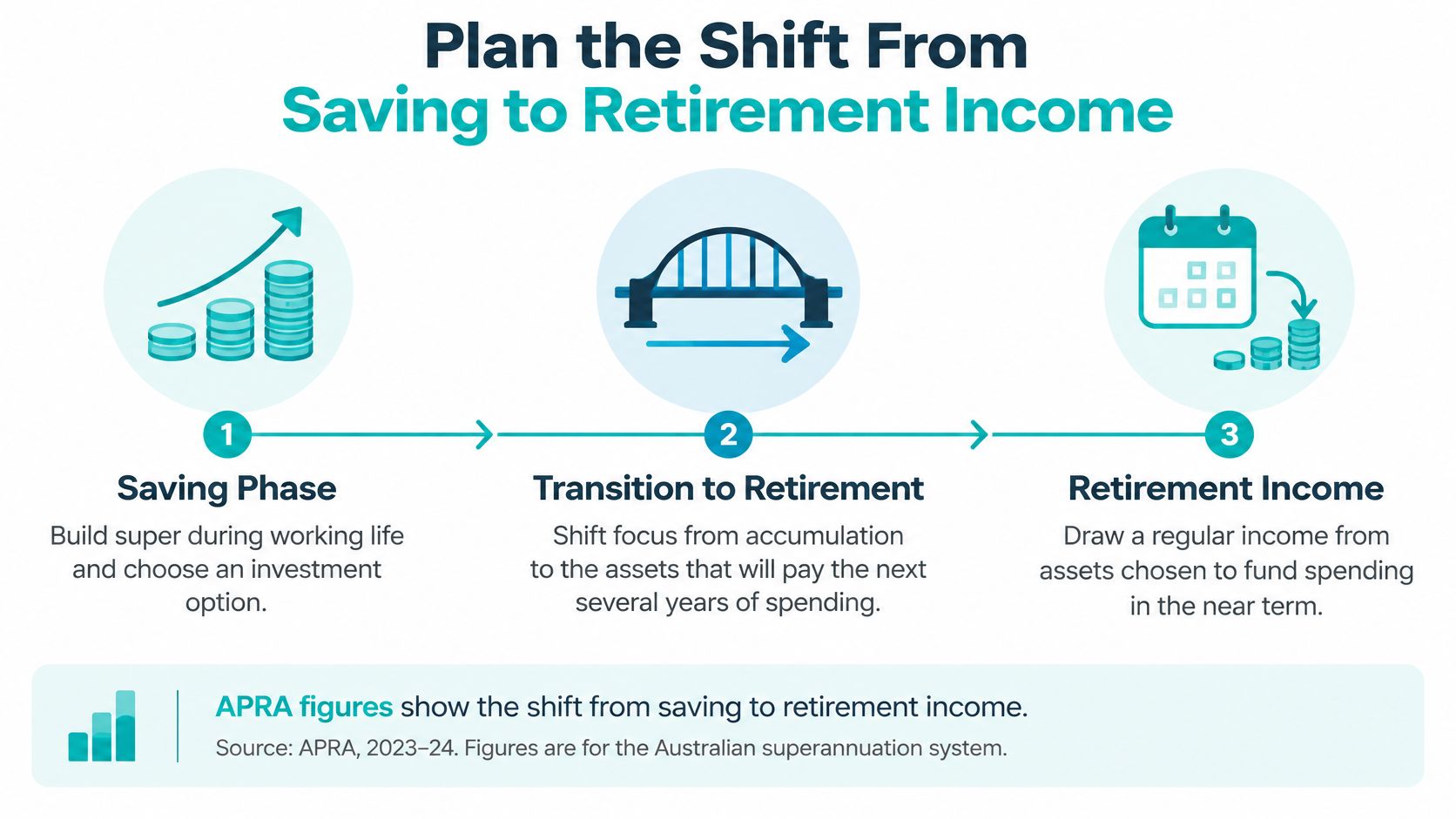
Most guidance stops at choosing an option. The harder question arrives when contributions stop: which assets pay for the next several years of spending, and which stay invested for later life?
Superannuation benefit payments across Australia are large and growing, and pension payments are taking a rising share of them, as reflected in the ATO's guidance on super and planning for retirement. More people are converting balances into income, and the sequencing decision is where that conversion succeeds or fails.
Fund each year of spending before you fund the future
A pre-retiree moves almost everything into cash two years before retiring because the market looks expensive. Twenty-five years later the defensive return hasn't kept pace with withdrawals. The plan survives the first bad year and loses to inflation over the next two decades. That is the failure mode this stage exists to prevent, and the fix is sequencing, not prediction.
Work out spending for the next three to five years. Include the regular income you need plus the lumpy costs you can see coming, such as a car replacement or a roof. This number drives everything below it, so err on the side of counting more rather than less.
Hold enough in defensive assets to cover those years. Cash and fixed interest are there to stop a downturn forcing you to sell growth assets at the bottom. A cash bucket sized to near-term spending solves the fear behind going fully defensive without sacrificing the growth that has to fund later life.
Keep the remainder invested with a growth allocation you can tolerate. Money you won't touch for 15 years shouldn't sit in cash just because you've retired. The risk level you set earlier in this review still applies after the retirement date.
Choose the structure deliberately. A lump sum and an account-based pension do different jobs. The ATO's income stream rules note that once an income stream starts, further contributions or rollovers generally can't be added to that pension account, so contributions and rollovers need to be finished first. A transition-to-retirement income stream generally limits payments to 10% of the account balance unless you've met a condition of release without cashing restrictions. The transfer balance cap also applies to what moves across.
Stress test the whole thing. Run several years of withdrawals against poor returns before you commit, not after. A plan that only works in average markets isn't a plan.
Age Pension eligibility is the other variable worth checking properly, because how income is drawn and how assets are structured can affect it. That is a conversation to have with an adviser rather than a guess. If you're working through the pension structure itself, our notes on the account-based pension cover the mechanics.
Confirm Your Plan and Book Your Intro Call
The decision in front of you is narrower than it feels: keep the current option, change it, or consolidate accounts. Everything above reduces to preparation for that choice.
Gather these before you decide anything:
- Your latest statement, plus the one before it, so fee changes are visible
- Fee and insurance details for your current option, including premium amounts
- A list of any duplicate or forgotten accounts, and any lost super you've located
- Your three answers, being the retirement outcome you want, your time horizon and the largest fall you could hold through
- Your fund type, and any cost line on the statement you can't explain
That list is what turns a general review into a decision. Anything you can't explain is a question worth asking before you switch, because a cost you don't understand is a cost you can't compare.
When you're ready, book a free 10-minute intro call with Wealth Collective and we'll review where you sit and tell you what to bring to the next step. Once you're 100% comfortable with the likely outcomes, we take care of the paperwork, any products required and end-to-end implementation, so you're not switching investment options alone.
"James at the Wealth Collective went above and beyond to explain our various options and helped me to decide on a superannuation investment strategy and set up the best insurance products for our situation.", Ben, Google
This is general information, not personal financial advice. Any decision should reflect your own circumstances, goals and timeline.
Wealth Collective works with pre-retirees, retirees and families across Perth, Dunsborough and the South West on exactly this sequence, from setting the goal and risk level through to the caps, the fee comparison and the move into retirement income. If you'd like a second set of eyes on the option you're holding and the costs behind it, visit Wealth Collective and book a free 10-minute intro call.