Business hours
Monday to Friday (8.30AM - 5PM)
Weekend (Closed)


If you can access your super, does that mean withdrawing it is the right retirement decision?
Usually, the harder question isn't how to submit the form. It's how much to withdraw, what tax you'll pay and whether moving the money changes your Centrelink position. If you're searching for how to withdraw my superannuation, start with eligibility, then decide what job the money needs to do before you ask your fund to pay it.
Check When You Can Access Your Super
You can withdraw preserved super only after meeting a legal condition of release. Your date of birth is the quickest starting point, followed by your employment status.
The Australian Taxation Office's super withdrawal guidance sets preservation age according to birth date, ranging from 55 to 60, and generally permits unrestricted access at 65, even if you're still working.
Preservation age and access routes by birth date
The table shows the ordinary retirement-related routes, not exceptional early-release conditions or benefits already classified as unrestricted.
| Date of birth | Preservation age | After retiring | While still working |
|---|---|---|---|
| Before 1 July 1960 | 55 | Yes, once preservation age is reached | Only a transition-to-retirement income stream, or wait until 65 |
| 1 July 1960 to 30 June 1961 | 56 | Yes, once preservation age is reached | Only a transition-to-retirement income stream, or wait until 65 |
| 1 July 1961 to 30 June 1962 | 57 | Yes, once preservation age is reached | Only a transition-to-retirement income stream, or wait until 65 |
| 1 July 1962 to 30 June 1963 | 58 | Yes, once preservation age is reached | Only a transition-to-retirement income stream, or wait until 65 |
| 1 July 1963 to 30 June 1964 | 59 | Yes, once preservation age is reached | Only a transition-to-retirement income stream, or wait until 65 |
| 1 July 1964 onward | 60 | Yes, once preservation age is reached | Only a transition-to-retirement income stream, or wait until 65 |
| Any birth date, age 65 or older | Not applicable | Yes, no work test | Yes, no work test |
Reaching preservation age isn't, by itself, permission to take a full lump sum. Retirement must satisfy the fund's legal requirements, rather than being your preferred description of reduced working hours.
Say a Perth resident is still working in the same job and hasn't met another release condition. A transition-to-retirement income stream may provide access to regular payments, but it generally won't give access to their preserved balance as a lump sum. Someone who has previously satisfied a release condition may have a different position, so don't assume that currently working automatically rules out access.
Preservation age and Age Pension age are separate concepts. Confirm your birth date, employment history and release route before preparing the withdrawal paperwork.
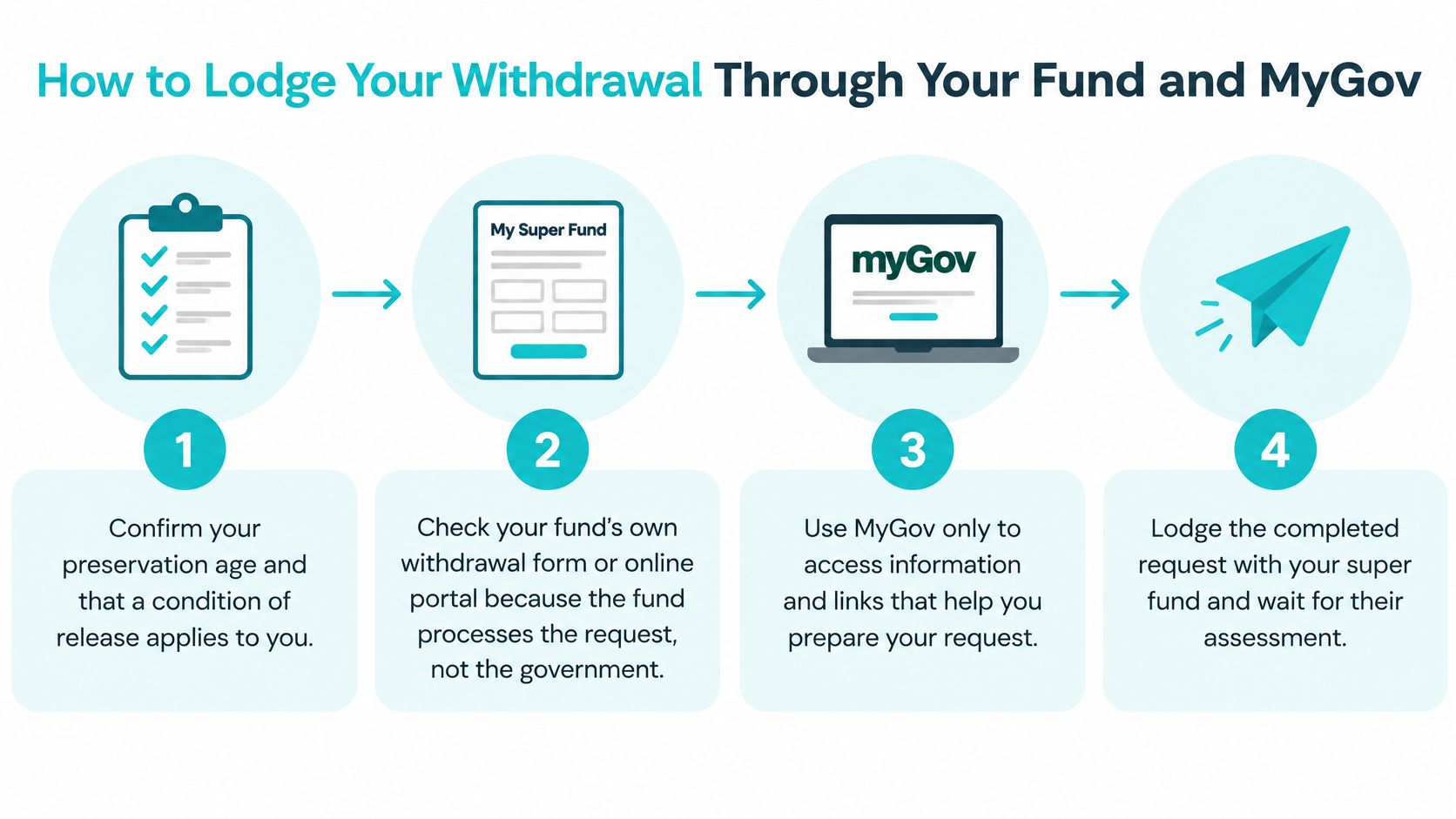
How to Lodge Your Withdrawal Through Your Fund and MyGov
For an ordinary retirement withdrawal, your super fund processes the request, not myGov. MyGov helps you find account information through linked ATO online services; it isn't a universal super withdrawal application portal.
Services Australia's superannuation guidance explains that access requires an applicable release condition. Your fund then assesses the request against its evidence requirements.
Prepare the request in the right order
Confirm your release condition. Match your circumstances to the applicable access route before choosing a payment date. Ask the fund what declaration or employment evidence it needs rather than relying on a general online eligibility checklist.
Check the classifications within each account. Ask whether your benefits are preserved, restricted non-preserved or unrestricted non-preserved. Also request the tax-free and taxable components, including whether the taxable component contains taxed or untaxed elements.
Review your accounts through myGov. Sign in, link ATO online services if necessary, and check the super accounts recorded against your details. Compare those records with your fund statements so an old or inactive account isn't overlooked.
Get the fund's current application requirements. Request its benefit-payment form or locate its withdrawal portal, and ask for the evidence list in writing. Confirm whether you're applying for a lump sum, opening an income stream or arranging both, because these may require different forms.
Gather identification and supporting documents. Prepare photo identification, your tax file number, bank account details and any retirement declaration or employment-separation evidence requested. Check whether identification must be certified and whether the receiving bank account must be held in your name.
Lodge the completed request with the fund. Use its secure portal or postal process, keep a copy and record the submission date. Decide on the payment structure only after checking its tax and Centrelink consequences, not while rushing through the form.
Track assessment and payment. Ask when the fund expects to assess a complete application and how it will notify you of missing information. Check the payment reaches your nominated account and retain the benefit statement showing any tax withheld.
Avoid the document that holds everything up
Retirement or employment-separation evidence often causes delays because applicants assume their birthday alone establishes eligibility. A bank statement proves where the payment should go; it doesn't prove the fund can legally release it.
Practical rule: Follow your fund's current evidence list where it differs from a general checklist, and send sensitive documents only through channels you've verified independently.
Don't consolidate accounts just to make withdrawal paperwork easier without checking insurance, fees and benefit features first. Closing an account can affect more than the balance you receive.
Choose Between a Lump Sum and an Income Stream
Lump-sum withdrawals are common: the Australian Bureau of Statistics reported that 922,000 Australians received a lump-sum super payment in 2024–25, up from 881,000 in 2022–23. Common doesn't mean suitable, and those figures don't establish that lump sums are the most common payment structure overall.
The useful distinction is between money you need to spend and money you need to support future income. You don't have to make the same choice for your entire balance.
Withdrawal options compared
| Option | Best suited to | Flexibility |
|---|---|---|
| Full lump sum | Clearing a mortgage or a one-off major cost | Withdrawn money leaves super; putting it back requires contribution eligibility |
| Partial lump sum | Covering a specific bill while keeping the rest invested | Remaining balance stays invested in super |
| Account-based pension | Regular income throughout retirement | Minimum annual payments apply; balance stays invested |
| Transition-to-retirement income stream | Reducing work hours after preservation age | Generally income stream only, with no ordinary lump-sum access to preserved benefits |
An account-based pension provides a payment structure, not a guarantee that your savings will last. Investment returns, spending and the timing of withdrawals still matter.
A partial withdrawal can be more deliberate than taking everything into a bank account. It separates an immediate spending need from the capital you want working towards later retirement expenses.
Match the withdrawal to its purpose
Say a Dunsborough couple has $220,000 remaining on their home loan. In this hypothetical scenario, they might use a partial lump sum to clear the debt and retain the remaining balance in an account-based pension.
That choice needs testing against their mortgage rate, available cash reserve and required retirement income. Paying off the loan may lower ongoing expenses, but it also leaves less accessible investment capital for repairs, health costs or an unexpected family commitment.
Withdraw for a defined purpose, not simply because the balance has become available.
A full lump sum removes that money from super's concessional environment. Returning it later isn't automatic: contribution eligibility and limits may prevent you from rebuilding the same position. Keep the decision focused on lasting cash needs, control over drawdowns and the effect on other entitlements.
How Tax Applies at Each Age and Payment Type
How much super reaches your bank account depends on your age, the payment type and whether the benefit includes a taxed or untaxed element. For a taxed-element lump sum paid below preservation age, the general maximum tax rate is 20%, excluding the Medicare levy, under the ATO's payments-from-super guidance. Between preservation age and 60, amounts above the low-rate cap may be taxed at up to 15%, excluding the levy. From 60, taxed-element member benefits are generally tax-free.
Those rates do not apply identically to every payment. Check the component and payment structure, especially if the benefit includes an untaxed element or is paid under severe financial hardship.
Tax on super withdrawals by age and component
The standard lump-sum rates below exclude the Medicare levy. Severe-hardship withholding follows a separate ATO rule, so don't apply the standard below-preservation-age rate to that situation without checking the applicable treatment.
| Situation | Component | General tax treatment |
|---|---|---|
| Below preservation age, taxed lump sum | Taxed element | Generally up to 20%, excluding Medicare levy |
| Below 60, severe financial hardship | Taxed element | Withholding follows the separate ATO rule |
| Preservation age to 59, up to the low-rate cap | Taxed element | Generally tax-free |
| Preservation age to 59, above the low-rate cap | Taxed element | Up to 15%, excluding Medicare levy |
| Age 60 or older | Taxed element | Generally tax-free |
| Age 60 or older | Untaxed element | May be taxed; check the payment structure |
| Any age, withdrawal outside a condition of release | Any | Can be taxed as ordinary income at your marginal rate |
The ATO's early-access guidance sets out the separate rules for severe-financial-hardship withdrawals. An untaxed element may still be taxable after 60, so age alone does not settle the amount you'll receive.
Compare the amount you'll actually receive
For a hypothetical $200,000 taxed-element lump sum paid below preservation age, applying the general maximum rate of 20% gives $40,000 tax before the Medicare levy. A payment made after the tax-free age threshold would generally produce a different result. The choice to take a lump sum now rather than later can therefore affect the amount available for retirement spending.
A hypothetical person aged 56 with a preservation age of 60 falls below that threshold. Birth date determines the applicable age band, so don't assume the same calculation applies to everyone who withdrew at that age.
Income streams do not necessarily follow the lump-sum table. Ask your fund for an estimated net payment, then use this guide to tax on superannuation to frame questions about the payment's components and structure. Compare the after-tax amount with the income you need and the balance you want to retain for later retirement expenses.
An unauthorised withdrawal outside a condition of release may be taxed as ordinary income at your marginal rate. The ATO's conditions-of-release guidance explains the release conditions. Confirm eligibility with your fund before lodging a request.
How Centrelink Sees a Withdrawal
Withdrawing super isn't a neutral move, but neither does it automatically reduce your Age Pension. Centrelink assesses what you own and the income attributed to it, not just the amount written on your withdrawal form.
Services Australia's superannuation guidance makes super's treatment part of the broader assessment of your financial position. Age, partner status, homeownership and other assets all matter.
Compare where the money ends up
Full lump sum held as cash. Money transferred to a bank account generally remains an assessable financial asset. Deeming can apply for the income test, so withdrawing it doesn't make it disappear from Centrelink's assessment and may reduce or delay an entitlement.
Lump sum spent on your principal home. A genuine renovation can convert a financial asset into value in a home that is generally exempt from the assets test. That may change the assessment, but you've also spent liquid savings, so a renovation shouldn't be justified by pension treatment alone.
Partial withdrawal with an account-based pension. This can organise spending and income, but it doesn't automatically shelter the pension balance. Account-based pensions are generally assessable assets and commonly subject to deeming for the income test; any exemption for super left in accumulation needs checking against the owner's circumstances.
Assess the household, not just the account
Age Pension eligibility involves both an assets test and an income test. A strategy that changes one assessment may not improve the payment if the other test remains the limiting factor.
Use a Centrelink asset test calculator as a starting point, not a substitute for checking your actual entitlement. Include your partner's position, other investments, debts and intended spending rather than entering only your super balance.
Would this withdrawal improve my cash flow but reduce or delay another entitlement?
Ask Services Australia to confirm the likely treatment before lodging. Keep records of how the money is held or spent, and report relevant changes rather than assuming the fund does that for you.
Early Release Options and Scam Warning Signs
Could an early super withdrawal solve the immediate problem without weakening your retirement income? Early release is limited to specific grounds, not a general way to manage debt. The ATO's withdrawal guidance covers pathways including financial hardship, compassionate grounds, incapacity, terminal illness, temporary-resident departure and qualifying low-balance cases.

Establish the lawful pathway
Severe financial hardship. If you're below preservation age, the general test includes receiving eligible income support continuously for 26 weeks and being unable to meet reasonable and immediate family living expenses. For applicants who have reached preservation age, the alternative test generally requires 39 weeks of cumulative eligible income support since reaching preservation age, and no gainful employment when applying. Check Services Australia's early-release application guidance for current requirements, then apply through your fund.
Compassionate grounds. The ATO assesses applications for qualifying expenses and requires supporting evidence. This is a separate process from a severe financial hardship application.
Terminal medical condition. Two registered medical practitioners, including a relevant specialist, must certify that the illness or injury is likely to result in death within the required certification period. Confirm current evidence requirements before arranging reports.
Incapacity and other restricted cases. Temporary or permanent incapacity, temporary-resident departure and qualifying low balances each have specific conditions. Unemployment alone does not qualify you.
Recognise pressure before signing
Be cautious of unsolicited calls or advertisements, upfront fees, claims of legal loopholes, and pressure to move quickly into a self-managed arrangement. Do not share myGov or fund login details with anyone offering to arrange a release.
Confirm the pathway with your fund and the relevant government agency using contact details you find independently. Get the evidence requirements in writing before signing an authority. The early super withdrawal guide can help you organise questions about eligibility and process.
Eligibility is only one part of the decision. Consider how the withdrawal's tax treatment, the amount taken and any Centrelink assessment may affect your retirement income, alongside whether the money will address the underlying problem or only defer it.
Book a Call Before You Lodge Your Request
Lodge only when you understand your release condition, net payment, Centrelink position and intended use of the money. A completed form isn't a retirement-income plan.
You can obtain procedural information from your fund and entitlement guidance from Services Australia. Personal financial advice adds something different: a comparison of the choices against your household's spending, debts, investment needs and retirement goals.
Bring the inputs that change the recommendation
Prepare the following before an introductory conversation:
- Your personal position. Date of birth, relationship status, employment arrangements and expected retirement date.
- Your super records. A recent statement for every account, plus available component information and details of any insurance.
- Your household finances. Mortgage and other debts, savings, investments, property and current benefit payments.
- Your proposed withdrawal. The amount you're considering, its purpose and when you need it.
- Your spending expectations. Essential living costs, planned larger purchases and the cash reserve you want available.
These details help distinguish a manageable spending decision from a withdrawal that could leave a lasting income shortfall. Bring your fund's forms too, if you've already obtained them, so questions about declarations and sequencing can be identified.
Turn the withdrawal into a coordinated plan
Wealth Collective offers Retirement Roadmap advice as an option for comparing a lump sum, an account-based pension and leaving money invested, alongside tax components, Centrelink treatment and household cash flow. The introductory conversation establishes your priorities and the scope of advice needed; personalised modelling and recommendations belong in the subsequent advice process.
A useful plan should show how you'll fund living expenses over the next five years, manage larger bills and respond if investment returns disappoint. It should also identify what must happen before lodging, rather than leaving you to coordinate separate answers from different organisations.
For business owners, retirement timing may also depend on a sale, succession arrangement or ongoing business income. The resource on planning ahead with Exit Pathways can help frame those business-exit questions alongside personal retirement planning.
The immediate objective isn't to withdraw as quickly as possible. It's to choose a payment structure you can explain, afford and live with before committing your retirement capital.
Wealth Collective offers retirement planning and superannuation advice that connects withdrawal choices with tax, Centrelink and ongoing income needs. Visit Wealth Collective to book an introductory call before you contact your fund to lodge a withdrawal request.