Business hours
Monday to Friday (8.30AM - 5PM)
Weekend (Closed)


You're 62, retirement is close, and a routine review of your superannuation statement raises an uncomfortable question. The life cover you assumed would protect your partner may reduce or disappear as you approach a fund's age limit. At the same time, buying replacement cover now could be far more expensive than it was earlier in your working life.
That leaves the question many Australians over 60 need answered: should you still have life insurance, and if so, what job should it perform? Availability matters, but it's only the first test. The sensible decision depends on debt, dependants, superannuation, estate plans, health, and whether the premium remains proportionate to the benefit.
Why Life Insurance Matters After 60
A 62-year-old couple in Perth might sit down to review their retirement position and discover that their super fund's default life cover is scheduled to reduce or cancel around the fund's age threshold. They still have a mortgage, one partner expects to live on a smaller retirement income, and their estate plan needs to treat children from previous relationships fairly.
Their situation isn't unusual. Around 15.0 million Australians held life insurance in 2022, and 85,000 Australians or their loved ones received $11.2 billion in claims, according to the Council of Australian Life Insurers' 2022 industry data. Claims included death cover, total and permanent disability, income protection, and other forms of protection. Those figures show that insurance remains a practical part of household finances, not just a product for young families.

The financial reasons can remain real
Life insurance after 60 can still serve a clear purpose:
- Mortgage protection: A death benefit can help prevent a surviving partner from selling the family home under pressure.
- Retirement income support: If one pension, salary, or superannuation balance disappears, the survivor may need capital to maintain their lifestyle.
- Blended-family planning: Insurance can provide cash to one beneficiary while other assets pass to a spouse or another child.
- Legacy funding: A policy can create a defined inheritance without forcing beneficiaries to sell property or divide an illiquid asset.
- Business or guarantee obligations: Some older Australians still have personal guarantees or business-related debts that need to be considered.
The emotional issue is straightforward. Many individuals don't want their partner to inherit a repayment problem, reduced housing choices, or a forced change in lifestyle during bereavement. But insurance should support a defined objective, not become an automatic expense.
The window also narrows quickly. Historical survey evidence found that only 53% of Australians aged 55–60 were likely to hold life or death cover, while 37% were likely to hold TPD cover, according to NobleOak's survey of older Australians. The point isn't that everyone over 60 needs a new policy. It's that many people reach this stage with gaps, and waiting can remove choices.
Practical rule: Review existing cover before assuming you need replacement cover. Once a policy lapses, you may never regain the same terms.
Types of Life Insurance Available to Over 60s
Start with the purpose, then identify the product. Life insurance for over 60s isn't one category, and choosing the wrong structure can leave you paying for benefits that don't match your actual need. A useful overview of the main categories is available in this guide to life insurance types.
Funeral and final-expense policies
Funeral insurance is generally the simplest option. Some policies offer guaranteed acceptance and ask no medical questions, but they usually provide a capped benefit and may include a waiting period for non-accidental death. The premium can be stepped or structured in a way that becomes expensive over time. Check the total premiums carefully, because they can eventually exceed the payout.
Accidental death cover is another limited option. It can be cheaper than medically underwritten life cover, but it pays only when death results from a covered accident. It isn't a substitute for complete death cover where illness is the primary concern.
Cover through superannuation
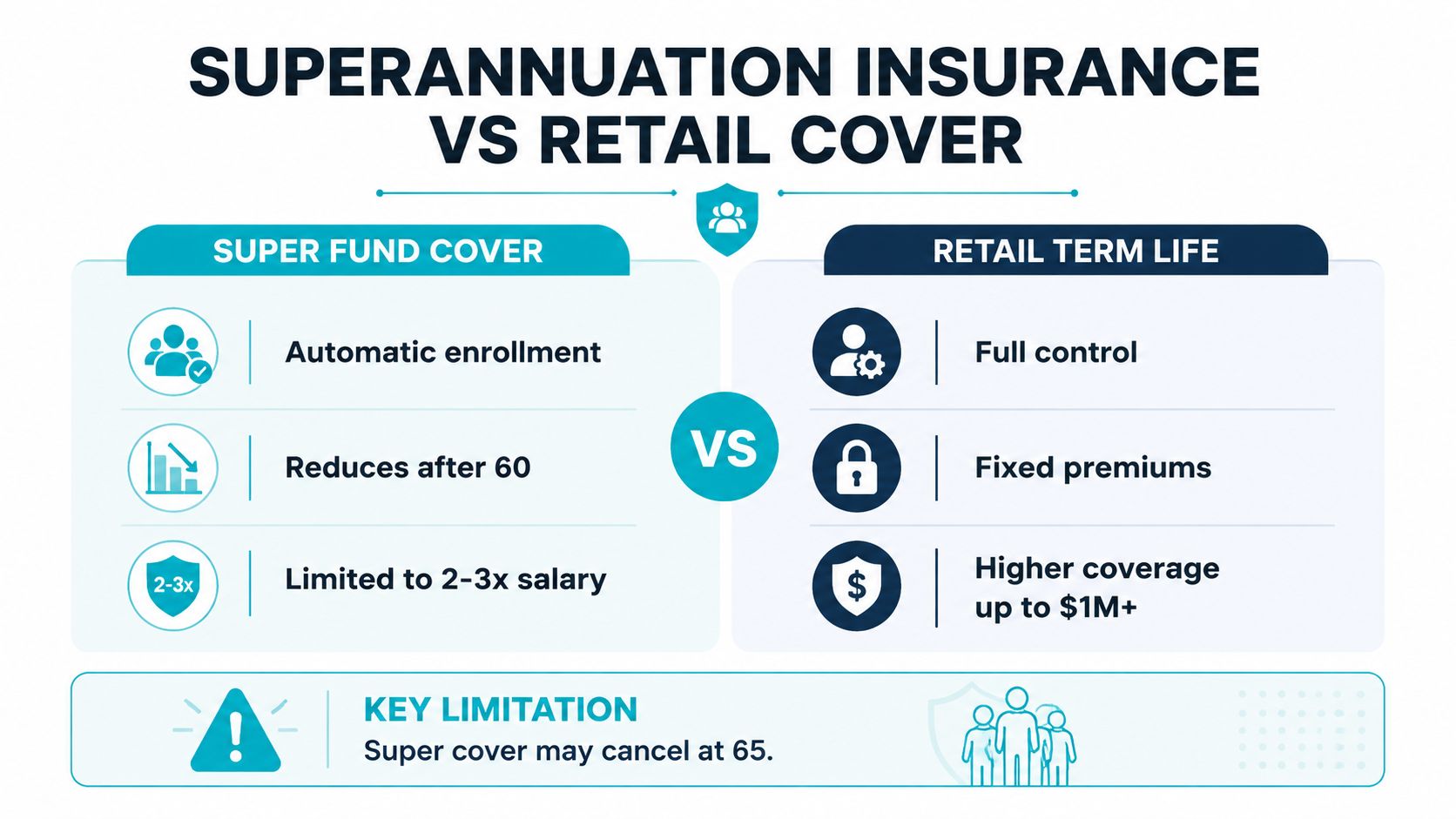
Superannuation funds commonly provide default life and TPD insurance, subject to fund rules, eligibility, and age-based reductions. The convenience is useful, but the cover may not continue at the level you expect as you approach retirement. It may also be cancelled if the account becomes inactive or if you consolidate funds without checking the insurance consequences.
Retail term life
Retail term life insurance provides a death benefit under an individually arranged policy. It generally involves detailed medical underwriting, which can produce exclusions, premium loadings, or a decline. Some policies can continue to advanced ages, but new entry becomes harder as you move through your 60s and into your 70s.
Permanent and guaranteed acceptance products
Whole-of-life or other permanent arrangements are niche options in Australia and usually involve higher premiums and more complex structures. Guaranteed acceptance products can suit someone who can't secure medically underwritten cover, but their benefit limits, waiting periods, and premium patterns need close examination.
| Insurance Type | Max Entry Age | Underwriting | Typical Max Cover | Premium Type |
|---|---|---|---|---|
| Funeral insurance | Varies by insurer, often higher than retail term | Usually guaranteed acceptance or limited questions | Capped benefit | Often stepped or age-related |
| Superannuation term cover | Set by fund rules | Fund-specific assessment | Set by fund and member rules | Usually stepped |
| Retail term life | Market availability narrows materially after 60 | Full medical underwriting | Depends on insurer and assessment | Stepped or, less commonly, level |
| Whole-of-life or permanent cover | Product-specific and usually more restricted | Medical underwriting may apply | Product-specific | Higher, structure-dependent |
| Accidental death | Product-specific | Usually limited medical assessment | Capped or restricted | Often stepped |
| Guaranteed acceptance | Can extend further into older ages | No medical underwriting | Usually limited | Often stepped |
The right category depends on whether you're protecting a temporary debt, funding a permanent legacy, or ensuring your family can meet final expenses.
Eligibility Rules and Underwriting Realities
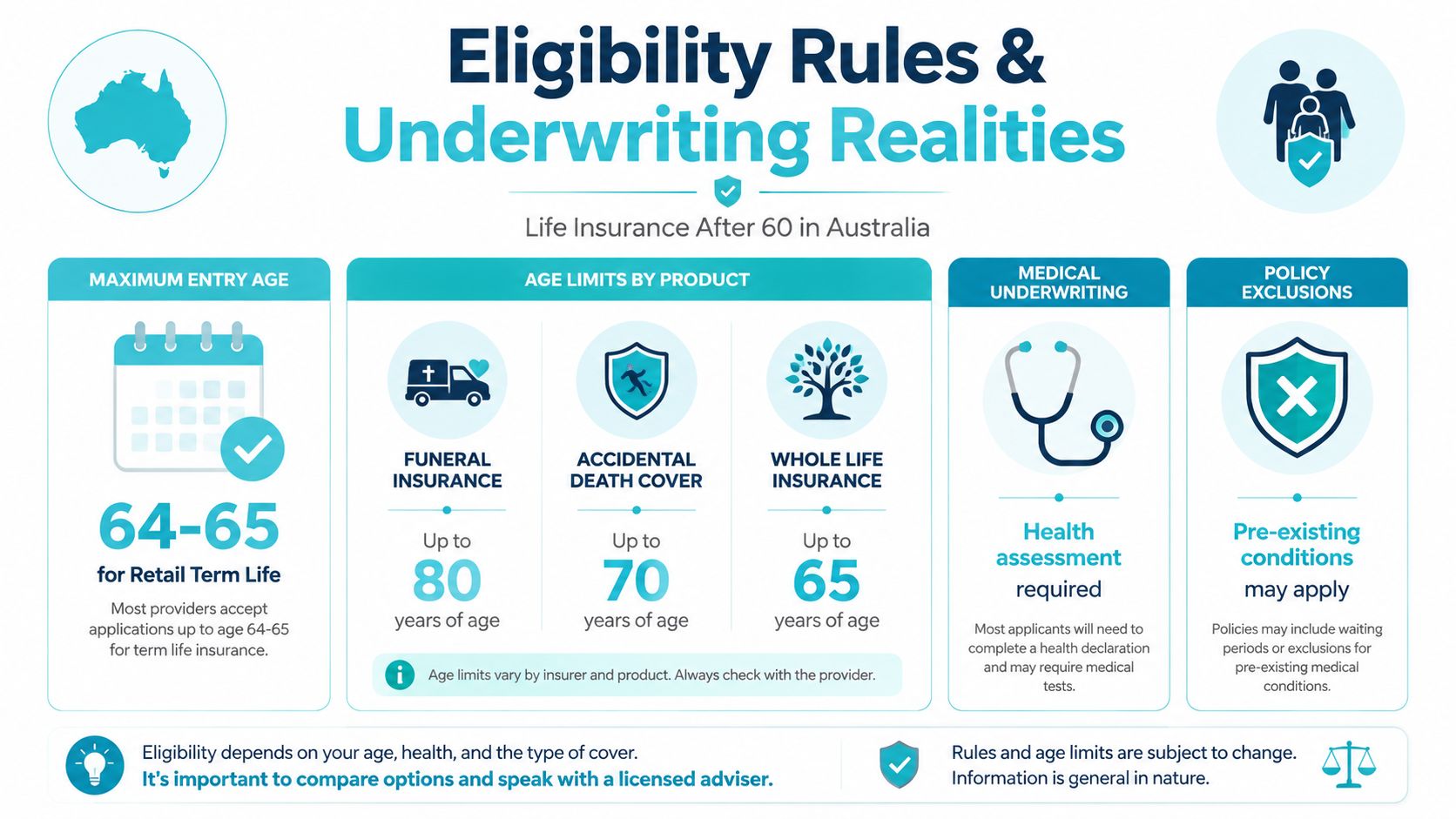
The main constraint after 60 isn't always affordability. It's availability. A market scan found that the average maximum entry age on one Australian policy database was 67, with the highest listed age at 74, according to Canstar's guide to life insurance for seniors. Those figures describe entry, not necessarily the age to which an existing policy can continue.
That distinction matters. You might be able to keep an existing policy beyond the age at which a new applicant could enter, but replacing it later may be impossible or restricted to a smaller benefit. A lapse caused by affordability, account consolidation, or an overlooked renewal notice can therefore have permanent consequences.
What underwriting examines
A retail application may consider your medical history, medications, recent investigations, smoking status, height and weight, occupation, and the type and amount of cover requested. Cardiovascular conditions, diabetes, and high BMI can lead to additional pricing or exclusions. The insurer's decision depends on the full profile, not one isolated diagnosis.
Stepped premiums usually rise as you age. Health-related loadings can then increase the cost further. A policy that appears manageable at application may become difficult to maintain later, particularly if your retirement income is fixed.
The funnel gets narrower
The market scan's average entry age of 67 and maximum of 74 are useful warnings, but they shouldn't be treated as a promise of eligibility. Insurers differ, product rules change, and medical underwriting can produce very different outcomes for applicants of the same age.
The practical sequence is clear:
- Check continuation rights: Find out how long current cover lasts and whether benefits reduce.
- Check new-entry limits: Confirm the insurer's maximum application age before cancelling anything.
- Apply before replacement becomes necessary: If you need new cover, investigate while you still have product choice.
- Compare the accepted terms: A policy with an exclusion or loading may still be useful, but only if the remaining benefit justifies the premium.
- Don't cancel existing cover prematurely: Secure replacement terms first and understand every condition.
You can't negotiate with an age cut-off after the fact. The review should happen while you still have options, not once a policy has already ended.
Understanding Premium Costs and Loadings
Premiums rise sharply after 60 because insurers are pricing a higher likelihood of claims over the policy period. Age is only one factor. Medical history, smoking, occupation, benefit amount, policy duration, and whether premiums are stepped or level all affect the result.
One Australian comparison showed indicative monthly premiums for $1 million of cover for a non-smoking retiree rising from about $340 at age 60 to $706 at 65 and $1,371 at 70 for men, according to Insure Me for Life's guide to life insurance over 60. Female premiums also nearly quadrupled over the same span in that comparison. These are illustrations, not quotes, but they show why delaying a decision can materially affect affordability.
Stepped versus level premiums
A stepped premium generally starts lower and increases with age. That can suit a temporary need, such as a mortgage that you expect to repay, but you need to model whether the cover remains affordable as retirement approaches.
A level premium aims for greater predictability, although the structure, insurer terms, and future changes still need careful review. It can cost more earlier, so it isn't automatically better. The useful question is whether the extra early cost buys stability that you'll realistically value later.
| Age and Profile | Annual Premium Approx. | Loading Applied | Notes |
|---|---|---|---|
| 60-year-old non-smoking male retiree | About $4,080 | Not specified | Indicative example for $1 million cover |
| 65-year-old non-smoking male retiree | About $8,472 | Not specified | Indicative example, higher age-based cost |
| 70-year-old non-smoking male retiree | About $16,452 | Not specified | Indicative example, steep later-life increase |
| Female non-smoking retiree | Not stated | Not specified | The comparison showed premiums nearly quadrupling across the same age span |
The annual figures above convert the cited monthly illustrations into annualised amounts. They aren't a personalised premium and shouldn't be used as a quote.
Decide whether the benefit still earns its place
Don't buy a large policy just because you can qualify. Calculate the debt, income replacement, estate, and final-expense need. Then compare that need with the premium path, not just the first year's price.
If the death benefit is modest but the long-term premium consumes money needed for retirement living costs, reducing the sum insured or self-insuring may be more rational. If the policy protects a vulnerable spouse or prevents a forced property sale, the same premium may be entirely justified.
How Superannuation Insurance Fits In
Superannuation insurance is often the starting point for an older Australian's review, but it shouldn't be the finishing point. Many members hold default cover without choosing the amount, checking the exclusions, or noticing that the benefit changes as they age.
The first task is to obtain the current insurance schedule from every super fund you've held. Check the cover type, sum insured, premium deductions, occupation definition, waiting periods, exclusions, and cancellation rules. If you've consolidated accounts, confirm that you didn't lose insurance when one account closed.
Super cover has convenience and limitations
Insurance inside super can be cost-effective and easy to maintain during working years. However, the fund controls the product terms, and age-based reductions can materially change the benefit near retirement. Cover may also be affected when you move from accumulation to pension phase, depending on fund rules and the policy arrangement.
Death benefits paid through super can also involve different tax outcomes from benefits paid under a personally owned retail policy. The tax treatment depends on the beneficiary and the nature of the benefit. In particular, a non-dependant adult beneficiary may receive a different after-tax amount, so your nomination and estate plan need to work together.
Compare, then layer deliberately
Holding both superannuation and retail cover isn't automatically duplication. It can provide strategic layering if the super benefit handles part of the debt and a retail policy funds the remaining mortgage, income support, or legacy objective.
The arrangement becomes wasteful when both policies insure the same need, premiums are unaffordable, or one policy's terms don't deliver the expected benefit. A structured life insurance through super review should compare the policies side by side, including ownership, beneficiaries, premiums, reductions, and claim mechanics.
Audit the total position: The number on your super statement is only one part of the family's protection plan. The real question is what your beneficiaries will receive, when they'll receive it, and whether it will meet the intended need.
Alternatives to Traditional Life Cover
A full retail life policy isn't always the right answer. After 60, the purpose may be narrower, the budget may be fixed, and a large death benefit may no longer be necessary. In those circumstances, a smaller or more targeted solution can work better.
Match the alternative to the risk
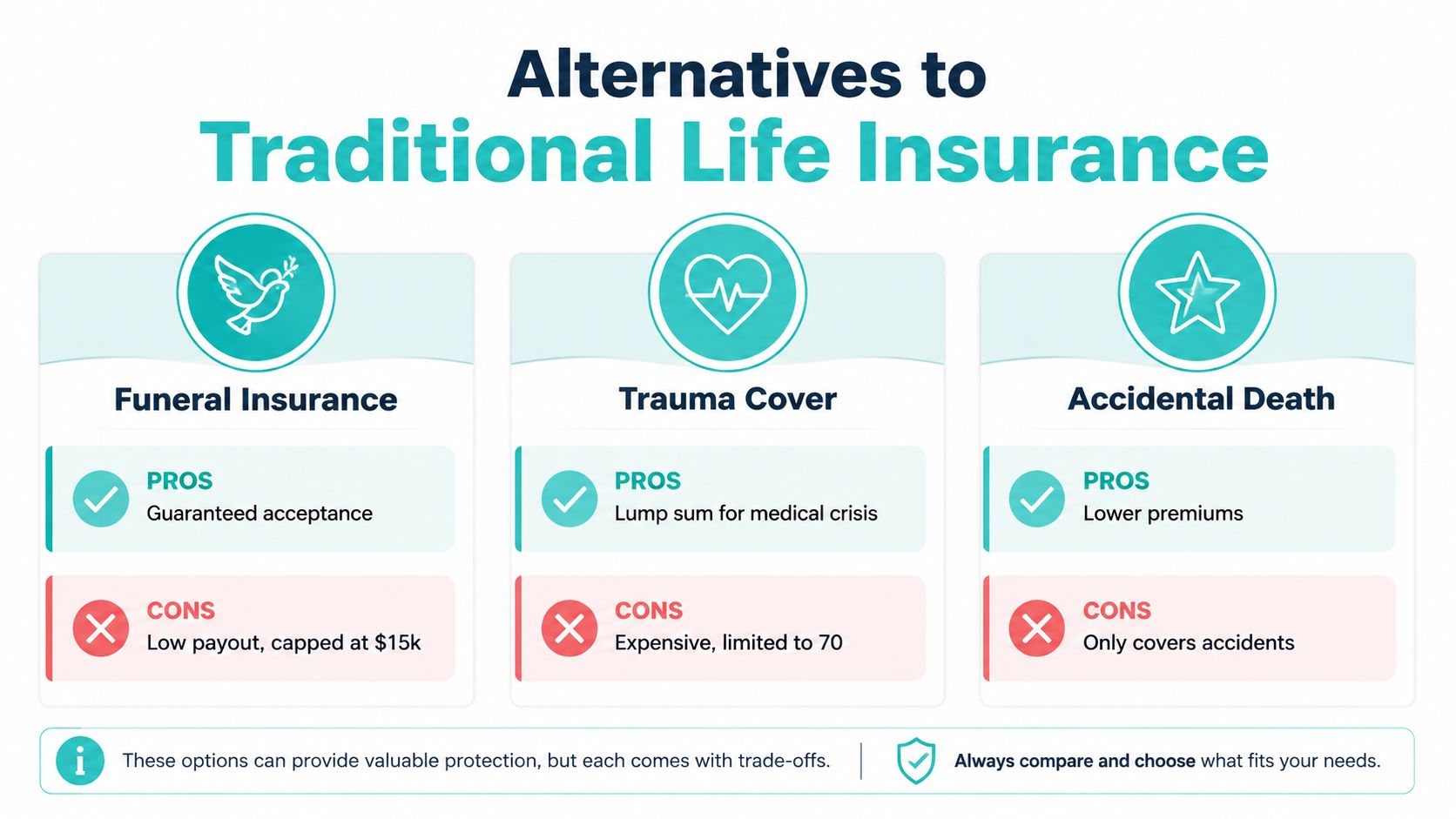
Funeral insurance can make sense when the only objective is meeting final expenses and the family would struggle to fund them from cash reserves. But guaranteed acceptance and convenience don't remove the need to check the premium structure. If premiums keep rising, the total paid may exceed the benefit.
Trauma cover pays a lump sum after a defined medical event, subject to the policy wording. It can help with treatment costs, home modifications, or lifestyle changes, but older applicants may face higher premiums, narrower definitions, or fewer covered conditions. It's useful when the financial risk is illness during life, not just death.
Income protection deserves attention if you're still working. It can replace part of employment income during a qualifying disability, but benefit periods, waiting periods, and age-based expiry rules matter. A policy that ends at retirement age may be sensible for a short remaining work horizon, but it shouldn't be treated as permanent protection.
Accidental death cover has a narrow trigger. It may be affordable, but it won't generally respond to death caused by illness, which is the central limitation.
Self-insurance can be the cleanest option when you have sufficient liquid assets, no dependants, manageable debt, and a clear estate plan. Set aside the intended amount and review it as your assets and obligations change.
Blended-family arrangements add another layer. A practical overview of how insurance can interact with relationship and property decisions is available in Miles Hansford Law Firm's discussion of life insurance. It's not a substitute for estate-planning advice, but it can prompt useful questions about ownership and beneficiaries.
Decision Checkpoints and Example Scenarios
Use five checkpoints before applying. They'll keep the decision focused on need rather than sales pressure.
- Outstanding debt: Proceed if a mortgage or guarantee would leave your partner exposed. Pause if debts are comfortably covered by liquid assets.
- Dependants: Proceed if a spouse, adult child with support needs, or another dependant relies on your resources. Pause if nobody depends on your income or capital.
- Superannuation death benefit: Proceed if the benefit is reducing, uncertain, or insufficient for the intended purpose. Pause if the existing benefit clearly meets the need and remains affordable.
- Estate objective: Proceed if you want to equalise inheritances, provide a defined legacy, or fund a tax-sensitive transfer. Pause if your assets already achieve that outcome.
- Insurability: Proceed with urgency if health is currently favourable and suitable cover is available. Pause and compare carefully if accepted terms include exclusions or significant loadings.
Three practical scenarios
A 62-year-old with a $200,000 mortgage and a non-working spouse has a clear protection need. Retail term cover may be appropriate if underwriting produces acceptable terms. The premium should be compared against the surviving spouse's income needs and the cost of retaining the home, not judged solely by the first quote. No exact premium range can be responsibly stated without an insurer's underwriting assessment.
A 65-year-old single homeowner with $600,000 in super and no dependants has a different answer. New cover may be unnecessary if the estate already has enough liquidity and no one relies on the death benefit. The priority is to review existing super insurance, beneficiary nominations, debt, and estate documents before buying more protection.
A 68-year-old couple wanting to leave a specific legacy may consider guaranteed acceptance cover if medically underwritten options are unavailable. The trade-off is higher cost, likely benefit limits, and waiting-period conditions. They should compare the policy against a dedicated savings reserve and confirm that the intended beneficiary will receive the amount efficiently.
For the first scenario, applying earlier can preserve more choice. For the second, buying more may reduce retirement cash flow. For the third, certainty may justify a costly policy, but only after the couple understands the total premium commitment.
Next Steps and Getting Personalised Advice
Your next move should match your position.
- Apply now: Take action while you're still medically insurable if you have debt, a dependent partner, or a legacy objective that existing assets can't fund.
- Optimise super first: Retrieve all fund documents, check reductions and cancellation conditions, and compare the actual benefit with your obligations.
- Consider alternatives or self-insurance: Use targeted cover, a dedicated reserve, or another estate-planning strategy when full life cover is disproportionate to the need.
Generic online calculators can estimate a figure, but they can't properly reconcile mixed super and retail policies, medical underwriting, beneficiary tax issues, and blended-family objectives. Personal advice becomes especially valuable when a policy may lapse, health conditions affect acceptance, or your estate plan depends on a particular ownership structure.
Wealth Collective's process starts with an initial discovery call, followed by a review of existing insurance and superannuation benefits. The adviser then presents recommendations with transparent fee disclosure, so you can decide whether to apply, adjust, retain, or cancel cover. For broader retirement decisions, their financial advice for retirees service can place insurance inside the wider retirement and estate-planning picture.
Book a no-obligation consultation before another birthday changes your eligibility or premium path. You don't need to commit to new cover immediately, but you do need a clear answer about what your current policies will do.
Wealth Collective can review your superannuation insurance, retail policies, debt exposure, and legacy objectives to determine whether life insurance still earns its place in your retirement plan. Visit Wealth Collective to arrange an initial call and clarify your options before cover becomes harder or more expensive to secure.