Business hours
Monday to Friday (8.30AM - 5PM)
Weekend (Closed)


A former manager has lodged an unfair dismissal claim. The ATO has issued a director penalty notice. A regulator wants documents and an interview. Or a bookkeeper has redirected supplier refunds into a personal account. None of these events looks like the dramatic shareholder lawsuit many business owners associate with management liability, yet each can create serious legal cost and personal pressure.
For Australian SMEs, management liability insurance is designed to address the overlapping risks faced by directors, officers and the company itself. The important question isn't whether you have a policy. It's whether the wording responds to workplace disputes, investigations, employee dishonesty and entity-level claims, as well as allegations against individual decision-makers.
Why Australian Directors and Business Owners Remain Personally Exposed
A Melbourne director receives an email from a former manager alleging dismissal after raising safety concerns. The owner believes the termination followed a fair performance process, yet the allegation can still trigger solicitor letters, document reviews, witness preparation and settlement advice. A courtroom may never be involved.
That pattern explains the overlooked risk in management liability. Employment practices claims, internal workplace complaints and regulator requests can create more immediate losses than the shareholder lawsuit many owners picture. ASIC, the ATO and Fair Work-related disputes may draw directors into decisions made by the company, even where they did not personally carry out the conduct being challenged.
For a comparison of personal responsibility for labour-law breaches in another jurisdiction, see this explanation of employer defence under Section 558.1. The legal framework is not Australian, but the warning applies: incorporation does not remove every personal exposure.
Why the company structure is not a complete shield
ASIC enforcement data illustrates the possible consequences. An ASIC enforcement study covering 2021 to 2023 recorded 203 successful outcomes against directors and officers, including 42 criminal outcomes, 22 civil outcomes and 136 administrative outcomes. The same study recorded 196 outcomes against directors, with banning or disqualification orders the most common result, appearing in 134 of the 203 cases.
Private companies were prominent in those findings. 95% of administrative outcomes and 83% of criminal outcomes involved directors or officers of private companies. Regulatory attention therefore reaches owner-managed businesses, not only listed-company boards.
Practical rule: Treat a regulator's first letter as a potential defence-cost event, not as something to consider only after proceedings begin.
A director under tax pressure should also understand the personal consequences of an ATO notice, including the issues explained in this guide to director penalty notices. A management liability policy may help with covered investigation and defence expenses, but it does not convert every company debt, deliberate act or penalty into an insured loss. The wording, exclusions, conduct provisions and timing determine the response.
That is why standalone D&O cover may leave gaps when the regulator knocks. A bundled management liability policy can bring employment practices, entity and statutory protections together with D&O, subject to its specific terms. For many Australian businesses, the first claim may arrive through the workplace rather than the boardroom.
What Management Liability Insurance Actually Covers
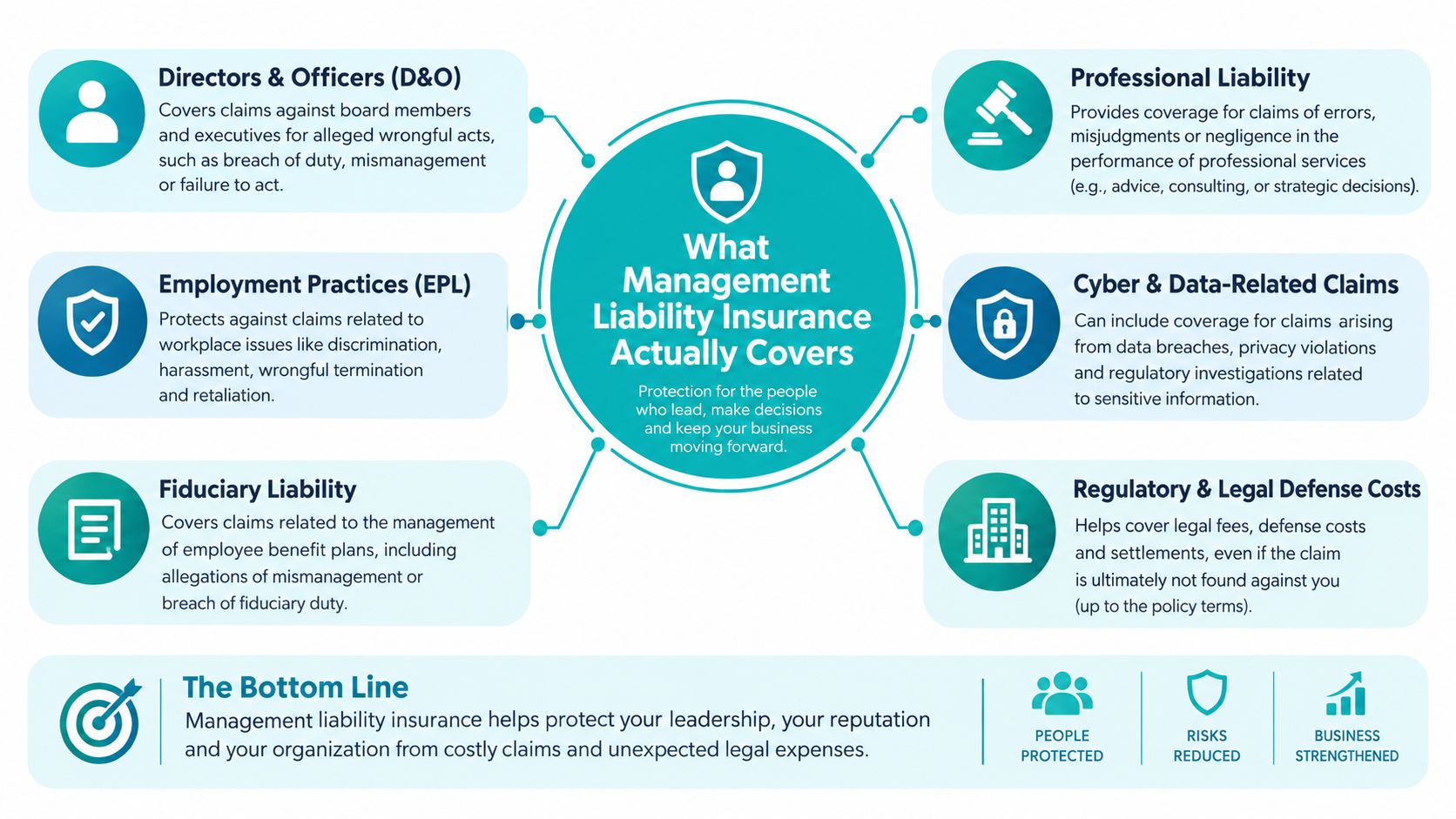
A management liability claim can start with a dismissed employee, an alleged breach of duty or a regulator's investigation. These events affect different people and create different costs. A policy therefore works like a combined first-aid kit for business leadership, with separate treatments for separate problems. It brings several specialised covers into one package for the company, its directors and its officers.
Australian policies commonly combine directors and officers liability, entity liability, employment practices liability, crime or fidelity, statutory liability and tax audit cover. The AIG Australian product material also illustrates how policy sections can be arranged. Depending on the insurer, business profile and wording selected, extensions may include cyber events, kidnap and extortion.
The difference between a package and standalone D&O
Standalone D&O insurance is aimed at wrongful acts by directors and officers acting in their managerial capacity. It can respond when a director is personally named in a claim, but it does not automatically address workplace disputes, employee dishonesty or a regulatory investigation involving the company.
A bundled policy can add protection for the company as an entity, employment allegations, employee dishonesty, statutory investigations and tax audit expenses. It may also respond when the company indemnifies an insured director or officer under its constitution or another permitted arrangement, subject to the wording (About Insurance Australia explanation).
This matters when the regulator knocks. D&O may address an insured individual's defence, while a management liability package can also include entity and statutory sections, alongside employment practices cover. The package gives an SME one coordinated programme, although each section can have its own sub-limit, excess, exclusions and conditions.
What the policy won't automatically do
Management liability is not a promise to pay every business loss. It generally responds to insured wrongful acts, defence costs and specified financial loss. Fines and penalties may be excluded, while legal costs for an investigation may be covered if the wording permits it (Edgewise management liability guidance).
Read the policy as a collection of agreements, rather than one unlimited pool of money. Check whether defence costs reduce the limit, whether the company is insured, and whether workplace, crime and regulatory sections are included. A bundled policy is only as useful as the sections, limits and conditions selected.
The Core Cover Elements Inside a Typical Policy
A management liability policy bundles several specialised covers for the company, its directors and officers. Each section addresses a different type of loss. An alleged breach of duty, a workplace dispute and employee theft may involve the same business, but they require different evidence and policy responses.
| Cover Element | Who It Protects | What It Pays For | Typical Australian Trigger |
|---|---|---|---|
| Directors and Officers liability | Directors and officers | Defence costs and covered loss arising from alleged wrongful management acts | A claim alleging a director breached duties |
| Entity liability | The company and, in some structures, its balance sheet | Covered claims made directly against the company or reimbursement under an indemnity | A claim against the company connected with management conduct |
| Employment Practices Liability | The company, directors and relevant insured people | Defence costs, settlements and covered employment-related loss | Unfair dismissal, discrimination, bullying or retaliation allegations |
| Crime or Fidelity | The company | Covered financial loss caused by employee dishonesty or specified fraud events | A bookkeeper diverts company money |
| Statutory Liability | The company and insured individuals, subject to wording | Legal defence and related covered costs for alleged statutory breaches | An OH&S or environmental investigation |
| Tax audit cover | The company and eligible individuals | Professional fees incurred during a covered tax audit | An ATO audit within the policy's scope |
| Cyber, kidnap and extortion extensions | The insured business and people named in the wording | Selected response costs and losses for specified events | A cyber incident, extortion demand or kidnapping event |
Workplace claims deserve close attention
Employment Practices Liability, or EPL, is often underestimated because the event may begin as routine management. A termination meeting, performance warning, roster change or bullying complaint can develop into an allegation of discrimination, retaliation or wrongful dismissal.
An Australian market review cited by Edgewise identifies EPL as the highest-frequency loss driver in the broader management liability pool, accounting for roughly 40% of claims (Edgewise market summary). For a business owner, the lesson is practical: cover selected only for boardroom litigation may overlook the employment disputes most likely to arise from daily operations.
Defence costs can be the first pressure point
Regulatory cover usually deals with the cost of responding to an investigation. It does not automatically pay an eventual fine. Australian product material discusses legal costs for directors responding to ASIC document requests, interviews and court proceedings that follow an ASIC investigation (AIG Australian product material).
The distinction affects how the policy should be read. Even where a penalty is excluded, lawyers may need to review documents, advise directors and manage communications with the regulator. Check whether investigation costs reduce the aggregate limit, whether a sub-limit applies and whether the insurer must consent before costs are incurred. Also confirm who qualifies as an insured person and whether the company itself receives protection under the relevant section.
Three Australian Claim Scenarios and How Cover Responds
The following examples show how the sections of a policy can operate. They aren't predictions of payment. An insurer will assess the actual facts, notification date, wording, exclusions, excess and applicable sub-limits.
A Fair Work dispute after a termination
A Sydney retail operator dismisses a long-serving store manager after a performance process. The manager files an unfair dismissal application with the Fair Work Commission and alleges that the process was unreasonable.
The Employment Practices Liability section may fund the business's legal defence and contribute towards a covered settlement, subject to the policy's terms and sub-limit. The business will still need to provide the employment file, performance records, correspondence and details of the termination decision.
The key point is that the dispute doesn't need to involve a shareholder or director personally to create a management liability claim. A workplace decision can become a significant company expense.
An ASIC investigation following a cyber incident
A Melbourne fintech self-reports a suspected cyber incident to ASIC. The regulator requests documents about the incident, board oversight, customer communications and the company's response plan.
The D&O and entity sides of a suitable management liability programme may respond to legal representation for the relevant directors and the company, provided the investigation and conduct fall within the wording. The cyber policy, if separately arranged, may address a different set of costs, such as incident response, notification or technology-related losses.
Policy coordination matters. Cyber governance allegations may raise management liability issues, while the underlying cyber event may sit elsewhere. Directors shouldn't assume one policy will automatically absorb every part of the incident.
Employee dishonesty in a trades business
A Brisbane tradies business discovers that its bookkeeper has been redirecting supplier refunds for two years. The company checks bank records, obtains accounting advice and investigates the extent of the loss.
The Crime or Fidelity section may respond to covered employee dishonesty, subject to proof, discovery requirements, the definition of employee and any applicable limits. The business may need to preserve records and avoid compromising the investigation before notifying the insurer.
The same event can involve multiple decisions, but it doesn't become a D&O claim because directors must manage the response. The crime wording is the section designed to address the direct financial loss.
What Drives the Cost of Management Liability Cover
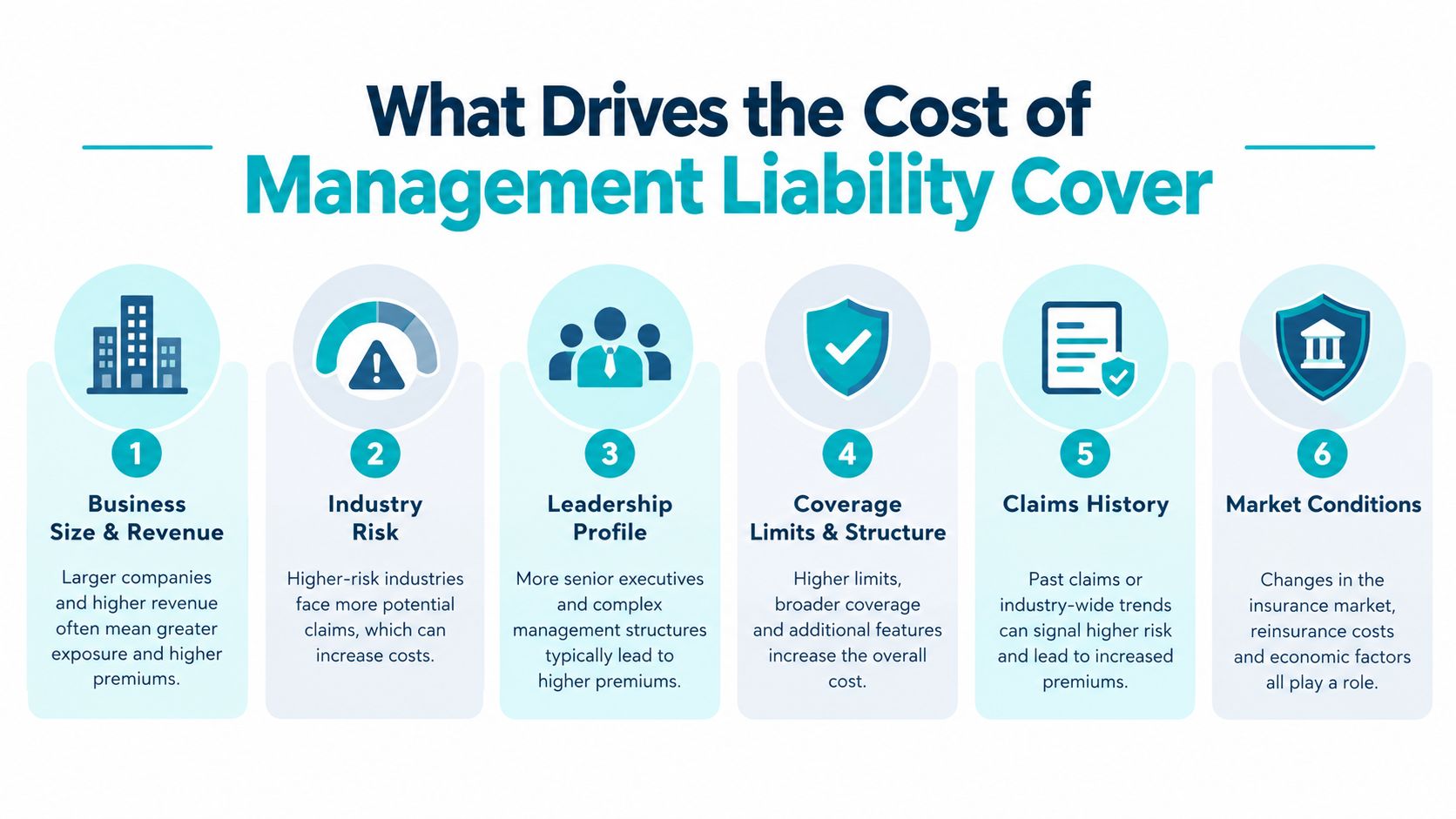
A business can have modest revenue and still present a difficult management liability risk. Insurers assess the activities, people, past events and protection requested before deciding how much uncertainty they are prepared to insure.
The main underwriting questions
Revenue and industry provide an initial guide, but they do not tell the whole story. A professional-services firm, construction business, hospitality operator and technology company can face very different employment, regulatory, contractual and financial exposures at similar revenue levels.
Headcount and workforce structure affect the likelihood and potential cost of employment disputes. Underwriters may review employee numbers, contractors, casual staff, locations, workplace policies and how the business handles performance management and termination decisions. These claims often drive management liability losses more than the boardroom lawsuit a business owner first imagines.
Claims and notification history also influences the assessment. Previous Fair Work disputes, workplace health and safety matters, regulator correspondence or internal fraud incidents may affect the quote and available wording. A clean history does not remove risk, although it gives the underwriter a clearer starting point.
The choices that change the premium
The requested limit and sub-limit structure have a direct effect. A business might select a broad aggregate limit, then find that employment claims, crime or tax audits have smaller internal caps. The excess changes the premium too, because the business accepts more of each covered loss before the insurer pays.
Jurisdiction adds another layer. Australia-wide wording may suit a local operation, while overseas subsidiaries, customers, employees or proceedings require careful review. Directors who retire or sell a business should ask whether run-off protection is available, since claims may emerge after someone leaves office.
Market conditions can also keep pricing firm when claims inflation and regulatory exposure continue to affect premiums, even if other commercial insurance lines soften. A cheap online quote may therefore provide poor value if it removes entity cover, restricts investigation costs or uses narrow employment definitions.
Price is only one part of the decision. Compare the insured people, entity cover, sub-limits, exclusions, retroactive date and defence-cost treatment before comparing premiums.
Management Liability Versus Standalone D&O and Other Business Covers
Business owners often place management liability beside public liability or professional indemnity and assume the risks overlap. They don't. Each policy answers a different question about who suffered the loss and what caused it.
| Cover Type | Who It Protects | What It Typically Pays For |
|---|---|---|
| Standalone D&O | Directors and officers, with wording-dependent company protection | Claims alleging wrongful acts in a management capacity |
| Management liability | Directors, officers and the company | A package of D&O, entity, employment, crime, statutory and possible tax-related covers |
| Public or general liability | The business for covered third-party liability | Bodily injury or property damage claims connected with business activities |
| Professional indemnity | The business and professionals | Claims alleging errors, omissions or negligent professional advice |
| Crime or fidelity bought separately | The business | Specified financial loss caused by dishonesty or fraud |
Standalone D&O can protect a director who faces a personal claim, but it may leave the business exposed to an employment dispute or an employee theft loss. A bundled management liability policy is broader because it brings company protection and several management-related sections into the same programme.
General liability won't normally respond because a director made a poor hiring decision. Professional indemnity won't normally replace EPL cover when an employee alleges bullying or wrongful dismissal. Those policies remain important, but they don't duplicate the management risks addressed by the package.
Use the gap test: For each major risk, ask whether the policy protects the person, the entity, the legal defence cost and the resulting covered loss.
International terminology can create further confusion. For example, businesses researching executive liability insurance Israel may find language that resembles Australian D&O discussions, but policy definitions and legal environments differ by jurisdiction. Australian SMEs should rely on the actual Australian wording rather than assume an overseas description transfers neatly.
A broader review of small business insurance requirements can help place management liability alongside the rest of the business insurance programme.
Choosing the Right Cover for Your Business and Booking an Initial Call
Start with the business rather than the product name. Review revenue stage, employee numbers, industry, ownership structure, overseas activity, regulatory exposure and previous claims. Then decide whether the policy needs strong entity protection, employment practices cover, crime protection, statutory investigation cover or extensions beyond the standard package.
For a growing Australian SME, a practical starting discussion may involve $1 million to $2 million of D&O and entity liability cover, increasing to $5 million or more once revenue exceeds $20 million or regulatory exposure rises. These are planning benchmarks, not automatic recommendations. The right limit depends on the business's assets, contracts, balance sheet, governance structure and tolerance for retaining defence costs.
Questions to ask before accepting a quote
- Employment sub-limits: Is the available amount realistic for a serious dismissal, discrimination or bullying dispute?
- Crime wording: Does it address employee dishonesty, social engineering and phishing, or only traditional theft?
- Retroactive date: Will the policy respond to an alleged act that occurred before inception?
- Defence costs: Do investigation and defence expenses reduce the policy limit?
- Entity protection: Is the company insured directly, or only when it reimburses an individual?
- Run-off cover: What happens when a director retires, sells the business or the policy changes?
Review the cover annually, especially after hiring senior staff, acquiring another business, changing ownership, expanding overseas or receiving regulator correspondence. Keep recent financials, the current insurance schedule and a summary of known risk issues ready for the advice process. Personal protection questions may also sit alongside business risk, including the role of key person insurance where the loss of a key owner or executive could disrupt the business.
Wealth Collective's Protection Plus service can form part of a broader conversation about insurance and asset protection, helping owners organise their personal and business protection priorities. Book an initial call with a qualified Australian adviser, bring your existing schedule and recent financial information, and use the discussion to test whether your current wording matches the risks your business carries.
Wealth Collective helps Australian business owners review protection needs, clarify policy gaps and connect business risks with wider financial planning. Visit Wealth Collective to book an initial call and discuss a management liability strategy suited to your business structure, stage and exposure.