Business hours
Monday to Friday (8.30AM - 5PM)
Weekend (Closed)


If you're searching for a perth tax agent, you're probably not looking for “tax” in the abstract. You're trying to solve something immediate. A return that feels messier than last year. A new investment property. Share income you're not sure how to report. A small business that has outgrown DIY bookkeeping. Or you're tired of guessing and hoping the ATO sees it your way.
My view is simple. Tax shouldn't be treated as a once-a-year admin task. It's one of the first signals of how organised your financial life really is. Get tax right and you create better decisions around cash flow, debt, super, investing and retirement. Get it wrong and the problems spread.
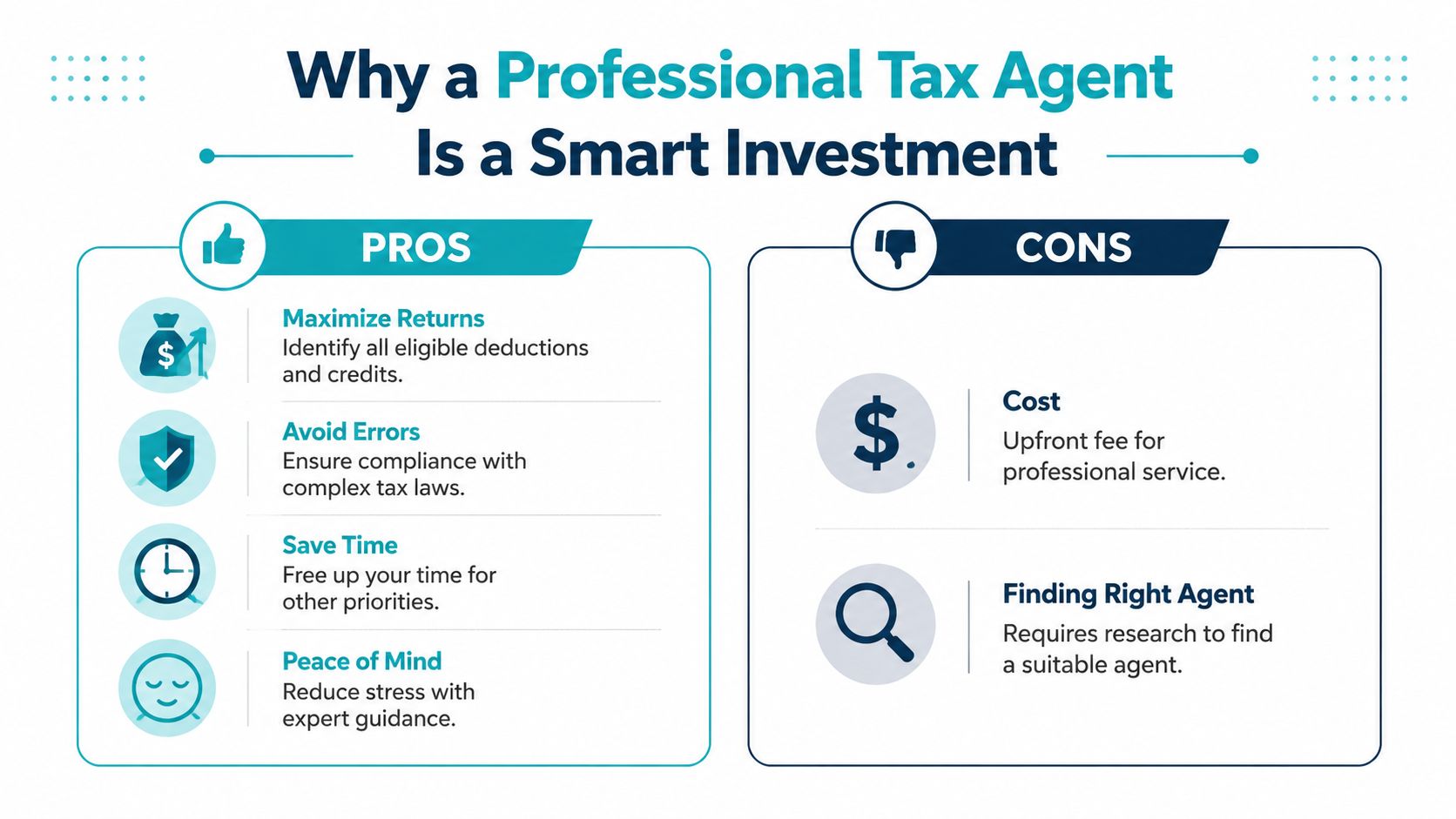
Why a Professional Tax Agent Is a Smart Investment
Taxpayers don't struggle with tax because they're careless. They struggle because the system is detailed, the rules change, and the ATO uses data-matching and analytics to identify inconsistencies across income, deductions and reporting streams, as outlined in the ANAO review of ATO data-matching and analytics. That means a rough estimate, an unchecked figure, or a deduction without records is more likely to create problems than it used to.
A professional tax agent helps you avoid that trap. Not by waving a magic wand, but by applying a proper process, checking records, and making sure the return reflects what can be supported.
Why this is normal, not niche
Using an agent isn't some premium add-on for a tiny group of people. The ATO says that for the 2025 financial year, over 7.1 million individual tax returns were lodged by tax agents, and in 2023 to 2024 registered agents lodged 95% of all non-individual tax returns such as company and trust returns, according to the ATO's tax time lodgment statistics.
That matters because it tells you something important. Serious taxpayers, especially business owners and investors, don't usually rely on guesswork.
Practical rule: If your income comes from more than one source, or you own assets outside a basic salary and savings account, a tax agent usually stops being optional and starts becoming sensible.
What you're really paying for
People often focus on the fee and miss the bigger value. A good perth tax agent gives you:
- Accuracy: Your records are reconciled properly instead of copied blindly into a return.
- Compliance: Claims are made within the rules, not based on myths from social media or the lunchroom.
- Time back: You stop spending nights hunting for documents and second-guessing categories.
- Judgement: An experienced adviser can tell the difference between a legitimate claim and a risky one.
- A better financial starting point: Clean tax reporting gives your planner, lender and adviser better information.
There's also a broader strategic point. Tax compliance is where financial discipline becomes visible. If you're interested in how that thinking applies in other business environments too, this piece on strategic tax compliance for businesses is a useful external read because it reinforces the same core idea. Strong compliance supports better commercial decisions.
The wrong way to think about tax is “How fast can someone lodge this?” The right question is “Who can help me lodge this correctly and use it to make smarter decisions next?”
How to Choose the Right Perth Tax Agent for You
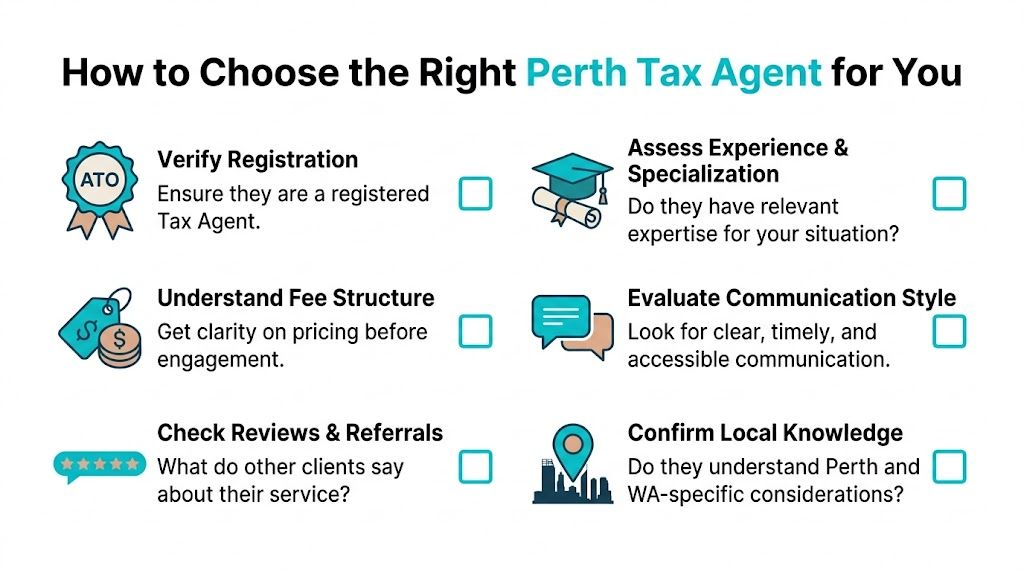
Many individuals choose a tax agent the wrong way. They compare price, look for a quick turnaround, and stop there. That's backwards. The first filter isn't cost. It's whether the person is legally allowed to do the work.
Under Australian law, anyone providing a tax agent service for a fee must be registered with the TPB, and that includes preparing returns or advising on tax obligations, as explained by the Tax Practitioners Board guidance on tax agent services. If someone isn't registered, that's a red flag immediately.
Know who you actually need
These roles get blurred constantly, and clients pay for that confusion later.
| Provider | What they can do | Where to be careful |
|---|---|---|
| Registered tax agent | Tax returns, tax advice, income tax obligations, broader tax agent services | Confirm registration and relevant experience |
| BAS agent | BAS and certain GST or payroll-related work within their scope | Don't assume they handle all income tax matters |
| Accountant | Financial reporting, business advice, management support | They still need TPB registration to provide tax agent services for a fee |
If you're unsure how to assess that difference in practice, this guide on how do you find a good accountant is a useful starting point.
A polished website doesn't matter if the provider can't legally do the work you're paying for.
The questions worth asking
You don't need a long interview. You need direct answers to the right questions.
Ask these before you engage anyone:
- Registration: “What's your TPB registration status?”
- Client fit: “Do you regularly work with people in my situation?” That could mean FIFO workers, retirees, company directors, sole traders, property investors, or people with share income.
- Scope: “Are you handling just the return, or also BAS, entity issues, record-keeping problems, and ATO queries?”
- Process: “How do you verify my figures against source records?”
- Fees: “What's included, what triggers extra fees, and when will I know?”
- Communication: “If something is unclear, who contacts me and how quickly?”
What a good fit looks like
The right perth tax agent isn't just technically capable. They're organised, clear, and willing to push back when a claim is weak.
Look for someone who:
- Explains decisions plainly: You should understand why something is claimable or not.
- Works from evidence: They ask for records, not rough summaries.
- Stays in their lane: They don't pretend to be your mortgage broker, planner and lawyer all at once.
- Can coordinate with other advisers: If you have a financial adviser or business adviser, they should be comfortable working as part of a team.
Cheap tax work often becomes expensive later. Good advice usually sounds more careful, less flashy, and a bit less exciting. That's usually a sign you're talking to the right person.
Your Guide to the Tax Agent Engagement Process
Clients often expect tax engagement to be confusing. It doesn't need to be. A solid process is straightforward, documented and predictable.
The best-practice standard is to reconcile your records against ATO pre-fill data before lodgment, because ATO data-matching makes discrepancies easier to detect, as noted in the earlier ANAO material already referenced above. That's why a proper engagement feels methodical rather than rushed.
What usually happens
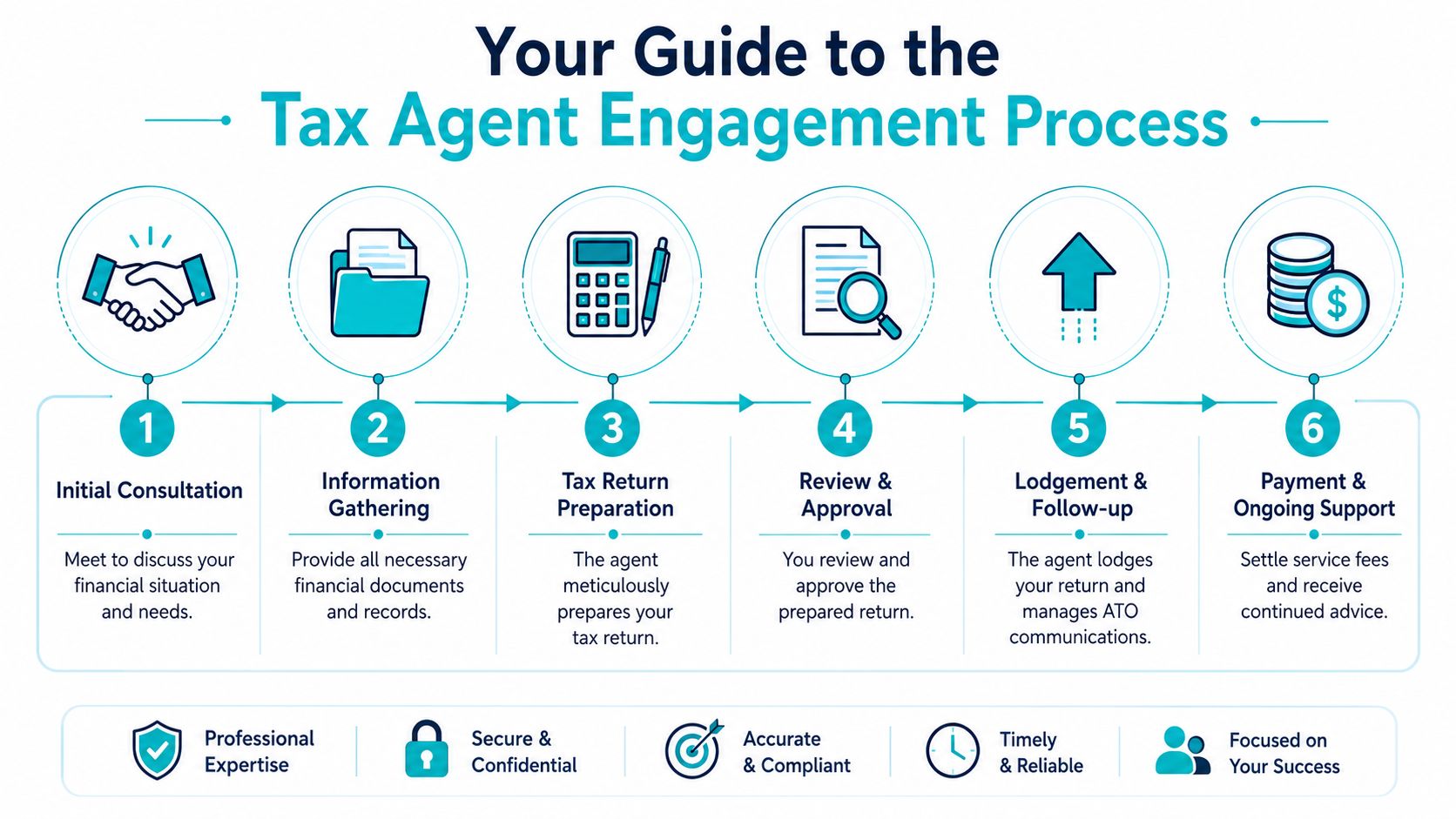
A professional engagement usually follows this sequence:
Initial conversation
You explain your situation. Salary, business income, investments, super, property, debt, overseas links, or upcoming changes.Scope and engagement
You receive an engagement letter covering the work, responsibilities and fees. Read it. If the scope is vague, fix that before you proceed.Document collection
You provide records. The more organised you are, the smoother the process.Preparation and reconciliation
The agent compares what you've provided with available ATO data and checks for inconsistencies.Review and approval
You review the return or BAS. This matters. Your approval isn't a formality.Lodgment and follow-up
The return is lodged, confirmations are retained, and any ATO follow-up is managed.
What to bring
You don't need every scrap of paper you've touched all year. You do need the records that support the story your return tells.
Bring items such as:
- Income records: PAYG information, business income summaries, trust or company distributions, bank interest, dividend statements.
- Expense evidence: Work-related expense receipts, loan interest records where relevant, agent statements, bookkeeping exports.
- Asset details: Property purchase or sale records, share transactions, crypto records if applicable, depreciation schedules where relevant.
- Super and insurance information: Contribution records, policy details if they affect the broader advice conversation.
- Prior-year context: Last return, carry-forward issues, ATO letters, payment plans or unresolved queries.
Bring source documents, not just spreadsheets. A spreadsheet helps. It doesn't replace evidence.
What clients often get wrong
The biggest mistake is assuming the agent will “sort it out later” if the records are incomplete. Sometimes they can. Often they're forced to work around missing detail, and that weakens the final result.
Another common problem is late disclosure. If you sold shares, earned foreign income, changed structures, or moved overseas temporarily, say it early. Good tax work depends on complete facts, not clever software.
Local Tax Considerations and Red Flags to Avoid
Perth clients often have tax issues that don't fit the standard suburban salary-earner template. FIFO arrangements, employee share schemes, family trusts, investment properties, business cash flow pressure, and periods of overseas work all create complexity fast.
International ties are one area people regularly underestimate. For Perth residents working temporarily overseas or holding foreign investments, tax can become far more technical because Australian residents are typically taxed on worldwide income, and residency status plus foreign income tax offsets can materially change the outcome, as discussed in this overview of international tax issues for Australians.

Local issues that deserve proper advice
A perth tax agent should be comfortable dealing with situations like these:
- FIFO and variable work patterns: Travel, allowances, roster changes, and employer reimbursements need careful treatment.
- Mining and executive remuneration: Share plans and deferred benefits can create reporting issues that generic preparers miss.
- Property investors: Perth investors need clean records for rental income, interest, repairs and capital works. If you like exploring broader property tax concepts, BatchData's real estate tax insights are a worthwhile external resource for framing the questions to ask.
- Small business owners: BAS discipline, payroll, GST and structure decisions all affect tax outcomes. This article on small business tax reduction is useful if you want to think beyond simple deduction-chasing.
Red flags that should stop you cold
Some warning signs aren't subtle. If you see these, walk away.
- They promise a refund before reviewing documents.
- They won't give you their TPB registration details.
- They push claims you can't substantiate.
- They're vague about scope, fees, or who is doing the work.
- They seem more interested in “maximising” than documenting.
If a provider sounds aggressive about deductions and casual about records, you're the one carrying the risk.
The safest choice isn't the loudest marketer. It's the adviser who asks better questions and insists on proper evidence.
Integrate Your Tax Plan with Your Wealth Strategy
A tax return is a snapshot. A wealth strategy is the full film.
That's why I don't think a perth tax agent should be treated as a standalone transaction if your financial life is becoming more complex. Tax decisions flow into cash flow. Cash flow affects debt reduction. Debt levels affect borrowing capacity. Your after-tax position shapes how much you can invest, how much you can contribute to super, and how confidently you can plan retirement.
The distinction matters here. A standard accountant may help with reporting and business matters, but only a TPB-registered tax agent can legally provide tax agent services for a fee, and for Perth small business owners that registration is an important consumer safeguard, as noted in the discussion of tax agent and accountant differences. That legal line is more than a technicality. It protects you.
Tax is the first pillar, not the final step
If your tax work is accurate but disconnected from the rest of your finances, you're still leaving value on the table.
A stronger approach looks like this:
- Tax informs strategy: Your return shows where money is going and where planning gaps sit.
- Strategy informs investment decisions: After-tax cash flow should guide how much risk you take and how you structure contributions.
- Advice gets coordinated: Your tax agent, mortgage broker and financial adviser should not be working in silos.
For readers thinking beyond compliance and into portfolio design, this overview of disciplined investment approaches for individual investors is a useful companion read. It helps connect the idea that good investing starts with disciplined inputs, and tax is one of those inputs.
If you want to see how that coordination works in practice, taxation and tax planning advice sits alongside broader planning around super, debt, insurance and retirement. That's where Wealth Collective can fit as one option within your advice team, working alongside your tax agent rather than replacing them.
A clean return is good. A coordinated financial strategy is better.
If you want help connecting tax decisions to the rest of your financial life, book a free introductory call with Wealth Collective. We'll help you work out what belongs with your tax agent, what belongs in your broader plan, and how to make the pieces work together with less stress and more clarity.