Business hours
Monday to Friday (8.30AM - 5PM)
Weekend (Closed)


Margaret and Ron had treated their super as background noise for years. Then, after Ron's heart procedure, the Perth couple sat at the kitchen table and pulled out two decades of insurance and super statements. Their question was simple but uncomfortable: if Ron didn't come home from hospital, who would receive the $640,000 in his super?
That question exposes the problem with superannuation beneficiary rules. It isn't enough to know that your spouse, children or estate may receive the money. You need to know whether your nomination is valid, whether the recipient is a tax dependant, whether the nomination has expired, and whether your fund or SMSF will follow the paperwork.
A lapsed binding nomination, an adult child described incorrectly, or a nomination that conflicts with an SMSF deed can send a large balance into a process your family never intended. The rules below follow the decision chain I use with WA retirees and pre-retirees: identify who can receive the benefit, choose the right nomination, understand the tax, check the failure points, then coordinate the outcome with your wider estate plan.
Why These Rules Matter to a WA Retiree or Pre-Retiree
If you have a substantial super balance, your beneficiary nomination deserves the same attention as your Will. A split between your spouse and adult children may feel fair, but “fair” is not a legal category. The trustee must follow superannuation law, the fund's governing documents and the nomination you have made.
Eligible recipients generally include a spouse or de facto partner, a child of any age, a person in an interdependency relationship, a financial dependant, or your legal personal representative, meaning your estate. The ATO's explanation of superannuation death benefits explains the difference between binding and non-binding nominations. A valid binding nomination directs the trustee. A non-binding nomination gives the trustee discretion.
That choice matters because super can be one of a family's largest assets outside the home. APRA-linked data cited by the Super Members Council and recorded by the Australian Law Reform Commission show that funds with five or more members paid about 40,000 superannuation death benefits in 2017-18, averaging around $128,000. The same source records about 9,000 terminal medical condition benefits, averaging around $90,000.
Practical rule: Treat your nomination as a live financial instruction, not a form you complete once and forget.
Work through the decision in order. Confirm who can receive the benefit, choose the nomination type, check the likely tax outcome, then test the arrangement against your fund rules and estate plan. Your spouse may receive a different tax result from an adult child. A former partner may qualify under one test but not another. An SMSF can add deed and trustee requirements that a retail fund does not. A copied 50/50 split is rarely enough.
Who Counts as a Dependant Under Superannuation Law
The word dependant causes trouble because superannuation uses related but different concepts. Start with eligibility, then test the tax result. Don't assume that someone who can receive a death benefit will receive it tax-free.
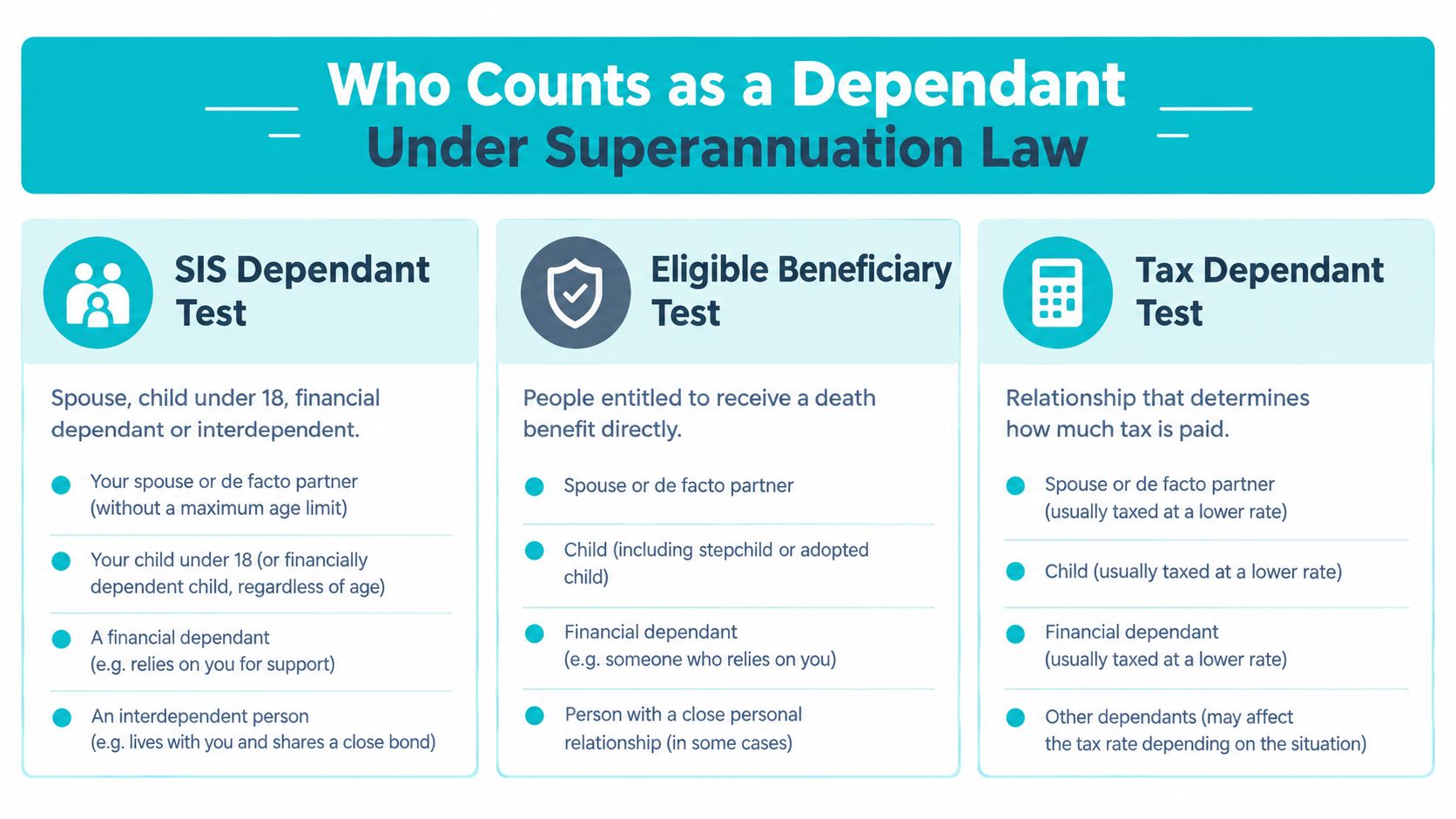
Under the superannuation framework, eligible recipients include a spouse or de facto partner, a child of any age, a financial dependant, a person in an interdependency relationship, or the member's legal personal representative. The ATO guidance for superannuation professionals confirms that payment must remain within this statutory framework.
The three questions to ask
First, can this person receive the benefit? A spouse, de facto partner, child, financial dependant or interdependent person may qualify. The estate is also a recognised route.
Second, can the fund pay them directly? The nomination must use an eligible recipient category and comply with the fund's rules. Naming someone in your Will doesn't automatically make that person a superannuation dependant.
Third, will they count as a tax dependant? This is the test that determines whether the taxable component can be paid tax-free. The ATO states that a lump sum death benefit paid to a tax dependant is tax-free, regardless of the taxable component.
A de facto partner may be both eligible to receive the benefit and a tax dependant. A minor child may also receive tax-free treatment. An adult child can be eligible to receive a benefit but still fail the tax-dependant test if they're financially independent. The same issue can arise with a former spouse, depending on the facts and the payment structure.
Interdependency is another category people overlook. It can apply where two people share a close personal relationship and provide domestic, personal or financial support, even if they aren't married. Older couples, same-sex partners and a family member who lives with and cares for the deceased may require careful assessment.
If you wouldn't describe the person's current financial reliance clearly and confidently, don't rely on a label alone. Check the fund's criteria and the tax position separately.
Binding, Non-Binding and Reversionary Nominations Compared
The nomination type decides how much control you retain after death. It also determines where the process can fail.
A non-binding nomination tells the trustee what you want, but the trustee keeps discretion. That can be useful where family circumstances are complex or the trustee needs to assess dependency. It can also produce an outcome your family didn't expect.
A binding nomination gives the trustee a direction it must follow if the nomination is valid and the recipients are eligible. It must be in writing, signed and dated in front of two adult witnesses who aren't named in the nomination. In many funds, it generally needs renewal every three years. The Australian Law Reform Commission's discussion of binding nominations highlights the significance of that renewal cycle.
A reversionary pension operates differently. Where the pension terms permit it, payments continue to an eligible nominated beneficiary after the member's death. This can suit a clean spouse-only outcome, but it doesn't replace the need to coordinate the pension documents with the rest of the plan.
| Feature | Binding | Non-Binding | Reversionary Pension |
|---|---|---|---|
| Who decides | The trustee follows valid instructions | The trustee decides after considering the nomination | The pension continues under its reversionary terms |
| What it covers | A death benefit paid to eligible recipients or the estate | A preferred distribution, subject to trustee discretion | An existing income stream continuing to an eligible beneficiary |
| How long it lasts | Often three years unless renewed | Fund rules determine the arrangement | Depends on the pension terms and beneficiary eligibility |
| Common failure | Expiry, witness errors, invalid recipient or deed conflict | Trustee outcome differs from the member's preference | The nominated beneficiary or pension terms don't support the intended outcome |
My shortcut is straightforward:
- Choose reversionary when the intended result is a straightforward spouse-only pension continuation.
- Choose binding when you have a blended family, unequal shares or a specific estate outcome.
- Choose non-binding only when you want the trustee to assess the circumstances at the time.
For a plain-English explanation of the binding option, read what a binding death benefit nomination does. Then check your own fund's form. A nomination can be in date and still fail if it conflicts with the trust deed, fund rules or insurance beneficiary arrangements.
Tax Outcomes for Dependants and Non-Dependants
The tax question is separate from the eligibility question. A person may be able to receive your super but still pay tax on the taxable component.
The ATO states that a lump sum death benefit paid to a tax dependant is tax-free, while a non-dependant may pay tax on the taxable component. That means the recipient category can change the amount left for your family, not just the person who receives the payment.
| Beneficiary | Tax-Free Component | Taxable Component | Approx Tax on Taxable Portion |
|---|---|---|---|
| Spouse or de facto partner receiving a lump sum | Tax-free | Tax-free | $0 |
| Eligible minor child | Tax-free | Tax-free | $0 |
| Financially independent adult child | Tax-free component remains tax-free | Tax may apply | Depends on the taxable component and applicable tax treatment |
| Former spouse or other non-tax dependant | Tax-free component remains tax-free | Tax may apply | Depends on the taxable component and applicable tax treatment |
I won't pretend a worked example can produce a reliable tax bill without knowing the fund's tax components, the payment type and the recipient's circumstances. A $500,000 balance isn't automatically taxed as one block. The taxable and tax-free components must be identified first, then the beneficiary's tax-dependant status assessed.
That's why an adult child needs closer attention than many parents expect. A financially independent adult child can be a permitted recipient under the superannuation rules but not a tax dependant. The ATO's explanation of tax on super benefits confirms the key distinction.
Where families commonly misread the result
A child's age, financial reliance and relationship with the deceased can all matter. A de facto partner can qualify as a tax dependant, while an adult child who earns their own income generally requires a different tax analysis. A former spouse also needs careful treatment because eligibility and tax status don't always line up.
For broader background on how beneficiary payments and income tax interact, this resource on beneficiary income taxes explained provides useful general context. It isn't a substitute for Australian advice, so use it to understand the issue, not to decide your nomination.
Wealth Collective also discusses tax on superannuation death benefits. The practical recommendation is to model the payment before you sign the form, particularly where adult children, a former partner or an estate are involved.
How to Nominate, Update and Renew Your Beneficiaries
A nomination only helps if the fund can accept it and the document remains current. Work through the fund's process in order, then keep proof that it recorded your nomination.
Put the nomination in place correctly
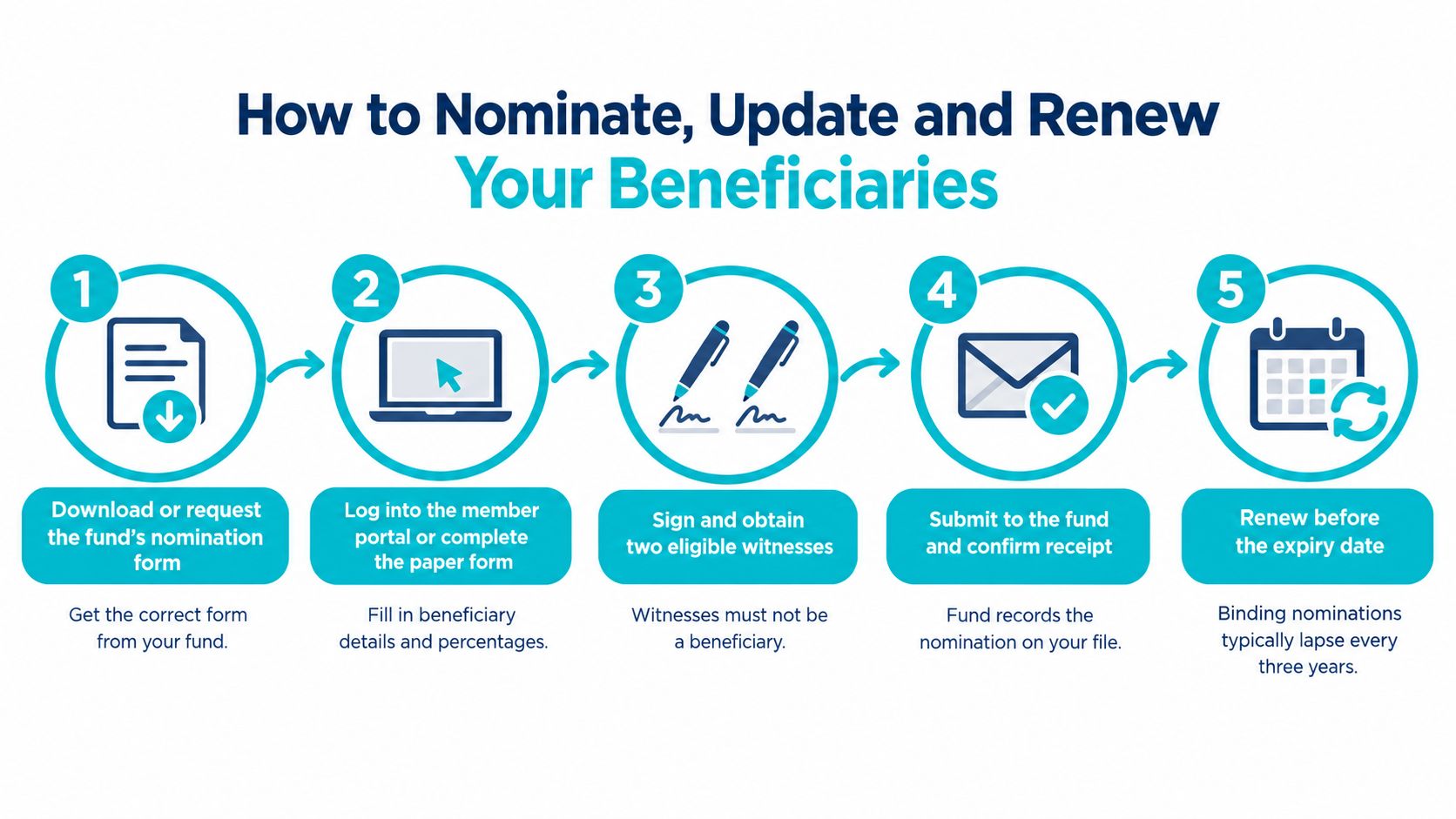
Get the right form. Download the fund's current binding death benefit nomination form or request it through the member portal. Do not use a template from another fund.
Use full legal details. Write each beneficiary's full legal name and relationship to you. Check that each person fits the permitted beneficiary category.
Set the shares. State the percentage for every beneficiary. The allocations must total exactly 100%.
Sign in the required manner. Sign and date the form in the physical presence of two adult witnesses. Neither witness should be a nominated beneficiary. Follow the fund's written requirements for signatures and witnessing.
Submit and confirm. Send the form through the fund's required channel. Then ask the fund to confirm that it has recorded the nomination. Keep the accepted copy with your Will and other estate documents.
Remote or electronic witnessing may not meet your fund's rules. If it requires wet signatures, use wet signatures. A completed-looking form can still fail if the signing process was defective.
Review the nomination after marriage, separation, divorce, a beneficiary's death, a new child, or a major change in family circumstances. Record the renewal date in your calendar and request written confirmation after each update. The fund's form, deed and acceptance record should all agree.
The SMSF difference
SMSF trustees must check whether the trust deed permits binding death benefit nominations, pass the required trustee resolution, and keep the arrangement within the deed's beneficiary categories. Member and trustee roles may overlap, but each role carries separate duties.
If dementia, illness or loss of capacity affects your family's planning, managing dementia finances offers practical ideas for authority, records and administration. Deal with those authority issues before capacity becomes uncertain. A nomination that expires or conflicts with the deed can return discretion to the trustee, so review both documents together.
Two Real-World Scenarios From Western Australian Families
Consider a Perth retiree whose documents are properly coordinated. He has a current binding nomination naming his wife and two adult children, with clear percentages. The fund can assess the nomination against the eligibility rules, and the family has a defined starting point rather than a vague preference.
The wife may be able to roll her share into her own super under the applicable rules. The adult children's treatment depends on whether they're tax dependants and on the taxable and tax-free components. The important point is not the family's intention alone. It's the combination of valid paperwork, eligible recipients and correct tax classification.
Now compare that with a Mandurah pre-retiree whose binding nomination has expired. His non-binding nomination doesn't set out clear percentages, so the trustee must consider the circumstances and may pay the benefit to the estate. The estate route can involve administration through the Will, which can delay access and create disagreement about how the money should be divided.
The difference between those families isn't necessarily wealth or family structure. It's whether the nomination still works on the date of death and whether the documents agree.
A tidy nomination doesn't remove every estate issue. It removes avoidable uncertainty before the family is under pressure.
I haven't treated hypothetical payment timelines, balances or legal costs as guaranteed outcomes. A trustee's process depends on the fund, the documents, the evidence and any dispute. That's precisely why a WA family with a substantial super balance should review the file while the member can still explain what they intended.
Common Mistakes That Derail a Super Death Benefit
A Perth couple can have the right intentions and still leave their family with a dispute. The usual failures are administrative, but their consequences affect control, tax and timing.
Letting a binding nomination lapse. Many funds require renewal after three years. Once the nomination expires, the trustee may no longer have to follow those instructions. Put the renewal date in your calendar and confirm the fund has recorded the replacement.
Using the wrong witnesses. A named beneficiary should not witness the form. Missing signatures, incorrect dates or ineligible witnesses can undermine an otherwise clear nomination.
Labelling an adult child a tax dependant without checking. An adult child may qualify to receive the benefit while still paying tax on its taxable component if they are financially independent. Check eligibility and tax status separately.
Ignoring the SMSF deed. For an SMSF, the deed and trustee resolutions can limit what the nomination achieves. A completed form does not override governing documents.
Failing to update after a relationship change. Divorce, remarriage, a new de facto relationship or a beneficiary's death can make an old nomination point to the wrong person or allocation. Review it as soon as the family changes.
Assuming the Will controls super. Super may pass directly to eligible dependants or the legal personal representative. The Will alone does not direct the trustee.
The practical cost can be a tax bill, trustee review or estate administration. Check the nomination against the Will, pension documents, insurance arrangements and SMSF deed. If those documents conflict, fix the inconsistency while you can still explain your decision.
Your Beneficiary Checklist and the Next Step
Use this as a file check, not a vague reminder.
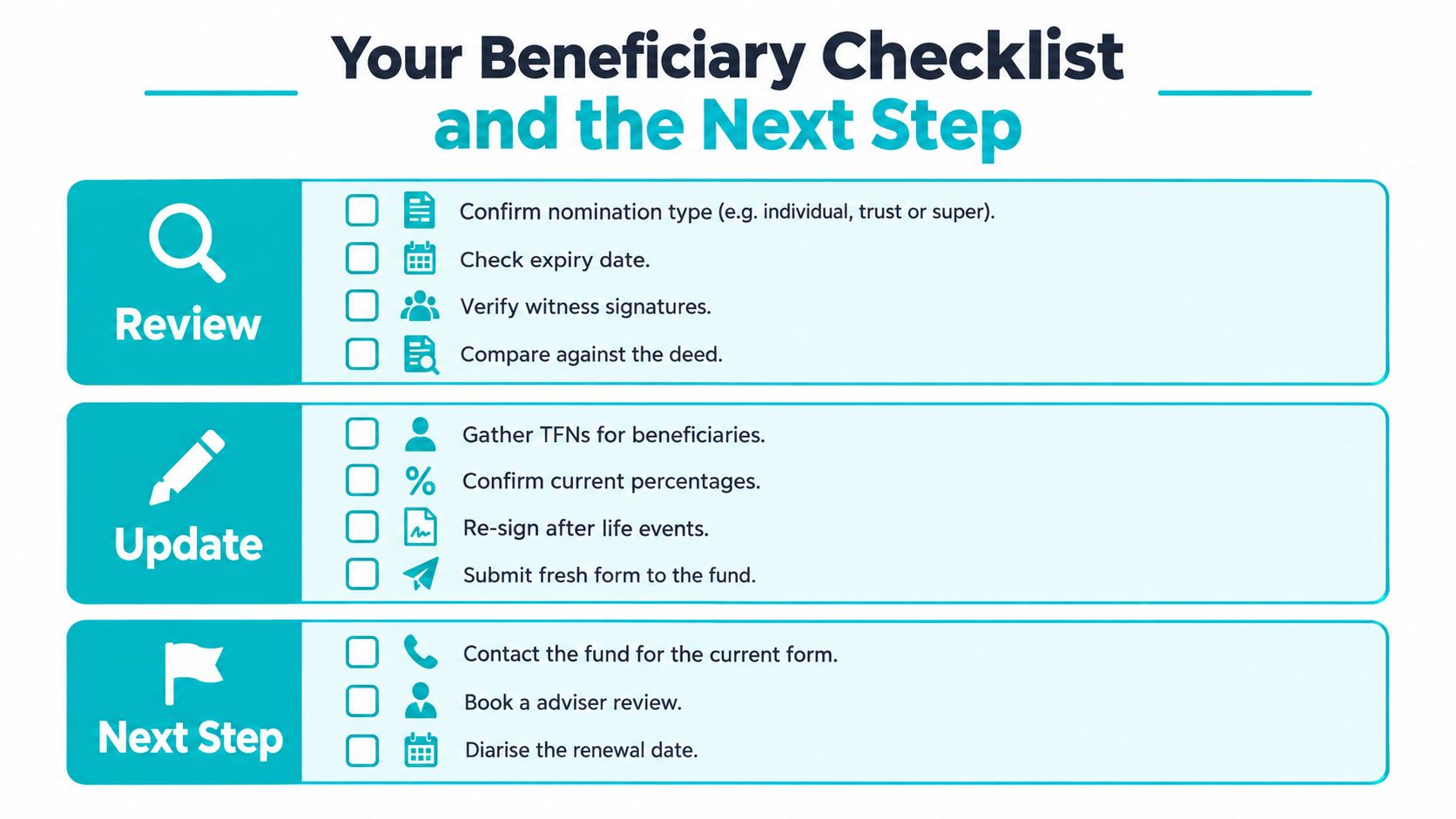
Review
- Confirm the nomination type: Is it binding, non-binding or reversionary?
- Check the expiry date: Has a binding nomination passed its renewal date?
- Verify the witnesses: Are the signatures, dates and witness eligibility correct?
- Compare the deed: Does the SMSF deed permit and support the nomination?
Update
- Confirm beneficiary details: Use full legal names and current relationships.
- Check percentages: Do the allocations total exactly 100%?
- Reassess dependency: Could the tax outcome differ for a spouse, adult child or former partner?
- Submit the current form: Keep proof that the fund received and recorded it.
Renew
- Set a calendar reminder: Review the nomination every three years where the fund's binding arrangement requires it.
- Review after life events: Recheck the documents after marriage, separation, death, illness or a major change in family support.
- Coordinate the estate plan: Make sure the nomination, Will, pension and SMSF deed point in the same direction.
If you've completed the self-check and still aren't certain, book a 10-minute initial call with Wealth Collective. The team can help you identify gaps in the nomination, tax-dependant assessment, pension instructions and SMSF documentation before your family has to deal with them.
Wealth Collective helps Perth and Dunsborough families review superannuation death-benefit nominations, coordinate them with broader retirement and estate planning, and clarify what needs updating. Visit Wealth Collective to arrange an initial 10-minute call and start with the documents you already have.