Business hours
Monday to Friday (8.30AM - 5PM)
Weekend (Closed)


You may already have TPD insurance and not know how much it covers, which definition applies, or whether the benefit would reach you when you need it. The premium comes from your super balance, so the policy can feel free while reducing the money available for retirement.
That makes TPD insurance in super more than an insurance decision. It's a retirement-balance optimisation problem involving cover, policy wording, claim evidence, release rules and long-term super growth. The cheapest-looking option can be the wrong option if it leaves you with inadequate protection or a retirement balance that has been steadily reduced without a clear reason.
When Your Super TPD Cover Becomes the Most Important Policy You Never Chose
Mark is 46 and works as a project manager. He never sat down with an adviser to choose TPD cover, but his super fund automatically provided it. After a serious back injury, he can't return to the demanding role he held for years. He assumes his super TPD benefit will be paid quickly and clear the mortgage.
That assumption is understandable. It may also be wrong.
Mark's injury could satisfy the insurer's TPD definition, but that's only the first hurdle. The super fund still has to decide whether the proceeds can be released under a superannuation condition of release. An insurer accepting a claim doesn't automatically mean the member can access the money immediately. APRA explains that both the insurance contract definition and the relevant superannuation release condition must be met before an insured benefit can be accessed on permanent incapacity grounds. APRA's explanation of insurance through super sets out this distinction.
Practical rule: Never treat the balance shown in your super portal as the same thing as money you can definitely receive after a disability.
What Mark expected
Mark expected one straightforward transaction:
- his doctors confirm he can't return to work
- the insurer accepts the TPD claim
- the benefit lands in his bank account
- the mortgage and household costs become manageable
The actual process may involve the insurer assessing whether he can perform other suitable work, the fund checking the permanent incapacity requirements, further medical evidence and restrictions on how the proceeds can be paid. The result depends on the policy wording and his circumstances, not just the seriousness of the injury.
Insurance through super remains a major source of TPD protection in Australia. Industry reporting indicates that around 8.1 million Australians have TPD protection through super, with broader estimates varying by reporting year. In 2023-24, group cover in super paid $3.0 billion in TPD benefits, according to industry reporting on insurance through super.
The rest of this guide covers what TPD in super is, how cover starts, the definitions that control claims, the claim process, the retirement-balance cost and the trade-off between holding cover inside or outside super. You'll then be in a better position to decide whether default cover is enough or whether you should get advice.

What TPD Insurance in Super Actually Is
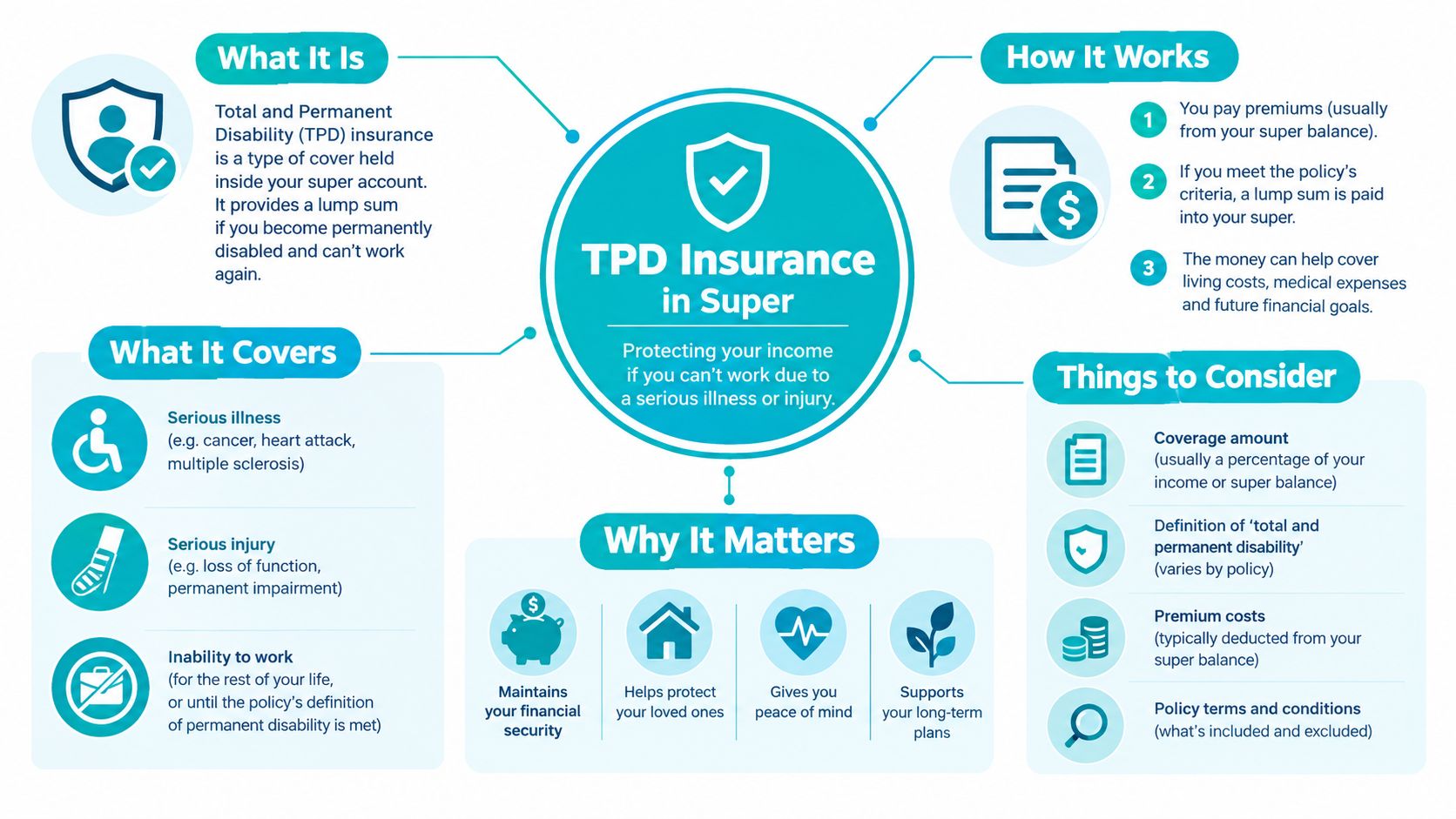
TPD insurance in super is usually a group insurance benefit arranged by the super fund trustee. You generally haven't applied for a personal policy in the same way you would with retail insurance. The trustee owns the policy, while you hold membership rights and an insured benefit under the fund's rules.
The mechanics are straightforward, but the legal pathway isn't.
- The fund arranges group TPD insurance for eligible members.
- The premium is deducted from your super balance, rather than your take-home pay.
- You make a claim when illness or injury may meet the policy definition.
- The insurer assesses the claim under the policy.
- The trustee checks whether super law allows the benefit to be released.
- The proceeds are paid into super or released according to the applicable rules.
The benefit is generally a lump sum, but the insurer's decision and the trustee's release decision are separate decisions. The insurer asks whether you meet the TPD definition. The trustee asks whether the payment can be accessed under superannuation law. Both must be satisfied before the money is available to you.
The tax question
Tax treatment depends on how the benefit is paid, the member's circumstances and the structure of the super account. A TPD benefit paid into super isn't automatically the same as a tax-free personal payment, and accessing money from super can involve tax consequences.
That matters when comparing cover. A lower premium inside super may look attractive, but the ultimate value of the benefit depends on how much is insured, whether the proceeds can be released, and how much reaches the member after any applicable tax. Obtain personal tax advice before relying on a projected net payout.
The key point is practical: TPD in super isn't just a policy sitting beside your retirement account. It's integrated with the preservation system. Premiums reduce the balance now, and a successful claim still has to move through the super rules before it becomes usable capital.
Automatic Cover and Retained Cover Side by Side
Most members encounter TPD through automatic cover. The fund applies eligibility rules, starts a default level of insurance and deducts the premium without requiring a separate application. This is convenient, but convenience can hide gaps in the amount insured and the definition that applies.
AustralianSuper provides a useful worked example of how automatic eligibility can operate. Its public rules state that default cover can start when a member is 25 or older, has at least $6,000 in super and has received an employer contribution. The fund makes TPD available to members aged 15 to 64, with optional cover levels up to $3 million, subject to the fund's rules. AustralianSuper's TPD cover information shows why members need to check the actual fund terms rather than assume every super account works the same way.
Retained cover is different. It matters when automatic eligibility changes, perhaps after a career break, unpaid leave, a period of low contributions or a balance falling below the fund's requirement. The fund may give you an opportunity to keep existing cover by making an election or continuing to meet specified conditions.
| Feature | Automatic Cover | Retained Cover |
|---|---|---|
| How it starts | The fund activates cover when its eligibility rules are met | The member elects to keep cover after automatic eligibility changes |
| Member action | Often none at commencement | Usually requires an election within the fund's stated window |
| Underwriting | May be limited because the cover is default | May remain on existing terms if retained correctly |
| Main risk | The default amount may not match your needs | Missing the election can cause cover to lapse or require new assessment |
| What to check | Age, balance, contributions, amount and definition | Election deadline, premium, continuation rules and reactivation terms |
The practical traps
A career break doesn't automatically mean your cover is protected. Nor does an old insurance statement prove that cover remains active today. Check the current portal, current premium and current policy wording.
If retained cover lapses, restoring it may require a new application or medical underwriting. That can be a serious problem after a diagnosis, an injury or a change in health.
My recommendation is direct. Treat automatic cover as a starting point, not a completed insurance plan. Confirm when it commenced, what event could end it and whether you need to opt in to preserve it.
The Three TPD Definitions That Decide Your Claim
The event doesn't decide a TPD claim by itself. The definition written into the policy does. A serious injury may end your career but fail the policy test if you can still perform another suitable occupation or basic daily activities.
MoneySmart identifies three practical TPD definitions used in Australia, own occupation, any occupation and activities of daily living.
Own occupation
Own occupation focuses on whether you're unlikely to return to your specific job or profession. A surgeon who develops a tremor, a pilot who loses the capacity required for flying or an accountant who can no longer perform accounting work may have a stronger claim under this wording, even if another type of work remains possible.
This is generally the more claimant-friendly definition, but it's not the standard assumption for cover held inside super. Check the policy rather than relying on the name of the benefit.
Any occupation
Any occupation asks whether you're unlikely to work again in an occupation suited to your education, training or experience. It doesn't matter only that you can't return to your previous role.
A 45-year-old accountant who can't return to desk-based accounting might still fail an any occupation test if the insurer considers her capable of suitable light clerical work. Under own occupation wording, the same facts could produce a different result because the assessment focuses on her established occupation.
Activities of daily living
Activities of daily living, often called ADL, focuses on basic self-care tasks. These can include bathing, feeding, dressing, toileting and mobility without assistance. A person may be unable to work but still fail an ADL test because they can perform these activities independently.
| Definition | Who it suits | Claim difficulty | Common use in super |
|---|---|---|---|
| Own occupation | People whose specific profession has unusual duties or licensing requirements | Usually less restrictive | More commonly associated with cover outside super |
| Any occupation | Members whose incapacity prevents suitable work across their education, training or experience | More demanding | Common in super-held TPD |
| Activities of daily living | People with severe functional impairment | The hardest for many working-age claims | Appears in some default and older policies |
Read the PDS and the insurance guide, not just the premium line. A definition generally can't be upgraded just because your circumstances change, so selecting the right structure at the start matters.
The Two-Hurdle Claim Process Inside Super
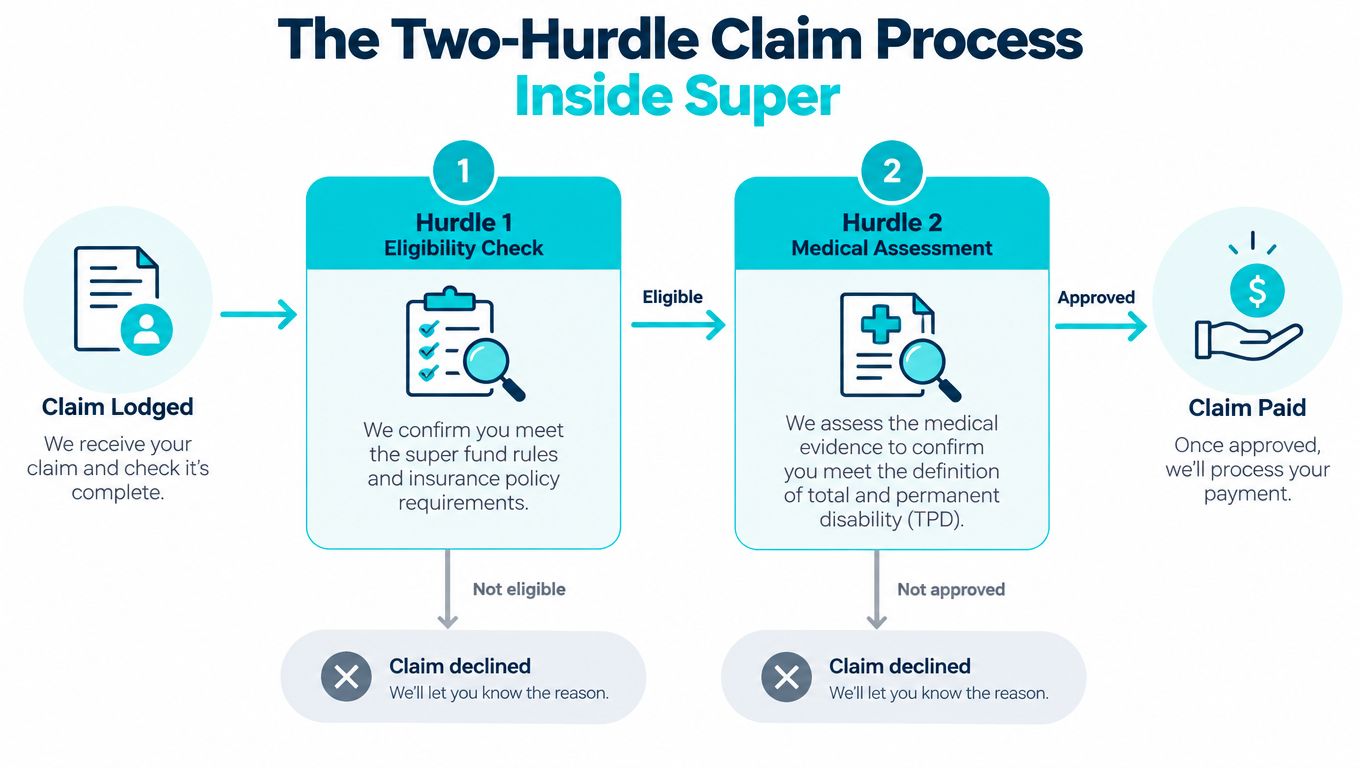
An insurer saying “accepted” doesn't always mean money is in your bank account. TPD claims inside super pass through two separate tests, and the timing can place real pressure on household cash flow.
Hurdle one is the insurance contract
The insurer assesses whether your illness or injury meets the policy's TPD definition. That can involve:
- medical reports from treating practitioners and specialists
- evidence about your duties and employment history
- information about education, training and transferable skills
- employer statements
- vocational evidence about suitable work
- proof that the required period of incapacity has been met
Cbus states that members usually need to be off work because of their disability for at least three consecutive months before a claim can be assessed. Other policies can have different qualifying periods, so read your policy documents rather than assuming a universal waiting period. Cbus claim guidance also highlights the importance of the supporting evidence.
Hurdle two is the super release rule
The trustee then needs to confirm that a superannuation condition of release applies. Permanent incapacity is the central pathway for many TPD claims, but the trustee still needs the required medical certification and other evidence before releasing the benefit.
Members can get caught here. The insurer may accept the contractual claim, while the trustee requests further evidence for the release decision. Alternatively, a member may satisfy a medical condition but fail the policy's definition.
The TPD insurance claim process should therefore be managed as a coordinated insurance and superannuation matter, not as a single form submission.
Evidence starts early
Don't wait until the claim form arrives to gather records. Keep specialist reports, treatment history, role descriptions and employment information organised. A diagnosis alone doesn't prove permanent incapacity. The claim needs evidence connecting the condition to the policy definition and the super release rules.
The Hidden Cost to Your Retirement Balance
Premiums paid from super reduce the balance that remains invested for retirement. That arrangement protects take-home cash flow, but it doesn't make the insurance free. Every premium is an amount that no longer earns investment returns inside your account.
The trade-off is material because TPD benefits are intended to replace the retirement savings and future earning capacity lost through permanent disablement. Industry reporting cites average TPD benefits of about $144,000, while another APRA-based industry estimate puts the average group TPD amount claimed at roughly $141,000 in 2022-23. Industry reporting on TPD claims and benefit sizes shows that these are substantial benefits, but they may still fall well short of a household's mortgage, dependants' needs and long-term income replacement requirement.
Model the premium, not just the benefit
The right comparison is not “premium versus no premium”. It's:
- what the cover would pay if accepted
- how long the cover is likely to remain relevant
- what the premiums will remove from super
- what balance you're targeting at retirement
- whether your household can fund protection outside super
- whether the definition is strong enough to justify the ongoing cost
A 35-year-old who pays premiums from super for decades gives up the opportunity to leave those amounts invested. The exact opportunity cost depends on premium changes, investment returns, salary, cover levels, fund fees and contribution patterns. Don't accept a precise projection unless those assumptions are shown.
The adviser's test: If the premium is reducing your retirement balance, the cover must provide a clearly understood benefit that you're prepared to keep funding.
Multiple super accounts make this harder. You may pay overlapping premiums, hold different definitions or carry cover in an account you no longer actively use. Review the insurance attached to every account before consolidating or closing one. Guidance on life insurance through super can help frame that review, but your own policy documents control the answer.
TPD in Super Versus TPD Outside Super
Holding TPD inside super is often cheaper and easier on household cash flow because premiums come from the super balance and group arrangements can offer access without the same application process as retail cover. That advantage comes with constraints.
Cover held personally can offer a broader occupation definition, depending on the policy available and underwriting outcome. It may also pay directly to you rather than first moving through the super account. But you'll generally fund the premium from after-tax cash flow and may need full medical underwriting.
| Decision factor | TPD inside super | TPD outside super |
|---|---|---|
| Premium funding | Deducted from the super balance | Paid from personal cash flow |
| Policy structure | Usually group cover owned by the trustee | Personal policy owned under the retail arrangement |
| Definition | Often any occupation, with some policies using ADL wording | May provide own occupation or other broader wording |
| Access | Requires insurer acceptance and a super release pathway | Generally avoids the super preservation hurdle |
| Retirement impact | Premiums directly reduce super capital | Premiums don't directly reduce the super balance |
| Underwriting | Default cover may involve limited underwriting | Medical and financial underwriting is commonly required |
| Suitable use | Basic protection where affordability and convenience matter | Stronger occupation-specific protection where the cost is justified |
The super rules are the dividing line. Trustees can generally only acquire TPD cover that aligns with a permanent incapacity condition of release. If insurance proceeds are paid into the super account, the member may still be unable to withdraw them until a full release condition is met. MLC's technical guidance on holding TPD through super explains why a successful claim isn't automatically an immediately accessible payment.
Tax treatment also differs according to ownership and payment pathway. Don't assume “inside” or “outside” is automatically tax-free. Get advice on the policy structure, the intended recipient and your personal circumstances.
My view is simple. Default super TPD is often better than having no cover, but it isn't automatically suitable for a professional, business owner or high-income household with a specific occupation to protect. Compare cost, definition, accessibility and retirement impact together. What TPD insurance covers is only the starting question.
What to Do Next and How Wealth Collective Can Help
You can complete a useful first review in under an hour. Log into each super account and record the information below.
- Confirm the cover: Write down the TPD benefit amount, definition, premium and policy name.
- Check eligibility: Confirm whether automatic cover is active or whether you need to opt in or retain it.
- Review the trigger: Look for age, balance, contribution and lapse rules.
- Check your occupation: Ask whether the policy assesses your old job, suitable alternative work or daily living activities.
- Review health and history: Note any pre-existing conditions, exclusions or underwriting terms that could affect a future application or claim.
- Model the balance: Ask how premiums could affect your super over the next 10 to 20 years, using assumptions you can understand.
- Compare ownership: Decide whether the convenience of super-held cover outweighs its definition and retirement-balance limitations.
Don't cancel existing cover before checking whether replacement cover is available and suitable. A new application can produce different terms, exclusions or premiums, and cancelling first can leave you exposed.
A proper review should connect the policy to your actual mortgage, dependants, occupation, income, savings and retirement target. Wealth Collective's Protection Plus process reviews personal insurance and superannuation arrangements, including the choice between holding cover inside or outside super. An introductory call is offered at no cost to map your existing TPD arrangements against your needs before any recommendation is made.
The right outcome may be more cover, a different definition, a different ownership structure or no change at all. The wrong outcome is continuing to pay for a policy you've never read and assuming it will solve a problem it may not cover.
Wealth Collective can review your TPD insurance in super, test the two-hurdle claim pathway and model the effect of premiums on your retirement balance. Visit Wealth Collective to book an initial call and start with a clear assessment before making changes.