Business hours
Monday to Friday (8.30AM - 5PM)
Weekend (Closed)


Own occupation TPD generally pays when you can no longer work in your own occupation, while any occupation TPD pays only when you cannot work in any job you are reasonably qualified for by education, training or experience. If your comparison stops at which premium is cheaper, you're looking at the wrong half of the decision.
Ask yourself this. A hand injury ends the work you're paid for, yet you could still teach, supervise or sit in an office. Does the policy pay? The occupation test answers that. The sum insured does not.
Two policies with the same benefit can reach opposite decisions on the same injury. Insurers weigh medical records, the duties you performed in practice, and whether another job is a reasonable fit for your education, training and experience. Premiums and ownership still matter. They don't replace the test.
That is the practical core of tpd own occupation vs any occupation. The useful comparison starts with the wording, then follows the claim file, the tax on the benefit, and the documents that prove the definition.
Own Occupation vs Any Occupation TPD at a Glance
Which test would your claim have to pass: the job you do, or any job the file says you could still do? Own-occupation TPD generally pays when an insured person can no longer work in their specific occupation. Any-occupation TPD asks whether they are unable to work in any occupation for which they're reasonably qualified by education, training or experience. The first test follows the duties that produced the income. The second looks for another suitable form of work.
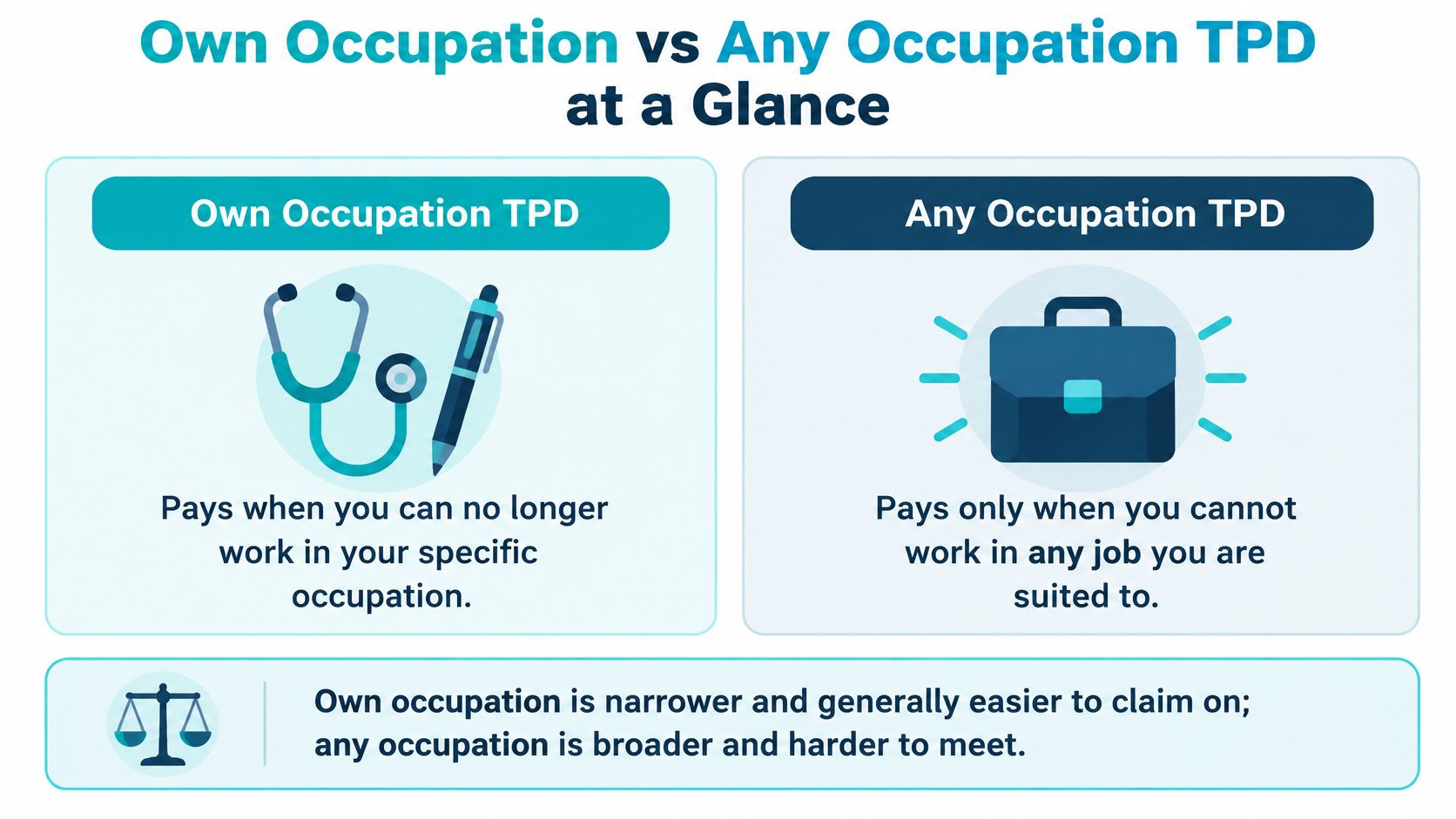
Own occupation and any occupation TPD side by side
| Criterion | Own occupation | Any occupation |
|---|---|---|
| Test applied | Cannot work in your own occupation | Cannot work in any occupation you are reasonably qualified for |
| Typical premium | Higher | Lower |
| Usual holding | Generally outside super, or through linked arrangements | Commonly held inside super |
| Best fit | Specialists, executives and business owners | Workers whose skills transfer to other roles |
Own-occupation cover is typically more expensive and generally cannot be held inside superannuation under current rules, though some insurers still offer it outside super or through linked arrangements. The premium gap is real. The definition gap decides whether the evidence in a claim file answers the insured test at all.
The scale is not niche. ASIC's Report 633 counted more than 13.4 million Australians with TPD cover at 31 December 2018, almost 90% of it obtained through superannuation; in the 12 months to that date, consumers paid approximately $3.548 billion in TPD premiums and lodged more than 26,000 claims. Most buyers therefore meet the wording inside a default super arrangement before they ever compare definitions. For the plain-language basics, read what TPD insurance is.
The definition decides whether a claim succeeds, not only what the premium costs.
If income depends on a narrow skill set, own occupation is the test built around that income. If skills transfer across roles, any occupation can be reasonable, provided the wording, claim documents and tax treatment have been read rather than assumed from the label.
How Each Test Plays Out in a Real Claim
The same injury can pay under one test and fail under the other. The insurer's question changes with the definition, and so does the evidence that answers it.

A cardiac surgeon who can still teach
Say a cardiac surgeon loses fine motor control after a hand injury and can't operate. An own-occupation policy generally pays, because the insured person can't work as a surgeon. An any-occupation policy may decline if teaching or medical administration is a suitable job given that person's qualifications.
The insurer asks whether surgery is the occupation, or whether another role the surgeon is already qualified for remains open. It weighs specialist reports on the hand, a description of operating lists and on-call duties, and an earnings history that shows income came from operating, not from lecturing.
An accountant who can't sit through a full day
Say an accountant develops a back injury and can't sit through long client days, yet can manage light admin for shorter stretches. An own-occupation test stays tied to the accounting role and the duties that role required. An any-occupation test asks whether a reasonably suitable job remains, which might include a reduced admin or review role if the person's training supports it.
Here the file needs occupational therapy notes on sitting tolerance, a role description that lists billable hours and site visits, and payslips that show what fraction of income depended on full days at a desk. A vague letter that says "unfit for work" doesn't answer either test.
A tradesperson who can still estimate
Say a tradesperson injures a knee and can't return to tools on site, but can supervise or estimate. The outcome turns on whether the policy treats supervision as part of the insured occupation or as a different job. If the insured occupation is "carpenter" and estimating was never a material duty, an own-occupation claim is stronger. If the person already spent half the week pricing jobs, an any-occupation assessor may treat estimating as suitable work.
The same injury can pay under one test and fail under the other.
Write down your actual daily duties and set them beside the occupation wording in the policy. That list is the start of a claim file, and our TPD insurance claim guidance sets out how those documents are assessed under each definition.
What Claim Outcomes Reveal About Each Definition
Decline rates don't crown a winner. They do show which test most claims face.
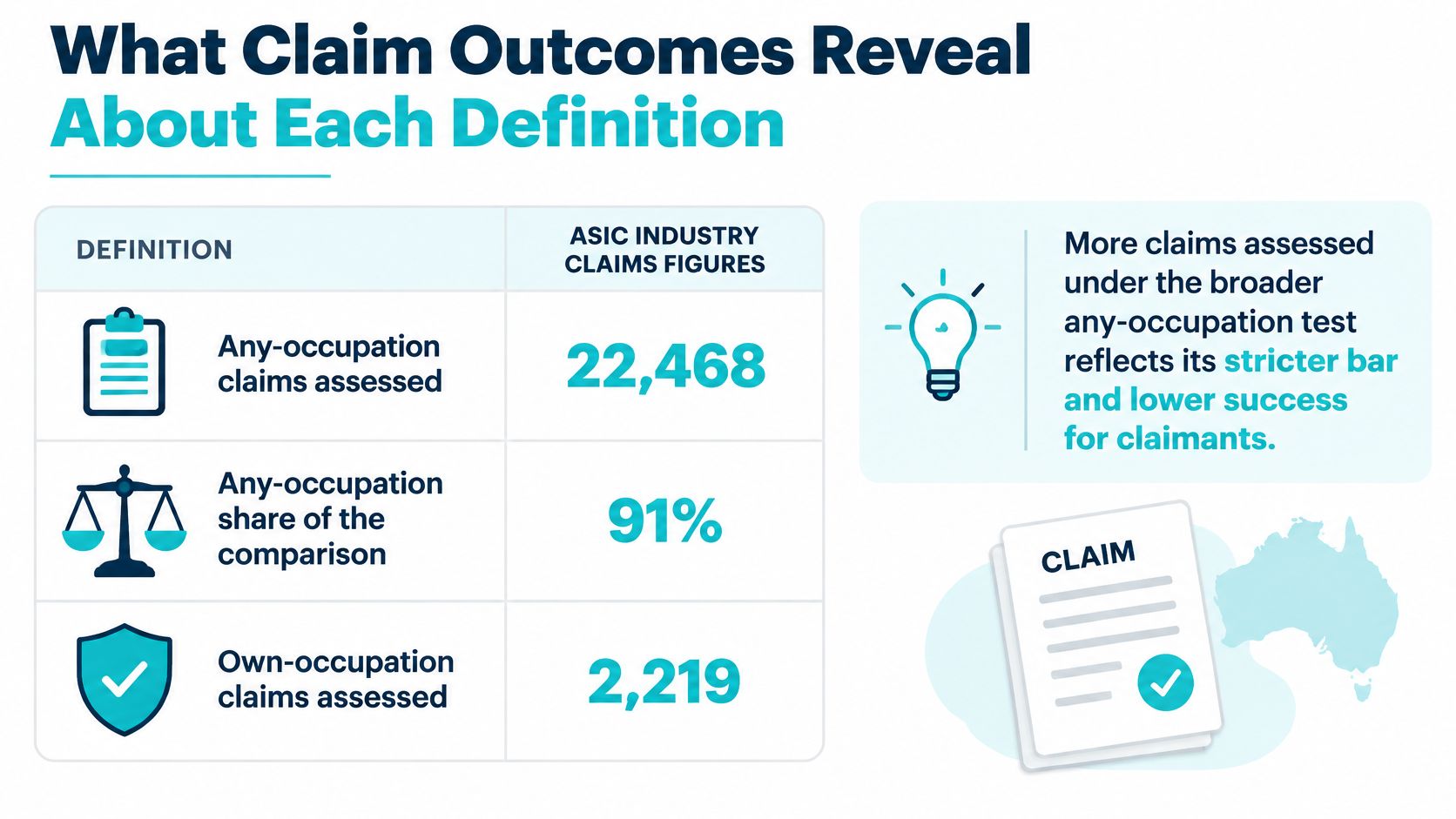
ASIC TPD claims figures by definition
| Measure | Figure | What it means |
|---|---|---|
| Any-occupation claims assessed | 22,468 (about 91%) | Most TPD claims are handled under this definition |
| Own-occupation claims | About 5% | A small share of claims, often for specialised workers |
| Average declined rate, any occupation | About 12% | Typical outcome across this definition |
| Average declined rate, own occupation | About 14% | Slightly higher, but not proof of a harder test |
| Declined rate, activities-of-daily-living | Markedly higher than either occupation test | Narrow wording declines more claims than the occupation label |
ASIC's Report 760 examined 26,150 TPD claims assessed between 1 January 2016 and 31 December 2017. In the detailed 2018 industry data, 22,468 claims were assessed under an any-occupation definition, about 91% of the relevant comparison, while own-occupation claims were about 5%. Average declined rates were about 12% for any-occupation claims and about 14% for own-occupation claims.
What those percentages don't prove
A gap of roughly two percentage points looks decisive until you weigh the size of each book. Medical evidence, policy wording, waiting periods, exclusions, employment history and the nature of the disability all move the result. The smaller own-occupation pool concentrates specialised workers whose duties are hard to replicate in another role, so a slightly higher decline rate can reflect who buys that cover rather than a harsher test.
The starker contrast sits outside the occupation comparison altogether. Activities-of-daily-living definitions, which ask whether you can manage basic self-care tasks rather than hold a job, decline far more claims than either occupation test. The breadth of the wording moves outcomes more than the own-versus-any label does. A policy can carry a generous benefit amount and still fail on a definition clause the holder never read.
The definition also decides what the assessor must be satisfied of, which decides which documents carry the claim. An any-occupation test weighs whether other work suits your training and experience, pulling qualifications and employment history into the file. An own-occupation test narrows the dispute to the duties of one role. The premium is the visible difference at purchase. The wording is the difference at claim.
Compare the exact occupational test and the claim criteria in your policy. Two products with the same benefit amount can pay on different definitions, so matching the wording to your actual duties matters more than matching the sum insured.
Cost, Tax and Ownership Trade-Offs
Own occupation cover usually costs more, so a premium comparison only means something once you place it beside the tax treatment of a successful claim.
ASIC's example statement of advice states that TPD benefits paid through superannuation may be partially or fully taxable, with tax potentially reaching 22% of the taxable component. Personally owned TPD cover is generally tax-free on claim, while premiums paid personally aren't tax-deductible. Cover held through super can be funded through contributions that may qualify as concessional contributions, subject to the rules and limits that apply.
Cash flow against the amount that arrives
That is a trade-off between monthly cash flow and the dollars that arrive if you claim. A cheaper premium inside super can shrink the benefit once tax is applied. A higher personal premium can leave more of the benefit in your hands, paid from after-tax income along the way.
Protection Plus simplifies personal insurance and superannuation, helping clients get better coverage and lower fees. The ownership question still has to be read against the benefit the premium buys, not against the premium alone. Our notes on TPD insurance in super set out how that holding changes access to the benefit.
Two households, two sensible answers
Say one household has a large super balance and a tight monthly budget. Funding any-occupation cover from concessional contributions can ease the cash-flow strain, and the members accept that part of a future benefit may be taxed. The fit is cash flow first, provided the occupational test still matches how they earn.
Say another household has dependants, a specialist income and little spare super. Personal own-occupation cover costs more each month and the premiums aren't deductible, yet a successful claim is generally tax-free. For that household, the after-tax benefit can matter more than the saving on this year's premium.
Read each premium quote against the benefit it buys, because tax changes with the claim amount and the way the policy is owned.
Neither answer travels well without the rest of the plan. Super balance, dependants and existing cover all change which side of the trade-off is rational. A quote that ignores those three items is only half a comparison.
Claim Readiness and Policy Wording Checks
A claim succeeds when the evidence fits the occupation test written in the policy. Premium decides the price; wording decides which duties must be proved and which work the insurer can call suitable.
APRA-based reporting cited by Shine Lawyers shows TPD claim rates rose from 262 per 100,000 policies in 2019 to 361 per 100,000 in 2025. A rising claim count means more definitions are being argued under real files, so readiness matters as much as the own-versus-any comparison itself.
Cheaper any-occupation cover can still be valuable. Its usefulness depends on policy wording, medical evidence, employment history and how "suitable" work is assessed. These figures do not make one occupational definition universally superior. They do show that disputes follow weak files.
Documents worth keeping before you need them
Keep these before any claim is lodged:
- Current role description. The version that lists duties, rather than a one-line job title.
- Earnings records. Payslips, business drawings or tax returns that show what the role produced.
- Qualifications. Degrees, tickets and licences that define the work you are reasonably qualified for.
- Medical records. Treating-doctor notes that speak to those duties, rather than a generic unfit certificate.
- Evidence of actual daily duties. Rosters, site diaries or a short written account of a normal week.
That file should let an assessor match capacity to tasks. For own occupation, the pressure point is whether you can still perform the duties of the role you held. For any occupation, the pressure point widens to other work your training, education or experience could make reasonable.
Wording to read while you're well
Then check the policy itself:
- The occupation definition. Own occupation, any occupation, or a blend through a linked policy.
- Waiting or qualification periods. The time you must be off work before the test is applied.
- Exclusions. Pre-existing conditions, hazardous pursuits or duties the insurer carved out.
- An activities-of-daily-living test. Some policies replace the occupation test with an inability to perform two or three specified activities, such as feeding, dressing or washing.
Record who owns the policy and where premiums are paid from, because ownership affects who receives a benefit and how tax is applied to it. Keep that beside the documents above, since a clean claim file connects the definition, the evidence and the payment path.
Default super cover is where this check matters most, because many members assume they hold meaningful protection without ever reading the TPD test.
Career changes, promotions and a move into running a business can alter which definition fits. Review the policy when the work changes, not only when a premium notice arrives.
Which Definition Fits Your Working Life
The right test follows the income you'd lose, not a general preference for the cheaper premium.
Five working lives, five different fits
A dual-income family with a mortgage and one specialist earner often needs both answers. Own occupation can justify its premium where that earner's income is hard to replace. Any occupation can suit the partner whose skills already move across roles, so the household isn't paying for the narrower test twice.
A small business owner should check whether the business depends on personal exertion, and whether the policy recognises the owner's role in running it. A definition that ignores that role can pay less than the owner expects, because the insurer may point to residual management duties as suitable work.
A senior engineer or a lawyer usually has income tied to a narrow expertise. Own occupation is often the stronger fit here. An any-occupation assessor can point to teaching, consulting or a reduced practice as work the person is already qualified to do, which turns a claim that looked solid into a declined one.
A tradesperson whose week already includes supervision or estimating may find any occupation cheaper and still workable, if those skills transfer and the policy would treat them as suitable. The test weighs the duties, not the trade label.
A young professional early in a career can use any occupation as a sensible base, then review it as the career narrows into a specialty. Paying for own occupation before the skill set has narrowed often buys a test the person doesn't yet need.
A sequence you can run on your own policy
- Write down the occupation's core duties and the income each would cost if it were lost.
- If that income depends on a narrow skill set that's hard to replace, own occupation is the direction to test.
- If the skills transfer to other suitable work, any occupation may be sufficient.
- Compare premiums under each definition and each ownership structure at the same cover amount.
- Confirm which test the policy applies, because cover held inside a default super arrangement frequently carries the narrower definition and a different tax treatment on any payout.
That last step decides more claims than the sum insured does. ASIC's Report 498 found that nearly half a million Australians were covered by a very narrow activities-of-daily-living definition that generally pays only in the most catastrophic circumstances. A headline sum insured doesn't reveal a trigger like that, and neither does the premium. The definition determines whether the claim succeeds at all.
Wealth Collective's advice covers personal insurance, superannuation, investment, debt reduction, retirement planning and strategic financial advice, and its Protection Plus service simplifies the personal insurance and superannuation side of that picture, helping clients get better coverage and lower fees. If the wording, the tax treatment and the likely claim file need a proper look, you can book a free 10-minute intro call and the team takes care of the rest. Visit Wealth Collective to arrange that call.