Business hours
Monday to Friday (8.30AM - 5PM)
Weekend (Closed)


At 58, a lot of people in Perth feel caught between two good options that don't seem to fit together. They want more time. Less commute. Fewer long weeks. Maybe fewer site visits, fewer flights, or fewer weekends spent recovering from work. But they also want to protect the lifestyle they've built.
That's where a transition to retirement calculator becomes useful. Not because it gives a final answer on its own, but because it helps you test whether reducing work has to mean a sharp drop in income. For many pre-retirees, that's the key question.
In practice, this often starts with a simple thought. Could I cut back a day or two a week and still cover the mortgage, groceries, rates, travel, and the extras that make retirement feel worth planning for? A good calculator helps turn that thought into something measurable.
Easing into Retirement with a TTR Strategy
A common scenario looks like this. A 58-year-old professional in Perth has done the hard part. They've built up super, stayed employed, and kept the household running. Now they're starting to ask whether full-time work still makes sense for the next several years.
They don't want to stop overnight. Most don't. They want a gradual shift. More flexibility, less pressure, and enough income to avoid feeling like semi-retirement is a financial setback.
That's the purpose of a Transition to Retirement, or TTR, strategy. It allows eligible Australians to keep working while drawing an income stream from super. Used well, it can support reduced hours, improve tax efficiency, or help direct more money back into super through salary sacrifice.
Why this matters in WA
In Western Australia, the decision is rarely just about “retirement age”. It's about lifestyle. FIFO workers may want to move into a local role. Small business owners may want to keep the business ticking over without carrying the same load. Perth professionals may want three-day weekends before they want permanent retirement.
A calculator helps you test those options before making a big change.
You don't need to decide your whole retirement plan in one sitting. You need to see whether the next step is affordable.
The first question most people are really asking
Most clients aren't asking for a formula. They're asking something more practical:
- Can I work less without straining cash flow
- Will drawing from super now hurt me later
- Am I missing a tax opportunity
- What does this look like if I plan to stay in Perth, or split time with Dunsborough
A transition to retirement calculator is the first pass at those questions. It won't capture every detail, but it gives shape to the trade-offs. That matters, because retirement planning usually becomes clearer once you can see the effect of one change at a time.
What a TTR Calculator Actually Shows You
A standard retirement calculator asks, “Will I have enough when I stop work?” A transition to retirement calculator asks a different question. “What happens if I keep working, change my hours, and start drawing from super at the same time?”
That's why I think of it as a financial dress rehearsal for retirement. You're not modelling a finished retirement. You're testing the in-between years, when your salary, super contributions, pension drawdowns, and tax position all overlap.

The three outputs that matter
Most TTR calculators are useful when they help you answer three practical questions.
How do I replace lost income if I reduce work hours
The calculator models options such as drawing a TTR pension while cutting back at work, or combining reduced salary with super income to keep household cash flow steadier.What happens to my final super balance
This is the part many people skip. Short-term income relief feels good, but you also need to see what's left at full retirement if you start drawing earlier.Is there a tax advantage
Some strategies involve salary sacrifice into super while drawing pension income. That can improve tax efficiency, but only if the settings match your age, income, and contribution limits.
What strategy options it usually models
The core of a TTR calculator is modelling strategic options. These include maintaining your income while reducing work hours by drawing a TTR pension, with a minimum of 4% of your balance annually and a maximum of 10% for those under 65 under ATO rules. It can also test boosting your super through salary sacrifice while drawing the minimum pension to live on. 68% of TTR adopters aged 60 to 64 use it to maintain their income while cutting work hours by 20%, according to the Industry Super TTR overview.
Practical rule: If the calculator only shows a bigger income today, but not the effect on your super at retirement, it's incomplete.
What to compare alongside it
Once you've modelled the TTR years, it also helps to understand how those retirement income decisions connect to withdrawal planning later on. A practical companion read is this Top Wealth Guide on safe withdrawal, especially if you want context around how retirement income can be sustained over time.
If you want to compare a TTR model with a broader retirement projection, use a general Australian retirement calculator as a second lens. The two tools serve different jobs. One tests the transition years. The other helps you see the long game.
Gathering Your Inputs The Key Numbers You Need
A TTR calculator is only as useful as the numbers you feed into it. If the inputs are rough, the output will look precise but may point you in the wrong direction.
Start with the dates that shape the strategy
Begin with your age, your likely retirement timing, and how you expect work to change over the next few years.
Your current age
TTR strategies only become available once you reach preservation age. For many people now approaching retirement, that is age 60. If you are unsure, confirm it against your super fund or the ATO rules before relying on any calculator result.Your intended retirement age
This is less about picking an exact finish line and more about setting the length of the transition period. A three-year glide path produces a different result from a seven-year one.Your work pattern during the transition
A calculator may not ask whether you are cutting from full-time to four days, stepping away from FIFO, or moving into consulting. You still need to decide that upfront, because the income gap is what the strategy is trying to manage.
That last point matters more in WA than many people expect. A client shifting out of FIFO often sees a sharp drop in allowances, overtime, and site-based income, not just base salary. If you only enter your headline pay, the calculator can understate the lifestyle adjustment required.
Use current figures, not estimates from memory
The best starting documents are your latest payslip, your most recent super statement, and last year's tax return. Five minutes of preparation here usually saves a lot of confusion later.
Gather these figures:
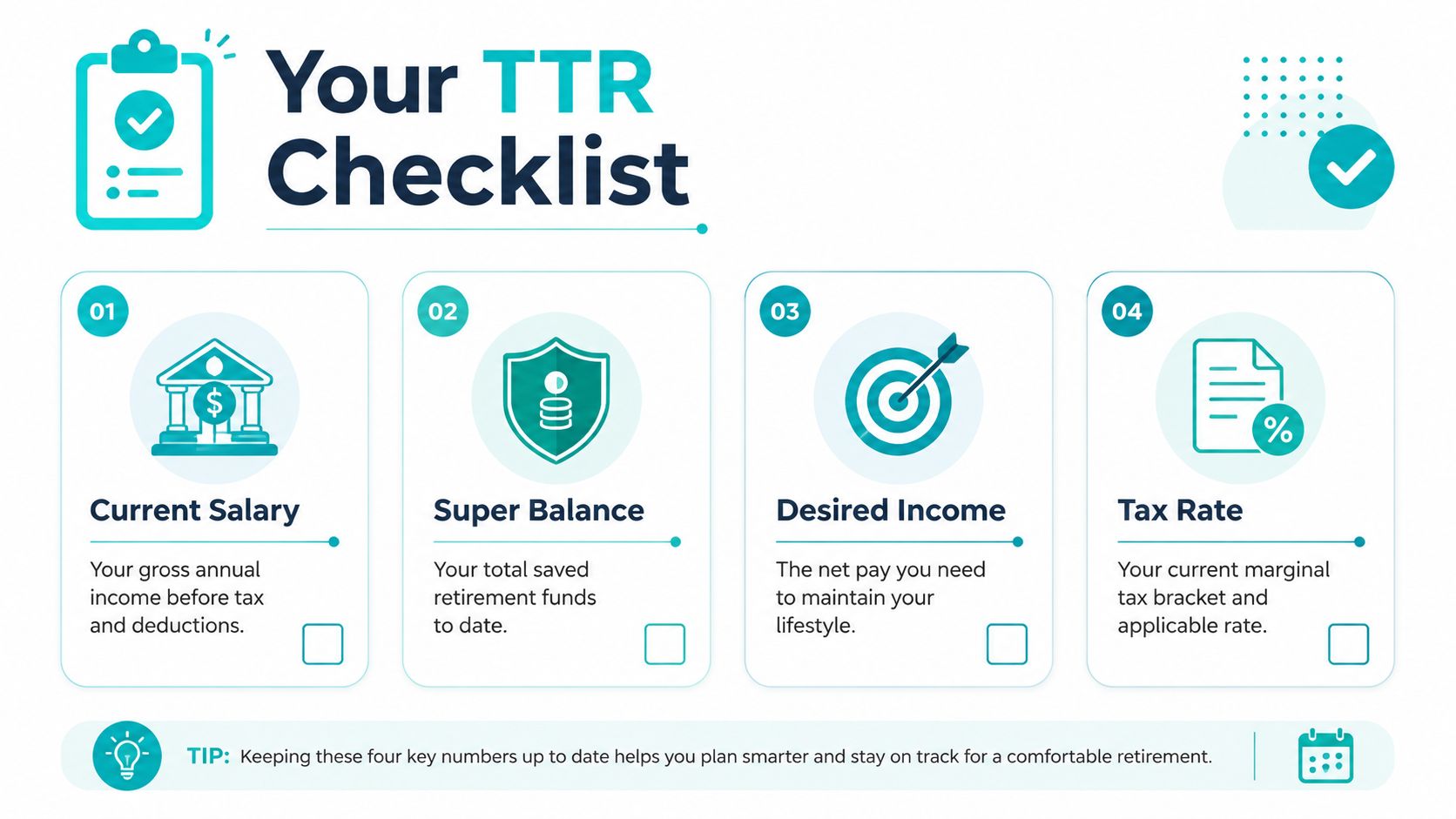
Gross annual salary
Include your normal base pay and be realistic about bonuses, overtime, and allowances if they are a regular part of your income.Current super balance
Use the actual account balance, not what you think should be there. TTR pension payments and contribution strategies are both sensitive to the opening balance.Employer and personal contributions
Include Super Guarantee amounts, salary sacrifice, and any personal deductible contributions already in place.Other income or debts that affect cash flow
Investment income, mortgage repayments, car finance, or support for adult children can all change how workable a TTR plan feels month to month.Your tax position
Many practical benefits are situated here. A calculator can only give a useful estimate if it has a fair picture of your taxable income and contribution pattern.
Set an income target that matches your WA lifestyle
This is the part people often rush, and it is usually where the core decision sits.
A calculator can ask how much income you want in retirement or during reduced work. That number should come from your spending, not from a guess that sounds reasonable. Perth living costs, a remaining mortgage, regular flights to see family, caravan travel up the coast, or plans to spend more time in Dunsborough all shape the answer.
A practical way to set that target is to split spending into three buckets:
- Fixed costs such as groceries, utilities, council rates, insurance, and loan repayments
- Lifestyle costs such as dining out, holidays, golf, boating, or helping family
- Flexible costs that could be trimmed if you cut work earlier than planned
The difference between Perth and a coastal retirement plan is not always lower spending. Some clients spend less on commuting and work costs in semi-retirement, then spend more on travel, hobbies, or maintaining two locations. The calculator will not judge whether that trade-off is right for you. It will only reflect the target you enter.
If you are still working out what level of assets might support your long-term plans, this guide on how much super you may need to retire can help frame the numbers before you model a TTR strategy.
Check the assumptions before you trust the result
Many online calculators assume steady returns, regular contributions, and a clean transition from work to retirement. Real life is rarely that tidy.
A good input set should also reflect expected changes over the next few years, such as selling a property, clearing a mortgage, receiving an inheritance, or reducing hours faster than planned. Those details often matter more than tweaking the pension drawdown by a small amount.
The calculator gives you a model. Good advice turns that model into a plan you can live with.
Interpreting the Results Two Real-World Scenarios
The calculator only becomes useful when you translate the output into a lived decision. A screen might show improved cash flow, a lower tax bill, or a stronger retirement balance. But the essential question is whether that result supports the life you want in Western Australia.
Sarah in Perth moving away from FIFO
Sarah is 60 and has spent years in demanding work patterns. She's not ready to retire fully, but she wants to move into a local Perth role with less travel and more predictable weeks. Her calculator result shows that a TTR strategy may help replace part of the income she gives up by stepping away from FIFO-style earnings.
What matters isn't just the projection. It's what that projection means. If her take-home income remains workable, the strategy may buy back time, improve routine, and reduce burnout without forcing a premature full retirement.
Without a TTR strategy, Sarah may still be able to cut back. But she'd usually be relying more heavily on a lower salary alone, which can tighten cash flow and make the transition feel abrupt.
| Metric | With TTR Strategy | Without TTR Strategy |
|---|---|---|
| Work pattern | Reduced hours may be more manageable | Reduced hours may create a sharper income gap |
| Income during transition | Super income can help support lifestyle | Household may rely mostly on reduced salary |
| Tax planning scope | May allow a more efficient mix of salary sacrifice and pension income | Fewer levers to manage tax and contributions |
| Effect on retirement readiness | Needs careful modelling so current withdrawals don't weaken later options | Simpler structure, but may miss planning opportunities |
| Lifestyle outcome | Better chance of easing into local work on purpose | More pressure to either keep pushing or retire later |
That table doesn't promise a universal result. It shows the trade-off clearly. TTR can improve flexibility, but only if the drawdown level, contributions, and retirement timing still make sense.
Mark and Jen in Dunsborough easing back from business
Mark and Jen are in their early 60s and run a café in Dunsborough. They're not chasing a dramatic retirement date. They want fewer early starts, more freedom, and a clearer path from owner-operators to semi-retired locals who still stay active.
Their transition to retirement calculator tells a different story from Sarah's. For them, the issue isn't FIFO fatigue. It's irregular business income and the challenge of stepping back without losing control of the household budget.
A TTR strategy may give them a steadier income base while they reduce their hands-on role. That matters when business cash flow changes with seasons, staffing, and visitor demand. It can also help them compare whether working less now is better than pushing hard for a few more years.
What the numbers should mean to you
According to the Equip Super TTR calculator guide, 75% of Australian pre-retirees who use TTR planning tools achieve over 90% of their income replacement goals. The same source notes ASFA target balances of around $595,000 for singles and $690,000 for couples for a comfortable retirement.
Those figures are useful benchmarks, but they're not the decision. The decision is whether your projected outcome supports your actual plans:
- Do you want to preserve energy, not just money
- Are you trying to smooth income while reducing work
- Will current withdrawals still leave enough flexibility later
- Does the result fit your housing, travel, health, and family plans
A good TTR result doesn't just show a higher or lower balance. It shows whether the next stage of life feels sustainable.
For Sarah, success might mean replacing enough income to leave FIFO behind. For Mark and Jen, success might mean a calmer business role without sacrificing confidence about retirement. Same tool. Different meaning.
Common Pitfalls and Calculator Assumptions to Watch For
A calculator can show a workable TTR outcome on screen and still leave a gap in real life. I see that often with Perth clients who assume the model has allowed for irregular bonus income, FIFO roster changes, rising insurance premiums inside super, or a later move south to Busselton or Dunsborough.

Default assumptions can flatter the result
Many calculators start with standard assumptions for investment returns, inflation, and retirement age. The Moneysmart retirement planner is a useful reminder that changing even one assumption can materially change the result over time.
That matters because a TTR strategy is often judged on a narrow margin. If the plan only works with optimistic returns or modest spending increases, it may not give you much room for error. A client who plans to cut back to three days a week in Perth may cope well under one set of assumptions. The same client may feel pressure quickly if rates, groceries, school support for adult children, or travel costs rise faster than expected.
Average figures are a poor substitute for your position
Generic tools also smooth out the details that matter most. They rarely reflect unequal super balances between spouses, a mortgage that will still be around at 65, or the cost difference between staying in metropolitan Perth and retiring in a regional lifestyle area where housing may be cheaper but travel and health access can cost more in other ways.
For WA households, that difference is the point. A result that looks strong in a calculator may still be thin once you translate it into actual weekly spending, fuel, private health cover, and the kind of lifestyle you want to keep.
What calculators often miss
Some issues sit outside the model completely, or only get handled in a very rough way.
- Irregular income patterns. This is common for FIFO workers, contractors, and small business owners whose earnings do not arrive evenly across the year.
- Timing risk. Early negative returns can reduce how long super lasts, especially if pension withdrawals have already started.
- Changing spending in semi-retirement. Many people spend more in the first few years of reduced work, not less.
- Couples retiring at different times. One partner may keep working while the other starts a TTR income stream, which affects tax, cash flow, and contribution strategy.
- Insurance and fees inside super. These can subtly reduce the projected benefit of the strategy if the calculator does not account for them properly.
The maths can be clean. The household reality usually is not.
That is why I treat calculator outputs as a starting point, not a recommendation. If the result looks attractive, test the assumptions against your actual WA plans. Are you staying in Perth close to family, downsizing, helping children into the property market, or aiming for more time away from a FIFO roster? Each choice changes what “enough” looks like.
If you want a balanced view before acting, this guide on transition to retirement disadvantages is worth reading alongside your calculator result. It helps frame the trade-offs clearly so the next conversation with an adviser is about decisions, not just projections.
From Calculation to Conversation Your Next Steps
A transition to retirement calculator is best used as a question-generator. It helps you ask sharper questions about income, work patterns, tax, and timing. It doesn't tell you whether the strategy fits the whole of your financial life.
One major gap is the interaction between TTR income, ongoing Superannuation Guarantee contributions, and Age Pension means testing. According to this retirement calculator discussion, that interaction is a key weakness in many online tools, particularly for WA pre-retirees where lower median balances can make pension outcomes more sensitive. That's exactly the kind of issue a generic calculator can miss while still producing a confident-looking answer.
What a proper advice conversation adds
A real planning conversation should do more than confirm the calculator.
- It tests whether reduced work is affordable
- It checks whether your drawdown rate is sensible
- It compares tax benefits against long-term opportunity cost
- It considers partner balances, business income, property plans, and Centrelink exposure
For some people, the right outcome is a TTR strategy. For others, it's waiting, changing contribution settings, or taking a simpler path. The point is to make the next move deliberately.
If you want that translated into year-by-year projections and practical decisions, one option is Wealth Collective's Retirement Roadmap service, which focuses on retirement income planning, super optimisation, and the transition years rather than just the end date.
If your calculator results raise more questions than answers, that's usually a good sign. It means you're looking at the right issues. Wealth Collective offers a free 10-minute introductory call to help you understand whether a transition to retirement strategy fits your plans in Perth, Dunsborough, or anywhere else in WA. It's a simple starting point if you want to turn rough projections into a personal plan.