Business hours
Monday to Friday (8.30AM - 5PM)
Weekend (Closed)



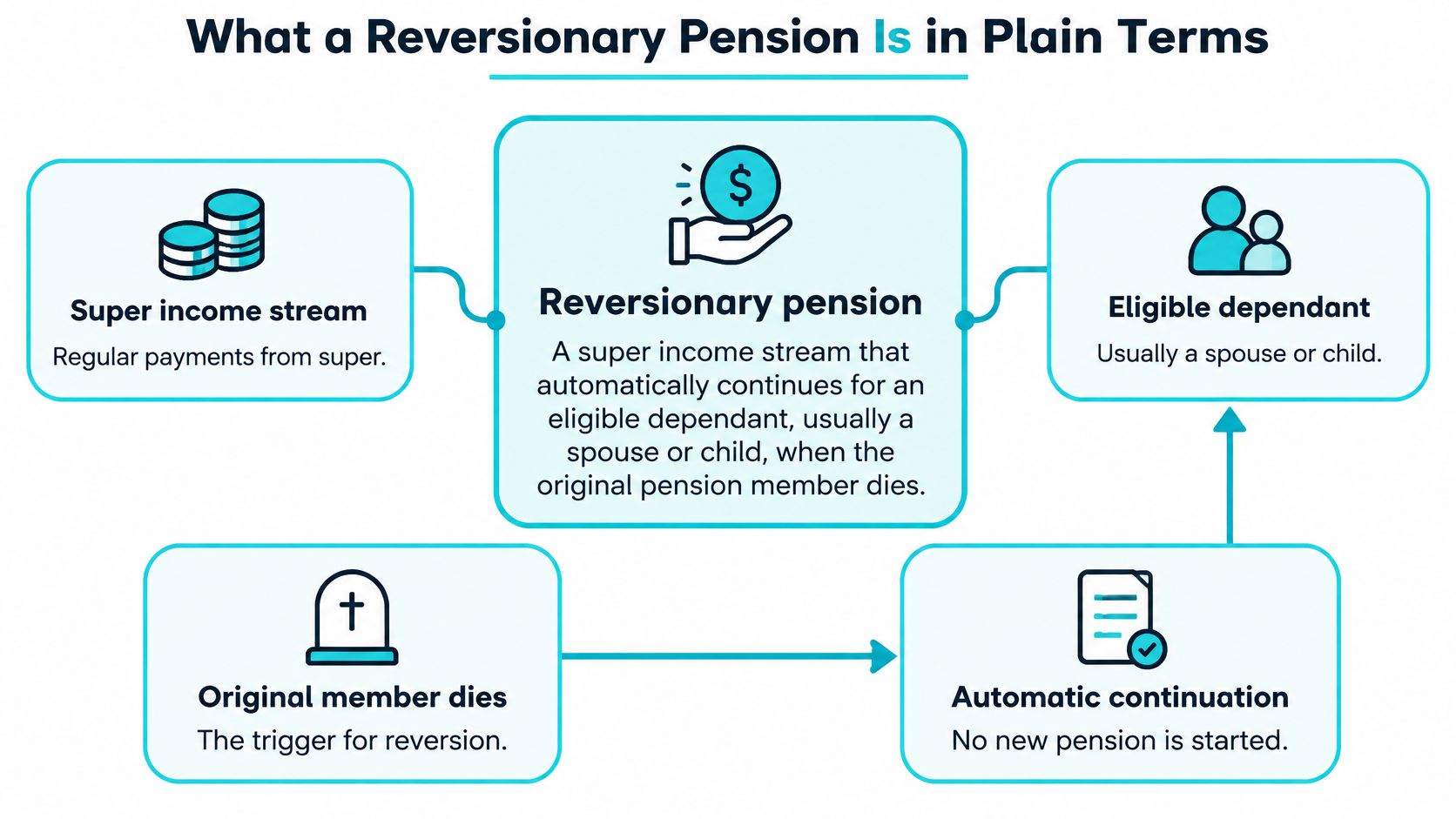
A reversionary pension is a super income stream that automatically continues for an eligible dependant, usually a spouse or child, when the original pension recipient dies.
But if you've named your spouse on a binding beneficiary nomination, have you arranged for your pension to continue? Not necessarily. The answer sits in the pension documents, not in the name on a nomination form.
For families, that distinction affects more than paperwork. It determines how the survivor receives income, while transfer balance rules can require decisions about their existing pensions. Understanding what is a reversionary pension starts with the definition, but useful planning means checking what will happen.
What a Reversionary Pension Is in Plain Terms
Think of a joint bank account that keeps operating for the surviving account holder rather than needing to be reopened. A reversionary pension has a similar continuity feature, although it isn't joint ownership of the super account.
The Australian Taxation Office's superannuation death benefits guidance explains that the eligible beneficiary becomes entitled automatically when the original recipient dies. The beneficiary doesn't need to elect to start a replacement pension, and the original member's date of death is treated as the starting day for that entitlement.
The people and documents involved
These terms make the paperwork easier to follow:
- Member: The person whose super supports the original pension.
- Reversionary beneficiary: The eligible person named to receive the continuing income stream after the member dies.
- Governing rules: The pension agreement, product rules or SMSF trust deed provisions that establish the automatic entitlement.
An ordinary, non-reversionary account-based pension generally stops when the member dies. The fund then deals with the remaining super through its death-benefit process, rather than continuing the original pension for someone else.
For a couple who use pension payments to cover groceries, utilities and housing costs, continuity can reduce financial disruption during bereavement. It can mean continuing regular income rather than waiting for the fund to determine and process a death benefit.
Automatic entitlement doesn't mean there's no administration. The survivor should still notify the fund and confirm its documentation and payment requirements. Whether the arrangement works as intended rests on the governing documents, the beneficiary's eligibility and the survivor's transfer balance position.
How Income Passes On at Death, Side by Side
| Feature | Reversionary pension | Ordinary account-based pension |
|---|---|---|
| Income after the member dies | Continues for the eligible dependant | Generally ends unless the governing rules provide reversion |
| Who becomes entitled | Nominated eligible dependant, from the date of death | Trustee determines the death benefit under the fund rules and any valid binding nomination |
| New pension election needed | No, the beneficiary becomes entitled automatically | Usually a death-benefit payment process instead |
| Effect of a binding nomination alone | Does not create reversion; the rules must provide it | Directs the death benefit, subject to validity and fund rules |
| Income gap risk | Low if the rules are correct and the beneficiary is eligible | Lump-sum payment and processing delay possible |
| Transfer balance credit | Generally 12 months after the starting day for streams starting on or after 1 July 2017 | Not applicable to a reversionary credit |
The timing in the table follows the ATO's guidance on the death of an SMSF member, which distinguishes automatic entitlement at death from the later transfer balance credit.
What the survivor actually receives
Start with income. With a properly established reversionary pension, the survivor receives a continuing income stream without first converting the pension into a lump-sum death benefit. With an ordinary pension, the fund must instead work through the applicable death-benefit arrangements.
Next comes entitlement. A reversionary beneficiary's entitlement is already established by the pension terms. For an ordinary pension, the trustee must apply the fund rules and any valid binding directions when determining the payment.
The election row describes another practical difference: continuing an existing entitlement isn't the same as arranging a new death-benefit pension. An eligible beneficiary may still receive a new pension under a non-reversionary arrangement, but it isn't automatic continuation of the deceased member's pension.
Practical rule: A nomination tells you something about the intended recipient. The pension terms tell you whether the existing income stream continues.
Payment certainty isn't the whole decision
The lower interruption risk can help a household that relies on regular payments. It isn't a guarantee that every payment will arrive unchanged or that the survivor has no decisions to make.
Our guide to what happens to super when you die provides broader context for the fund's death-benefit process.
Families dealing with a separate workplace death claim may also find Lein Law Offices' family benefit guide for injured workers useful. That resource concerns a different legal system and benefit type, so its dependant rules shouldn't be applied to Australian super.
Pull out the pension documents and establish which column describes your arrangement. Don't infer the answer from the account's name or the fact that your spouse is listed somewhere on file.
How to Confirm Your Pension Is Reversionary
Treat this as a document check, not a memory test. The ATO's guidance on reversionary income streams makes the governing rules central: a pension normally ends at death unless a dependant is automatically entitled under the relevant deed or pension rules.
Follow the document trail
Find the pension commencement documents. Gather the pension agreement and the product rules or SMSF trust deed that apply to it. A beneficiary nomination form alone doesn't establish how the pension operates.
Look for automatic continuation wording. Search for terms such as reversionary, reversion and automatically continues, then read the surrounding provisions. A reference to paying a death benefit isn't necessarily a promise that the existing pension continues.
Identify the beneficiary and check eligibility. Confirm the person named in the pension arrangement, then establish whether they qualify to receive a continuing death-benefit income stream. Don't assume a family relationship by itself settles that question.
Record the relevant dates. Keep the original pension commencement date separate from the date it first becomes payable to the beneficiary. Those dates answer different questions, particularly when applying transfer balance rules.
Gather the valuation and balance records. After a death, obtain the supporting interest's value at the beneficiary's starting day and an updated transfer balance account position. While the member is alive, identify who will obtain those records and where they'll be kept.
Compare the documents with today's family situation. Check for a new partner, separation, an adult child or another change that could affect the intended outcome. An accurate name on an outdated strategy still needs attention.
Keep an evidence record. Note the document title, relevant clause and written confirmation supporting each answer. Keep copies with your estate-planning records so your family and advisers can locate them.

What a confirmed result looks like
You're looking for a clear documentary chain: the pension terms establish automatic continuation, identify the reversionary beneficiary and operate consistently with the governing rules. A form that merely lists a preferred recipient leaves important questions unanswered.
If the wording is unclear, we can help you assemble the documents and identify what needs written clarification from the fund or legal adviser. Don't change a nomination or restart a pension just to tidy up uncertainty before assessing the consequences.
A useful written confirmation should explain the entitlement, not just say that a beneficiary is recorded. Ask for the clause that makes the transfer automatic and confirmation of which pension account it applies to.
Who Qualifies and the Misconceptions to Avoid
Naming your spouse in a binding death-benefit nomination doesn't automatically make your pension reversionary. The ATO's ruling on superannuation income streams distinguishes a binding nomination from an entitlement that passes automatically under the pension's governing rules or agreement.
A binding nomination and a reversionary arrangement can both form part of an estate plan. They don't perform the same job, and one shouldn't be treated as proof of the other.
Family membership isn't enough
The next misconception is that anyone who can receive super after a death can also take over a pension. Eligibility to receive a death benefit and eligibility to receive it as an income stream aren't interchangeable.
A spouse will commonly be the intended reversionary beneficiary. A child must meet the relevant conditions, so an adult child shouldn't be assumed eligible merely because they're financially responsible or named in the will.
- Blended families: Clarify which person is intended to receive income and whether the documents deliver that outcome.
- Adult children: Check income-stream eligibility separately from any entitlement to a lump-sum death benefit.
- Changed relationships: Review the legal effect of separation or a new relationship rather than relying on an old nomination.
Our explanation of superannuation beneficiary rules can help you distinguish the recipient question from the payment-method question.
What happens if the intended recipient isn't eligible
If the person named can't receive a continuing pension, the benefit may need to be paid as a lump sum or addressed through another permitted death-benefit strategy. Tax may also apply, so the family shouldn't assume the alternative delivers the same after-tax result.
A clear intention to provide for someone doesn't replace the legal requirements for paying them a pension.
These issues are easier to address while the member is alive. There may be scope to revise the arrangement, but the permitted method and consequences need checking before anything changes.
The practical test is straightforward: the rules establish reversion, the recipient qualifies, and the recorded arrangement reflects the family's current intentions. If any part remains uncertain, treat the outcome as unresolved rather than reassuring yourself that the nomination is probably enough.
Transfer Balance Cap and the 12-Month Window
The survivor's entitlement and transfer balance credit arise at different times. Under the ATO's transitional transfer balance guidance, the credit generally arises 12 months after the starting day for a beneficiary starting on or after 1 July 2017, while earlier arrangements use the transitional timing shown below.
| Case | When the transfer balance credit arises | Credited amount |
|---|---|---|
| Beneficiary already receiving before 1 July 2017 | Later of 1 July 2017 or 12 months after the income stream first became payable | Amount determined under the applicable transitional valuation rules |
| Beneficiary starts on or after 1 July 2017 | 12 months after the starting day | Value of the supporting super interest on the starting day |
That deferral gives the survivor time to review their pensions. It doesn't create an exemption from their personal transfer balance cap, which limits the amount that can be transferred into retirement-phase pensions.
The ATO example in practical terms
In the ATO's superannuation death benefits example, the beneficiary became entitled to a $1.1 million reversionary pension on 15 April 2018, and the $1.1 million transfer balance credit arose on 15 April 2019.
The important distinction is the valuation date. The credit generally uses the value when the beneficiary's entitlement began, not whatever balance happens to remain when the credit is recorded.
Tax components also need attention. The proportioning rule preserves the relevant taxable and tax-free proportions for subsequent pension payments and commutations. Don't confuse a preserved tax component with a promise that every recipient or payment will have the same tax outcome.
What to do during the planning window
The survivor should build a coordinated picture rather than assess the inherited pension in isolation:
- Obtain the account position: Request an updated transfer balance account record and reconcile it with fund reporting.
- List existing pensions: Include the survivor's own retirement-phase income streams and any pending transactions.
- Model available capacity: Compare the expected reversionary credit with the survivor's personal cap and existing transfer balance position.
- Assess corrective action: Work through any required commutation, including which pension to adjust and the permitted destination of the money.
- Keep cash flow visible: Check how the proposed changes affect money available for living costs.
A commutation means converting all or part of a pension entitlement into a lump sum. It isn't another name for taking an ordinary pension payment, so withdrawals and commutations shouldn't be treated as interchangeable in the calculation.
If the reversion creates an excess, corrective action may be required and excess-transfer-balance consequences can apply. Our guide to the superannuation transfer balance cap explains the broader framework.
Diary action: Record the credit date alongside the valuation evidence and the person responsible for reviewing the calculation.
Request the transfer balance position promptly after death. The deferred credit gives breathing space, not a reason to postpone the review until the deadline approaches.
Reversion Scenarios and When a Lump Sum Fits Better
According to Class's 2025 Annual Benchmark Report, approximately 30% of about 2,000 deceased SMSF members in the 2024 financial year had a reversionary pension, as reported by SMSF Adviser's sister publication, SMS Magazine. That finding describes the report's deceased SMSF members, not all Australian retirees.
The following hypothetical households show why the right structure turns on the survivor's circumstances.
Illustration A, ongoing household income
A retired member receives an account-based pension with valid reversionary terms naming their eligible spouse. When the member dies, the spouse becomes entitled to the continuing pension rather than having to elect to establish a replacement.
The trade-off: Continuity supports the household budget, but the spouse still needs to review their own pensions and transfer balance capacity. Automatic continuation doesn't remove that responsibility.

Illustration B, an ineligible adult child
A parent intends their independent adult child to receive the pension, but the child doesn't meet the income-stream eligibility conditions. The family must consider a permitted alternative, potentially a lump-sum death benefit, with the tax consequences assessed separately.
The trade-off: The child may need access to capital rather than ongoing pension payments anyway. The planning task is to deliver a lawful, suitable outcome, not preserve a pension label.
Illustration C, a survivor with substantial pensions
A surviving spouse already has significant retirement-phase pensions. Continuing the deceased partner's pension could create a cap issue, so the adviser compares partial restructuring with taking some benefits as a lump sum.
The ATO's guidance on reversionary income streams provides the framework for considering the deferred credit alongside the survivor's circumstances.
- Income and liquidity: Compare regular spending with foreseeable capital needs.
- Tax and cap capacity: Model the after-tax result and permitted pension amounts.
- Family circumstances: Consider whether the arrangement still reflects current relationships.
For families with a separate US legal connection, Miles Hansford Law Firm's guide to pension division during Georgia divorce addresses that jurisdiction-specific issue. It isn't guidance on Australian superannuation reversion.
A lump-sum death benefit can have different tax outcomes from a continuing pension depending on the recipient. Compare the options using the survivor's own numbers, with tax modelled alongside income and access to capital.
Review Your Reversionary Pension Before It Matters
Check the arrangement while there's still time to make informed changes. The decision rests on the governing rules, beneficiary eligibility and the survivor's transfer balance position, not on whether reversion sounds reassuring.
After a death, the documents already in force determine important parts of the outcome. While the member is alive, you can investigate uncertainty, coordinate advice and assess proposed changes without adding bereavement to the decision.
Turn the paperwork into a practical plan
At Wealth Collective, we can help review how your pension documents and family circumstances fit your retirement and estate-planning intentions. Our Retirement Roadmap simplifies retirement planning and gives clients a clear path to financial security.
The initial step is a conversation before anything is changed. Booking an initial call lets you explain what you hold, who you want to provide for and which parts of the paperwork are unclear, with no obligation to act on the call.

What to have ready
Bring the documents that allow a useful discussion:
- Pension commencement documents: Include the agreement and any later amendments.
- Trust deed or product rules: Have the applicable governing documents available.
- Current beneficiary nomination: Include any separate reversionary election or confirmation.
- Pension and super balances: List existing accounts for both partners, where relevant.
You don't need to interpret every clause before contacting us. Identifying the missing document or unresolved question is a useful starting point.
Our satisfaction commitment is straightforward: if you're not 100% satisfied, we'll make it right or refund your money, with no questions asked. This article provides general information; decisions about changing your pension should reflect your circumstances and the applicable fund rules.
Wealth Collective offers Protection Plus, Guided Growth and Retirement Roadmap, with retirement planning support to help you assess how your pension could provide for your family. Visit Wealth Collective to book an initial call and talk through your pension documents, intended beneficiary and transfer balance questions before making changes.