Business hours
Monday to Friday (8.30AM - 5PM)
Weekend (Closed)



Separation rarely arrives with a neat financial checklist. One person is trying to find somewhere to live, the other is sorting bills, and both are staring at statements that suddenly carry much more weight than they used to. Then comes the difficult question: what happens to the superannuation built during the relationship?
For many Perth couples, super is one of the most significant assets in the settlement, even though it can't be accessed like a bank account or property. The superannuation splitting rules are designed to deal with that imbalance, but the 2025 regulatory changes mean smaller balances, pension-style interests and defined benefit arrangements need closer attention.
The right decision isn't always to split super. It is to understand what can be divided, what the trade-offs are and how the decision affects retirement security for both people.
Navigating Superannuation Splitting During Separation
A separating couple may have a home, savings, vehicles and business interests to value. Superannuation often sits in the background until someone realises that one partner has accumulated substantially more because of a longer career, higher income or employer contributions. That difference can materially affect each person's retirement, particularly where one partner took time out of paid work to care for children.
Super splitting is not a penalty imposed on the higher-balance partner. It is a recognised part of Australian property settlement law. Parts VIIIB and VIIIC of the Family Law Act govern the framework, and the Family Law (Superannuation) Regulations 2001 established the mechanism for treating super as a divisible property interest after relationship breakdown.

The basic idea
The rules apply to married couples and de facto couples. A split can be arranged through a superannuation agreement or a court order, including an order made by the Family Court of Western Australia. That matters for WA residents because the state Family Court is expressly recognised in federal guidance, alongside the federal court system.
The process doesn't automatically mean one fund transfers cash directly into the other person's bank account. Instead, the receiving person generally obtains a superannuation interest in their own name, subject to the preservation and access rules that apply to super.
Practical rule: Treat the proposed split as a retirement decision, not just a settlement figure.
A split may be appropriate where one partner has significantly less retirement savings because of unpaid caring responsibilities or uneven income. It may be unnecessary where the broader property settlement already produces a fair result, or where the parties agree to retain their existing super interests. Couples aren't required to split super.
The principle is easier to understand when compared with other legal systems. For general background on how another jurisdiction approaches property division, see this explanation of how assets split in Texas divorce. The Australian framework is different, so don't use overseas guidance to decide a WA settlement.
Fairness needs a long view
A settlement that looks balanced today may leave one person exposed later. A smaller immediate entitlement can sometimes be offset by retaining more home equity, but that choice should be tested against future housing costs, investment risk and access to retirement income.
My recommendation is straightforward: get the super values, understand the proposed settlement as a whole and model the retirement effect before signing anything. Legal advice establishes whether the agreement is valid. Financial advice helps determine whether the result supports the life each person needs to fund.
Understanding the Two Types of Super Splitting
People use “super splitting” to describe two different strategies. Confusing them can lead to the wrong paperwork, the wrong expectations and a settlement that doesn't address the actual problem.
Family law splitting deals with an existing super interest after a relationship breaks down. Spouse contribution splitting happens during an ongoing relationship and redirects eligible contributions from one spouse's account to the other's. One divides accumulated retirement wealth. The other reallocates future contributions.
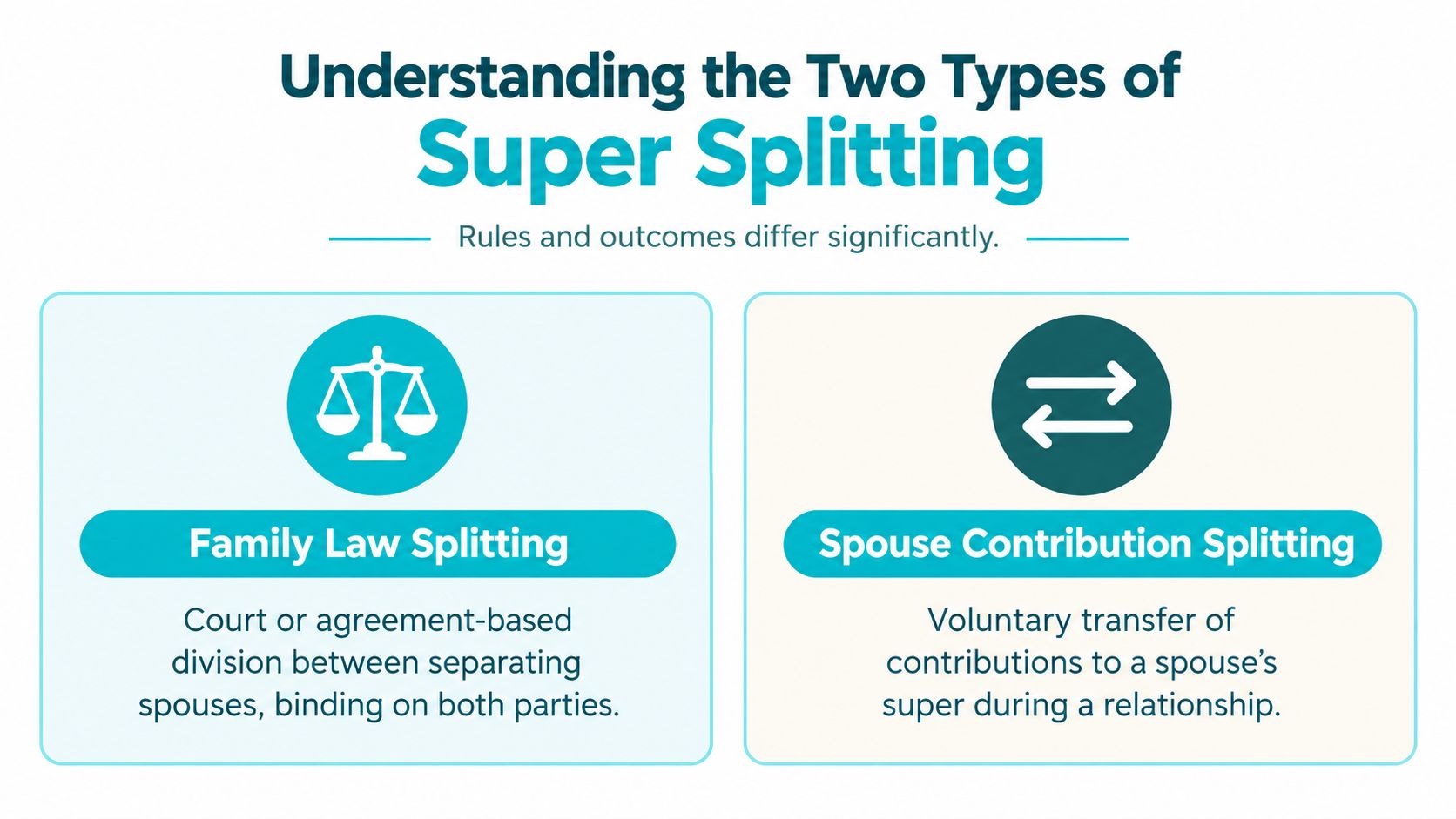
Family law splitting after separation
A family law split is usually considered as part of the overall property settlement. The parties identify the relevant superannuation interests, obtain appropriate valuation information and then agree on a percentage or fixed amount, subject to the applicable legal and fund rules.
The arrangement must be formalised. Depending on the circumstances, that may involve a financial agreement or a court order. The fund then implements the split, creating or transferring the relevant interest for the non-member spouse according to the formal instrument.
This approach is about dividing the value already accumulated, not redirecting new employer or salary sacrifice contributions. It can be relevant to married and de facto couples, and the parties can choose not to use it if another settlement structure is acceptable.
Contribution splitting while together
Contribution splitting is a retirement-planning tool for couples who are still together. The Australian Taxation Office says a member can transfer up to 85% of that financial year's taxed splittable contributions to a spouse, but the amount can't exceed the member's concessional contributions cap for that year. The request is generally made for contributions from the prior financial year, and fund rules commonly require the application to be lodged from 1 July to 30 June of the following year. These requirements are set out in the ATO guidance on superannuation contributions splitting.
Only eligible taxed concessional contributions can be split. That can include employer contributions and salary sacrifice, but after-tax contributions, rollovers, downsizer contributions and many defined benefit amounts are excluded.
| Strategy | When it applies | What it changes |
|---|---|---|
| Family law splitting | After relationship breakdown | Divides an existing super interest under a formal agreement or order |
| Contribution splitting | During the relationship | Redirects eligible contributions to a spouse's super account |
AustralianSuper's member form illustrates fund-level conditions that may apply, including a $2,000 minimum account balance, a $1,000 minimum split amount and $1,000 remaining after the split. Those thresholds aren't universal, so check the receiving and contributing fund's rules before relying on them.
Contribution splitting can suit a couple where one person receives higher employer contributions or salary sacrifice while the other has lower retirement savings. It doesn't replace family law advice, and it won't solve an existing imbalance by itself. It is a targeted way to build retirement savings in both names while the relationship continues.
The Step-by-Step Process for Initiating a Split
The safest process starts with evidence, not assumptions. A recent account balance alone may not reveal the information needed to value a super interest or determine whether a fund can implement the proposed split.
Start with the correct type of split
First, establish whether you're dealing with a relationship breakdown or an ongoing contribution strategy. A family law split requires a formal legal pathway. Contribution splitting uses the fund's contribution-splitting process and must comply with the relevant contribution rules.
Gather the fund information
Collect current member statements, fund names, member numbers and contact details. Ask the fund what information it requires to value and implement a proposed split. Defined benefit funds, pension products and other unusual interests may need information beyond a standard accumulation statement.
Don't rely on a spreadsheet prepared from memory. The fund's records control implementation, and missing details can create delays or force the parties to revise documents.
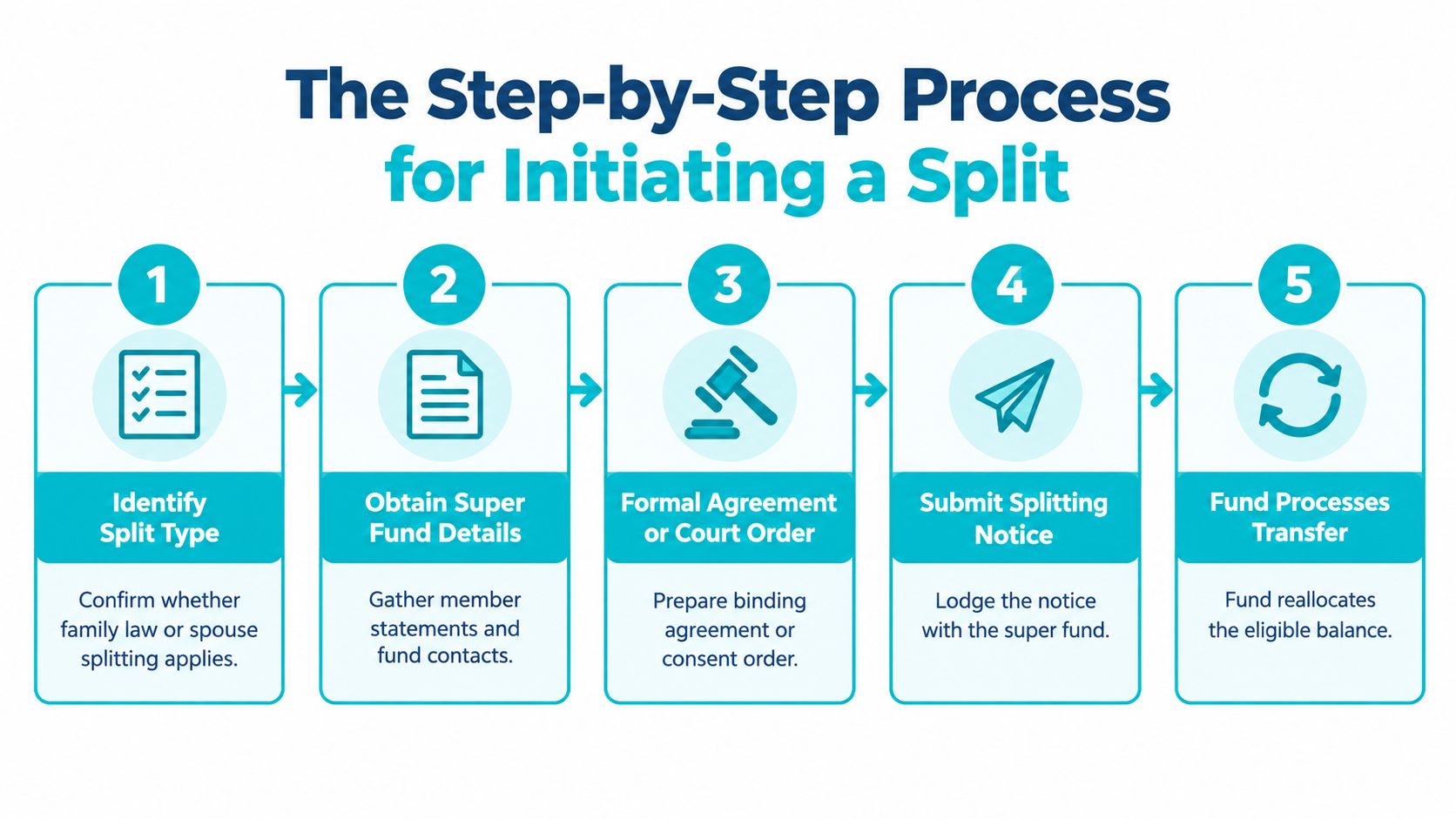
Choose the formal pathway
For a consent-based family law split, the parties and their lawyers prepare the appropriate financial agreement or consent order. Each person should obtain independent legal advice before signing. That advice matters because a document can be technically completed yet still fail to protect one party's interests.
If agreement can't be reached, a court application may be required through the Family Court of Western Australia or the Federal Circuit and Family Court of Australia, depending on the circumstances. A court order gives the fund a formal instruction, but it doesn't remove the need for accurate fund information.
Notify the fund
Once the agreement or order is in place, the required splitting notice is lodged with the super fund. The fund checks the document, confirms that the interest is splittable and applies its administrative requirements. The 2025 framework also changed terminology and information requirements for notices provided by a non-member spouse, so older templates shouldn't be used without checking that they remain current.
Confirm implementation
The process isn't finished when the court document is signed. Obtain written confirmation from the fund that the split has been processed and check the new member statement. The receiving spouse should confirm the account ownership, transferred amount or percentage and any preservation conditions.
The document creates the entitlement. The fund's confirmation proves the transfer has been implemented.
Keep the agreement, order, notices, statements and correspondence together. If the parties later review Centrelink, tax or retirement planning outcomes, that file will be far more useful than relying on recollection.
Calculating the Split and Navigating New Rules
The amount transferred depends on the value and type of the super interest, the agreed settlement and the formal terms of the agreement or order. There isn't a universal rule that says every couple receives half of the higher balance.
The settlement should identify the relevant valuation date, often the separation date or another agreed date. It should also account for the fact that super funds use prescribed valuation methods for different products. An accumulation account is relatively direct. A defined benefit interest or pension-style product can require a more specialised calculation.
The 2025 minimum-balance change
The 2025 Regulations give effect to superannuation splitting orders and agreements, but they also expand the circumstances in which an interest is treated as unsplittable. QSuper's 2025 update says the minimum account amount for a family law split increased from $5,000 to $10,000 from 1 April 2025. The change is significant for couples whose accounts sit near the threshold.
For example, consider an account with a withdrawal benefit of $9,500. Under the earlier $5,000 threshold, that interest could have been eligible for a family law split, subject to the other requirements. Under the current $10,000 threshold, it may be treated as unsplittable. That doesn't mean the $9,500 disappears from the property settlement. It means the parties may need to address its value through other assets or settlement adjustments.
Certain pension or annuity interests may also be unsplittable where their annual payments are below $4,000, while other interests may be excluded where the withdrawal benefit is below $10,000. The Attorney-General's explanation of the 2025 changes sets out the updated framework.
Product type changes the answer
A defined benefit interest doesn't behave like an ordinary account balance. Its value and adjustment can depend on the fund's prescribed method, the payment stage and the timing between the operative split and payment. Pension and annuity products may also have payment and valuation characteristics that make a standard percentage approach unsuitable.
The right question isn't, “How much super do we have?” Ask instead:
- What type of interest is it?
- Is the withdrawal benefit above the current threshold?
- Does the product fall within an unsplittable category?
- What valuation method does the fund require?
- What alternative asset should account for any excluded value?
For readers approaching retirement, the split should also be tested against broader transfer-balance planning. The superannuation transfer balance cap guide can help frame the wider retirement-account implications, but it doesn't replace fund-specific or legal advice.
Tax Implications and Centrelink Considerations
The transfer itself is only one part of the financial result. The receiving spouse needs to understand what type of super interest they receive, how its tax components are recorded and how the new account fits with their retirement plan.
Super can contain tax-free and taxable components, and the proportions attached to the receiving interest can affect future withdrawals. A split doesn't turn every dollar into a tax-free amount. The fund records the components under the applicable rules, and the receiving spouse should ask for confirmation rather than assuming the tax treatment mirrors the original member's expectations.

Compare the position before and after
For the transferring spouse, the immediate effect is a lower super balance and potentially a different retirement income pathway. For the receiving spouse, the benefit is an increased retirement interest, but access remains governed by superannuation conditions. Neither person should assess the arrangement solely by looking at the amount moved.
| Area | Transferring spouse | Receiving spouse |
|---|---|---|
| Super balance | Reduces under the agreement or order | Increases through the new interest |
| Tax components | May change the mix remaining in the account | Requires confirmation of taxable and tax-free components |
| Retirement income | May need higher future contributions or other assets | May have greater retirement capital, subject to access rules |
| Centrelink | Future assessable assets and income may change | Future assessable assets and income may change |
Centrelink needs deliberate planning
Superannuation interacts with Centrelink's assets and income tests, particularly when a person approaches Age Pension age or is already receiving benefits. The outcome can differ depending on age, whether the interest is in accumulation or pension phase, the person's other assets and the income generated.
A settlement that increases one person's super may improve long-term retirement security while affecting their future Centrelink position. Conversely, retaining a different asset instead of receiving super may look attractive now but create higher maintenance costs, investment risk or less reliable retirement income.
Tax outcomes also depend on the person's age, the nature of the benefit and whether money remains inside super or is withdrawn. The guide to tax on superannuation provides useful background, but a separation settlement deserves individual modelling.
My recommendation is to test at least three views before finalising the agreement: the immediate settlement, the retirement position and the likely Centrelink treatment. Ask the lawyer to address legal validity and the adviser or tax professional to assess the financial consequences. No one should sign a settlement based on the gross super balance alone.
Protecting Your Retirement Future with Expert Guidance
A super split can resolve an imbalance created during a relationship, but it can also permanently change the retirement resources available to both people. The 2025 minimum-balance rules make this especially important for smaller accounts, pension-style interests and products that may now be unsplittable.
The most useful advice combines legal process with financial planning. You need to know whether the document works, whether the fund can implement it and whether the resulting assets support your future housing, income and lifestyle needs.
For Perth and Dunsborough residents, Wealth Collective's financial adviser service can help connect the settlement decision with superannuation optimisation, retirement planning, debt management and investment strategy. The firm offers a free 10-minute introductory call, giving you a practical starting point before committing to a broader advice process.
Don't wait until the agreement is signed to discover that a balance can't be split or that the proposed trade-off leaves you short in retirement. Gather your statements, identify the fund types and have the proposed settlement reviewed from both a legal and financial perspective.
Wealth Collective can help you assess the retirement impact of a proposed superannuation split, coordinate practical planning around super, debt and investments, and turn complex choices into a clear action plan. Visit Wealth Collective to book a free 10-minute introductory call and discuss your circumstances with the team.