Business hours
Monday to Friday (8.30AM - 5PM)
Weekend (Closed)



A transition to retirement (TTR) lets you draw regular income from super once you reach preservation age, currently 60, while continuing to work reduced hours. It acts as a structured bridge between full-time work and full retirement, rather than allowing an early lump-sum withdrawal from super.
You might be 61, still capable of doing your job, but ready for more time with family, travel, health or community commitments. The difficulty is practical: working fewer days usually means earning less, while your household bills don't automatically shrink with your hours. TTR can help replace some of that lost pay with regular super income, but it comes with rules that affect your payments, tax, contributions and future retirement balance.
The Bridge Between Working Full-Time and Full Retirement
At 61, a project manager might want to work three days a week instead of five. The extra time could make a major difference to daily life, but the pay cut may feel impossible. Rent or mortgage payments, utilities, insurance and ordinary spending still need funding.
TTR is designed for this gap. Think of it as a bridge between full-time work and full retirement. Your employer continues paying you for the days you work, while a TTR income stream draws regular payments from your super to top up the difference. The super payment becomes a second tap of income, not a complete replacement for employment.
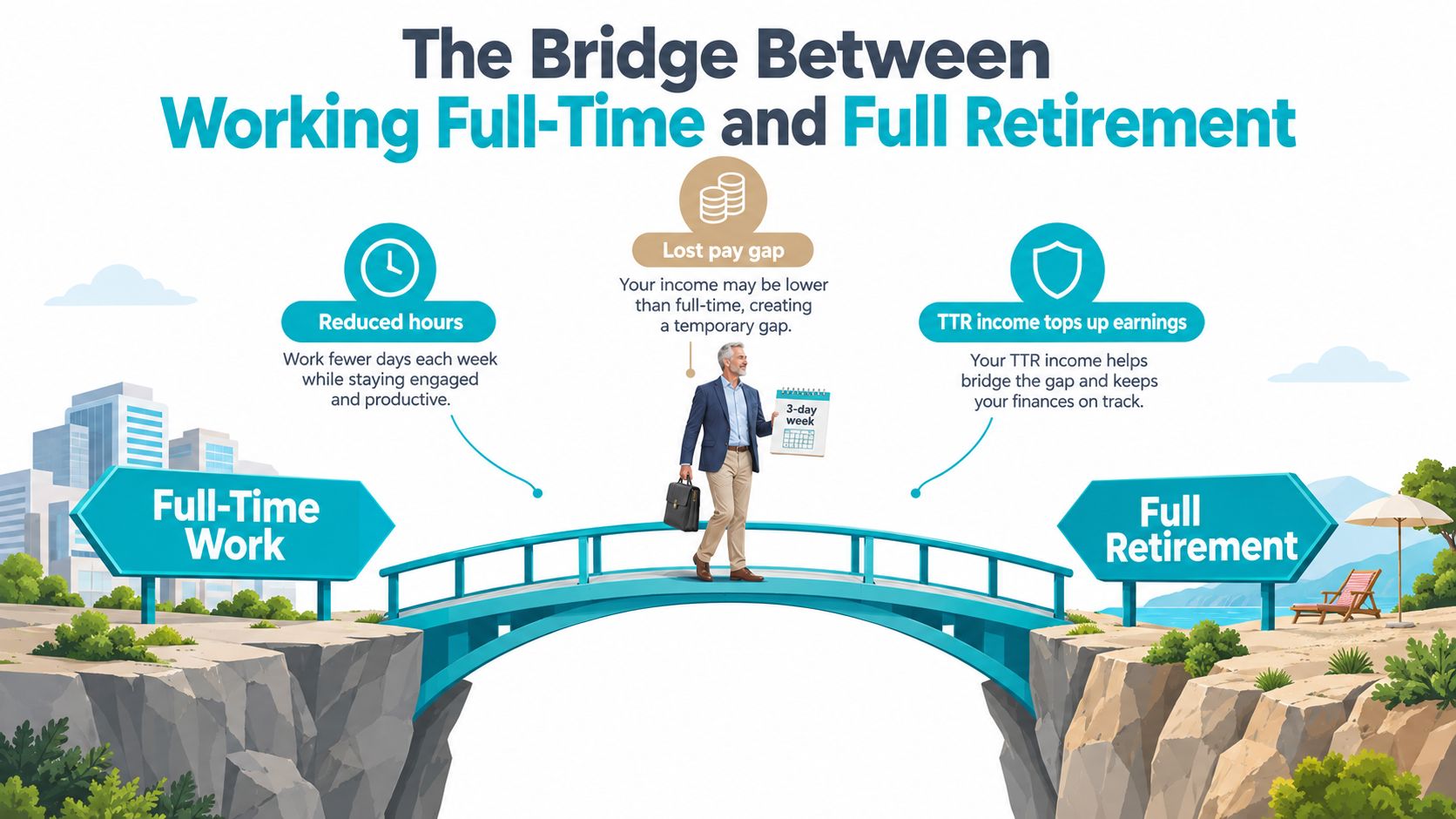
What TTR is designed to solve
The traditional retirement choice was often presented as binary. You worked full-time until you stopped, then began drawing on super. A phased approach gives you more room to adjust. You can reduce working hours, maintain a more stable household income and gradually test what retirement might feel like.
The strategy commonly addresses three connected problems:
- Reduced hours: You gain time without needing to leave employment altogether.
- Lost pay: Super payments can help cover part of the income gap created by fewer shifts or days.
- Retirement preparation: You can begin changing your routine before making a permanent retirement decision.
TTR doesn't make reduced work automatically affordable. The payment range, tax treatment, contribution strategy and effect on government benefits all need checking. Your super balance also matters because every payment comes from money that could otherwise remain invested.
Practical rule: TTR works best when it supports a clear lifestyle decision, not when it simply creates extra spending money without a retirement plan.
The important question isn't only “Can I access super?” It's “How much income do I need, how much work do I want to keep doing, and what does drawing on super now mean for later?”
What a Transition to Retirement Income Stream Actually Is
Start with preservation age. This is the age at which Australian super rules may allow you to begin a transition to retirement arrangement while you continue working. Current guidance treats preservation age as 60, and the ATO's transition to retirement guidance explains that people who reach preservation age can draw an income stream while still employed.
The technical name is a Transition to Retirement Income Stream, or TRIS. It's a regulated, account-based super pension that pays regular income from a nominated super balance. You don't generally withdraw the original balance as a lump sum just because you've started a TRIS. The arrangement is non-commutable until you meet another condition of release.
The payment band
A TRIS must pay between 4% and 10% of the account balance each financial year, under the rules described by MoneySmart's transition to retirement explanation. The fund calculates the payment range using the relevant balance, and the amount is generally reviewed annually.
That means TTR isn't an unrestricted cash account. You select a payment level within the permitted range, often receiving the money fortnightly or monthly. The payments are intended to replace part of your employment income while the rest of your super remains invested.
A full account-based pension is different because it usually becomes available after a broader retirement condition of release is met. It can generally offer greater flexibility, including lump-sum access, subject to the applicable rules. A TRIS is more limited by design.
| Feature | TTR Income Stream | Account-Based Pension |
|---|---|---|
| Purpose | Supplement income while you continue working | Provide income after reaching retirement phase |
| Access | Regular payments within the permitted band | Regular payments with broader retirement-phase flexibility |
| Lump sum | Generally unavailable from the TTR portion until another condition of release | Generally available, subject to the rules |
| Drawdown | Between 4% and 10% of the balance each financial year | Minimum drawdown rules apply, with different retirement-phase treatment |
| Status | Non-commutable transition arrangement | Retirement-phase income stream |
Tax treatment depends on your age and the components of your super. Payments aren't automatically tax-free merely because they're paid from a TTR arrangement. The account's investment earnings also need to be considered separately from the payments you receive.
How a TTR Income Stream Works in Practice
A TRIS has two moving parts: money leaves your nominated super account as regular income, while the remaining balance stays invested. The account must follow the 4% to 10% annual drawdown range, with the applicable amount generally recalculated for the new financial year.
You can't treat the TTR portion like an ordinary savings account. The non-commutation rule generally prevents you from taking that balance as a lump sum or rolling it elsewhere just because you want more flexibility. The arrangement is built for income substitution, not unrestricted early access.
The salary sacrifice connection
Salary sacrifice can change the cashflow equation. If your employer reduces the salary paid to you and directs an agreed amount into super, you may increase concessional contributions while using TTR payments to support your take-home income. This can be useful for someone who wants to keep building super while reducing taxable salary.
The strategy needs careful limits and timing checks. Contributions, employer payments, fees, investment returns and pension withdrawals all affect the result. A TTR payment may arrive monthly or fortnightly, while salary sacrifice occurs through payroll, so the cashflow needs to be mapped rather than guessed.
Cashflow check: Match the timing of salary-sacrifice reductions, employer pay and TTR payments before changing your work pattern.
A TRIS can receive a tax concession on investment income supporting the stream, but the treatment depends on whether the account is still in the transition phase or has entered retirement phase. At 65, MoneySmart says the arrangement automatically converts to an account-based pension, which changes the access position. The ATO's retirement withdrawal guidance also explains why the transfer balance cap becomes relevant when an income stream enters retirement phase.
Keep the TTR balance distinct from accumulation money. Your fund may use separate accounts, and mixing the two can make payment calculations and future planning harder. If you begin or stop part-way through a financial year, the required payment can also need pro-rata treatment.
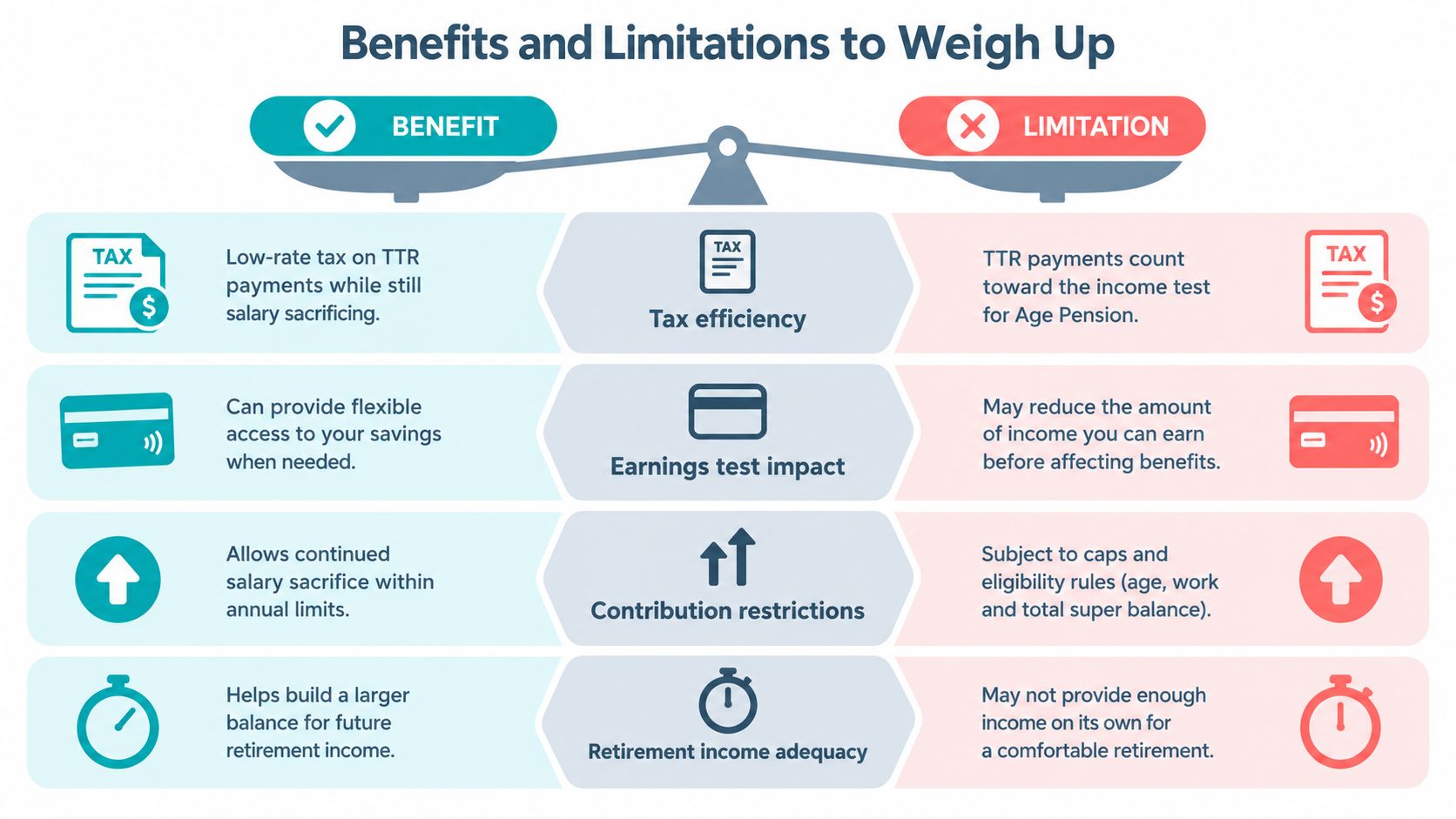
Benefits and Limitations to Weigh Up
TTR can create useful flexibility, but the same withdrawals that support a shorter working week reduce the money left invested for later. The decision should be judged against your intended retirement date, spending needs, tax position and tolerance for investment risk.
Where the strategy may help
Income smoothing is the clearest benefit. Employment income falls when you reduce hours, and TTR payments can help keep household cashflow steadier. That can make a gradual change feel more manageable than moving directly from full-time wages to retirement income.
Salary sacrifice may also improve tax efficiency for some higher-income earners. You redirect part of your employment income into concessional super contributions, while TTR payments provide cashflow. The benefit depends on your marginal tax rate, contribution capacity and the amount you need to draw.
Other potential advantages include:
- Lifestyle flexibility: You can reduce work without treating retirement as an all-or-nothing event.
- A controlled transition: You can test a different routine before leaving employment permanently.
- Strategic timing: You can coordinate work, contributions and super withdrawals rather than making each decision separately.
Where the strategy may hurt
Drawing super earlier can leave a lower balance for full retirement. A modest balance may not support enough income after accounting for investment performance, fees and future spending. TTR can also affect the insurance attached to your super account if the account structure changes.
Government benefits need particular care. MoneySmart warns that TTR can affect government benefits for you or your partner, because payments can be relevant to assessment rules. Running contributions and pension withdrawals at the same time also creates administration that many people find difficult to monitor.
For a detailed discussion of the potential drawbacks, review the disadvantages of a transition to retirement strategy. Professional advice adds value when the answer depends on several linked decisions, especially if you have a partner, insurance inside super, variable income or a planned move to part-time work.
Eligibility and the Work Test Rules
Begin with age and access. You generally need to have reached preservation age, currently 60, to start a TTR income stream while continuing to work. Earlier preservation ages can apply to people born before 1 July 1964, so your birth date and fund records should be checked rather than relying on a general online calculator.
Next, confirm that your super fund offers a complying TRIS product and that you have a suitable accumulation balance to nominate. The fund must be able to establish the income stream under the relevant super rules, and the payments must stay within the permitted annual range of 4% to 10%.
Working status and contributions
For people between preservation age and 67, work and contribution rules can matter. The arrangement is designed for someone who is still working, whether that means remaining full-time or moving to reduced hours. If you want to make additional contributions, ask the fund or adviser to confirm the current work test that applies to your circumstances.
From 67 to 75, the work test doesn't apply for certain contribution purposes in the same way. People aged 75 and over can generally contribute only if they meet the relevant work test for that year. These rules can change how salary sacrifice, personal contributions and spouse strategies fit around TTR.
The TTR stream can't be backdated. You need to establish it at the appropriate time, select the payment amount and arrange the fund's administration before relying on the income.
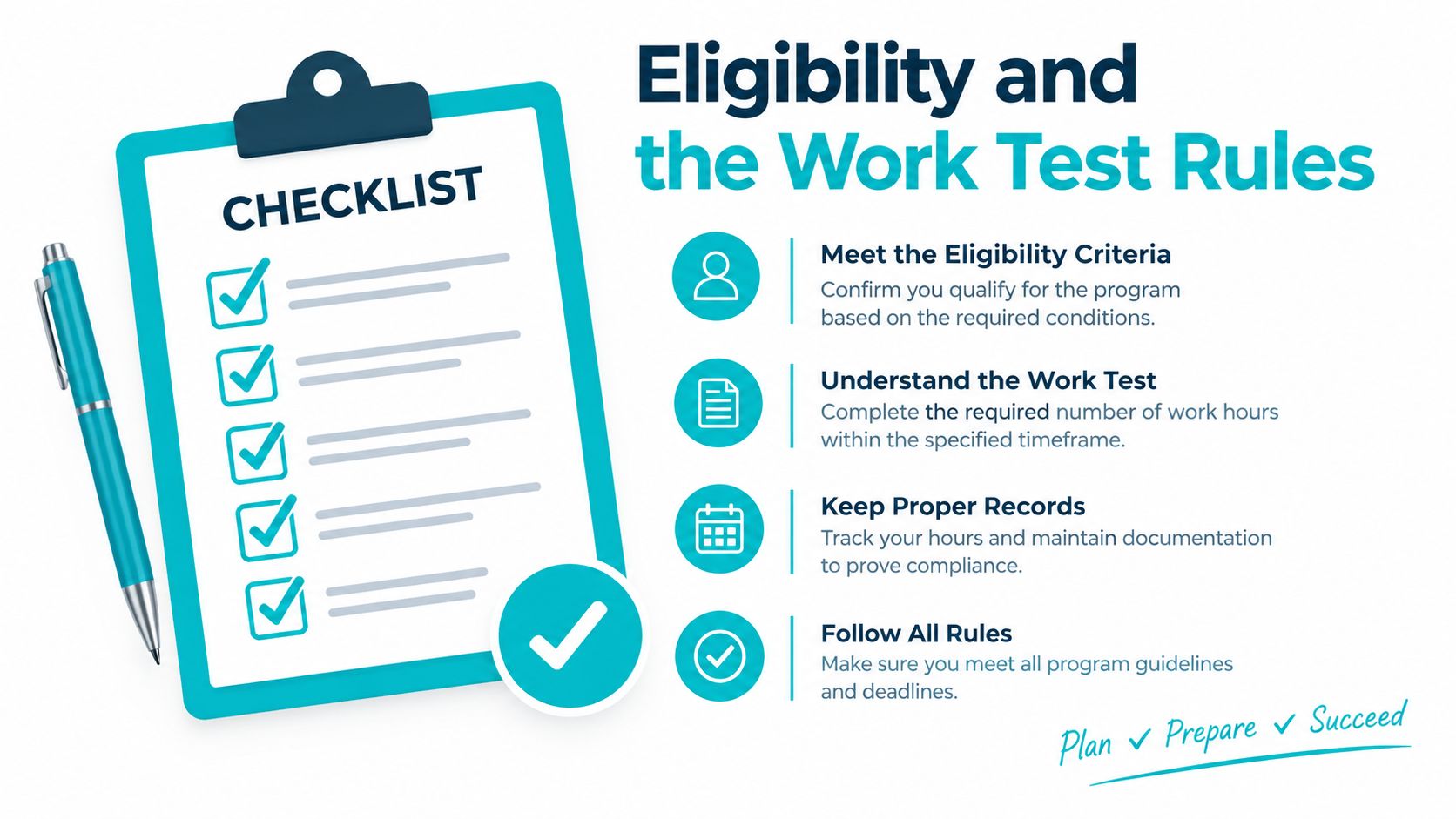
Use this quick self-check:
- Age: Have you reached preservation age?
- Employment: Are you still working, and are you planning to reduce hours?
- Super: Does your fund offer a TRIS, and is the balance suitable?
- Cashflow: What income will replace the pay you give up?
- Benefits: Could the payments affect you or your partner's government benefits?
If any answer is unclear, don't start by selecting a payment amount. Start by confirming eligibility and modelling the whole arrangement.
A Worked Example for a 61-Year-Old Pre-Retiree
Consider Sarah, aged 61, earning roughly $110,000 a year with about $450,000 in super. She wants to reduce work but also wants to keep contributing. In this illustration, she salary sacrifices an extra $20,000 into super and draws $40,000 through a TTR income stream.
The contribution is taxed at the concessional rate of 15%, rather than Sarah's assumed marginal rate of 34% on that employment income. Her TTR payment is modelled at a 15% pension tax rate, with a 12-month pension exemption available in the stated example. The exact outcome depends on her tax components, other income, fund fees, investment returns and contribution limits.
| Item | Without TTR | With TTR + Salary Sacrifice |
|---|---|---|
| Employment income | Roughly $110,000 | Roughly $90,000 after the additional salary sacrifice |
| Additional salary sacrifice | None | $20,000 |
| TTR income stream | None | $40,000 |
| Concessional tax rate used in illustration | Not applicable to the extra amount | 15% |
| Assumed marginal tax rate on sacrificed income | 34% | Avoided on the sacrificed amount in this illustration |
| Pension payment tax rate used | Not applicable | 15%, with a 12-month pension exemption available in the illustration |
| Main cashflow effect | More salary, no pension payment | Lower salary, super-funded top-up and larger contribution |
| Long-term balance | More money remains invested from the starting balance | Earlier withdrawals may leave a slightly lower balance by age 65 |
The mechanics are easier to see than the headline. Sarah gives up part of her salary, sends that amount into super, then uses the TTR payment to support current spending. Her taxable employment income falls, but her super receives a larger concessional contribution.
This can create a current-year cashflow and tax benefit, but it isn't free money. The $40,000 withdrawal leaves Sarah's super earlier, so her projected balance at age 65 may be slightly lower than if she had continued working full-time without the TTR withdrawals. Investment returns could change either projection.
Use the Wealth Collective transition to retirement calculator to test the inputs, then have the assumptions reviewed. Sarah's result won't automatically apply to another person with a different balance, income, tax component or retirement date.
Where TTR Fits in Your Broader Retirement Plan
TTR is one lever inside a retirement plan, not the plan itself. It changes today's cashflow, but it also changes how much super remains available when you eventually move into retirement phase.
Australia's retirement system is large and moving many people through this transition. At 30 June 2025, Australia had more than $4.3 trillion in superannuation assets, around 160% of GDP, with over 1.5 million retirement-phase member accounts holding about $575 billion, according to the APRA and ASIC Retirement Pulse Check. Treasury has estimated that 2.5 million Australians would move from accumulation to retirement phase over the following 10 years, showing why sequencing matters.
Build, bridge and draw
A practical roadmap has three phases:
- Build: Keep working, manage debt, protect income and make appropriate super contributions.
- Bridge: Use TTR, if suitable, to reduce work while coordinating salary sacrifice and household spending.
- Draw: Move into full retirement income, manage withdrawals and consider government benefits and estate objectives.
TTR belongs in the bridge phase. It may work alongside after-tax contributions, spouse contributions and the bring-forward rule, but those decisions require separate eligibility and cap checks. A contribution that appears sensible in isolation may be unsuitable if it creates excess contributions or clashes with a planned transfer to retirement phase.
The transfer balance cap is the lifetime limit on amounts transferred into tax-free retirement-phase accounts. The ATO says a person's personal cap starts from the general cap when they first commence a retirement-phase income stream. From 1 July 2026, the general transfer balance cap is $2.1 million, increasing in $100,000 CPI-linked increments, according to ATO transfer balance cap guidance.
A TRIS doesn't count towards that cap until it enters retirement phase, including when it converts at age 65. That makes the bridge period important. Your withdrawals, contributions and eventual pension amount should be considered together rather than in separate spreadsheets.
Wealth Collective's Retirement Roadmap can organise those decisions around protection, cashflow, super and the timing of retirement income. The transition to retirement strategy service is one way to examine how the bridge phase fits your wider plan.
Common Misconceptions and Your Next Steps
Myth one: starting TTR means you must stop working. The opposite is generally true. A TRIS is designed for someone who has reached preservation age and continues working, whether they remain full-time or reduce their hours.
Myth two: TTR locks you into one payment for life. The payment must stay within the applicable rules, but you can usually review or vary the income level as your circumstances change. You should confirm the fund's process before making a change.
Myth three: TTR income is always tax-free. It isn't. Payments may be taxed depending on your age and the taxable and tax-free components of the super interest. Investment earnings and pension-phase treatment also need to be separated.
Myth four: you can only start one TTR arrangement. You may be able to establish another arrangement if the fund and rules allow it, but consolidating or splitting accounts can affect administration, insurance and the eventual retirement strategy. At 65, the existing TTR arrangement automatically converts to an account-based pension under the rules described by MoneySmart.
Starting TTR is a financial decision and a lifestyle decision. Both need to work.
Before acting, ask yourself:
- How many hours do I want to work, and when do I want that change to begin?
- What income must my household receive each month?
- Will TTR payments replace reduced wages or fund extra spending?
- Can my super balance support withdrawals without weakening later retirement income?
- Could the payments affect government benefits for me or my partner?
- Should I adjust salary sacrifice, personal contributions or spouse contributions?
- What happens to insurance if I change accounts or funds?
Review your latest super statement, confirm the fund's TRIS rules and model income both before and after reducing work. A short advice conversation can expose issues that a simple calculator won't show, especially around tax components, contribution limits, insurance and the transfer balance cap.
Wealth Collective helps Australians turn TTR rules into a retirement plan built around their situation, including cashflow modelling, super contribution strategy and the timing of reduced work. Visit Wealth Collective to arrange a free 10-minute introductory call before you make any changes.