Business hours
Monday to Friday (8.30AM - 5PM)
Weekend (Closed)



Australia has just over $21.2 billion in total lost, fund-held and ATO-held super across nearly 7.5 million accounts as at 30 June 2026, according to the ATO data on lost and ATO-held super. That figure should stop you treating consolidation as a tidy up you can finish between other jobs. If you're learning how to transfer super to Australian Super, the click is the easy part. The decision that matters is which accounts you close, what you lose when each one closes, and whether replacement insurance is already in force.
Don't assume one AustralianSuper account is automatically better than what you hold now. Sometimes it is, especially when you're paying duplicate fees across two plain accumulation accounts. Sometimes keeping an old account open is the smarter call, at least until cover, pension or defined benefit entitlements are sorted. Treat every account separately, get a yes or not yet verdict on each one, and only then open the transfer form.
Decide Which Accounts to Move Before You Roll Over
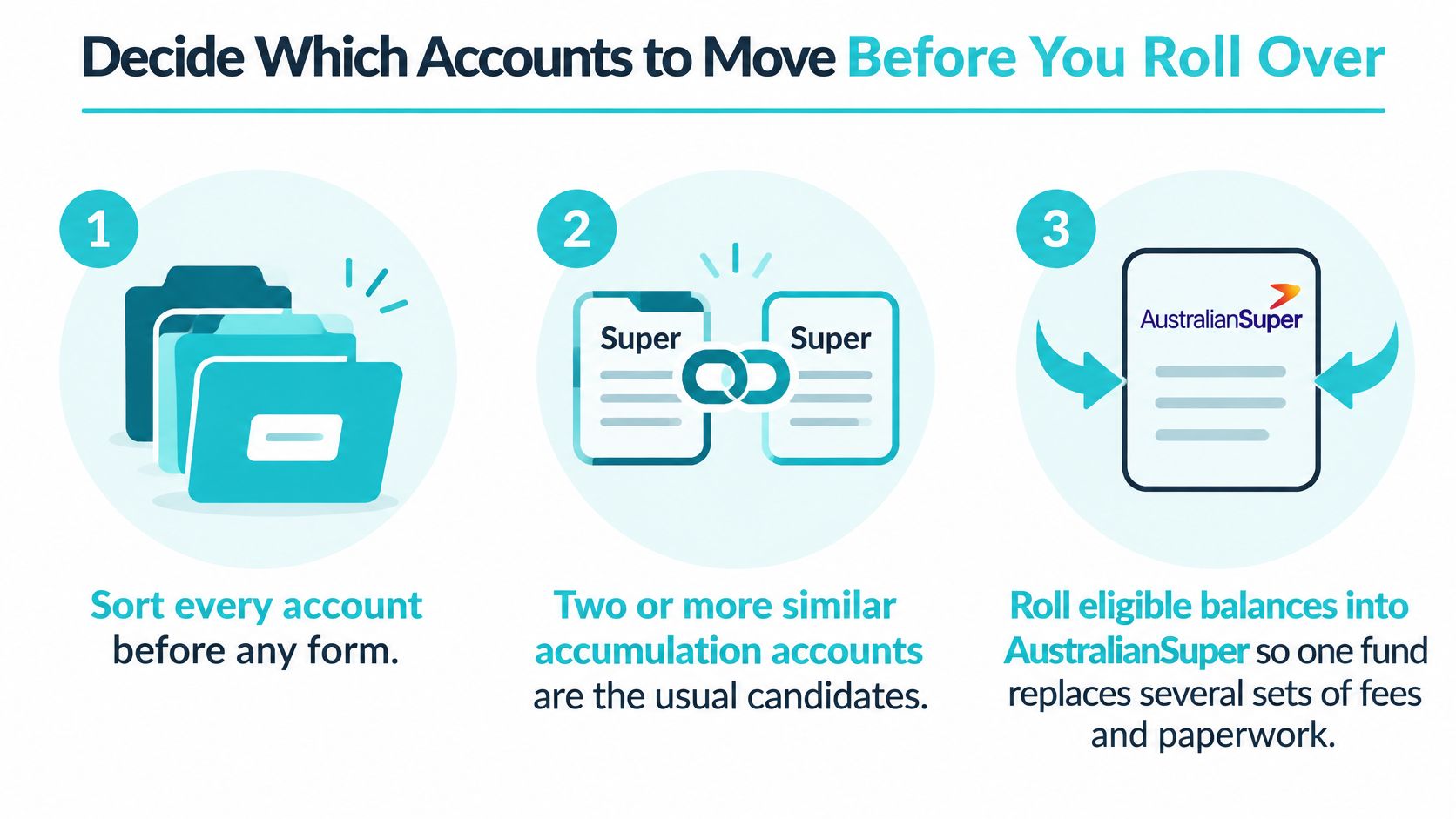
Sort every account before you touch a form. List each fund, balance, investment option, insurance, beneficiary nomination and account type in one place. Then judge each account on its own merits, because a rollover that suits one balance can damage another. Consolidation is a decision per account, not a decision per person.
A rollover is a transfer between complying super funds. You can start one through myGov linked to the ATO, or you can ask the receiving fund to request it. MoneySmart notes that consolidation can reduce duplicate fees and paperwork, with transfers available through myGov or by contacting the receiving fund in its guide to consolidating super funds. That tells you the mechanism. It doesn't tell you whether moving a particular account leaves you better off.
Start With the Obvious Candidates
Two or more similar accumulation accounts are your usual candidates. If the investment options are comparable, no special features are attached, and AustralianSuper's ongoing fees suit you better, roll the eligible balances across. You'll pay one set of administration fees instead of several, track one member number, and stop insurance premiums being deducted from small balances you never look at.
Compare like for like before you conclude AustralianSuper wins. Match investment options with similar growth asset exposure, compare total fees over the same period, and check returns over comparable time horizons. A headline return from a high growth option tells you nothing about a balanced option in another fund. Product type matters too, so don't treat every MySuper, choice and platform product as interchangeable just because they all hold super.
Use a Keep or Move Test for Every Account
Keep or move before you roll into AustralianSuper
| Situation | Safer action | Why it matters |
|---|---|---|
| Two or more similar accumulation accounts | Roll eligible balances into AustralianSuper | One set of fees instead of duplicates |
| Defined benefit or older public-sector style | Do not move until the scheme confirms entitlements | Formula or guarantees may not transfer |
| Death, TPD or income protection you still need | Keep the account until new cover is accepted in writing | Closing the account can cancel that cover |
| Account-based pension already started | Leave it until pension and cap effects are checked | A pension is not a standard accumulation rollover |
| Lost or ATO-held super | Find it in myGov, then transfer if eligible | ATO auto-transfer generally needs at least $200, age under 65, and no prior fund request |
| Employer still paying the old fund | Update choice or stapled fund before closure | A new account can open after you consolidate |
Defined benefit and older public sector style schemes need written confirmation before anything moves. Your entitlement may depend on a formula, years of service, a final salary figure or a guarantee that disappears once you elect a rollover. Ask the scheme to confirm, in writing, what you'd receive if you stay and what you'd receive if you leave. Don't rely on a balance figure on a statement, because that figure may not capture the value of the promise behind it.
An account based pension already in payment is also a stop sign. That money is in retirement phase, not plain accumulation, and moving it can affect your transfer balance cap position, pension payments and the tax components paid to you. Get the pension and cap effects checked first. A standard rollover instruction is the wrong tool for money already supporting an income stream.
Find Lost Money Before You Decide
Check myGov for lost and ATO-held amounts before you finalise your list. Fund-held lost super covers accounts where you're uncontactable or the account has become inactive, while ATO-held amounts include unclaimed super money and super holding account balances. You may find a small account from a casual job years ago that's still being eroded by fees. Our guide to tracking down missing super funds walks through that search if you suspect an account is missing from your list.
Don't wait for the ATO to move money for you. It may initiate a transfer of ATO-held super only when the amount is at least $200, you're under 65, and you haven't already requested a transfer to a preferred fund. If you don't meet those conditions, or you'd rather choose the destination yourself, request the transfer into your active AustralianSuper account directly. Verify the account is yours and check any attached insurance before you close it.
Fix Employer Payments Before Closure
Tell your employer where super should go next before the old account closes. Update your choice of fund nomination or confirm your stapled fund details point to AustralianSuper. If you skip this step, the next Superannuation Guarantee payment can land in the old fund and reopen an account you thought you'd closed. You'll then need a second rollover for a small balance, with fresh fees deducted in the meantime.
Move an account only when AustralianSuper accepts the rollover, the fees and investment option compare fairly, and nothing valuable is attached to the account you're closing.
Apply that test account by account. If an account fails on insurance, a defined benefit formula, a pension or a cap issue, the answer is not yet. Leave it open, fix the blocker, and revisit the transfer when you have written confirmation. That patience costs you a few weeks of duplicate fees at most. Closing too early can cost you cover or entitlements you can't buy back.
How to Roll Super into AustralianSuper
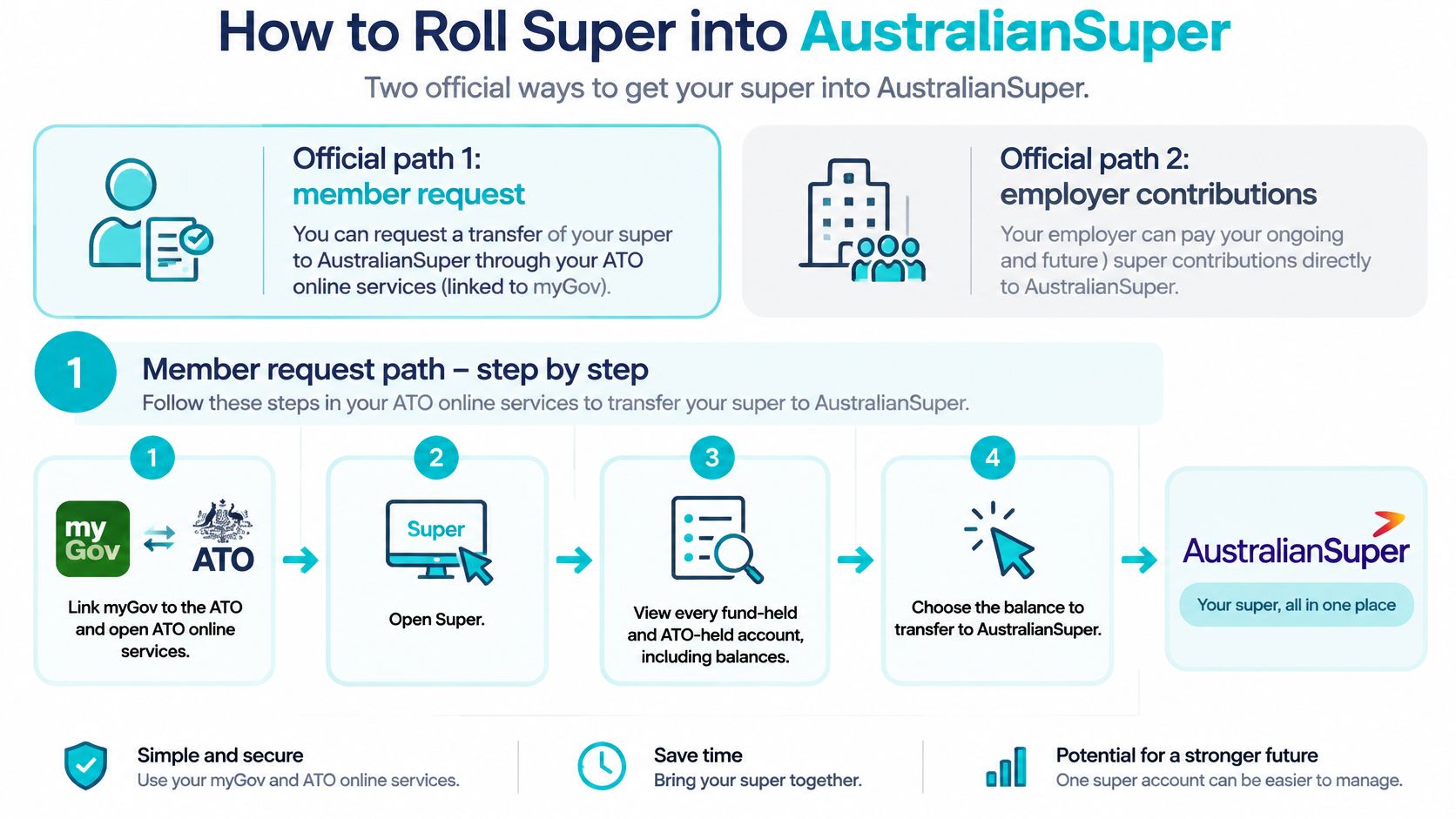
There are two official paths for moving money. You can request the rollover yourself through ATO online services, or you can ask AustralianSuper or the transferring fund to handle it by form. The ATO guidance on transferring or consolidating your super confirms members may be able to transfer to another fund subject to the rules of the funds involved, and that combining accounts can mean paying only one set of account fees and charges. Use the member path below for straightforward accumulation accounts.
Follow the Six Steps in Order
- Link myGov to the ATO. Open ATO online services, then Super, so every fund-held and ATO-held account is visible in one list. Forgotten balances show up, including accounts from former employers you stopped thinking about years ago. Screenshot or note each fund name, member number and balance before you change anything.
- Confirm AustralianSuper will accept the rollover. Note your AustralianSuper member number, and open an account first if you don't already have one. Choose your investment option now, before money arrives, so incoming funds don't sit in a default option you didn't want. Confirm your tax file number, name and date of birth match across both funds.
- Use Manage and Transfer super for each eligible account. Select the account you want to move and nominate AustralianSuper as the destination. This standard online process transfers the entire balance and closes the original account, and partial transfers aren't permitted through it. If you want to leave some money behind, don't use this path.
- Use a fund form when online transfer isn't available. Ask AustralianSuper to request the rollover on your behalf, or complete the transferring fund's paper rollover form. Keep a copy of the signed form, any certified identification you supplied, and the date you sent it. Paper requests stall more often than online ones, so your copy is your evidence.
- Update your employer before the old account closes. Give payroll your AustralianSuper member number and fund details, and complete a choice of fund form if your employer asks for one. Do this while the rollover is in progress, not after it settles. You want the next contribution paid to AustralianSuper, not to a fund you're trying to exit.
- Reconcile the balances after settlement. Match the old fund's closing balance against the amount that lands in AustralianSuper. Check for exit fees, a final insurance premium, or a contribution that was still in transit. Confirm the money sits in the investment option you chose and save the rollover confirmation with your statements.
Understand the Whole Balance Rule
The whole balance rule in step three catches people out. Say you hold an old account with cover you want to keep for now, but you'd like most of the balance invested with AustralianSuper. The ATO online path won't do that for you. It moves everything and closes the account, which ends the cover attached to it. A partial move, if it's possible at all, has to be arranged directly with the funds, and they may refuse.
Timing is usually days to a few weeks for a clean online request. It stretches out when personal details don't match between funds, when a paper form is incomplete, or when the transferring fund is slow to release the money. Don't lodge anything else while a request is pending. Wait for the confirmation, then check the figures.
Know What a Rollover Does Not Do
A rollover between complying funds is not a withdrawal. Your money stays inside the super system, so preservation rules continue to apply after it arrives in AustralianSuper. You haven't gained access to cash you couldn't access before. You've changed which fund holds and invests the money, and which fees, options and insurance arrangements apply from here.
Check three things before you press submit on any account. Confirm AustralianSuper accepts rollovers for your account type, ask the transferring fund whether it charges fees on exit, and decide whether valuable benefits such as life insurance would be lost. Then compare fees, investment options, insurance, beneficiary arrangements and service features one final time. If all of that lines up, proceed. If it doesn't, you're not ready, no matter how simple the online screens look.
Protect Insurance and Tax Before You Close
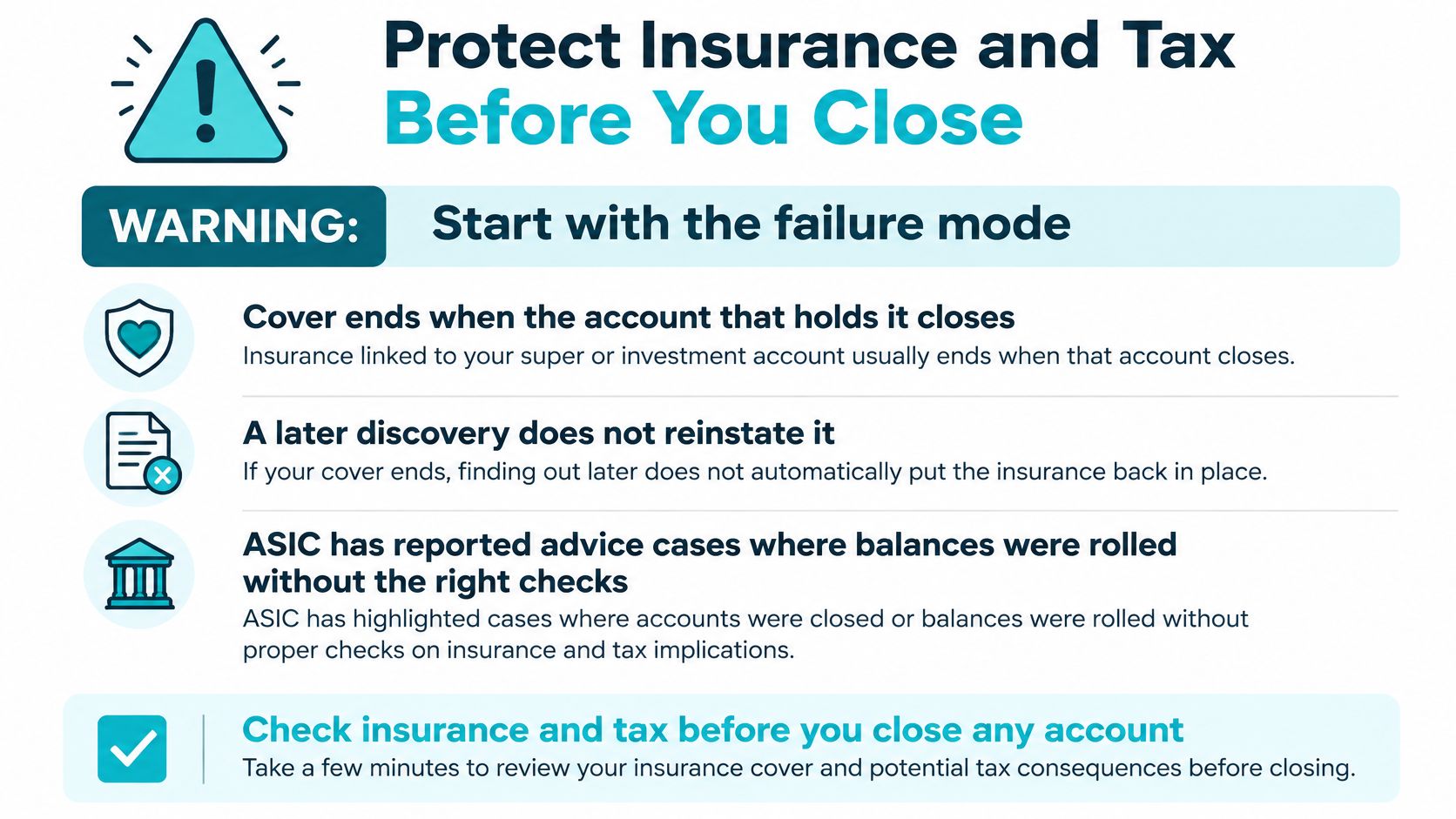
Start with the failure mode. Cover ends when the account that holds it closes, and discovering that later doesn't reinstate it. The ASIC financial advice update from September 2026 reported a case where clients rolled balances into a new plan without advisers identifying existing death and total and permanent disability insurance, resulting in lost cover that wasn't detected until a later review. Those clients did nothing unusual. They consolidated, like thousands of people do, and the insurance was lost with the old account.
That's why treating consolidation as pure administration is the highest risk mistake in this process. A rollover can cancel or reduce insurance attached to the old account unless replacement cover is approved and active before closure. The form doesn't warn you loudly enough. You have to build the warning into your own process.
Gather the Documents Before You Apply Anywhere
Collect the full picture for each account you plan to close. You need the paperwork in hand, not a memory of what cover you think you hold.
- Product disclosure statement. Confirm the product rules, fees and any conditions on closing or transferring.
- Insurance schedule. Record the type of cover, sum insured, premium, exclusions, waiting periods and the definition of disablement.
- Beneficiary nomination. Check who is nominated, whether it's binding, and when it lapses, because nominations don't follow your money automatically.
- Tax and account components. Note preserved and unrestricted amounts, any untaxed element, contribution history and whether a pension is attached.
Then apply for cover with AustralianSuper and wait. You need written acceptance and an effective date before you request any transfer that closes the old fund. An application in progress isn't cover. An indicative online quote isn't cover either. Only the acceptance letter counts, so file it with your rollover paperwork.
No written cover, no closure.
Compare Cover Instead of Assuming a Match
Default cover in the new fund can differ from your current cover in ways that matter at claim time. Definitions of total and permanent disability vary, occupation categories change your premium or eligibility, and medical questions may apply where your existing cover was issued without underwriting. Income protection may have a different waiting period, benefit period or offset rules, or may not suit your occupation at all.
Families, higher income earners and anyone with a medical history should be especially careful here. If your current cover was granted years ago under default arrangements, you may not secure equivalent cover now. Keeping the old account open just to retain that cover can be a rational outcome, even if it means paying a second set of account fees. Our explainer on life insurance through super covers how cover inside super is structured if you want to compare the moving parts properly.
Get the Tax Position Straight
A rollover to another complying fund generally does not trigger tax at the time of transfer, although tax can apply on a later withdrawal. Keep that distinction clear. You're moving money within the system, not taking a benefit, so the transfer itself is usually tax neutral. The tax conversation happens when you eventually withdraw, based on your age, components and condition of release at that time.
One exception needs checking before you move. If your account contains an untaxed element above the applicable untaxed plan cap threshold, tax can be withheld during the rollover. That risk sits mainly with certain public sector and older untaxed schemes. Ask the transferring fund for your untaxed element figure in writing, and get advice on it before you instruct the transfer, not after the withholding appears on your statement.
Also check whether the move affects your contribution cap records, any pension arrangement, or your transfer balance cap position if retirement has started. After settlement, reconcile the old closing balance against the new opening balance and confirm the receiving investment option. Keep the rollover receipt and the insurance acceptance together in one file. If anything is questioned later, that file is your proof of what was supposed to happen and when cover started.
Fixes When a Rollover Stalls
Most rollover problems have a mundane cause and a specific fix. Work out which symptom you're looking at, apply the matching action, and resist the urge to lodge a second request while the first one is still moving. Duplicate instructions create confusion, slow both funds down, and make reconciling your balances harder than it needs to be.
Rollover problems and what to do next
| What you see | Usual cause | Next action |
|---|---|---|
| Transfer rejected | Name, date of birth or TFN does not match, or the fund will not accept it | Align details in myGov and both funds, then resubmit once |
| Whole balance moved when you wanted part | ATO online transfer is full balance only and closes the account | Ask the funds about a partial rollover; do not use that online path |
| New balance is lower | Exit fee, premium or a contribution still in transit | Match the old closing statement to the AustralianSuper opening balance |
| Nothing has moved after several weeks | Fund still processing or paper form incomplete | Chase the fund that holds the money; do not lodge a second full transfer |
| Money arrived but cannot be withdrawn | Preservation rules still apply | Treat it as invested super, not a failed payment |
| Insurance gone after closure | Old account closed before new cover started | Ask both funds about reinstatement, then arrange cover in writing |
Work Through the Symptom in Front of You
A rejected transfer usually means a name, date of birth or tax file number mismatch between myGov, the old fund and AustralianSuper. A married name updated in one place but not another is enough to stop a request. Fix the record at the source, confirm both funds show identical details, then resubmit once. If the receiving fund won't accept that product type at all, no amount of resubmitting helps, so ask AustralianSuper to confirm acceptance before you try again.
If the whole balance moved when you wanted to leave some behind, you've used the ATO online path, which only does full transfers. There's no undo button once the account closes. Talk to both funds about whether a partial rollover back is possible, understanding they may say no. For any future partial move, skip the online path and ask the funds directly what they permit.
A lower than expected balance in AustralianSuper rarely means money vanished. An exit fee, a final insurance premium deducted on the way out, or a contribution that hadn't cleared the old account explains most shortfalls. Line up the old fund's closing statement against the AustralianSuper opening balance and account for each deduction. If a contribution was in transit, it may follow later as a second, smaller rollover or land in the old fund and need moving again.
Silence for several weeks usually means the transferring fund is still processing your request or a paper form is missing something. Contact the fund that still holds the money, because that's where the blockage sits. Ask what they need from you, note the name of the person you spoke to, and get a timeframe. Don't submit a second full transfer to speed things up.
Handle the Two Outcomes That Are Not Errors
Money that arrives in AustralianSuper but can't be withdrawn is behaving correctly. Preservation still applies, so treat the balance as invested super and check it's sitting in the option you selected. That's a completed transfer, not a failed payment.
Lost insurance is the one outcome that's hard to fix after the fact. Reinstatement is uncertain once an account has closed, and neither fund is obliged to restore cover that ended under the product rules. Ask both funds in writing what, if anything, can be restored, then arrange new cover and get acceptance confirmed. Keep every confirmation, statement and letter from this process together. If you later need to dispute a balance or a cover decision, that paper trail does the heavy lifting.
Book a Call Before You Consolidate
Consolidate account by account, not by default. If every account is ordinary accumulation super, AustralianSuper accepts the rollover, replacement insurance is in force and your employer has updated its details, you can complete the transfer through myGov. Then reconcile the balances and keep the confirmations.
Get personal advice before closing an account with a defined benefit entitlement, a pension in payment, an untaxed component or insurance that has not been replaced. If retirement is close, the transfer balance cap and super access rules may also affect what to move and when. A transfer can be delayed; a closed account or lost cover can be harder to put right.
Why Access Rules Still Govern the Plan
Moving super to AustralianSuper does not make preserved money available to withdraw. Services Australia's superannuation guidance explains that access normally requires reaching preservation age and retiring. For people born after 30 June 1964, preservation age is generally 60. Most funds allow unrestricted access from age 65. Limited early access pathways have strict eligibility rules. Consolidation changes how your super is invested and managed, not when you can access it.
Retirement Roadmap connects super decisions with retirement timing, income stream planning and the access conditions that apply to you. Read about financial advice on superannuation if you want help assessing the transfer before an account closes.
Bring the Paperwork to a Free Introductory Call
Wealth Collective is a Western Australian financial advice business and a Corporate Authorised Representative of Wealth Collective Adviser Services Pty Ltd. Once you are comfortable with the agreed outcomes, the team handles the paperwork, products if required, and end-to-end implementation.
Before closing an account you are unsure about, book a free introductory conversation. Email hello@wealthcollective.co or call (08) 9202 6833. The Perth office is at 67 Howe St, Osborne Park. Bring your account list, latest statements and insurance schedules so the team can review each account and explain which ones to move, keep or pause. Website information is general, not personal financial advice. Consider your circumstances and consult a qualified Financial Adviser before acting.
Bring your account list, insurance schedules and latest statements to Wealth Collective before closing a fund. Get clear on which accounts to roll into AustralianSuper, which to keep open and what insurance must be in force first. Book a free introductory call to make sure the consolidation fits your retirement plans.