Business hours
Monday to Friday (8.30AM - 5PM)
Weekend (Closed)



You've spent years building a business, paying down debt, accumulating superannuation and investing for retirement. Then a supplier dispute, serious illness, stolen credentials or a fraudulent payment exposes how little separation exists between your working life and your personal wealth. Many discover the gap only after the loss has already started.
Asset protection and security isn't about hiding assets or creating complicated structures for their own sake. It's about arranging your legal ownership, insurance, superannuation, physical safeguards and digital controls so one event doesn't force you to sell the family home, raid retirement savings or abandon a business legacy. For Western Australians, that means building a defence before a creditor, burglar, scammer or health event tests it.
Wealth Defence in Western Australia: The Current Reality
A Perth business owner can hold a company bank account, a personally owned home, investment properties and superannuation accumulated over decades. That balance sheet may look strong while personally guaranteed debt, shared online banking access, outdated insurance and no plan for incapacity leave serious gaps.
Risk rarely stays in one category. A customer dispute can become a legal claim. A compromised email can redirect a payment. Serious illness can interrupt income while loan repayments and business overheads continue. A break-in can affect the home, records and equipment that keep a small business operating.
A sound defence has three connected layers:
- Legal structuring, which sets ownership and allocates liability.
- Insurance, which transfers selected financial risks and supports future cash flow.
- Physical and digital security, which limits access to people, property, accounts and information.
The aim is practical: stop one weak point from reaching every asset you own. Risk cannot be removed, but it can be contained.
Practical rule: Protect the asset before you protect the paperwork. Ownership, beneficiaries, access permissions and policy terms must work together.
Pre-retirees face the same structural problem. Years of accumulation can create a larger target, while retirement can reduce the ability to replace lost capital. Review estate planning, superannuation nominations and debt arrangements alongside investment returns. Your estate planning guidance for Australians should clarify ownership, beneficiaries and who can make decisions if you lose capacity.
Ask what could interrupt your income, compromise your assets or transfer control away from you, and what will stop that outcome. That question should guide the legal structure, insurance settings, superannuation arrangements and cyber response plan you put in place now.
Quantifying Physical and Digital Threats to Your Wealth
Physical crime remains a practical reason to review household and business security. Western Australia recorded 8,124 selected offences against property in 2024–25, at a rate of 347.0 per 100,000 people, compared with 10,590 offences and 377.1 per 100,000 in the previous year, according to the state's official crime statistics. Property crime is declining, yet it remains a practical risk for households and businesses.
The same government material records 15,056 offences against property in 2015–16, showing that property-related offending has persisted in WA for years. A household may face burglary, theft or damage. A business may lose devices, operating time, premises or sensitive information in the same incident.
Physical loss is only one side of the problem
A national Australian Institute of Criminology profile found that about 522,000 Australian households were targeted by at least one break-and-enter, attempted break-and-enter or motor vehicle theft in the 12 months before its survey. It reported 44 break-ins per 1,000 households nationally, while Western Australia recorded 75 break-ins per 1,000 households, the highest state result at that time. The figures appear in the Australian Institute of Criminology profile.
Digital fraud creates a separate path to financial loss. In 2025, Australians reported $2.18 billion in scam losses across 481,523 reports, including $166.8 million from payment redirection scams and $97.6 million from phishing scams, according to the Australian Competition and Consumer Commission's scam reporting. By the first three months of 2026, Scamwatch had received 13,428 phishing reports and 16,759 email-based scam reports. Email impersonation and fraudulent payment instructions belong in any wealth defence plan.
Map exposure before buying more security
Start with an asset register covering property, vehicles, business equipment, accounts, intellectual property, superannuation and insurance policies. Record who can access each account, approve payments and act if a key person is unavailable.
Households need physical access controls, secure document storage and recovery plans. Businesses need verified payment procedures, restricted system permissions and tested backups. Both need a clear escalation path for suspected fraud.
“Watch out for scams” is not a control. A second-person payment check, a known phone number for verification and a written response plan are controls. Use these measures alongside appropriate ownership structures, superannuation arrangements and insurance so one physical or cyber incident cannot expose every part of your wealth.
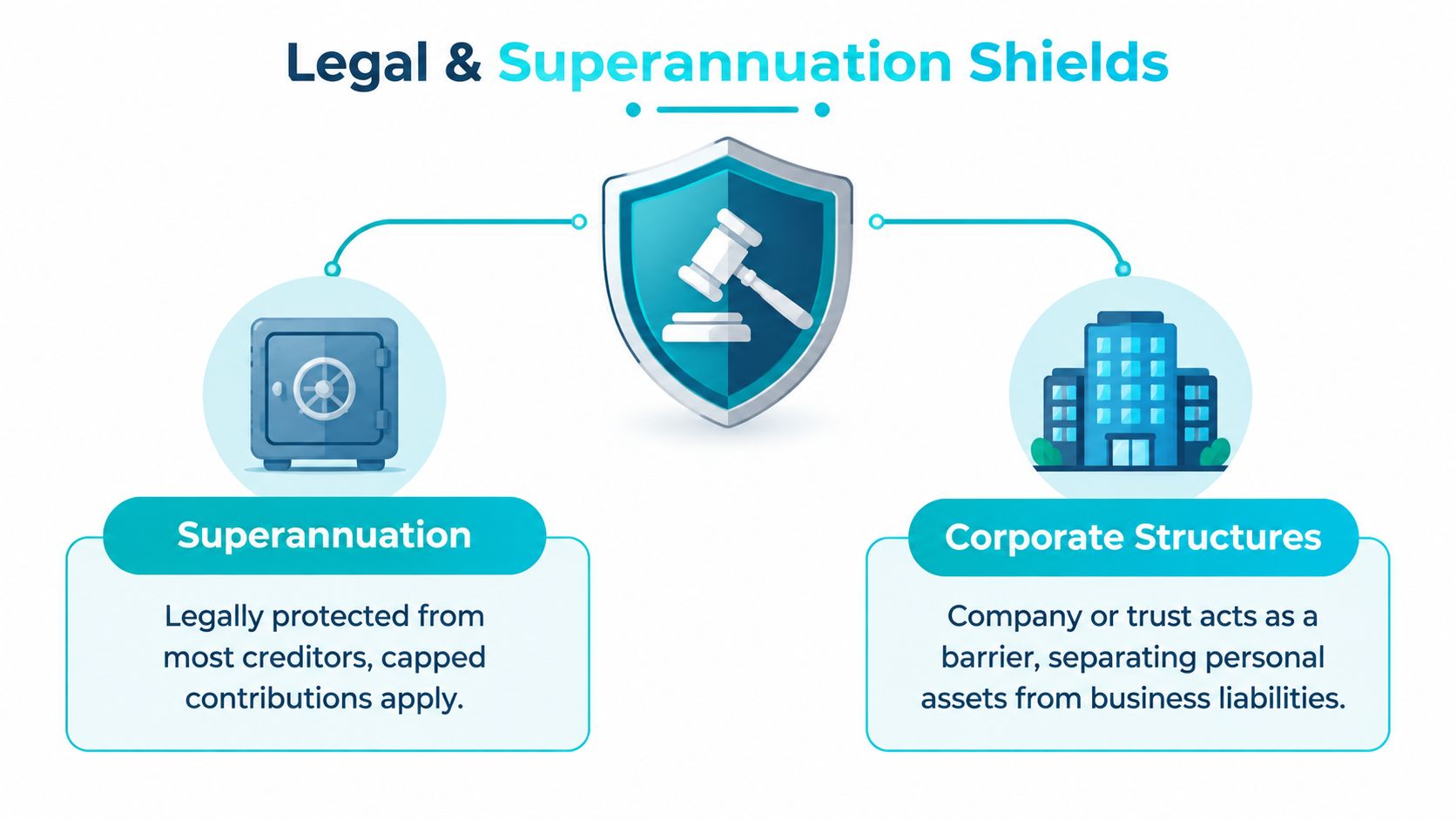
Legal Structures and Superannuation Shielding
The legal owner of an asset matters. So does the liability attached to the activity that produces your income. If a high-risk business activity and your retirement assets sit in the same personal ownership environment, a dispute can place too much wealth in the path of the same claim.
Superannuation is a distinct category. Under Australian bankruptcy law, superannuation held in a regulated superannuation fund at the date of bankruptcy is protected property, and if it's later paid out during bankruptcy as a lump sum, the payment and assets bought with it remain protected from creditors, according to the Australian Financial Security Authority's bankruptcy guidance. That protection doesn't mean super is untouchable for every purpose. Contributions, withdrawals, tax treatment, investment choices and beneficiary nominations still require careful advice.
Separate business risk from personal wealth
Companies and trusts can create a boundary between business liabilities and personally owned assets, but the boundary depends on proper establishment and administration. Directors can still face personal exposure in some circumstances, especially where they provide guarantees or breach duties. A trust isn't a magic shield, and transferring assets without considering solvency, tax, family law and creditor rules can create serious problems.
The family home deserves particular attention. Australian bankruptcy law doesn't provide an automatic family-home exemption. If a bankrupt person owns residential property with available equity, the trustee may seek possession and sale to realise funds for creditors, as outlined in Australian bankruptcy and asset-protection guidance. Ownership between spouses, loan guarantees and the source of funds can all affect the outcome.
Ownership test: Ask who owns the asset, who controls it, who benefits from it and what liability could reach it. If the answers are unclear, the structure isn't ready for a serious risk event.
A practical review should examine:
- Business ownership, including company or trust arrangements, guarantees and director responsibilities.
- Personal assets, especially the family home, investment property and jointly owned assets.
- Superannuation, including fund choice, contribution strategy and death benefit nominations.
- Estate documents, including wills, powers of attorney and agreements that support the intended ownership outcome.
A family trust may help separate certain assets from operating risks, but it must fit the family's broader legal and financial position. Read a plain-English explanation of how a family trust works before treating a trust as a standalone solution.
The strongest structure is one designed early, maintained properly and reviewed after major changes such as a new business, property purchase, marriage, separation, guarantee or retirement transition.
Insurance as a Financial Firewall
Legal structures protect assets already accumulated. Insurance protects the income and cash flow that support the structure. Without that layer, an illness, disability or death can force a family to sell investments, draw down superannuation or sell a business at the worst possible time.
The correct policy depends on the risk being funded. Income protection replaces part of earnings during an eligible period of incapacity, subject to policy terms. Total and permanent disability cover is designed for a severe, lasting disability. Life insurance creates capital for dependants, debt repayment or business continuity after death. Business interruption and cyber insurance address operational losses, but they need to be matched to the actual business model and exclusions.
AIA's 2024 group-insurance claims data reported more than $1.794 billion paid across 28,500+ members, comprising $660 million in income protection claims, $644 million in total and permanent disability claims and $490 million in death claims. The AIA claims data illustrates why cash-flow interruption deserves equal attention to mortality risk.
| Claim Type | Payout Amount | Primary Financial Risk Addressed |
|---|---|---|
| Income protection | $660 million | Ongoing earnings interruption |
| Total and permanent disability | $644 million | Long-term loss of work capacity |
| Death | $490 million | Dependants, debt and estate liquidity |
Match the cover to the pressure point
A business owner with personal guarantees may need enough cover to protect household cash flow and address business debt. A pre-retiree may need to consider how a health event affects retirement timing, superannuation withdrawals and a partner's security. A dual-income family may need to insure both incomes, even if one appears secondary.
Basic home insurance isn't a complete asset-protection plan. Check the sum insured, contents, business-use exclusions, excesses, temporary accommodation terms and claims process. For a business, review cyber, professional indemnity, public liability, management liability and interruption cover together, because a single incident can trigger several types of loss. A practical overview can help you find cyber insurance for your SMB, although Australian businesses still need local advice on policy wording and regulatory obligations.
Personal and business insurance should be reviewed whenever income, debt, ownership or dependants change. Management liability insurance can form part of a broader risk review, but it shouldn't be assessed in isolation from director duties, indemnities and the company's actual operations.
Operational Security and Cyber Incident Response
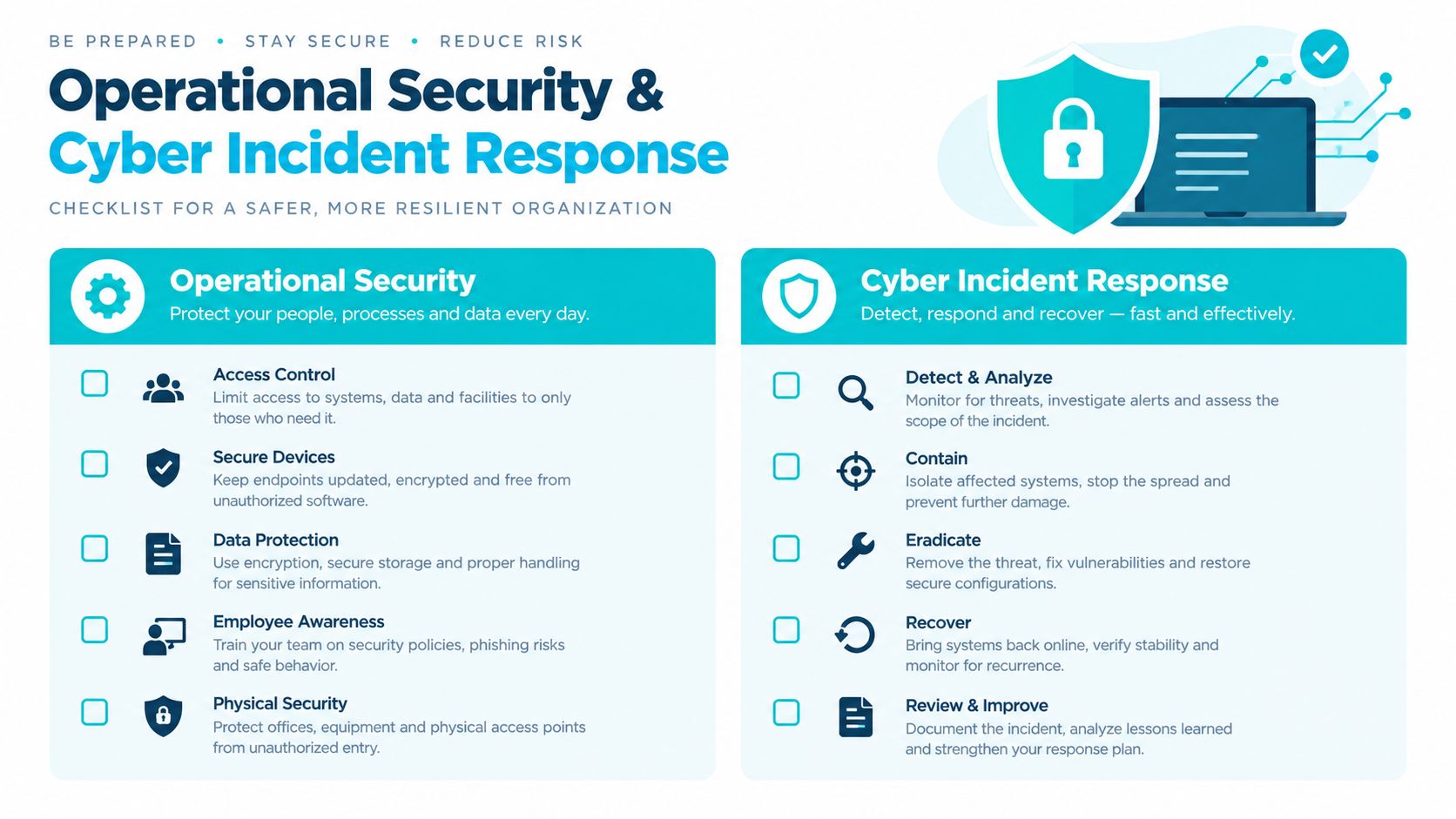
A strong structure can still fail if the wrong person controls the email account, approves a fraudulent payment or delays reporting an incident. Operational security is the daily discipline that keeps legal and financial protections connected to reality.
APRA-regulated entities must report a material information security incident within 72 hours and a material information security control weakness within 10 business days under CPS 234. APRA guidance also expects incident trend analysis, incident-response test results and control-testing records, as described in this cyber insurance and CPS 234 guide. Even if your business isn't APRA-regulated, that standard is useful: test controls, record results and know who makes the escalation decision.
Make payment control non-negotiable
Use multi-factor authentication for email, banking, accounting software and administrator accounts. Restrict permissions so staff only access what their role requires. Keep backups automated, encrypted and separated from the systems they protect, then test restoration rather than assuming the backup works.
For payment redirection risk, the procedure should be simple:
- Verify new details: Call the supplier or client using a trusted number already held in your records.
- Separate approval: Require a second person to approve new payees and material changes.
- Pause urgency: Treat unexpected secrecy, pressure or changed instructions as a reason to stop.
- Preserve evidence: Keep emails, invoices, call records and transaction details for the bank, insurer and investigators.
- Escalate immediately: Contact the bank as soon as a suspicious payment is identified.
A written incident plan should name decision-makers, advisers, technology contacts, insurers and communication channels. A useful executive-level companion is this boardroom cybersecurity guide, particularly for owners who need to turn cyber risk into board or management actions.
Protect control at home as well
Economic abuse belongs in an asset-security conversation. Australian law recognises it as controlling money or assets, sabotaging employment or income, creating debts in another person's name, withholding essential financial support or coercing someone about money, assets or dowry practices. The economic abuse and the law resource explains how the Family Law Act 1975 operates nationally alongside state and territory laws.
If financial control is part of domestic or family violence, WA provides the Women's Domestic Violence Helpline on 1800 007 339 and the Men's Domestic Violence Helpline on 1800 000 599, listed in the WA Government's financial abuse guidance. Secure access, private advice and safe documentation can be as important as a firewall.
Common Asset Protection Mistakes to Avoid
The most expensive mistake is waiting until a claim, separation, bankruptcy risk or cyber incident is already underway. A structure created after the event may face scrutiny, restrictions or practical limitations. Asset protection is planning, not a last-minute transfer exercise.
Mistake one, treating the home as automatically safe
The family home may be emotionally central, but it isn't automatically exempt from bankruptcy claims. Available equity can expose residential property to trustee action, depending on the ownership and circumstances. Never rely on a common assumption when a legal review can establish the actual position.
Mistake two, assuming super solves every problem
Superannuation has important bankruptcy protection, but it still requires decisions about investment risk, access, nominations and retirement income. An outdated death benefit nomination can send benefits somewhere other than intended. Review nominations after marriage, separation, divorce, the birth of children and major estate changes.
Mistake three, buying insurance without testing the policy
A policy schedule isn't a protection strategy. Check definitions, waiting periods, benefit periods, exclusions, offsets, ownership and affordability. Business owners should also check whether personal and business policies respond together, or whether a claim in one area leaves a major gap elsewhere.
Mistake four, confusing privacy with concealment
Using a company or trust for legitimate commercial and estate-planning purposes differs from moving assets to defeat creditors. The structure must be commercially defensible, properly documented and maintained. Get legal and financial advice before changing ownership.
Mistake five, relying on one password or one decision-maker
A single administrator account, shared banking login or informal payment process creates a fragile point of failure. Use separate access, MFA, dual approval and tested recovery procedures. Security controls should remain effective when the owner is travelling, ill or unavailable.
Do the review before the trigger: A new guarantee, property purchase, relationship change, health concern or business expansion should prompt a protection review, not a wait-and-see response.
Building Your Protection Strategy with Wealth Collective
A practical plan starts with a map of your assets, liabilities, ownership, income sources, insurance and access controls. From there, advice should connect the legal work performed by your solicitor and accountant with the financial decisions that keep the plan funded and workable.
Wealth Collective's three service pillars provide a clear framework:
- Protection Plus focuses on personal insurance and superannuation.
- Guided Growth addresses investment strategy, debt reduction and wealth accumulation.
- Retirement Roadmap aligns retirement income, superannuation decisions and the transfer of wealth.
The Perth and Dunsborough-based team uses a free 10-minute introductory call to understand your situation before developing advice. The firm also describes a satisfaction guarantee and a transparent process, which suits business owners and pre-retirees who want decisions explained plainly rather than buried in technical language.
You can also compare practical ideas in this asset protection strategies for 2026 resource, then test those ideas against your own ownership, insurance and retirement arrangements. Generic information can start the conversation, but your structure must reflect your liabilities, family circumstances and goals.
Wealth Collective can help you bring superannuation, personal insurance, investment decisions and retirement planning into one coordinated asset-protection strategy. Visit Wealth Collective to book the initial call and start turning scattered safeguards into a plan designed around your business, family and future.